AFECTO EXTRATERRESTRE
Una exposición como un sistema hecho de esculturas mecánicas con la finalidad de interpretar, en el espacio físico mundano, el comportamiento del espacio fenomenológico extramundano.
“…el hecho es que haya mucha menos diferencia entre la materia orgánica y la inorgánica de lo que solemos suponer. En última instancia, toda la materia, viva o inerte, está sujeta al mismo ciclo de organización y descomposición, aunque la velocidad a la que se producen estos procesos sea muy diferente. En este sentido, los planetas, las estrellas, las galaxias —y, podría decirse, todo el universo— no son tan diferentes de nuestros cuerpos. Así que quizá no sea imposible aprender algo de la longevidad de la piedra, al tiempo que le enseñamos nuestra capacidad de ser conscientes”.
Elena Shaposhnikova
Me formé como escultor. La escultura es el lenguaje que padezco cuando pienso en mi trabajo y todo lo que involucra su producción. Por otra parte, siempre he tenido el impulso, la tendencia a generar piezas que se mueven. La escultura no tiende a asociarse a comportamientos como el movimiento, el que es más propio de los cuerpos que están vivos. Siempre he interactuado con el mundo de las cosas estáticas, como intuyendo que dentro de ellas habita algún poder, alguna capacidad. En este sentido, las esculturas, o incluso las piedras u otros cuerpos inmóviles, siempre me han parecido un poco seres, cuerpos misteriosos con la capacidad de comunicar, a partir de señales leves, como zumbidos de baja frecuencia. Estas señas, esta especie de comunicación silenciosa de la escultura (y lo inanimado en general), es una manera que el mundo tiene de establecer conexiones en el espacio. De esta manera los cuerpos (vivos o no) tienden a generar sistemas interconectados, como constelaciones. El silencio de la constelación es una manifestación de su enigmático comportamiento, el que -independiente que ha sido de interés humano desde tiempos remotos- solo hemos podido, incipientemente interpretar, asistidos por los sofisticados avances de la técnica científica.
El pensamiento científico ha sido una importante influencia a mi trabajo. Caminaba un día en el bosque cuando me encontré con una gran roca. Despojada de todo elemento simbólico, este gran cuerpo geológico me pareció una especie de escultura prototípica, pura, genuina, antigua, contra-intelectual. Me pregunté por las condiciones que hacen de este volumen emparentable a la escultura. Consideré a la roca como; silenciosa, enigmática, de una presencia disruptiva respecto del entorno, poseedora de una superficie drástica, dócil y rebelde al mismo tiempo, estática. Todas estas características son puntos de encuentro formales entre esculturas y piedras.
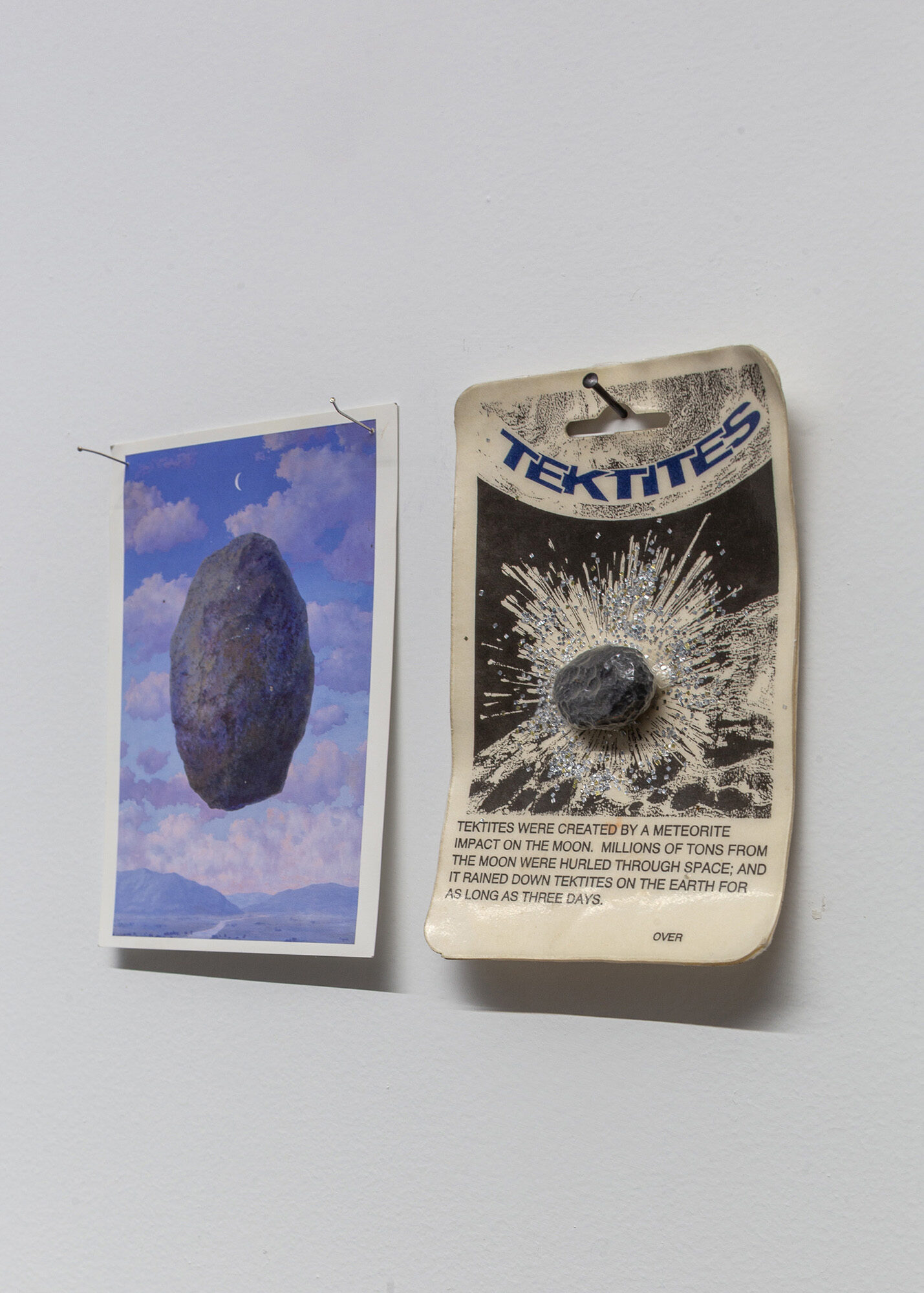
Desplacé mi pensamiento a un territorio distante por sobre mi cabeza y más allá del planeta, visualicé otros tipos de piedra, rocas espaciales; meteoritos y asteroides. Estos son similares a sus símiles terrestre, pero a su diferencia, saben volar, no cesan de moverse. Ante este pensamiento comprendí que la roca terrestre no está detenida, o al menos la detención no es su disposición. En nuestro planeta las piedras han encontrado una superficie que tiene la capacidad de oponerse al trazado que su energía proyecta hacia el centro gravitacional de la tierra. La roca parece estática, pero está empujando con una energía equivalente a su peso, que es la manifestación cuantificable de su deseo de movimiento. Esta visión me llevó a comprender que la fenomenología física que afecta a la escultura (o a cualquier otro volumen con masa), no es constante en el resto universo. Esto quiere decir que lo que determina a la escultura en cuanto a su comportamiento (habitualmente) estático, es en realidad una condición que no es propia de la materia, sino del ambiente terrestre y como este influye sobre la materia. Fuera de nuestro planeta los cuerpos se desplazan como imantados a la anatomía del espacio y sus movimientos. En el espacio exterior el movimiento es constante. Una piedra que no conoce el suelo tampoco conoce la detención. En este punto comencé a desear realizar mi práctica artística en un territorio extraterrestre (portador de nuevas condiciones físicas y ambientales). Ente la frustración de entender como imposible la práctica de una escultura extraterrestre, he intentado producir mi práctica en un espacio material que interpreta al comportamiento de la materia fuera de los límites de nuestro planeta.
¿Que es un afecto extraterrestre?
“Lo contrario del caos es el cosmos. Al igual que los cosméticos, el caos significa belleza y armonía.”
Anton Vidokle
Con la esperanza de influenciar al espectador y sus lecturas de mi exhibición, instalé en el muro de la galería D21 la siguiente frase: “El universo es una extensión llena de obscuridad. Esta obscuridad radical esconde la anatomía del sistema que conecta a todas las partes que se encuentran suspendidas en este espacio. La ilusión que el pensamiento humano nos propone, es que entre una cosa y otra hay una distancia llena de vacío, cuando en realidad ese espacio que no vemos está colmado. Todo está en contacto, todo en el universo se acaricia por medio de ondas invisibles pero llenas de materia. El universo es una construcción eterna y vasta hecha de las formas materiales difíciles de percibir. Esta exposición habita el deseo de interpretar esas formas masivas de comportamiento material extraterrestre, tan esquivas al entendimiento humano.”
La humanidad lleva mucho tiempo preguntándose sobre la posibilidad del vacío. Alberto de Sajona (1316 - 1390), por ejemplo genera una serie de preguntas desde una perspectiva escolástica en torno a las ideas que formulan los antecedentes de las ciencias físicas. Entre estas, varias formulan inquietudes en torno al vacío y el movimiento:
“3- Si un lugar específico se encuentra inmóvil.
“8- Si la existencia del vacío es posible.
“9- Si, en un movimiento descendente, un cuerpo pesado simple posee una resistencia interna; y, similarmente, si en su movimiento ascendente, un cuerpo liviano posee una resistencia interna.
“10- si se requiere un medio resistente para cada movimiento de los cuerpos pesados y livianos.
“11- Si, en caso de existir un vacío, un cuerpo pesado podría trasladarse dentro de él.
“12- si algo podría ser impulsado dentro de un vacío -si este existiera- con una velocidad finita o movimiento local o movimiento de alteración.”[1]
La ciencia ha llegado a la conclusión de que en el espacio no hay nada que no esté en contacto. Esa enigmática obscuridad que pensábamos como espacio vacante, un gran hueco, es en realidad una materia (aún) indescifrada. De esta manera, así como conchas en la arena, las rigideces del espacio se encuentran incrustadas en el Universo. El espacio mismo se mueve, esta materia obscura, pareciera ser un medio material flexible y con la capacidad de circular y expandirse (como un mar extenso en todas las direcciones y de manera infinita). El meteorito parlante que se encuentra en la exhibición (entre otras cosas) menciona: “…los fenómenos del espacio están sumergidos en una obscuridad llena de misterio. Este espacio hecho de materia invisible resulta casi muscular, se dobla como una anguila infinita y bifurcada en todas direcciones. Como un tejido, un sesto urdido de una musculatura energética, líneas de fuerza magnética que constituyen una especie de fibra interconectada.” Todo se toca, hay materia generando puentes incesantes, como líneas de hormigas magnéticas e ingrávidas que circulan en todas direcciones y conectando a todas las partes del universo. De esta manera, todo se acaricia, todo movimiento en el espacio implica una fricción imperceptible al ojo humano. Tener cuerpo es inevitablemente y de manera constante, ser acariciado por el universo circundante. La piel se acostumbra a la insistencia de este contacto, dejando de tener la conciencia táctil de su presencia, el ojo no lo sabe ver, o, aprende a situar en ese espacio infestado de bacterias, partículas y magnetismos, ese ente ficticio que llamamos espacio vacío. De la misma manera el universo, más que un territorio desierto es una gran masa que no sabemos comprender. Ahí donde reconocemos obscuridad, situamos una ausencia. Esta hiper abundancia de caricias que actúan como una red de fuerzas que constantemente empujan todo lo que tiene masa, inspira el título de la exhibición: “Afecto extraterrestre”.
Sobre la exposición
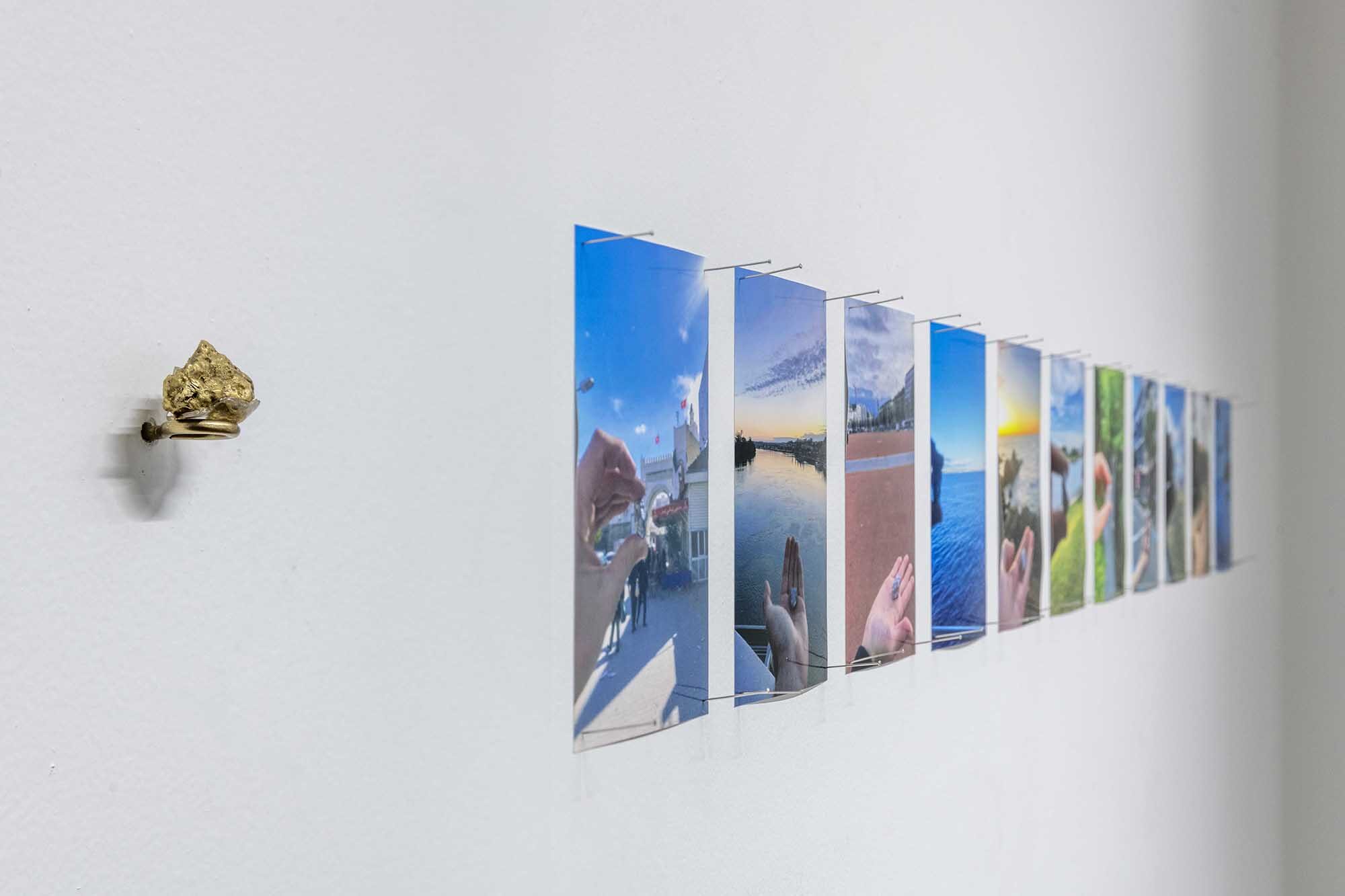
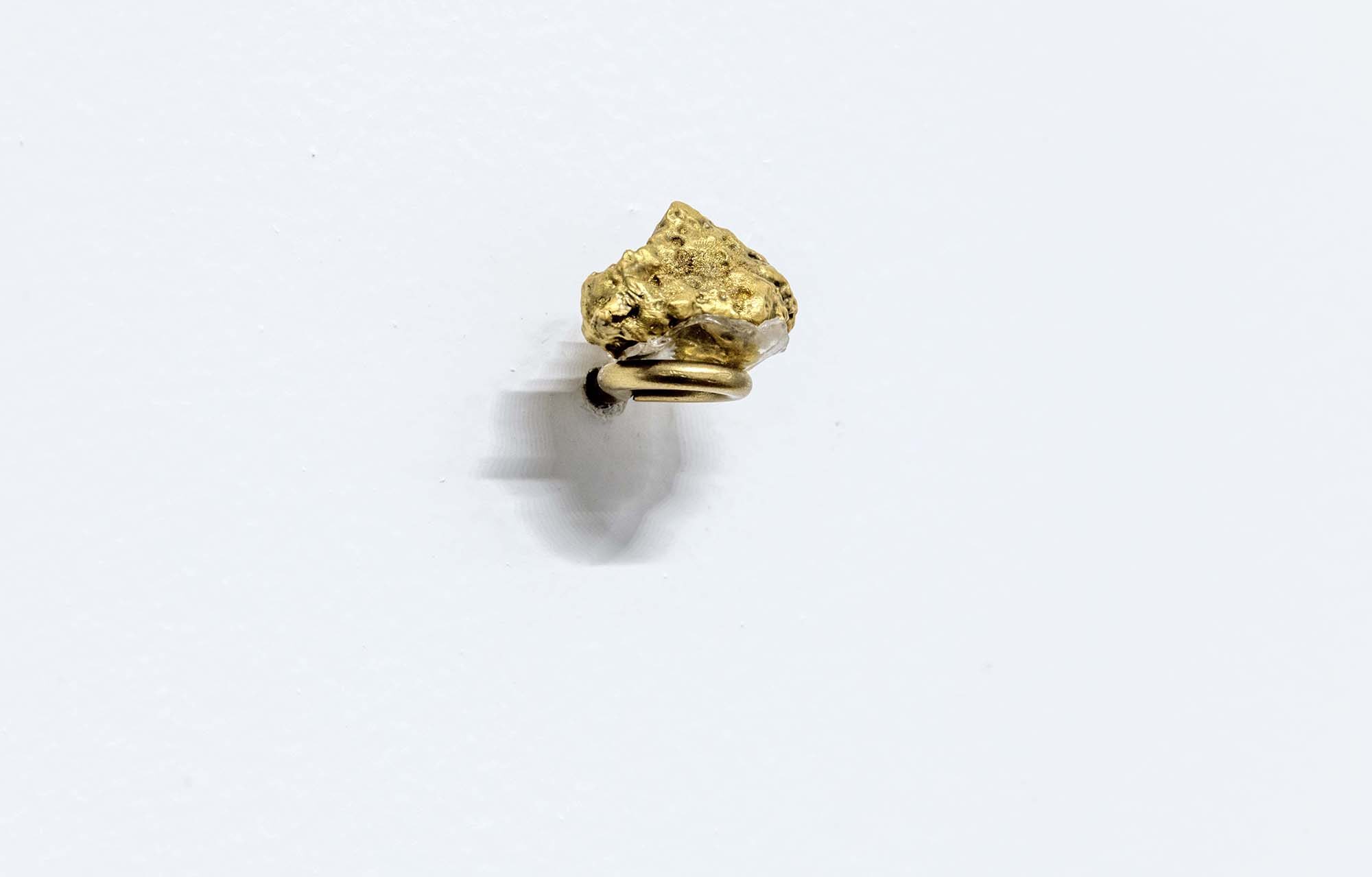
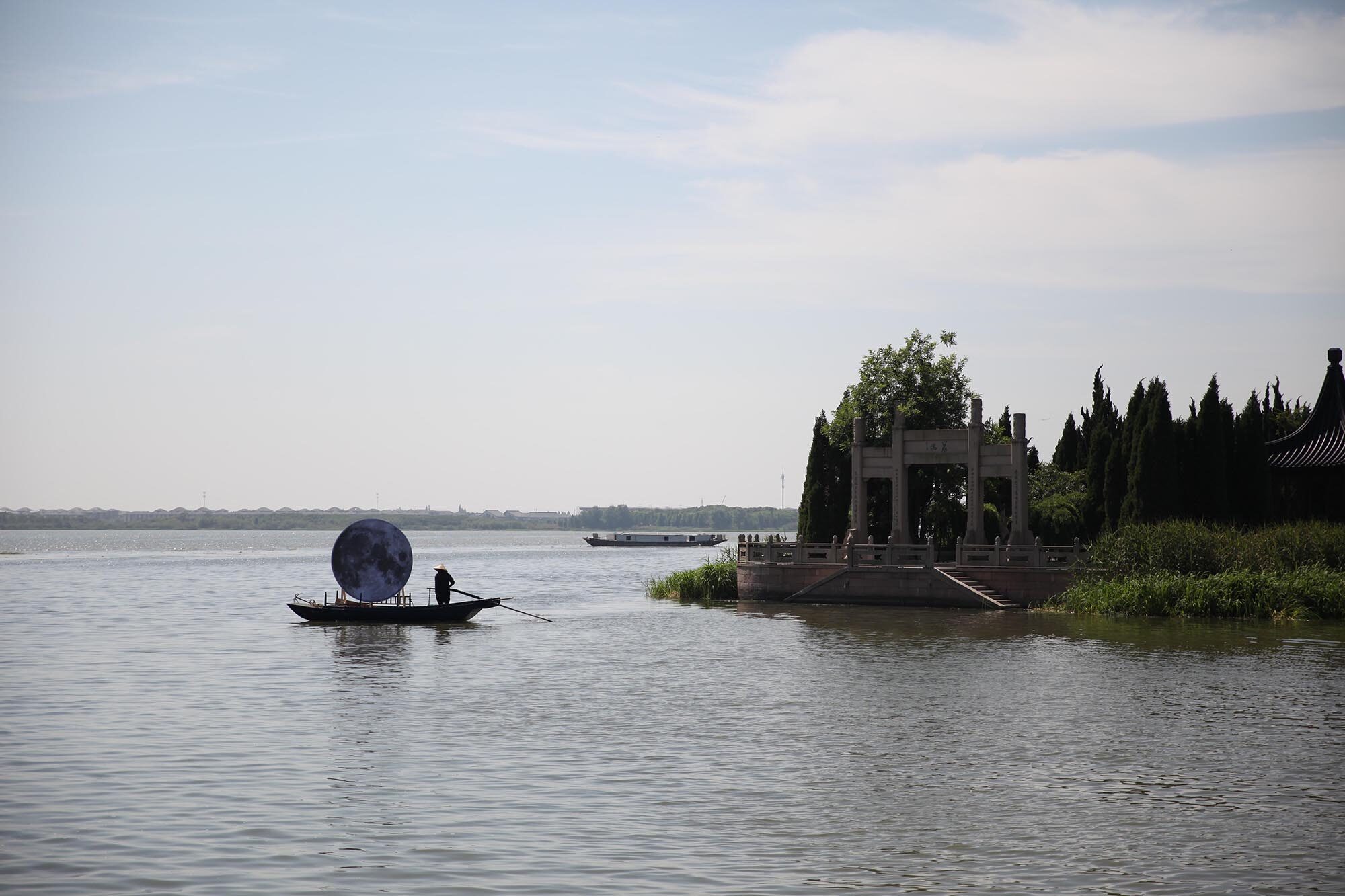
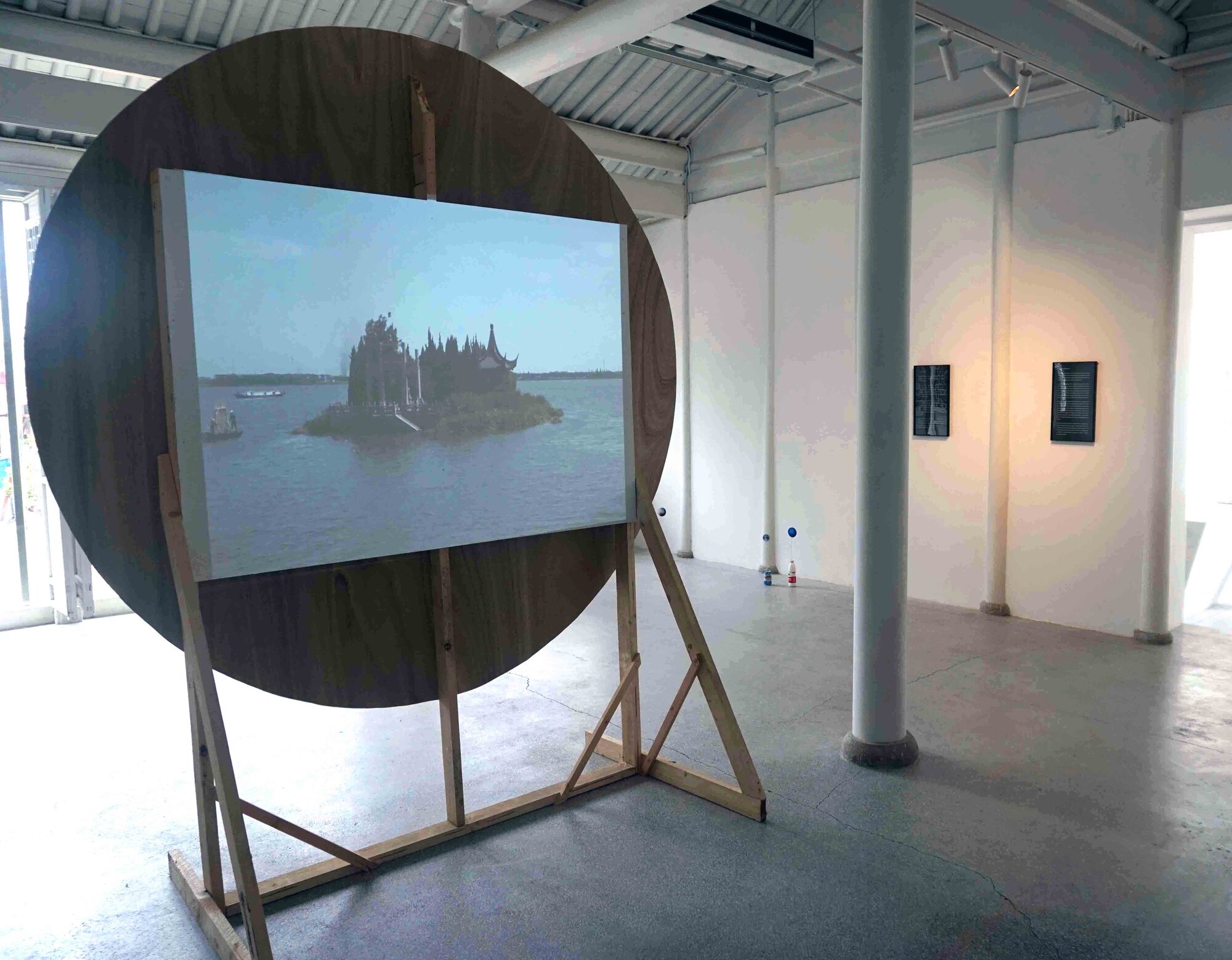
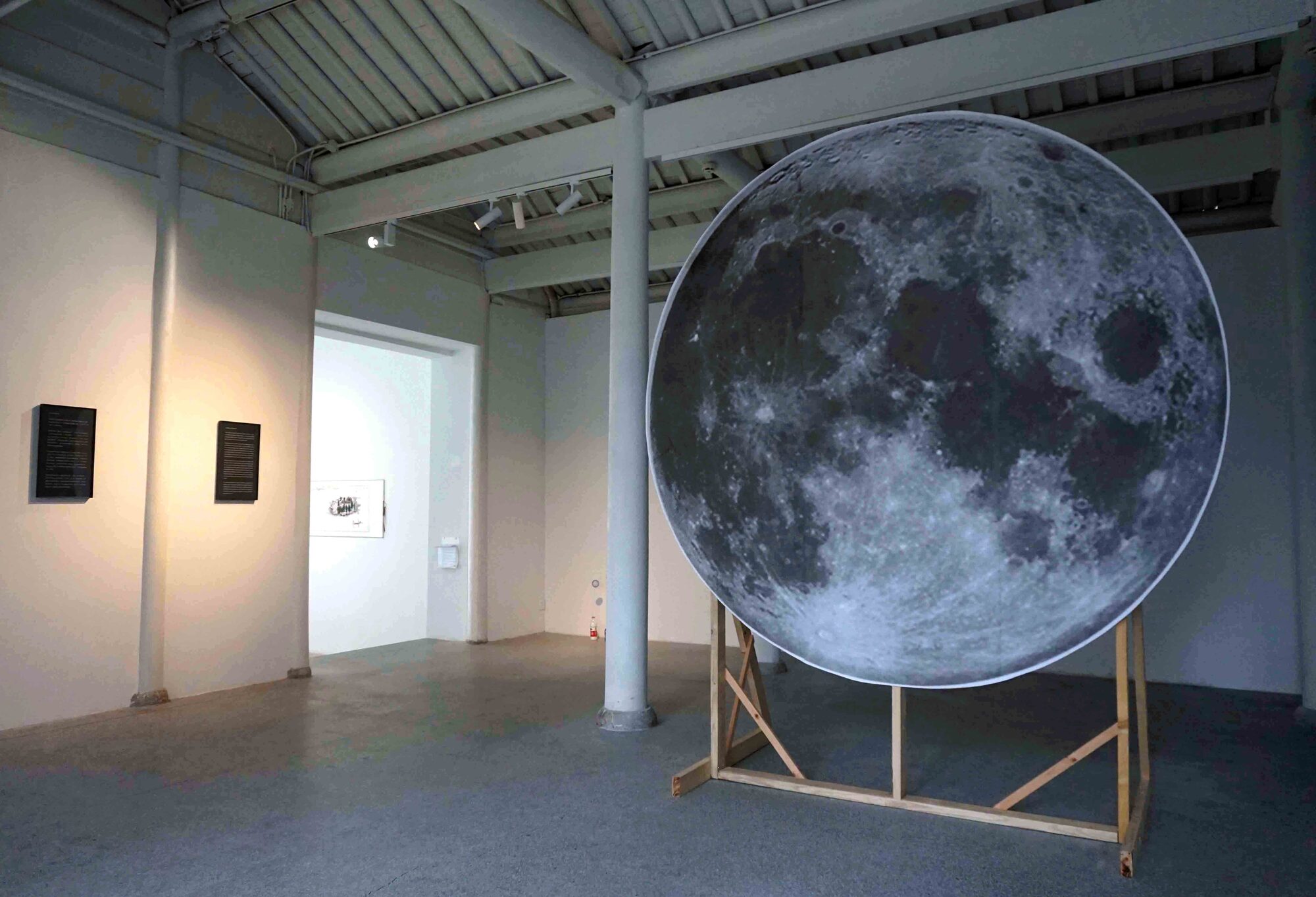
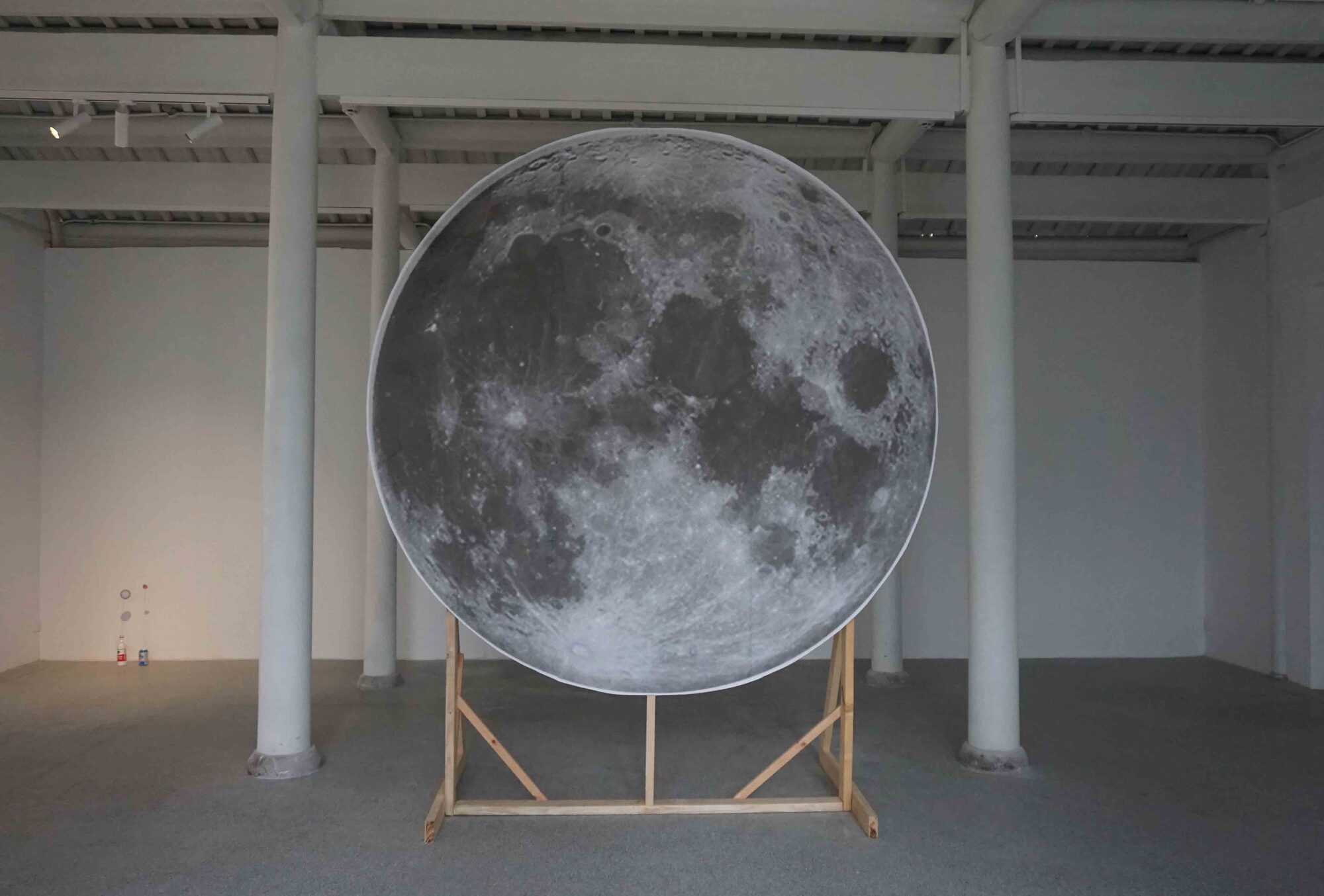
Mi interés fue producir piezas como modelos para la visualización de fenómenos extraterrestres descritos por las ciencias físicas del espacio como situaciones de contacto: -un primer trabajo; sistema atractivo 1, consiste en un video registro de una acción en la que un bote que acarrea una imagen de la luna, orbita en torno a una isla. Esta escena repetitiva y circular funciona como un modelo activo de la situación atractiva en la que la Tierra y la Luna se encuentran ancladas. Junto a este video se encuentra la pieza “piedra performática”: -Escaneé un fragmento lunar traído a nuestro planeta por la expedición Apolo 11 que actualmente se encuentra en el Museo Nacional Historia Natural en Santiago. A partir de un modelo 3D imprimí una réplica que en este momento orbita la tierra siguiendo la trayectoria que dibuja la luna al girar en torno a nuestro planeta. Para esto uso el correo postal enviando constantemente la pequeña escultura de un país a otro. En este momento la pieza se encuentra viajando desde Brasil hacia Nigeria. Su siguiente estación será Túnez, donde este viaje se inició en Marzo de 2026 y donde, en un par de meses, completará su primera órbita alrededor del mundo.
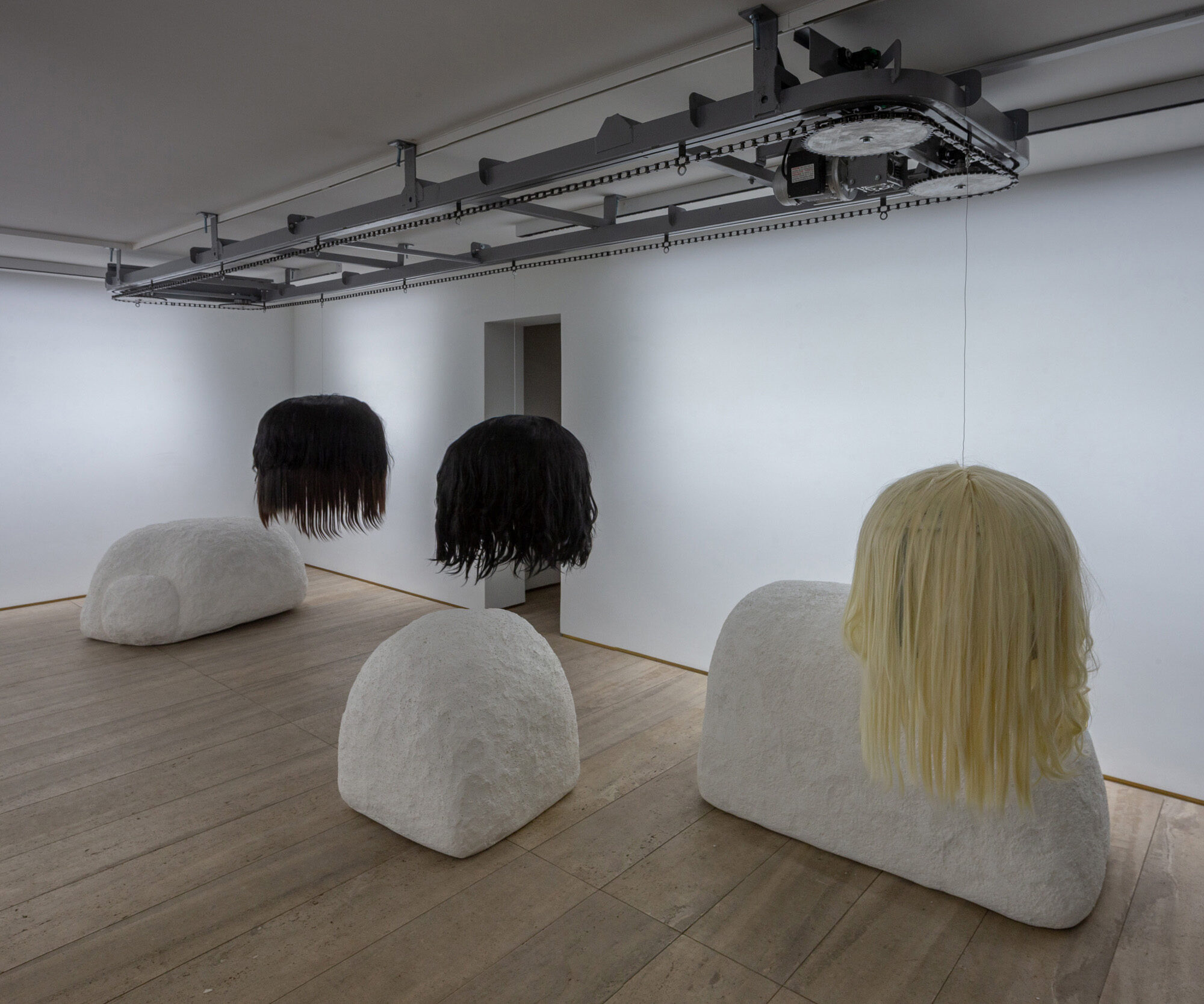
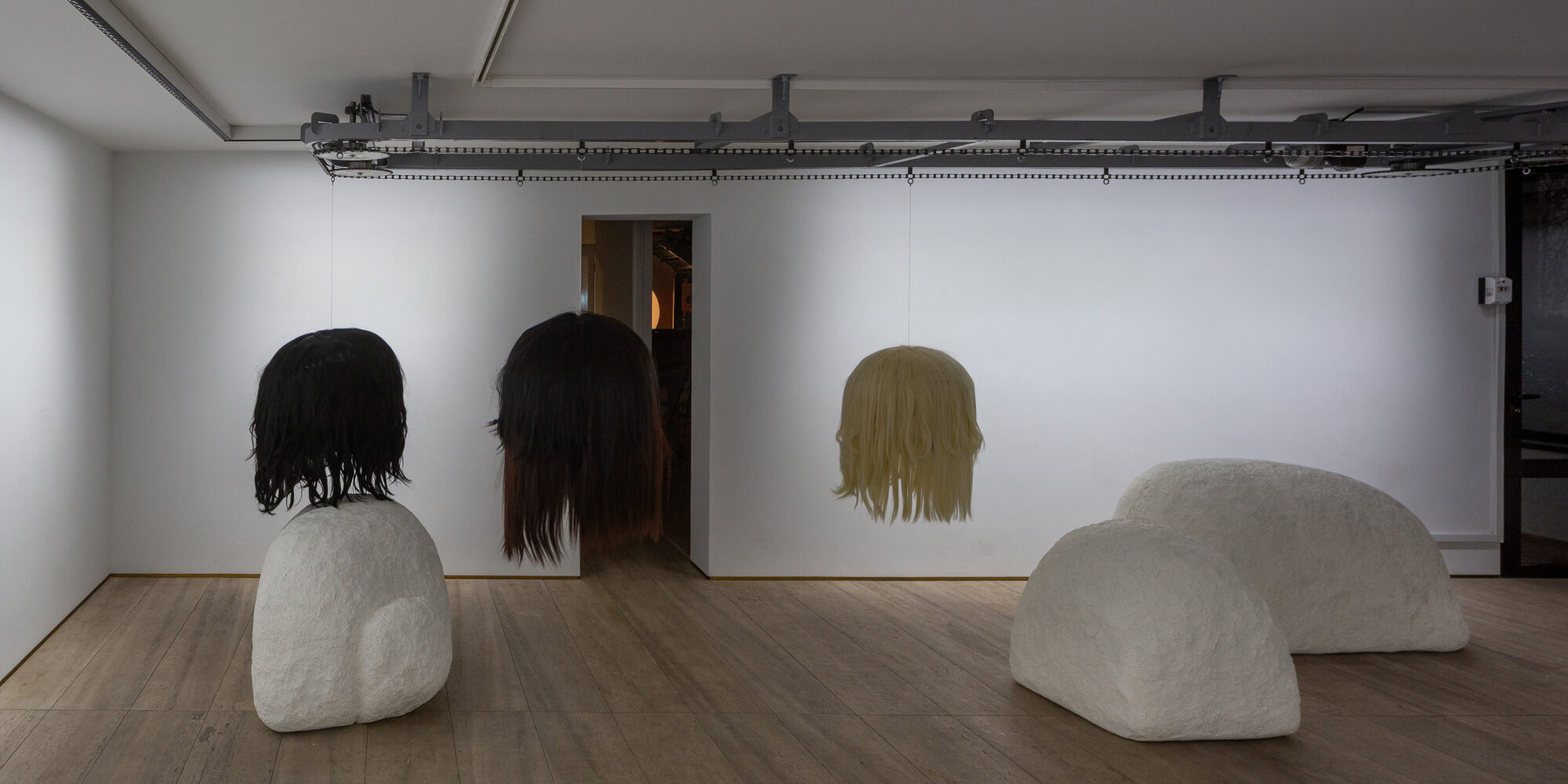
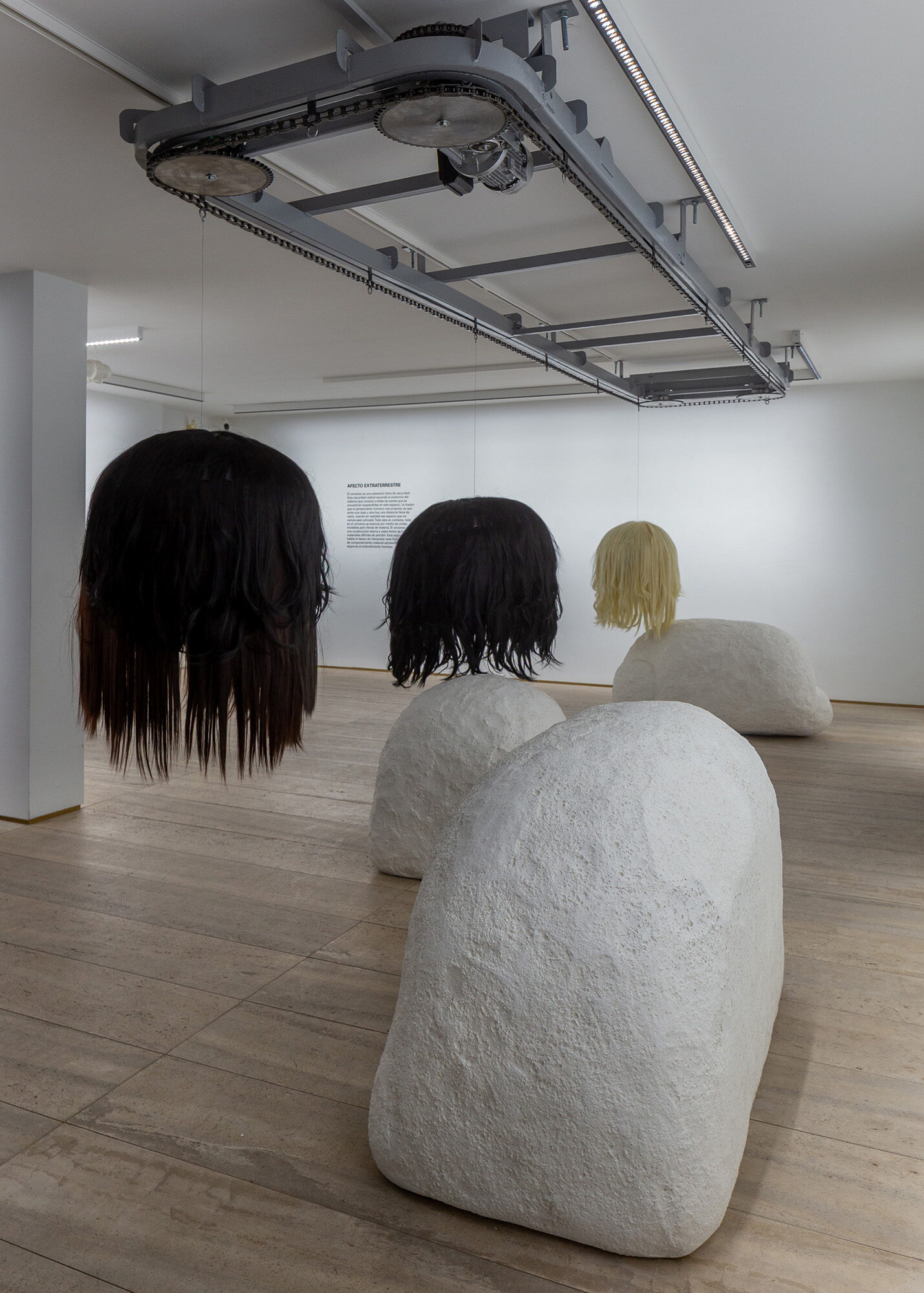
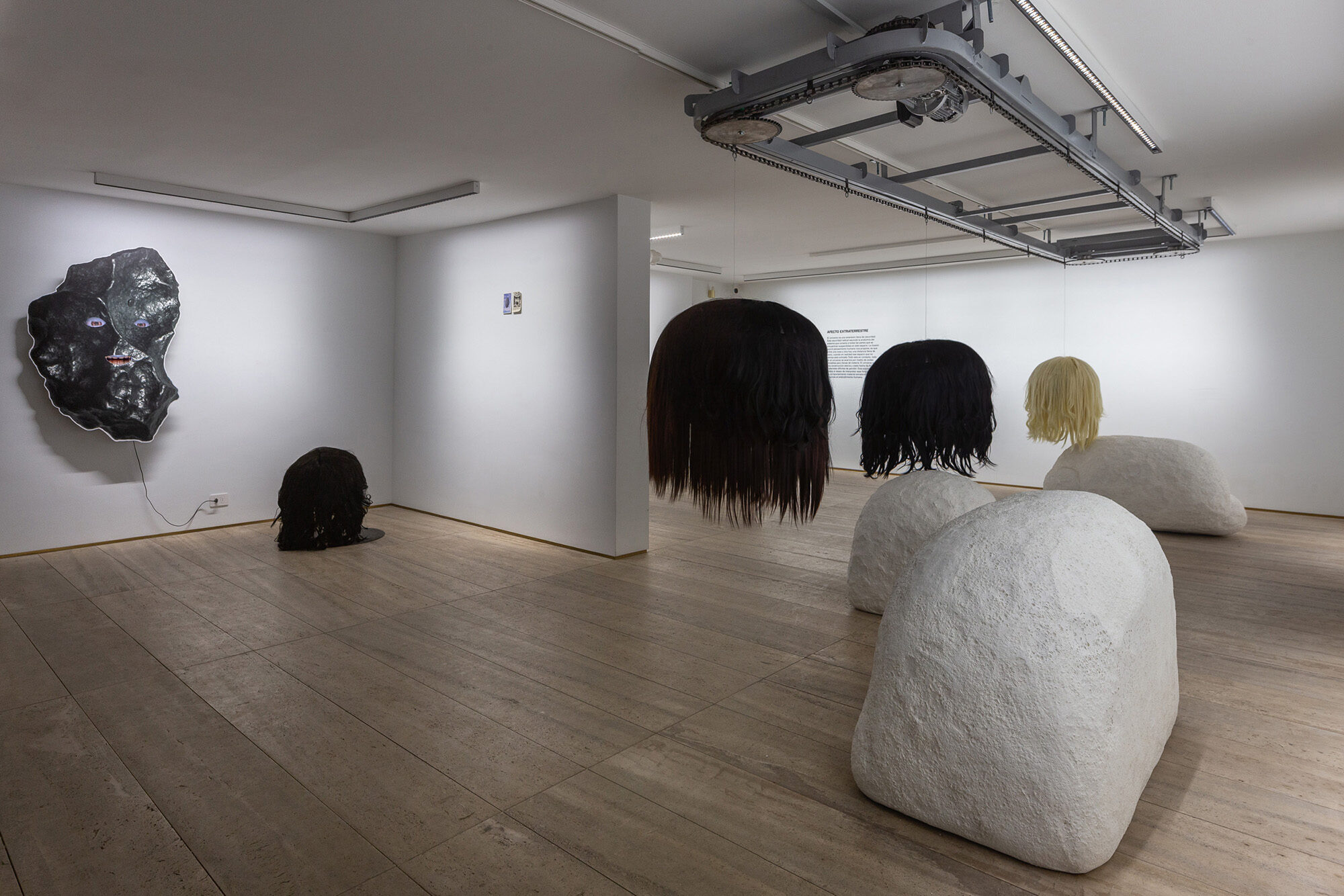
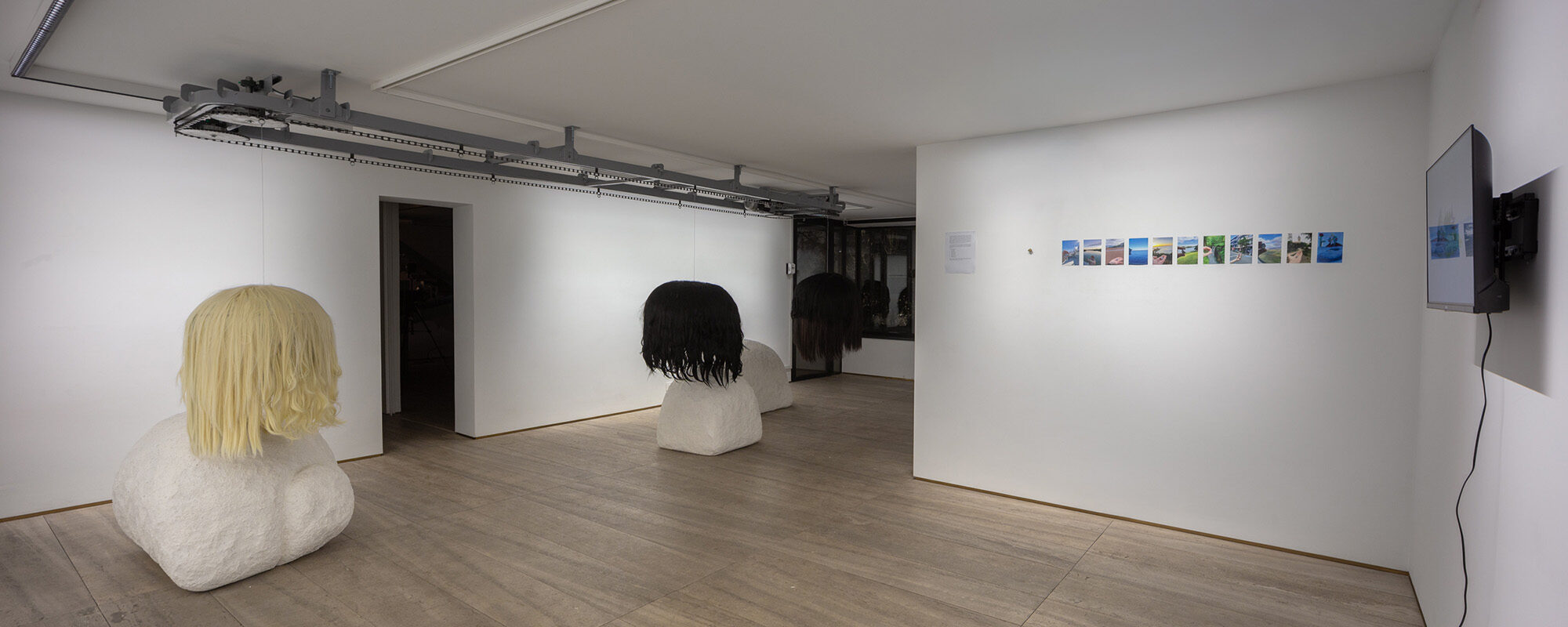
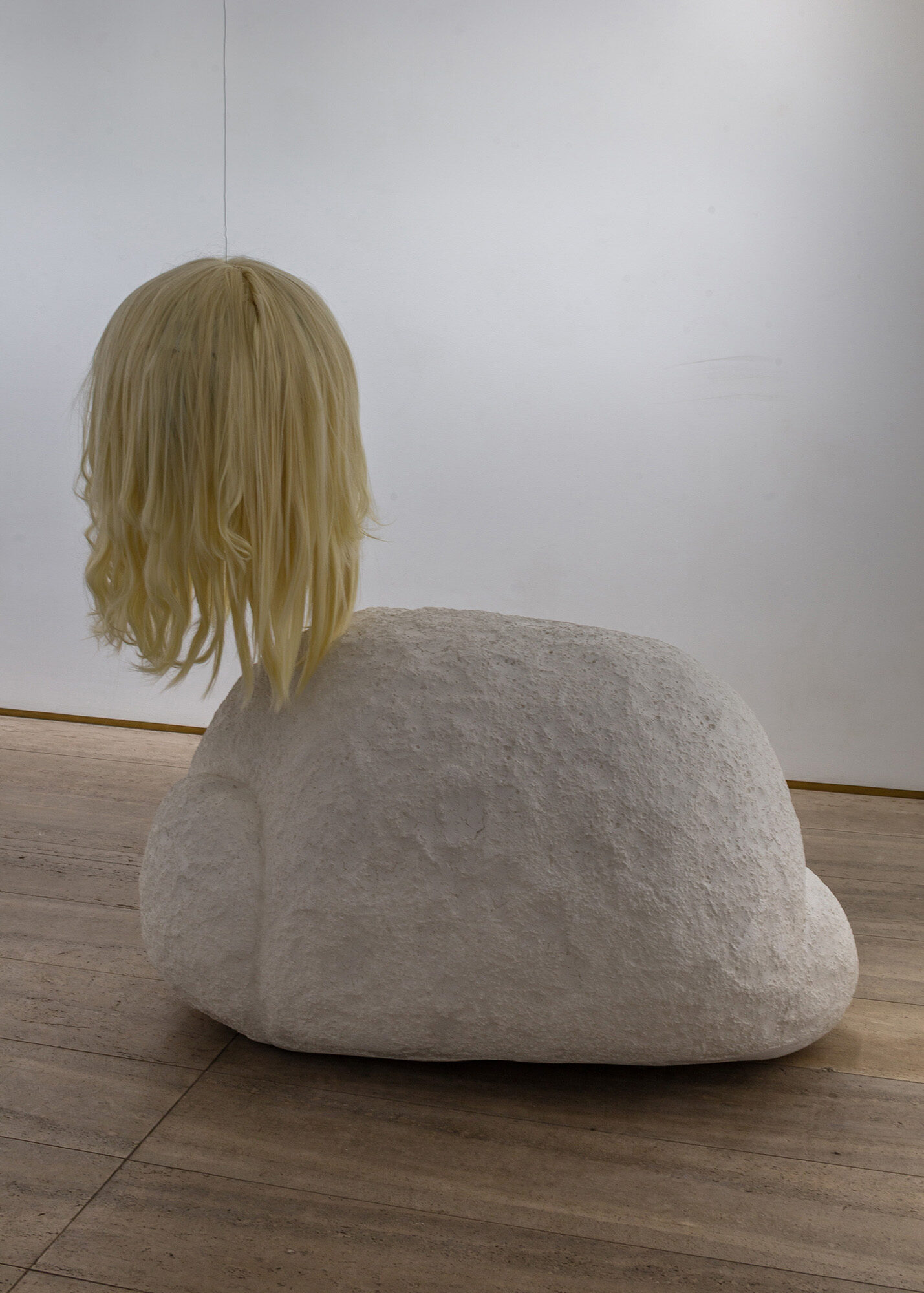
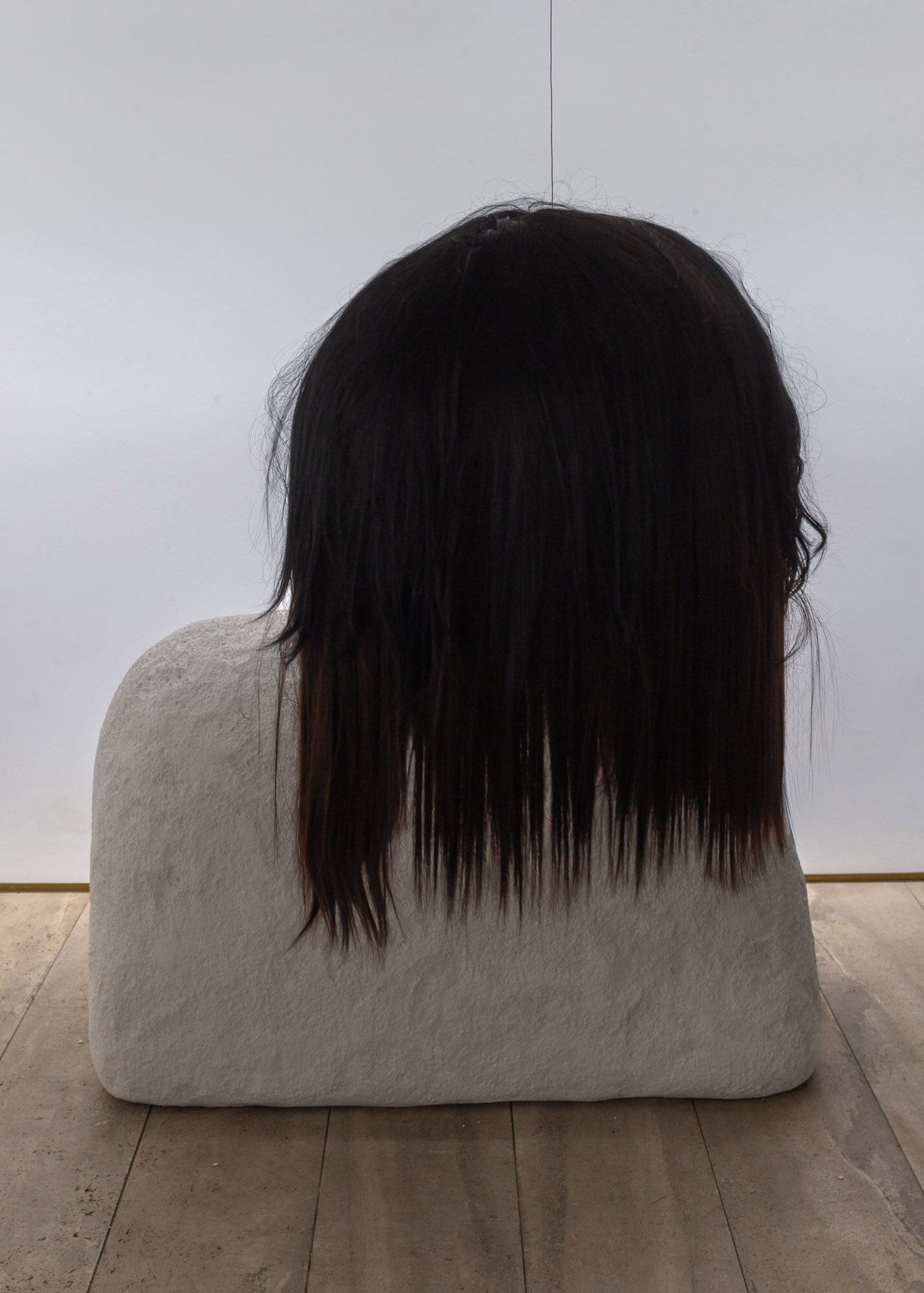
Como una manera de volver observable el contacto físico que se desarrolla en el espacio en las vastas zonas ocupadas por la “materia obscura”, diseñé la pieza “Tacto a distancia”: por un riel aéreo instalado en el techo de la galería transitan tres volúmenes, los que están construidos tomando como figura referencial meteoritos con rasgos mamíferos (inspirados en las descripciones de partículas microscópicas hechas por científicos del siglo XVI). Los pelos de estas figuras rozan una serie de esculturas instaladas en el suelo de la galería. El universo está sujeto a puentes materiales oscuros, un tipo de contacto que carece de forma visible pero que establece una serie de conexiones basadas en la energía. Estas fuerzas, aparentemente silenciosas, son las formas del orden material, de las que depende que los planetas no se desvíen de su circuito o que los cuerpos en la Tierra no se desprendan del suelo indefinidamente. Esto refleja el sistema repetitivo y ordenado que las fuerzas gravitatorias imponen a la materia que se mueve por el universo. El cabello nos permite visualizar el contacto suave y constante que habita en la distancia aparentemente vacía entre cuerpos que se reclaman mutuamente, estableciendo dinámicas de proximidad.
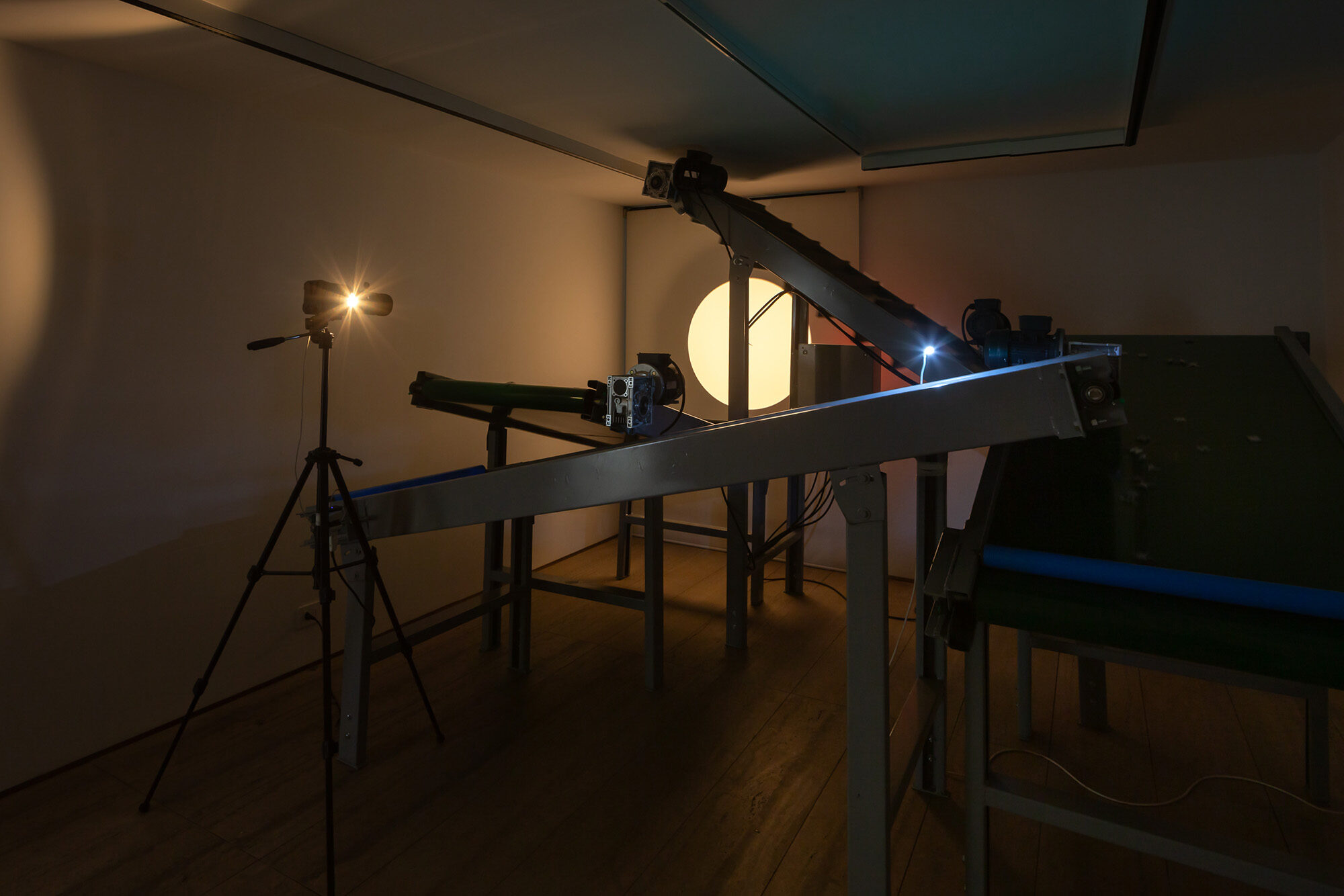
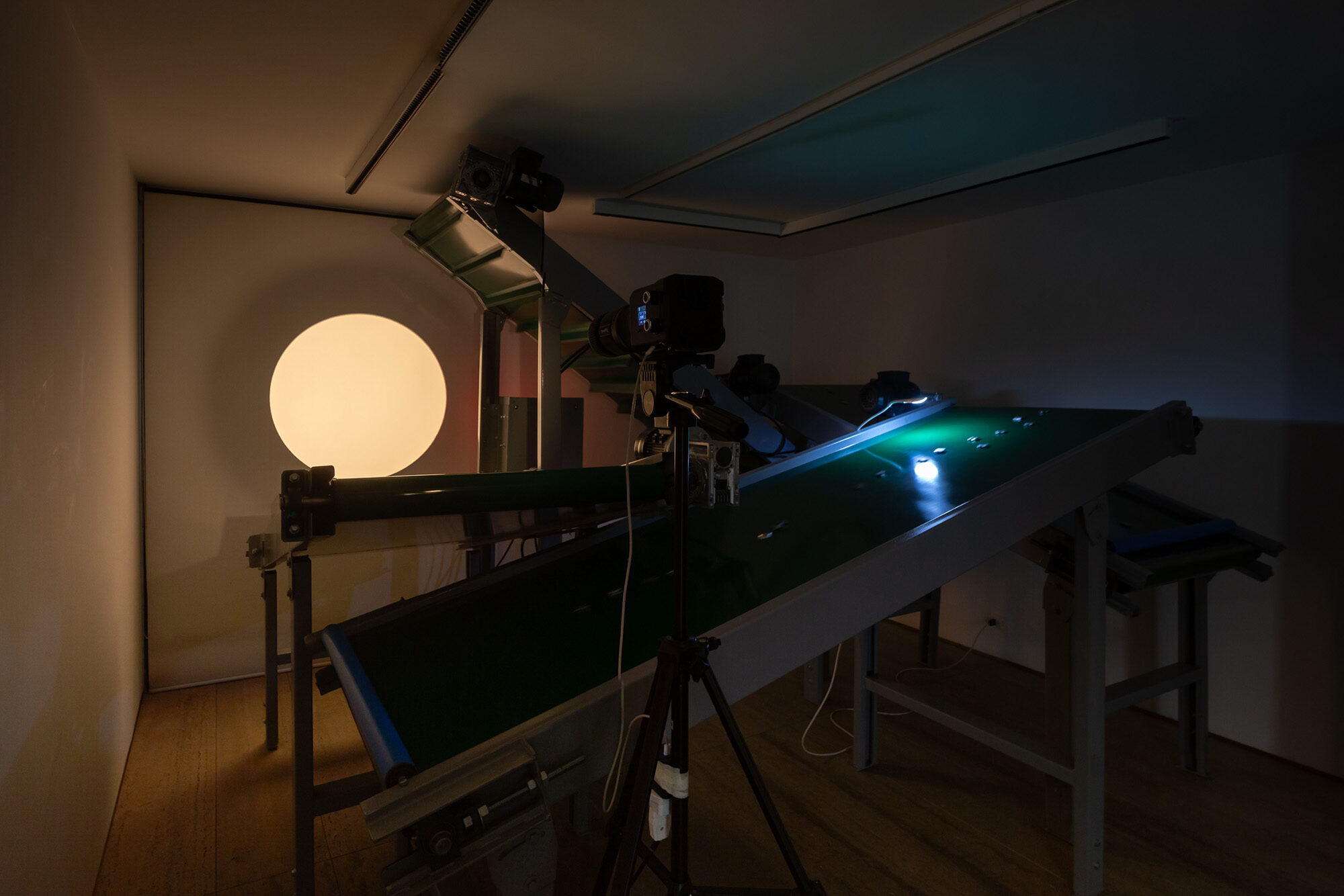
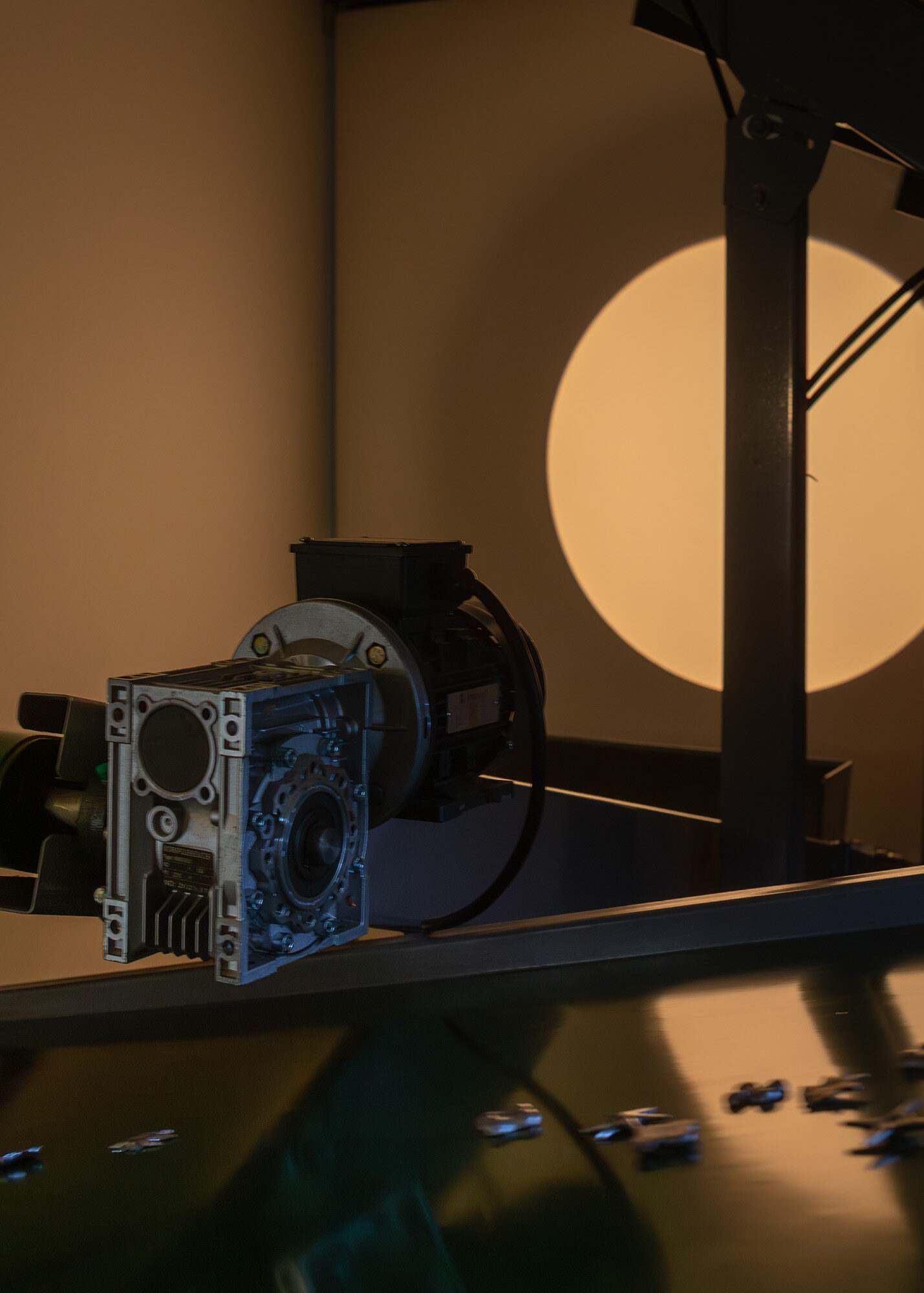
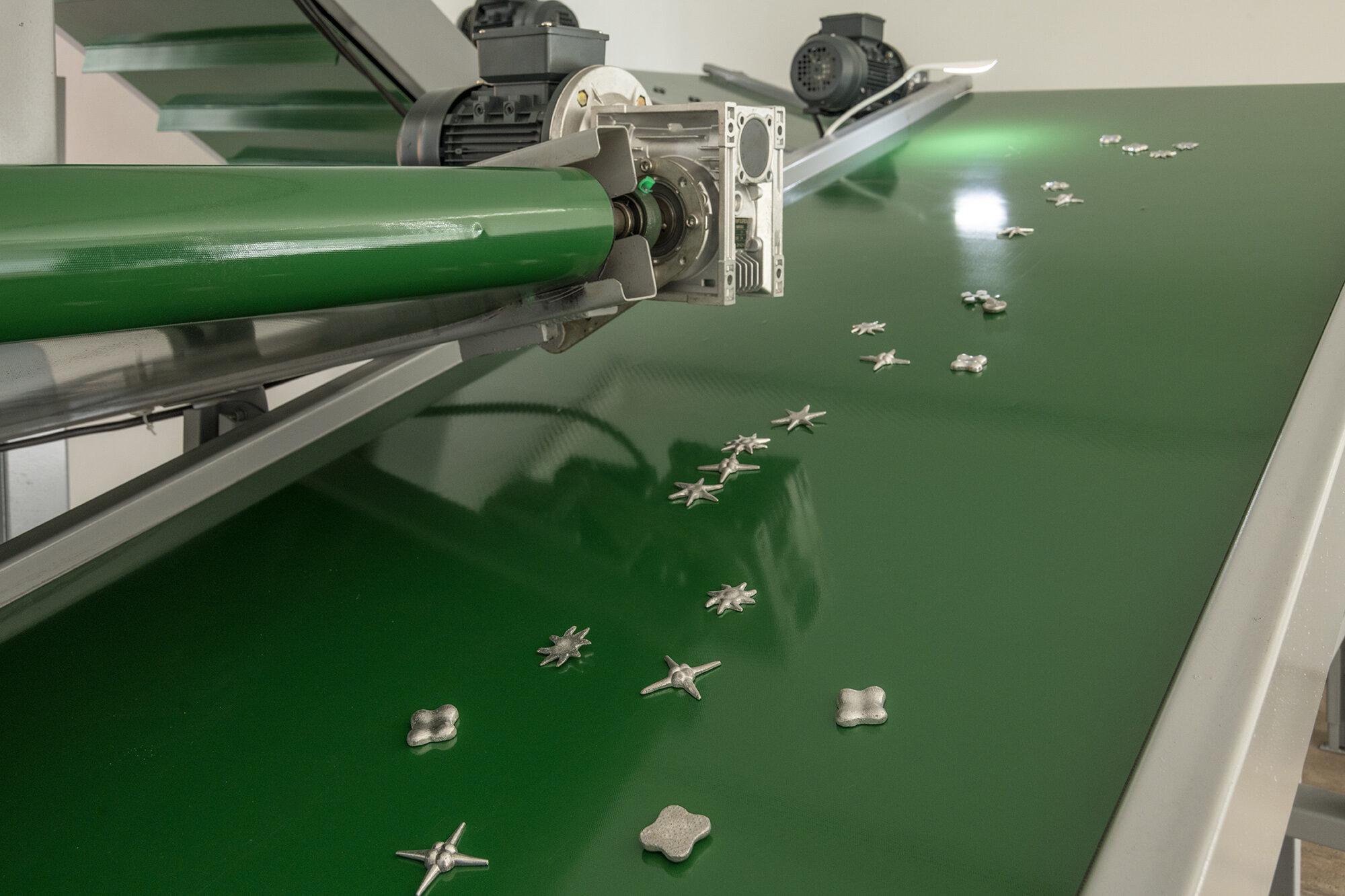
Como un modelo del movimiento expansivo del espacio y como este arrastra todos los cuerpos que se encuentran en su interior, diseñé la pieza “Cinturón de estrellas”, donde una serie de figuras de aluminio (realizadas en base a los dibujos de astrónomos del siglo XVII) se desplazan por un circuito de bandas transportadoras. Estas ascienden en un tramo del recorrido para caer, cual cascada de objetos, frente a una luz circular, eclipsando su redondez con sus formas puntiagudas.
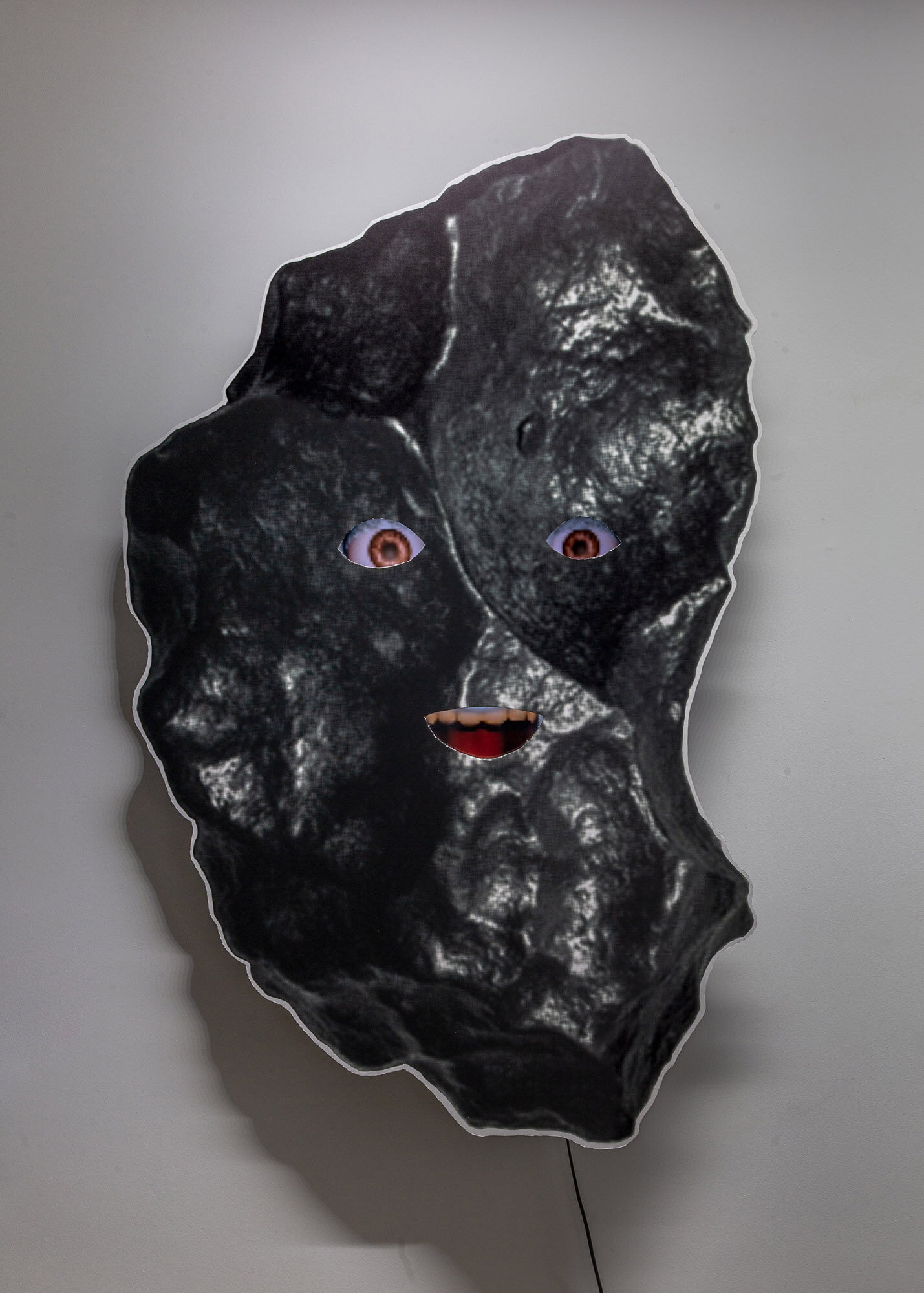
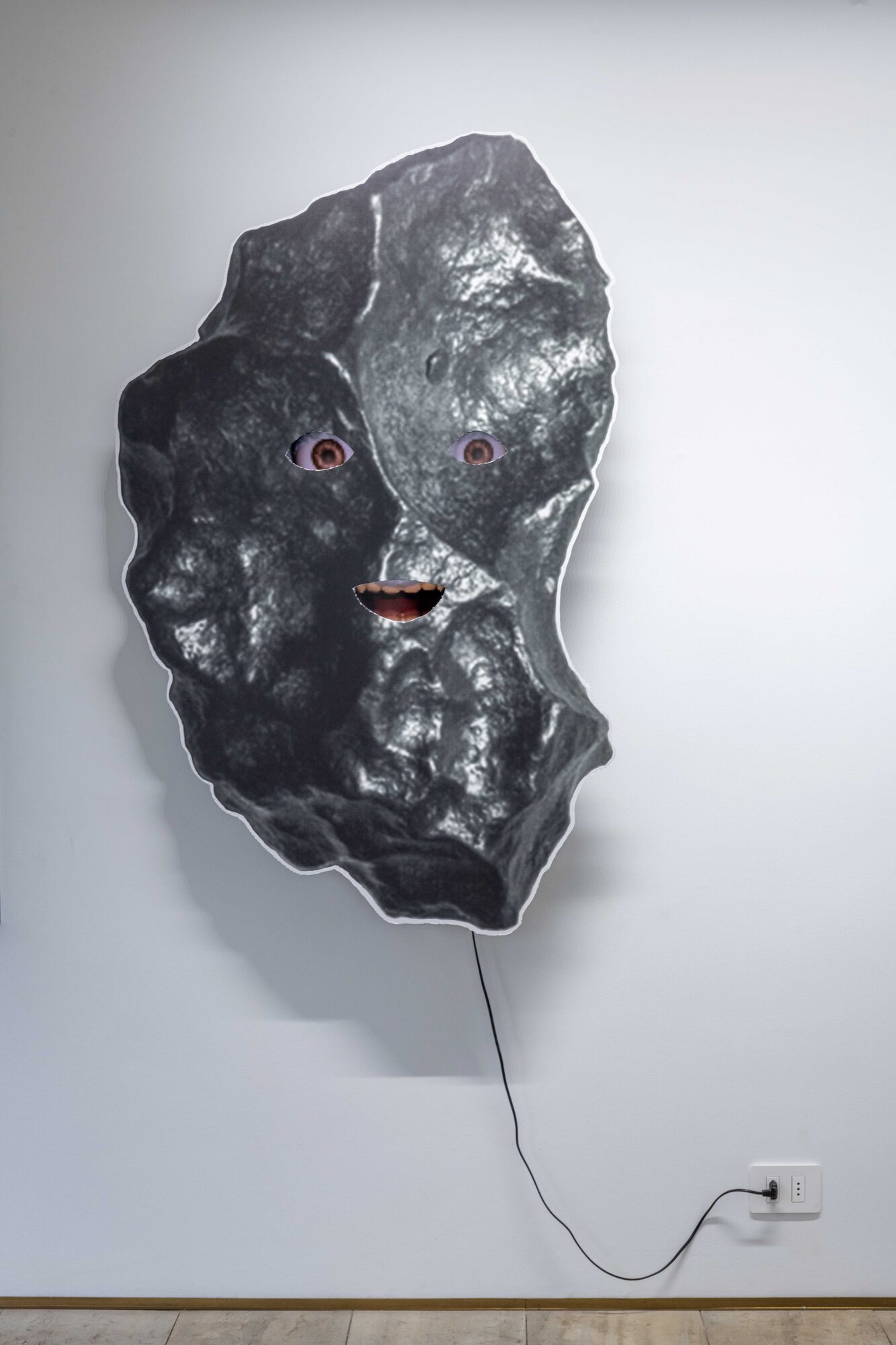
Finalmente, la imagen de un meteorito es animada con un video que articula sobre esta, unos ojos y una boca animados. El meteorito habla sobre los asuntos que dotan de contenido a esta exhibición, describiendo al universo como un fenómeno de la materia, una gran figura escultórica en movimiento como un ser lleno de partes sujetas a su estructura configurando un infinito fenómeno material.
El universo como un ser material.
Spinoza propone al universo como una eternidad material de la que siempre seremos parte y en la que estamos en estado de convivencia con todas las otras formas de existencia. Nos propone una visión del universo que presenta una alternativa al vacío, permitiéndonos reemplazar la nada con un algo. Edward Grant resume su postura de la siguiente manera: “En los hechos Spinoza adoptó ese punto de vista al convertir la extensión en un atributo de Dios, quien era concebido como un ser material infinito. Mientras que en la edad media la no dimensionalidad de Dios determinaba las propiedades de un espacio vacío infinito, extramundano y sin dimensiones, en los siglos XVII y XVII fue el vacío infinito tridimensional de la nueva física lo que, tal vez inadvertidamente, confirió a la deidad la tridimensionalidad.”[2] Spinoza nos presenta la posibilidad de un Dios como un infinito material, idea que luego se vuelve científica si remplazamos al concepto Dios por el de Universo. Esta antigua intuición de toda la existencia como una figura en movimiento, una Materia infinita y portadora de todos los atributos, es la escultura más grande que se pueda imaginar, y desde donde propongo extraer zonas como modelos para la construcción de mi pensamiento y acción artística.
Javier González Pesce
[1] Alberto de Sajonia. Preguntas sobre los ocho libros de la Física de Aristóteles.
[2] Edward Grant, La Ciencia Física en la Edad Media.
EXTRATERRESTRIAL AFFECTION
An exhibition conceived as a system of mechanical sculptures designed to interpret, within the mundane physical space, the behavior of the otherworldly phenomenological space.
“…the fact that there is a lot less difference between organic and inorganic matter than we tend to presume. Ultimately all matter, living or inert, is subject to the same cycle of organization and decay, even if the speed at which these processes occur is vastlt different. In this sense, planets, stars, galaxies -and arguably the entire universe- are not so different from our own bodies. So maybe it’s not impossible to somehow learn from the longevity of stone while teaching it our ability to be conscious, self-aware and intelligent.”
Elena Shaposhnikova
I am trained as a sculptor. Sculpture is the language I find myself drawn to when I think about my work and everything involved in its creation. On the other hand, I’ve always had the tendency to create pieces that move. Sculpture isn’t typically associated with behaviors like movement, which is more characteristic of living bodies. I’ve always interacted with the world of static objects, as if sensing that some power, some capacity, dwells within them. In this sense, sculptures —or even stones or other immobile objects— have always struck me as being somewhat like beings: mysterious bodies with the ability to communicate through subtle signals, such as low-frequency hums. These signals, this kind of silent communication from sculpture (and the inanimate in general), are the world’s way of establishing connections in space. In this way, bodies (whether living or not) tend to generate interconnected systems, like constellations. The silence of the constellation is a manifestation of its enigmatic behavior, which —though it has been of interest to humans since ancient times— we have only been able to interpret in a rudimentary way, aided by sophisticated advances in scientific technology.
Scientific thought has been a major influence on my work. One day, while walking in the forest, I came across a large rock. Stripped of all symbolic elements, this massive geological body struck me as a kind of prototypical sculpture: pure, genuine, ancient, and counter-intellectual. I wondered about the conditions that make this volume comparable to sculpture. I considered the rock to be silent, enigmatic, possessing a presence that disrupts its surroundings, with a stark surface, docile and rebellious at the same time, static. All these characteristics are formal points of convergence between sculptures and stones.
I shifted my thoughts to a distant realm above my head and beyond the planet; I visualized other types of stone extraterrestrial rocks: meteorites and asteroids. These are similar to their terrestrial counterparts, but unlike them, they can fly; they never stop moving. Faced with this thought, I realized that terrestrial rocks are not stationary, or at least, stillness is not their nature. On our planet, stones have encountered a surface capable of resisting the trajectory that their energy projects toward the Earth’s gravitational center. The rock appears static, yet it is pushing with an energy equivalent to its weight, which is the quantifiable manifestation of its desire for movement.
This insight led me to understand that the physical phenomenology affecting sculpture (or any other object with mass) is not constant throughout the rest of the universe. This means that what determines sculpture’s (typically) static behavior is, in reality, a condition that is not inherent to matter itself, but rather to the Earth’s environment and how it influences matter. Outside our planet, bodies move as if magnetized by the anatomy of space and its movements. In outer space, movement is constant. A stone that knows no ground also knows no stillness. At this point, I began to desire to carry out my artistic practice in an extraterrestrial territory (one that offers new physical and environmental conditions). Frustrated by the realization that creating extraterrestrial sculpture is impossible, I have attempted to develop my practice in a material space that interprets the behavior of matter beyond the limits of our planet.
What is an extraterrestrial affect?
“The opposite of chaos is the cosmos. Like cosmetics, chaos signifies beauty and harmony.”
Anton Vidokle
Hoping to influence the viewer and their interpretation of my exhibition I installed the following phrase on the wall of the D21 gallery: “The universe is an expanse filled with obscurity. This radical darkness conceals the anatomy of the system that connects all the parts suspended in this space. The illusion that human thought presents to us is that between one thing and another there is a distance filled with emptiness, when in reality that space we cannot see is filled. Everything is in contact; everything in the universe touches one another through invisible waves that are nonetheless full of matter. The universe is an eternal and vast construction made of material forms that are difficult to perceive. This exhibition explores the desire to interpret those massive forms of extraterrestrial material behavior, so elusive to human understanding.”
Humanity has long wondered about the possibility of a vacuum. Albert of Saxony (1316–1390), for example, raised a series of questions from a scholastic perspective regarding the ideas that laid the groundwork for the physical sciences. Among these, several raise concerns regarding the vacuum and motion:
“3—Whether a specific place is immobile.
“8—Whether the existence of a vacuum is possible.
“9—Whether, in a downward motion, a simple heavy body possesses internal resistance; and, similarly, whether, in its upward motion, a light body possesses internal resistance.
“10- Whether a resistant medium is required for every motion of heavy and light bodies.
“11- Whether, if a vacuum were to exist, a heavy body could move within it.
“12- Whether anything could be propelled within a vacuum—if it were to exist—with a finite velocity, or local motion, or motion of alteration.”[1]
Science has concluded that in space there is nothing that is not in contact. That enigmatic darkness we once thought of as empty space—a vast void—is in reality a (still) undeciphered form of matter. Thus, just like shells in the sand, the rigid presences in space are embedded within the Universe. Space itself moves; this dark matter appears to be a flexible material medium capable of flowing and expanding (like a vast sea extending in all directions and infinitely). The talking meteorite on display (among other things) mentions:
“…the phenomena of space are submerged in a darkness full of mystery. This space made of invisible matter is almost muscular; it bends like an infinite eel, branching out in all directions. Like a fabric, a weave woven from an energetic musculature, lines of magnetic force that constitute a kind of interconnected fiber.” Everything touches everything else; matter is constantly forming bridges, like lines of magnetic weightless ants circulating in all directions and connecting every part of the universe. In this way, everything caresses one another; every movement in space involves friction imperceptible to the human eye. To have a body is inevitably and constantly to be caressed by the surrounding universe. The skin grows accustomed to the persistence of this contact, ceasing to have a tactile awareness of its presence; the eye cannot perceive it, or learns to locate within that space—infested with bacteria, particles, and magnetism—that fictitious entity we call empty space. In the same way, the universe, rather than a deserted territory, is a vast mass that we cannot comprehend. Where we perceive darkness, we perceive an absence. This hyperabundance of caresses—which act as a network of forces constantly pushing everything that has mass—inspired the exhibition’s title: “Extraterrestrial Affection.”
About the Exhibition
My interest was in producing pieces as models for visualizing extraterrestrial phenomena described by the physical sciences of space as situations of contact: -a first work, Attractive System 1, consists of a video recording of an action in which a boat carrying an image of the moon orbits an island. This repetitive, circular scene functions as an active model of the gravitational situation in which the Earth and the Moon are bound together. Alongside this video is the piece “performative stone”: -I scanned a lunar fragment brought to our planet by the Apollo 11 expedition, which is currently housed at the National Museum of Natural History in Santiago. Using a 3D model, I printed a replica that is currently orbiting the Earth, following the path traced by the Moon as it revolves around our planet. To achieve this, I use the postal service to constantly send the small sculpture from one country to another. At this moment, the piece is traveling from Brazil to Nigeria. Its next stop will be Tunisia, where this journey began in March 2026 and where, in a couple of months, it will complete its first orbit around the world.
As a way to make observable the physical contact that occurs in space within the vast zones occupied by “dark matter,” I designed the piece “Distant Touch”: three volumes travel along an overhead rail installed on the gallery ceiling; these are constructed using meteorites with mammalian features (inspired by 16th-century scientists descriptions of microscopic particles). The hairs of these figures brush against a series of sculptures installed on the gallery floor.
The universe is governed by dark material bridges—a type of contact that lacks visible form but establishes a series of energy-based connections. These seemingly silent forces are the forms of material order, upon which it depends that planets do not stray from their orbits or that bodies on Earth do not detach from the ground indefinitely. This reflects the repetitive and orderly system that gravitational forces impose on matter moving through the universe. Hair allows us to visualize the gentle and constant contact that exists in the seemingly empty distance between bodies that draw one another toward each other, establishing dynamics of proximity.
As a model of space’s expansive movement—and how it draws in all the bodies within it—I designed the piece “Star Belt” in which a series of aluminum figures (based on drawings by 17th-century astronomers of stars and other bodies observed in outer space) move along a circuit of conveyor belts. These figures ascend along a section of the path before falling—like a cascade of objects—in front of a circular light, their pointed shapes eclipse its roundness.
Finally, the image of a meteorite is motioned with a video that superimposes animated eyes and a mouth onto it. The meteorite speaks about the themes that give substance to this exhibition, describing the universe as a phenomenon of matter—a vast, moving sculptural figure, like a being composed of parts bound to its structure, forming an infinite material phenomenon.
The universe as a material being.
Spinoza conceives the universe as a material eternity of which we will always be a part and in which we coexist with all other forms of existence. He offers us a vision of the universe that presents an alternative to the void, allowing us to replace nothingness with something. Edward Grant summarizes his position as follows: “In fact, Spinoza adopted this viewpoint by making extension an attribute of God, who was conceived as an infinite material being. Whereas in the Middle Ages God’s non-dimensionality determined the properties of an infinite, otherworldly, and dimensionless empty space, in the 17th and 18th centuries it was the infinite three-dimensional void of the new physics that, perhaps inadvertently, conferred three-dimensionality upon the deity.”[2] Spinoza presents us with the possibility of a God as a material infinity, an idea that later becomes scientific if we replace the concept of God with that of the Universe or space. This ancient intuition of all existence as a figure in motion —an infinite Matter that embodies all attributes— is the greatest sculpture one can imagine, and from which I propose to extract areas as models for the construction of my artistic thought and practice.
Javier González Pesce
[1] Albert of Saxony. Questions on the Eight Books of Aristotle’s Physics.
[2] Edward Grant, Physical Science in the Middle Ages.
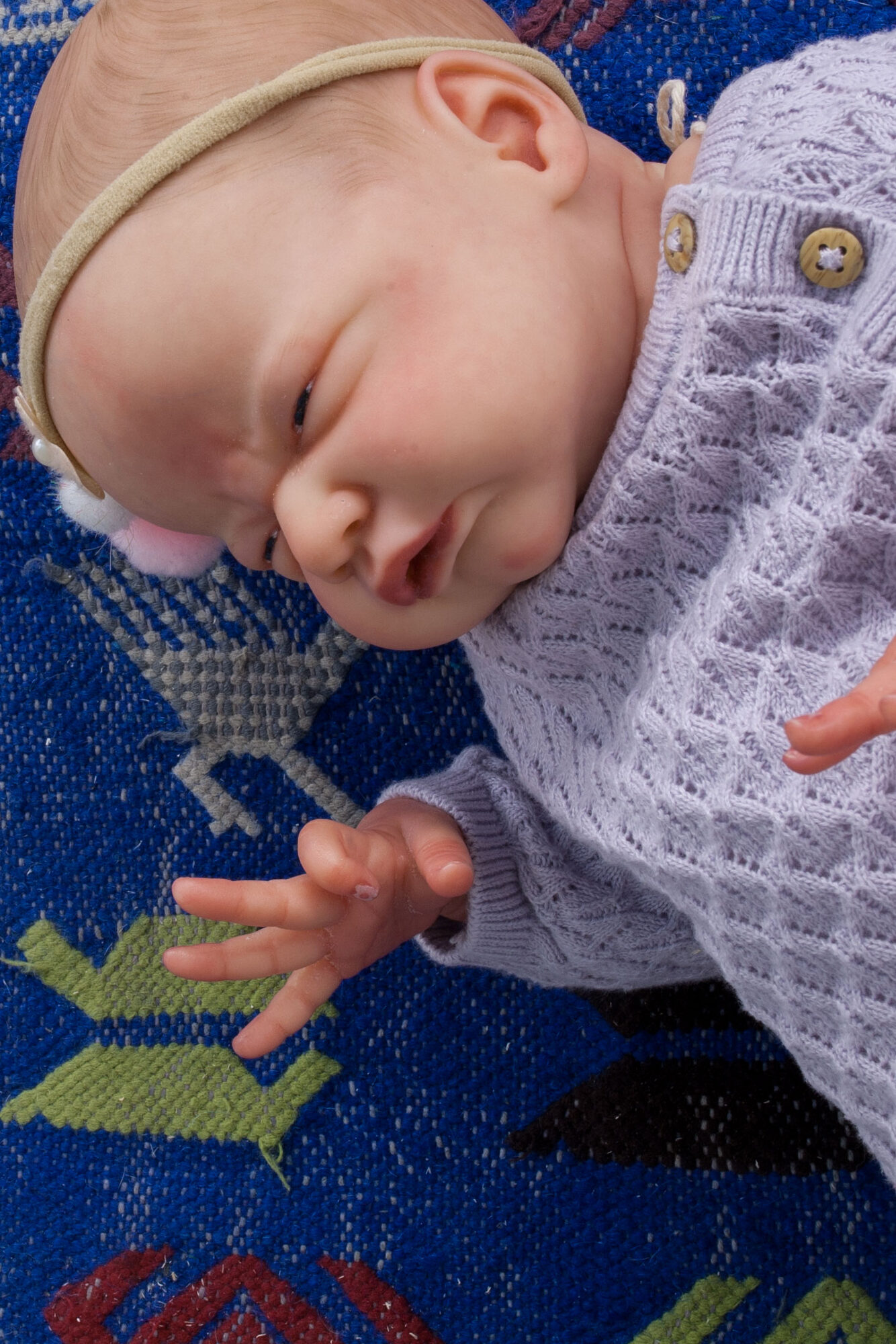
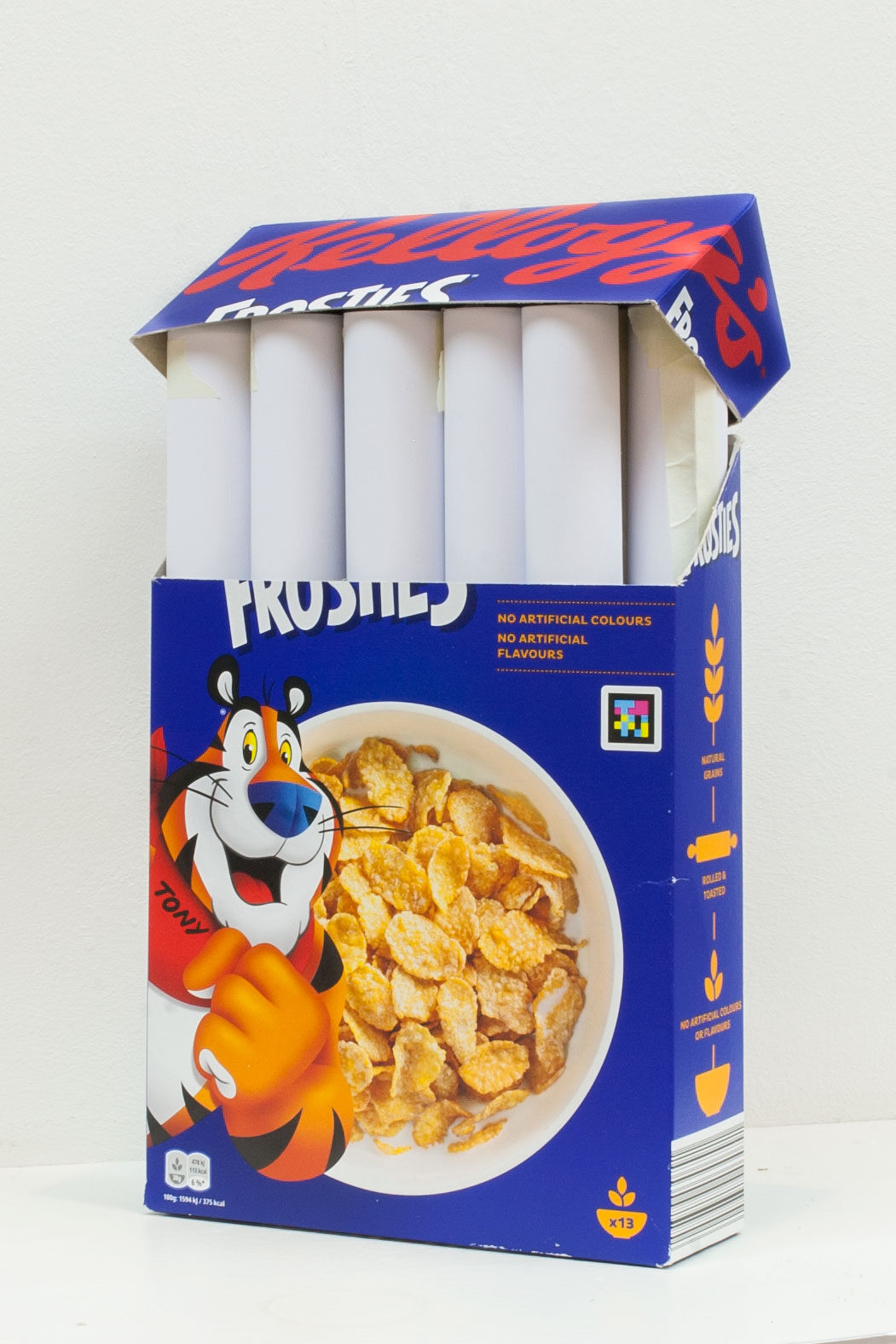
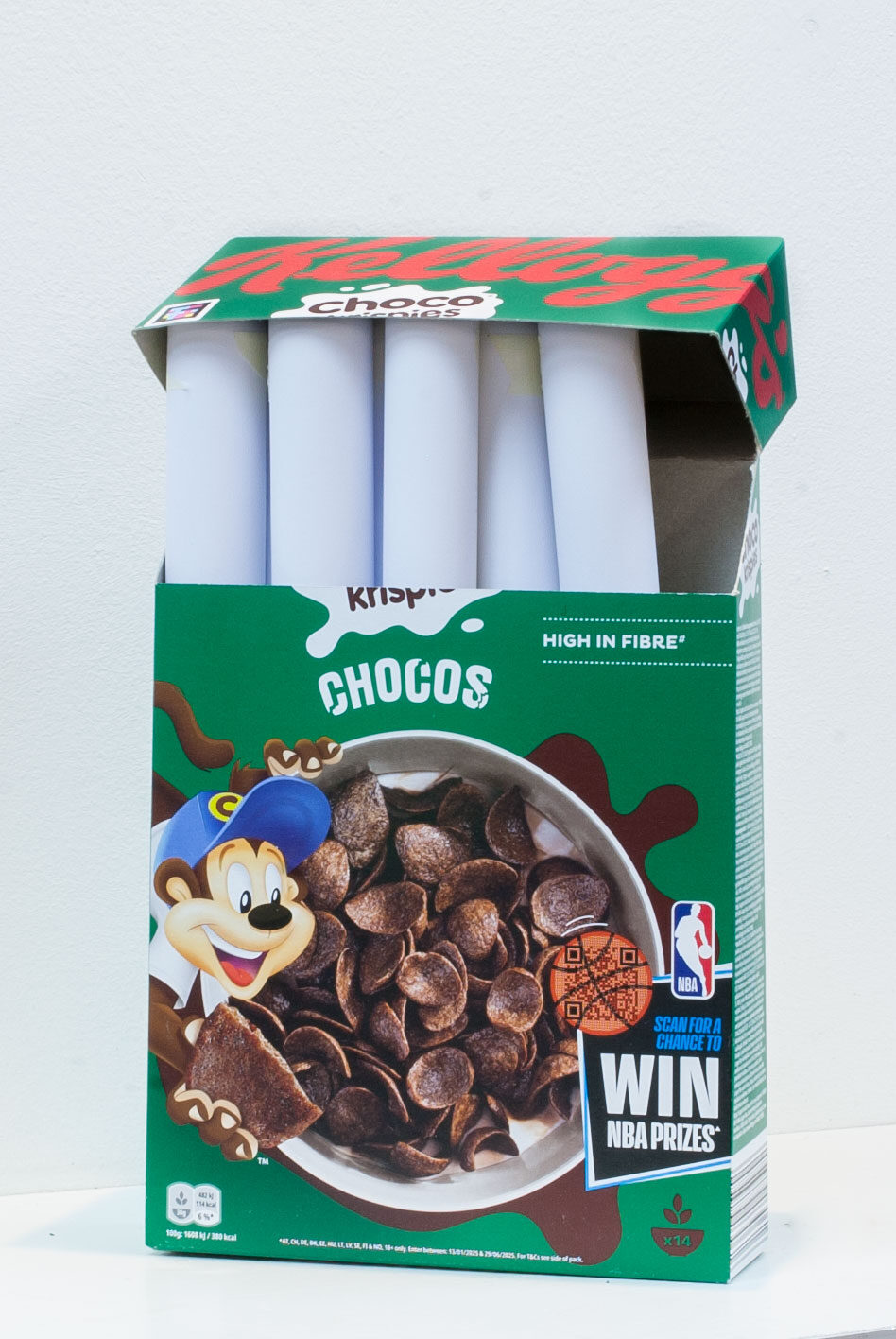
Entre Enero y Marzo de este año, Javier González Pesce estuvo realizando una residencia en Suiza bajo el respaldo de Pro Helvetia y su programa de apoyo a artistas de América del Sur. Javier estuvo un mes en la ciudad de Ginebra en la residencia Embassy of Foreign Artists y luego otros dos meses en Villa Numa en la ciudad de La Chaux des Fonds. Su investigación se centró en las reflexiones y métodos investigativos de científicos del siglo XVII, especialmente Charles Bonnet. Este tiempo en donde los instrumentos para la observación del medio (como los microscopios) eran aún muy poco avanzados, demandaba de los científicos una disposición creativa, casi poética. De la reproducción de algunos experimentos en terreno en la zona de Jura y la extensa lectura de tratados de ciencia y correspondencias entre científicos de la época (especialmente Lazzaro Spallanzani) la investigación resultó ser más extensa de lo previsto. El artista se encuentra hoy comprometido con una fase del proyecto que consiste en conectar la zona del Jura (Suiza, Francia) con la cadena montañosa que lleva el mismo nombre en la superficie de la luna.
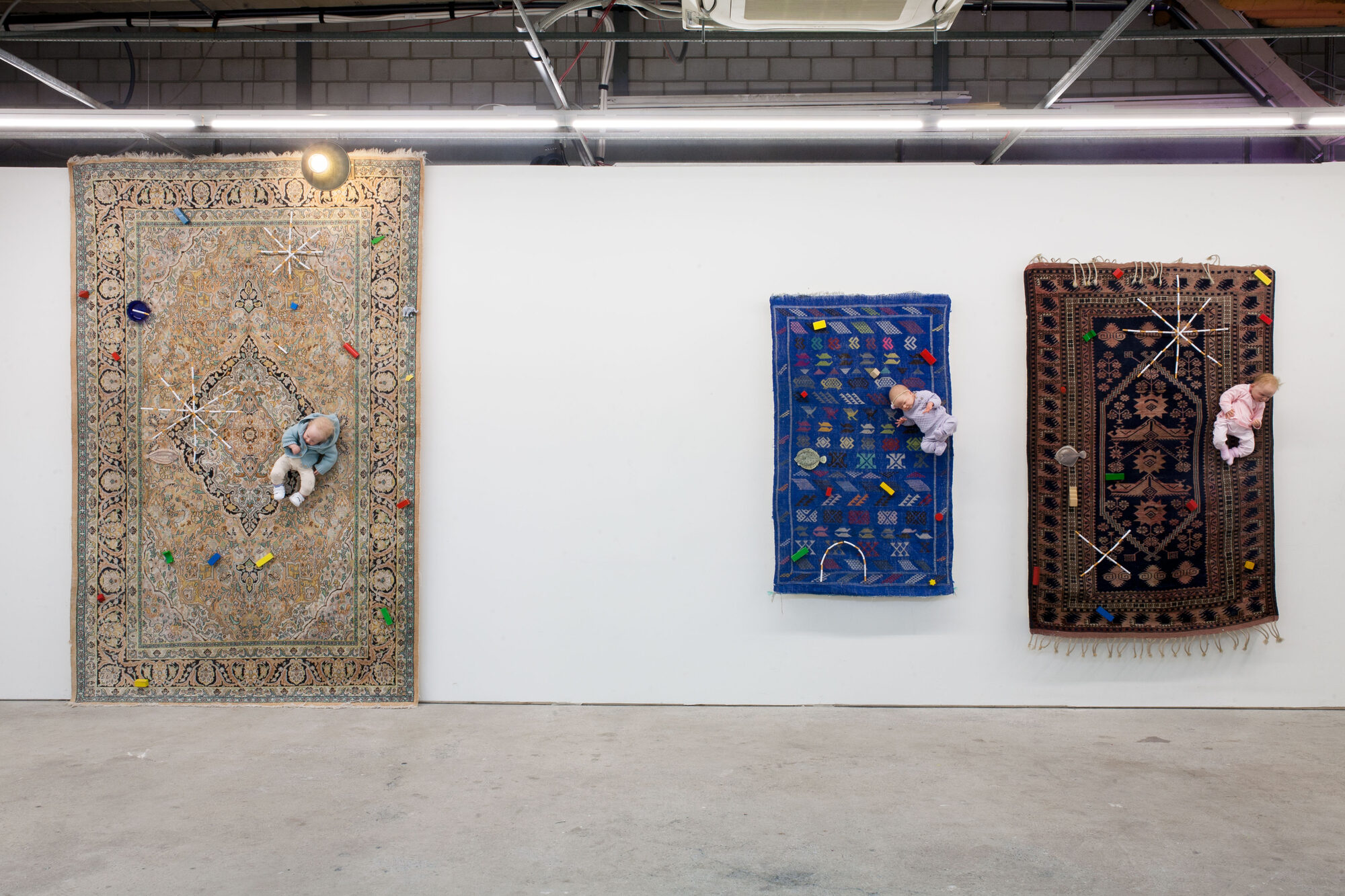
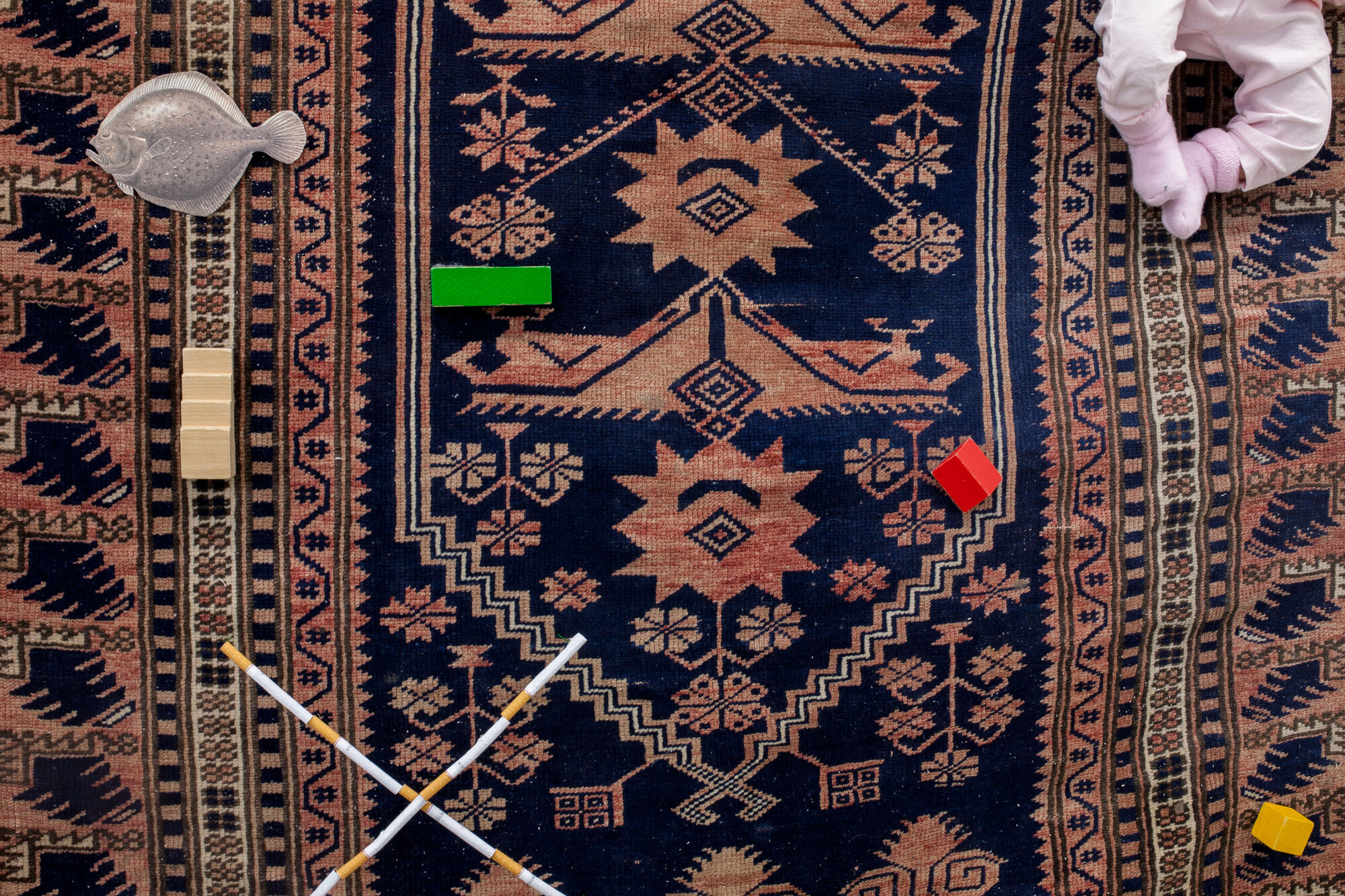
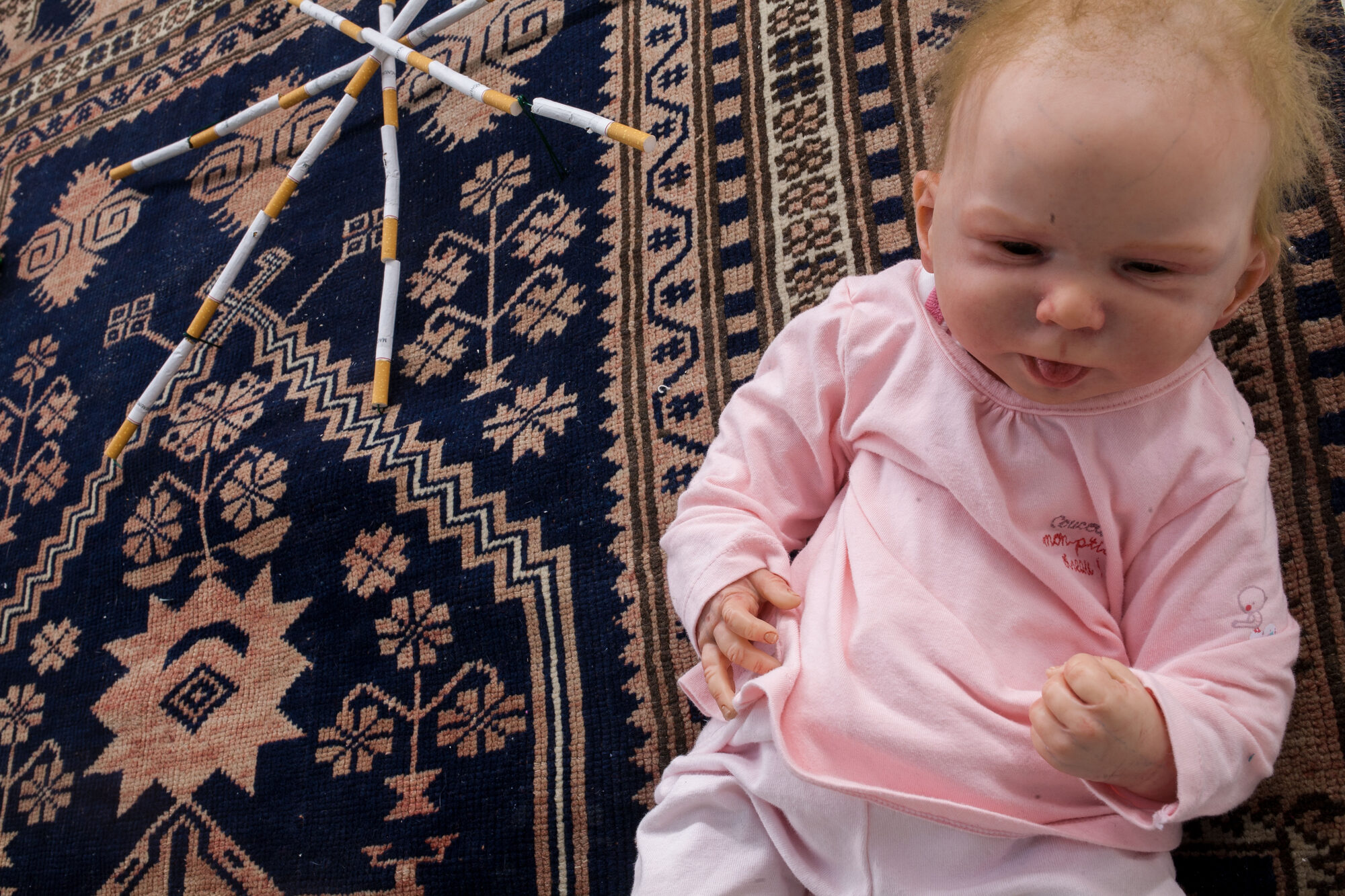
Dentro de este contexto (el del periodo de residencia en Suiza) Javier realizó dos exhibiciones. Una en Villa Numa y la otra en el espacio Amore de la ciudad de Basilea. En esta última, la invitación surge desde un vínculo de trabajo, afinidad y amistad con los artistas Manuela Flores Délano (Chile) y Charles Benjamin (Suecia), quienes trabajan de manera colectiva en un proyecto, a veces colectivo artístico, otras equipo curatorial, bajo el Nombre de Mario Kreuzberg. Es entonces esta dupla quienes hacen de curadores de la exhibición “Porque construir si destruir es más rápido?”. A continuación el texto escrito por Charles Benjamin.
"Why to build if to destroy is faster"
Amore x Mario Kreuzberg
14.03.2025
Basel
Como en la mayoría de las ciudades, si son vistas desde arriba, las calles de Santiago son como grietas de actividad en un desierto de techos. Durante mucho tiempo, Javier ha estado recogiendo cosas encontradas en ellos, cosas que los techos han transformado en ex-cosas. Pelotas, juguetes, baldosas, revistas, huesos, ropa, tuberías, objetos electrónicos y bolsas de plástico que hablan desde un lugar alejado con una vista desde arriba. De alguna manera son readymades, pero también son recordatorios de cómo los readymades esperan hacernos sentir: como una botella de champán en el Titanic o una bandera en la luna o un cuerpo en el Everest. Hay una cierta distancia requerida para este cambio de perspectiva que generalmente se proporciona en nuestro pequeño mundo del arte aislando casi cualquier cosa en una caja blanca. Lo bonito de los objetos de Javier es que ya han sido despojados de su vida como objetos comunes antes de entrar en nuestro pequeño mundo del arte. Los objetos parecen enfrentar esto con una cierta ambivalencia, fluctuando entre melancolía y caos. Es como si esta transformación invisible, que se
supone debe servir a nuestra perspectiva, también creara sospechas hacia nuestros sentidos. Javier pone a flotar una enorme oreja solitaria en un bote frente a un horizonte brumoso (Lost Ear, 2017) y vara una gran nariz en el centro de la Galería Gabriela Mistral (Lost Nose, 2017). En 2019, pone a flotar una luna alrededor de una pequeña isla en China, dice que habla sobre la relación atractiva ebtre la luna con la tierra (Attractive system 1, 2019). En Espacio TeleArte, Javier muestra enormes ojos que miran al centro de Santiago con una mirada paranoica, y objetos encontrados en techos en la mitad del espacio, luego se encuentran reproducidos en hologramas en la otra mitad. Telstar, el título de la exposición, se toma del Adidas Telstar, un icónico balón de fútbol perdido en los techos alrededor de todo el mundo, llamado así por el satélite de comunicación Telstar de 1962. Para mí, todos estos objectos hablan de una distancia impuesta, donde la perspectiva se nubla en lugar de ser proporcionada.
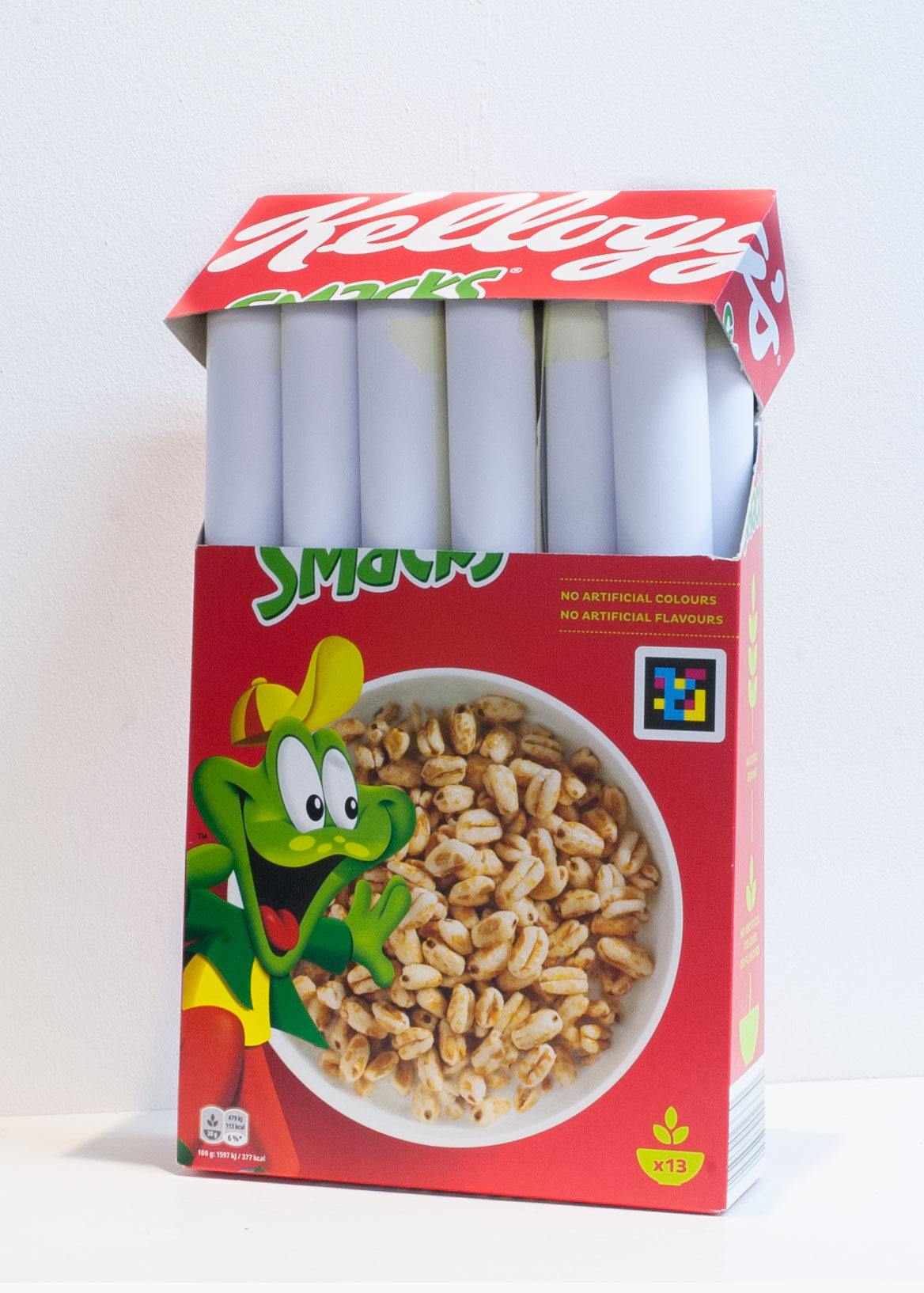
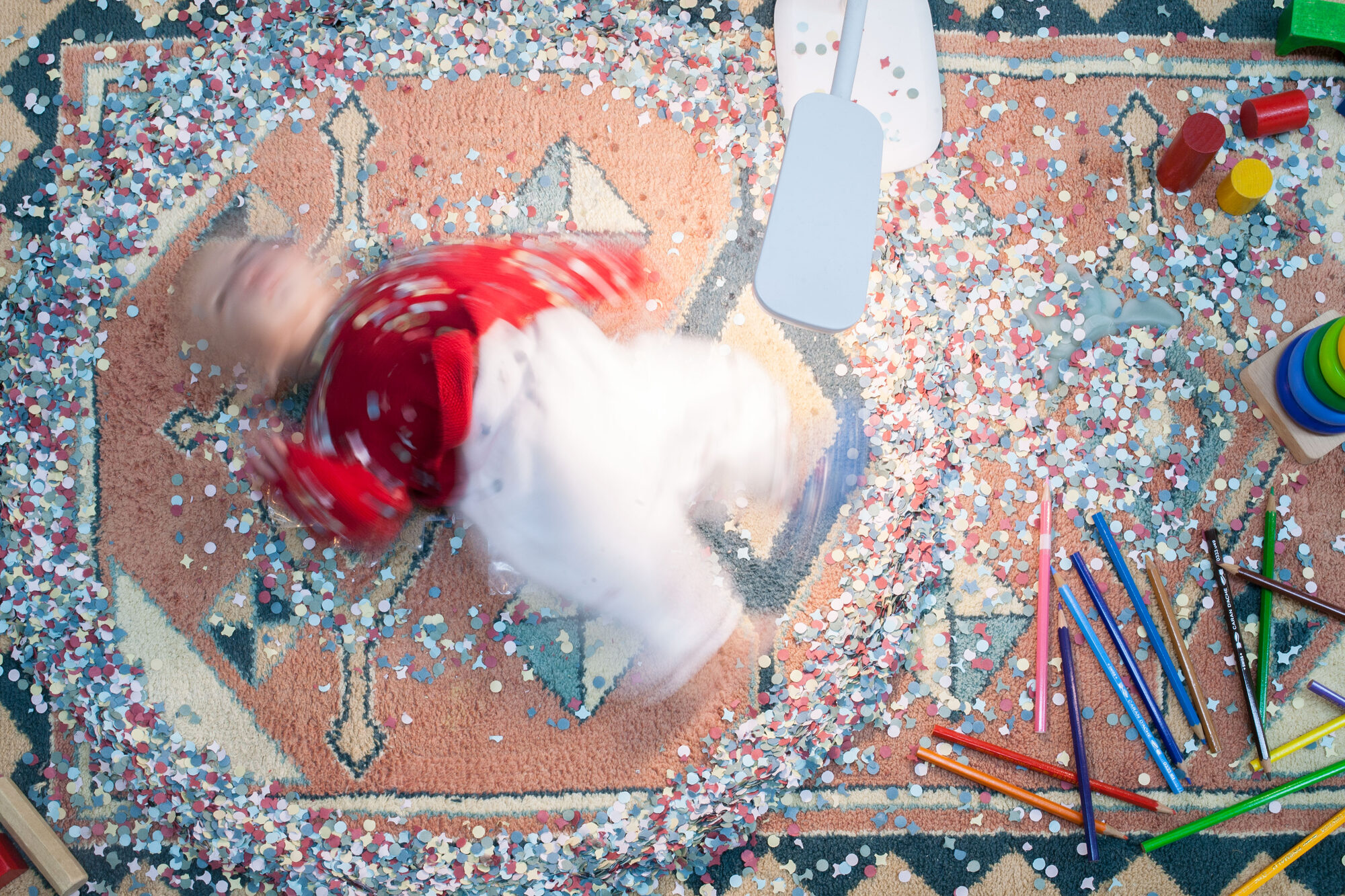
Javier me cuenta sobre ser invitado a una fiesta. La "fiesta" es su colega y una pareja con una botella de whisky cada uno, un poco de helado de piña y otras sustancias. La conversación fluye bien. Después de un par de horas maravillosas, el colega sugiere educadamente que todos tengan un cuarteto. La oferta queda en el aire mientras Javier va al baño y escucha lo que piensa que son gritos alucinatorios de un bebé. Investigando llega a una habitación por el pasillo, allí encuentra a la hija de su colega dibujando tranquilamente en las sabanas, y a su hermana menor con la cara garabateada. En el suelo hay platos pegados con tape que contienen diferentes comidas; cereales, arroz, fideos y una botellas de leche con agua esparcidas por toda la habitación. Visto desde arriba, es como una jaula de hámster muy bonita.
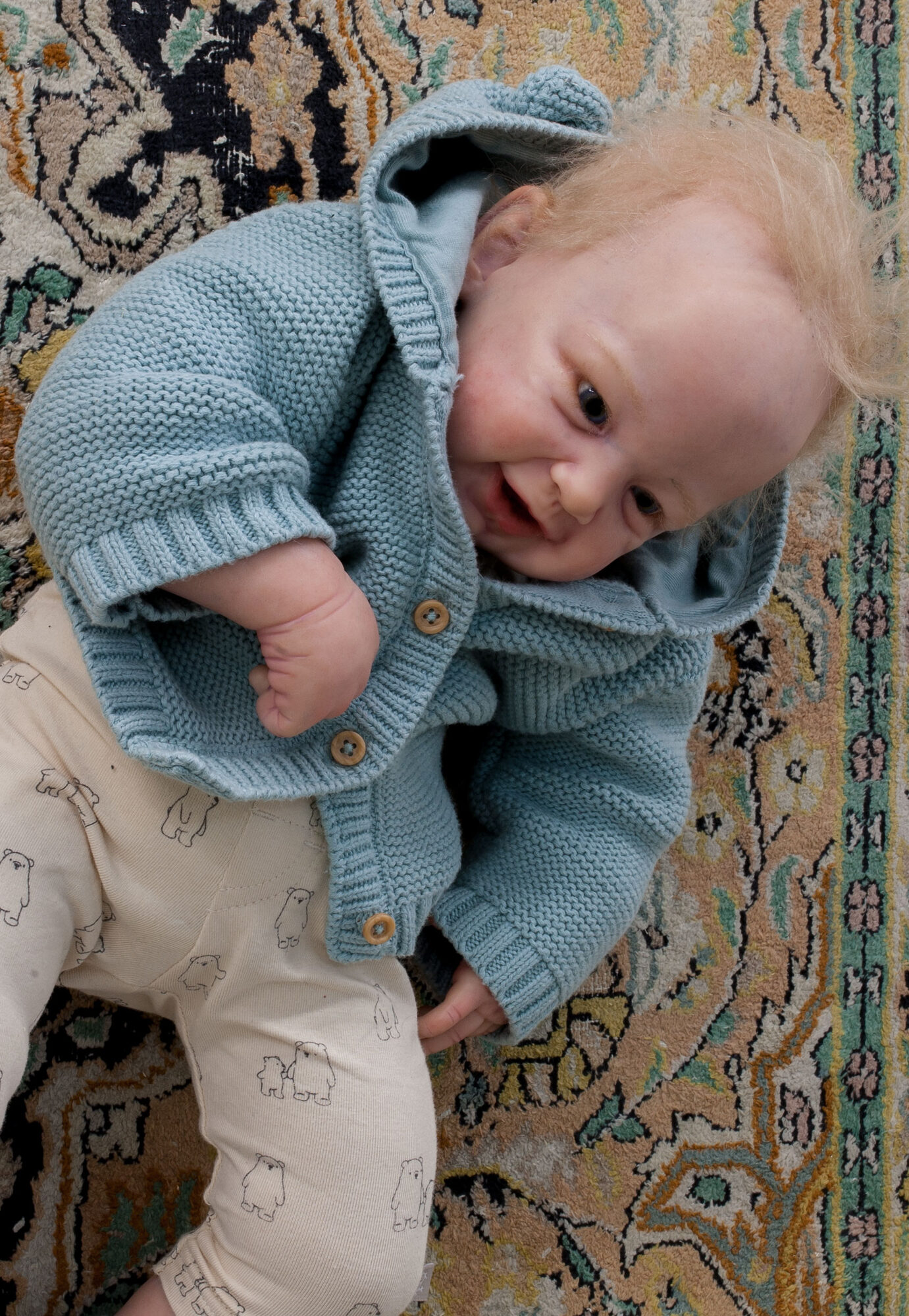
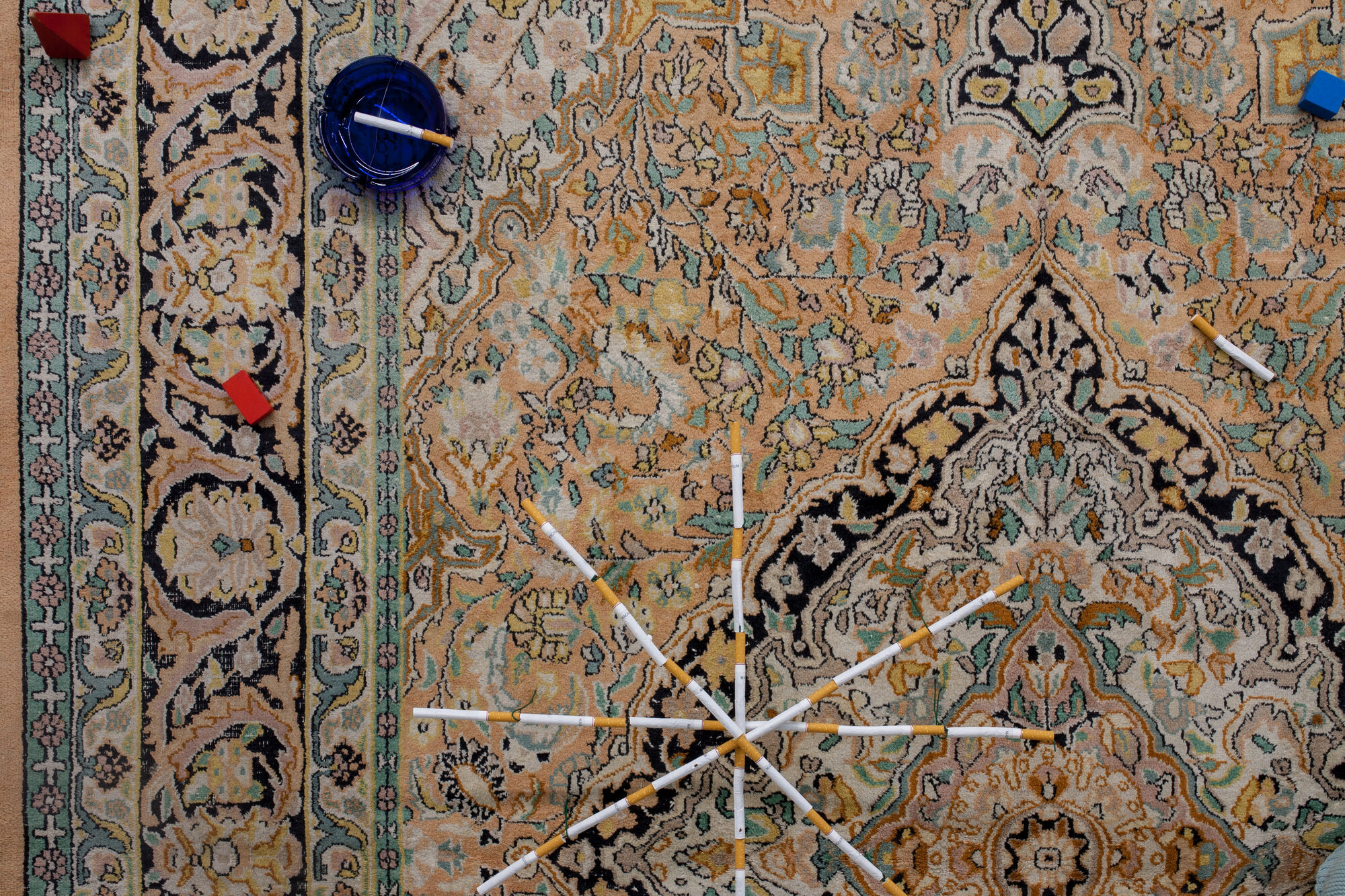
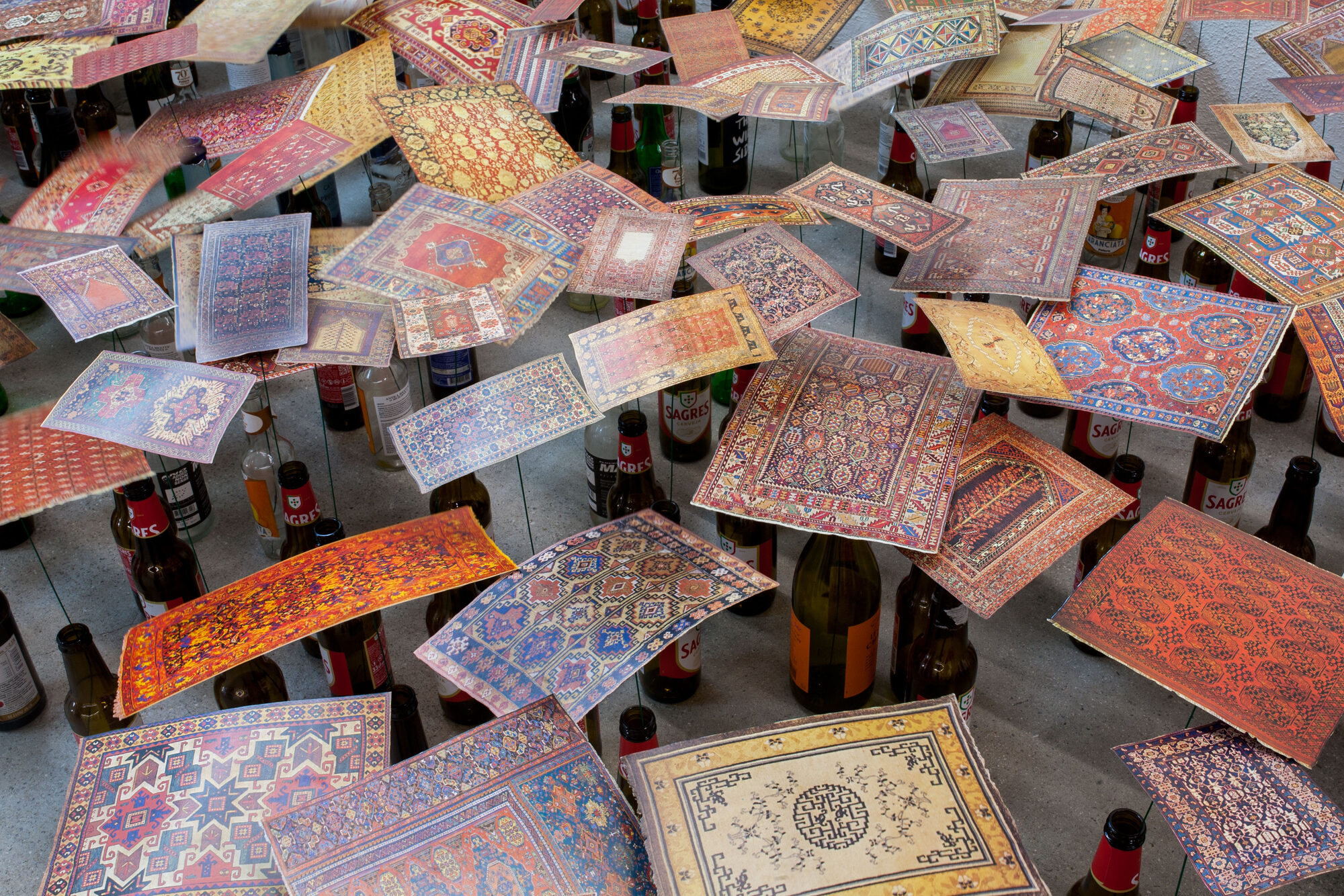
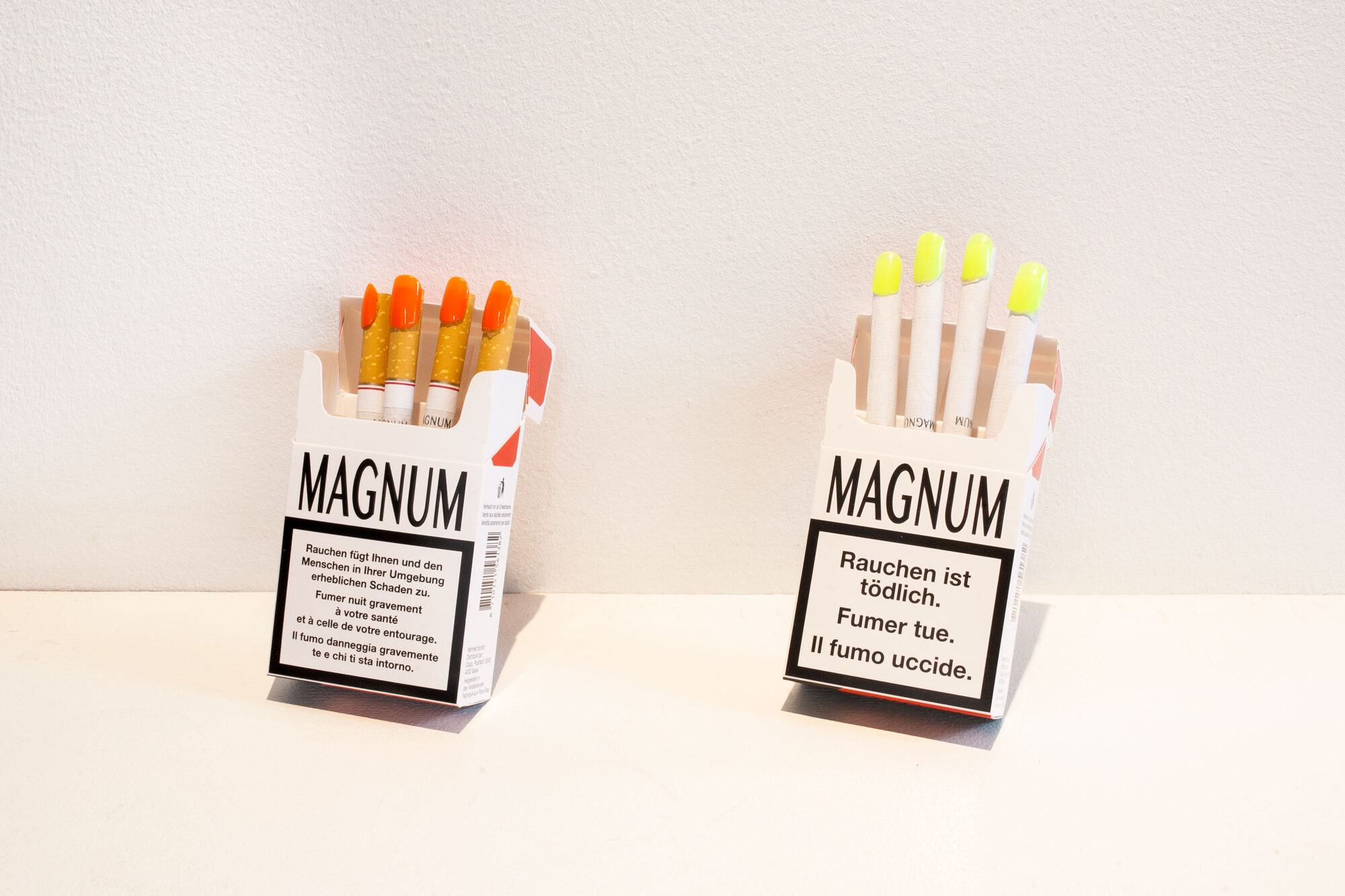
Este evento es la base para "¿Por qué construir si destruir es más rápido?" en Amore, Basel. La vista desde arriba ya no son los olvidados techos de Santiago, sino un paisaje doméstico de alfombras. En cierto sentido, "en el techo" y "debajo de la alfombra" son lugares muy similares, pero lo que se descarta y se olvida en el techo, está oculto y es para siempre vergonzoso debajo de la alfombra. El título se toma del "Emilio, o de la educación" de Jean-Jacques Rousseau, un tratado filosófico sobre educación y la naturaleza del hombre, donde destruir y construir se dice que tienen el mismo valor para un infante. Se dice que eligen destruir porque es inmediatamente satisfactorio. Una satisfacción que Rousseau argumenta no existe en la construcción, porque el valor de crear es moral. El bebé que fuma no se preocupa por su salud. Sin embargo, el artista creador sí se preocupa por el bebé que fuma. En el caso de Javier, esta preocupación parece ser un tema en sí mismo. ¿Qué se puede decir desde la distancia? ¿Cuál es el uso de moralizar cuando la realidad claramente no obliga? ¿Cuál es el uso de crear si no se está moralizando?
Charles Benjamin
Between January and March of this year, Javier González Pesce participated in an artist residency in Switzerland with the support of Pro Helvetia and its program for South American artists. Javier spent one month in Geneva at the Embassy of Foreign Artists residency and then another two months at Villa Numa in La Chaux-de-Fonds. His research focused on the reflections and investigative methods of 17th-century scientists, particularly Charles Bonnet. At that time, when instruments for observing the environment (such as microscopes) were still very primitive, scientists were required to adopt a creative, almost poetic approach. Through the reproduction of some field experiments in the Jura region and extensive reading of scientific treatises and correspondence among scientists (especially Lazzaro Spallanzani), the research turned out to be more extensive than anticipated. The artist is currently engaged in a phase of the project that involves connecting the Jura region (Switzerland, France) with the mountain range of the same name on the Moon’s surface.
Within this context (that of his residency in Switzerland), Javier held two exhibitions. One at Villa Numa and the other at the Amore space in the city of Basel. In the latter, the invitation arose from a professional connection, affinity, and friendship with the artists Manuela Flores Délano (Chile) and Charles Benjamin (Sweden), who work collectively on a project—sometimes as an artistic collective, other times as a curatorial team—under the name Mario Kreuzberg. It is this duo, then, who curated the exhibition “Why to Build If to Destroy Is Faster?” Below is the text written by Charles Benjamin.
“Why to build if to destroy is faster”
Amore x Mario Kreuzberg
March 14, 2025
Basel
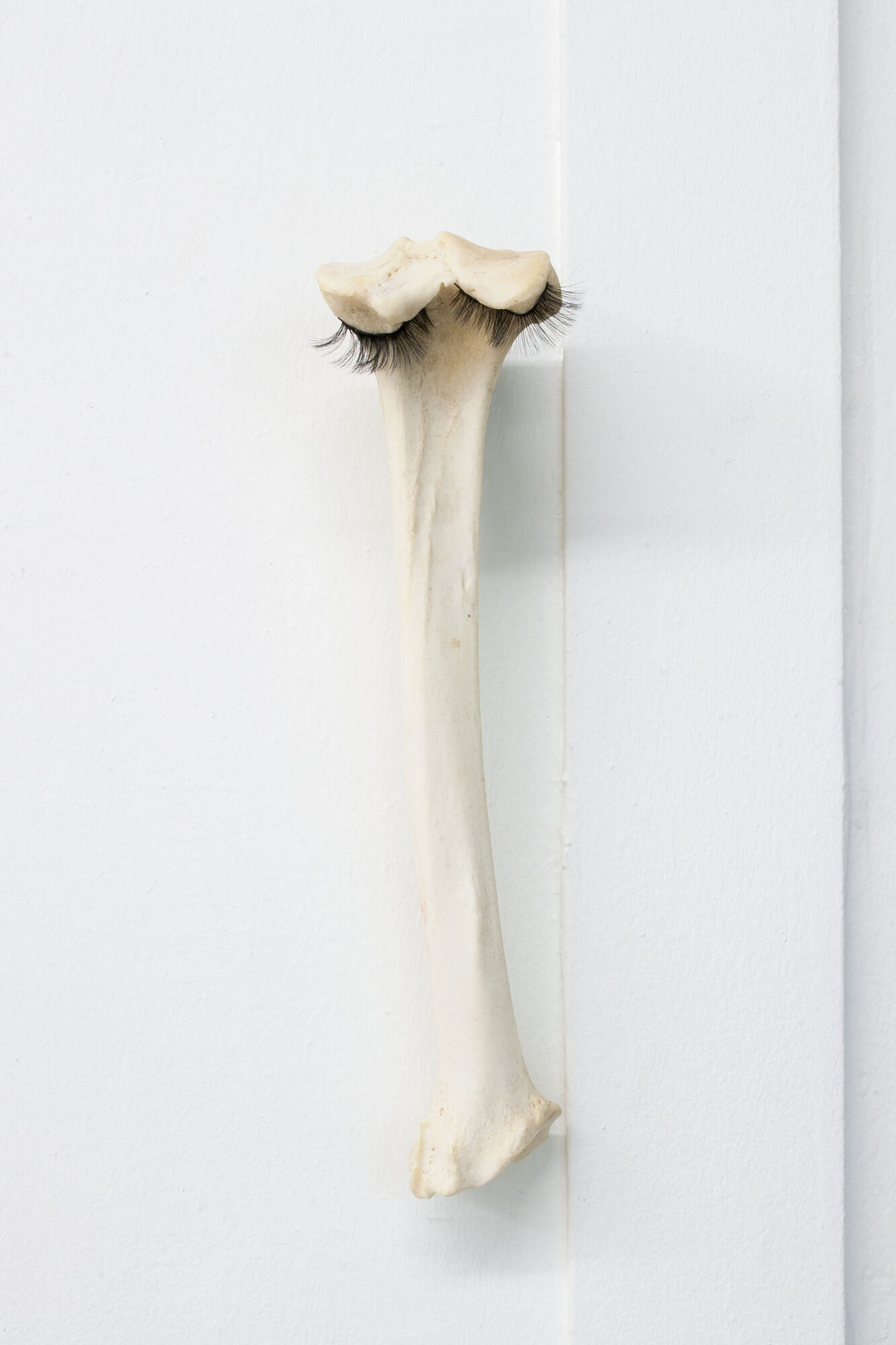
As in most cities, when viewed from above, the streets of Santiago are like cracks of activity in a desert of rooftops. For a long time, Javier has been collecting found objects from them—things that the rooftops have transformed into “ex-things.” Balls, toys, tiles, magazines, bones, clothing, pipes, electronic devices, and plastic bags that speak from a distant vantage point. In a way, they are readymades, but they are also reminders of how readymades are meant to make us feel: like a bottle of champagne on the Titanic, or a flag on the moon, or a body on Everest. A certain distance is required for this shift in perspective, which is generally achieved in our little art world by isolating almost anything within a white cube. The beauty of Javier’s objects is that they have already been stripped of their lives as everyday objects before entering our little art world. The objects seem to confront this with a certain ambivalence, fluctuating between melancholy and chaos. It is as if this invisible transformation, which is supposed to serve our perspective, also sows doubt in our senses. Javier sets a huge, solitary ear adrift in a boat against a misty horizon (Lost Ear, 2017) and plants a large nose in the center of the Gabriela Mistral Gallery (Lost Nose, 2017).
In 2019, he made a moon float around a small island in China, saying it speaks to the attractive relationship between the moon and the earth (Attractive System 1, 2019). At Espacio TeleArte, Javier displays enormous eyes that gaze at downtown Santiago with a paranoid stare, and objects found on rooftops in one half of the space, which are then reproduced as holograms in the other half. “Telstar,” the exhibition’s title, is taken from the Adidas Telstar—an iconic soccer ball lost on rooftops around the world, named after the 1962 Telstar communications satellite. To me, all these objects speak of an imposed distance, where perspective becomes clouded rather than proportionate.
Javier tells me about being invited to a party. The “party” consists of his colleague and a couple, each with a bottle of whiskey, some pineapple ice cream, and other substances. The conversation flows smoothly. After a couple of wonderful hours, the colleague politely suggests that everyone have a foursome. The offer hangs in the air as Javier goes to the bathroom and hears what he thinks are the hallucinatory cries of a baby. Investigating, he reaches a room down the hall, where he finds his colleague’s daughter quietly drawing on the sheets, and her younger brother with his face scribbled on. On the floor are plates taped together containing various foods—cereal, rice, noodles, and bottles of milk and water—scattered throughout the room. Seen from above, it looks like a very pretty hamster cage.
This event served as the basis for “Why Build When Destruction Is Faster?” at Amore, Basel. The view from above is no longer the forgotten rooftops of Santiago, but a domestic landscape of rugs. In a certain sense, “on the roof” and “under the rug” are very similar places, but what is discarded and forgotten on the roof is hidden and forever shameful under the rug. The title is taken from Jean-Jacques Rousseau’s EEmile, or On Education”, a philosophical treatise on education and human nature, in which destroying and building are said to hold equal value for an infant. It is said that they choose to destroy because it is immediately satisfying—a satisfaction that Rousseau argues does not exist in building, because the value of creation is moral.
The baby who smokes doesn’t worry about his health. However, the creative artist does worry about the baby who smokes. In Javier’s case, this concern seems to be a theme in and of itself. What can be said from a distance? What is the point of moralizing when reality clearly requires it not? What is the point of creating if one isn’t moralizing?
Charles Benjamin
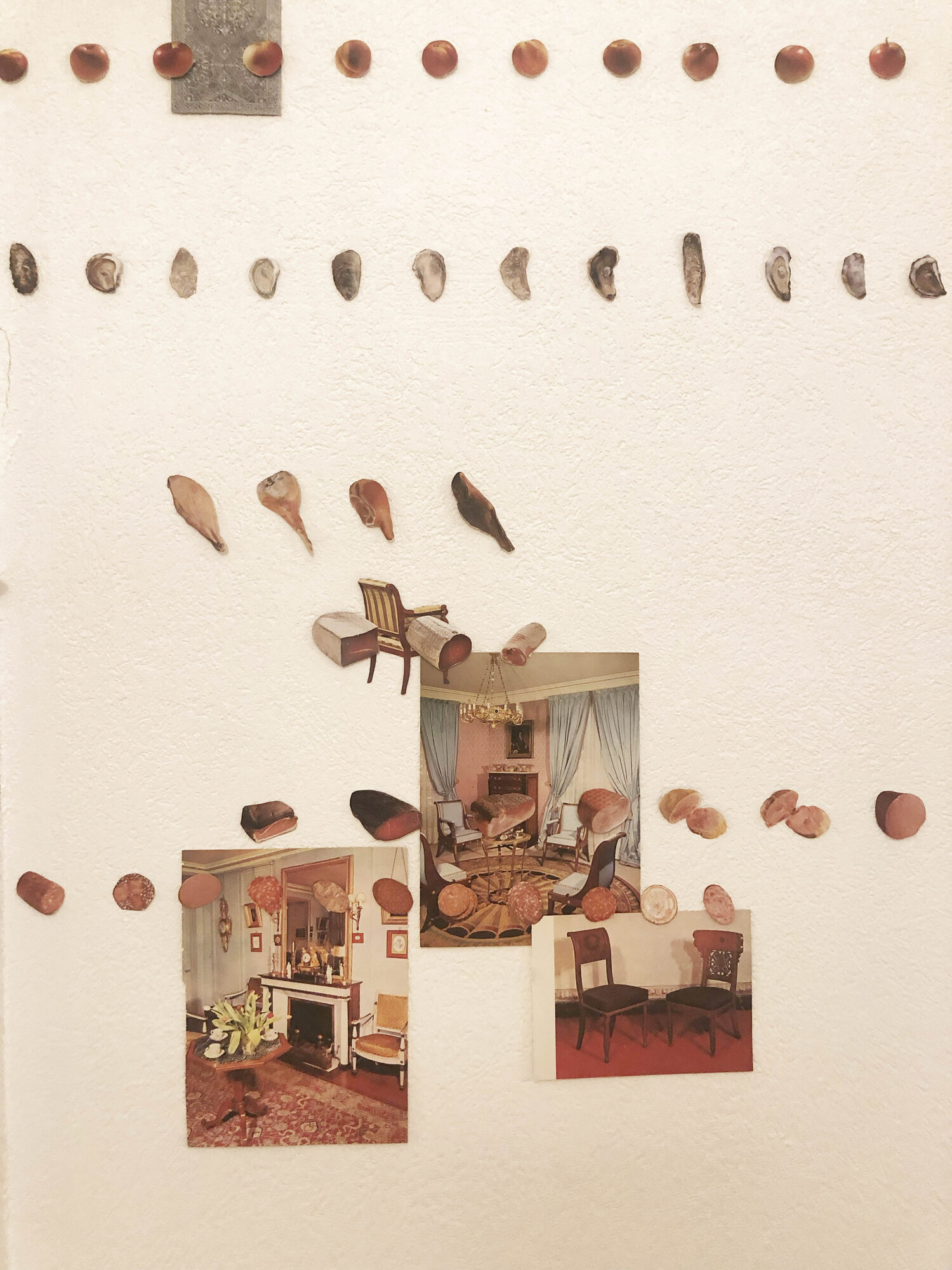
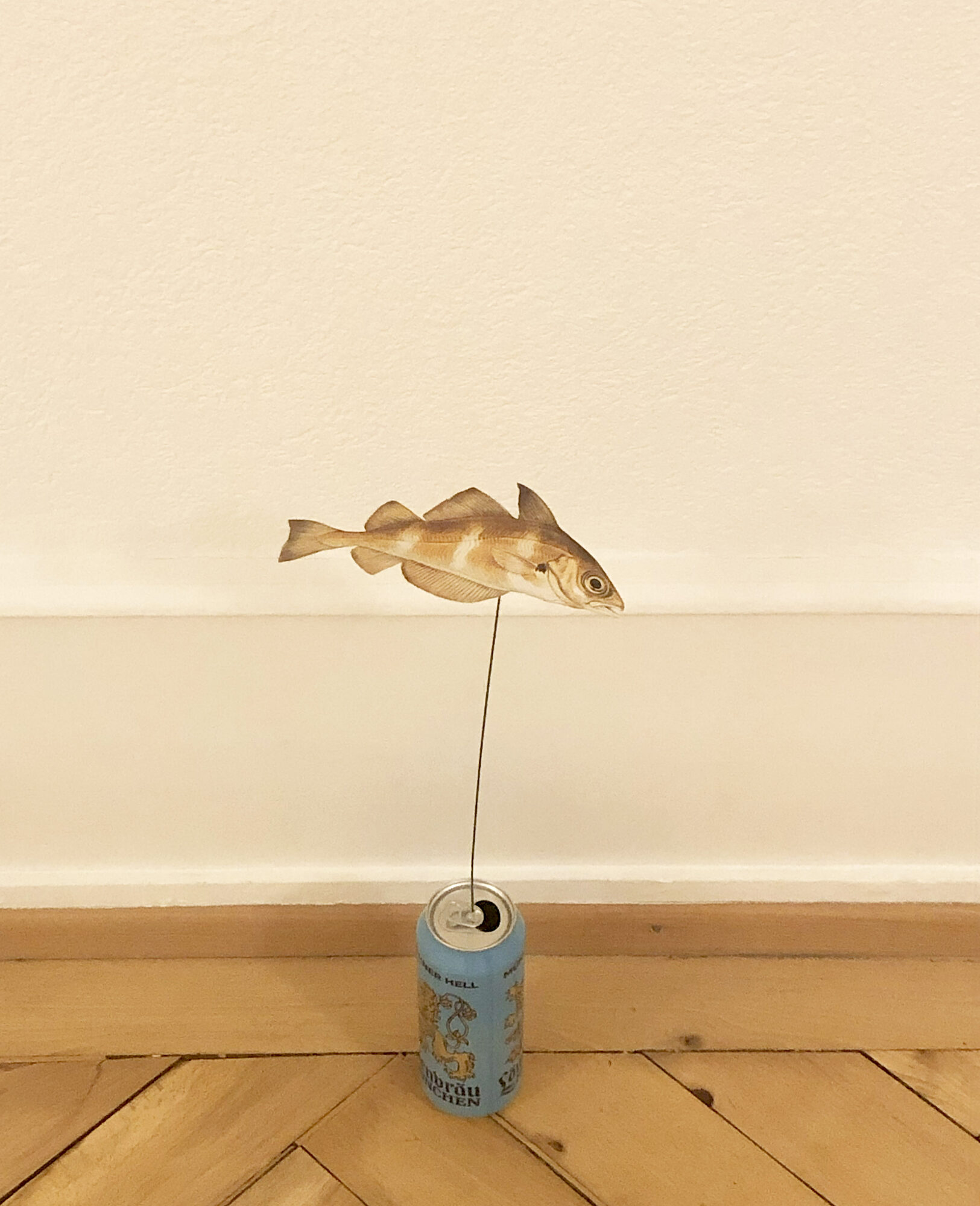
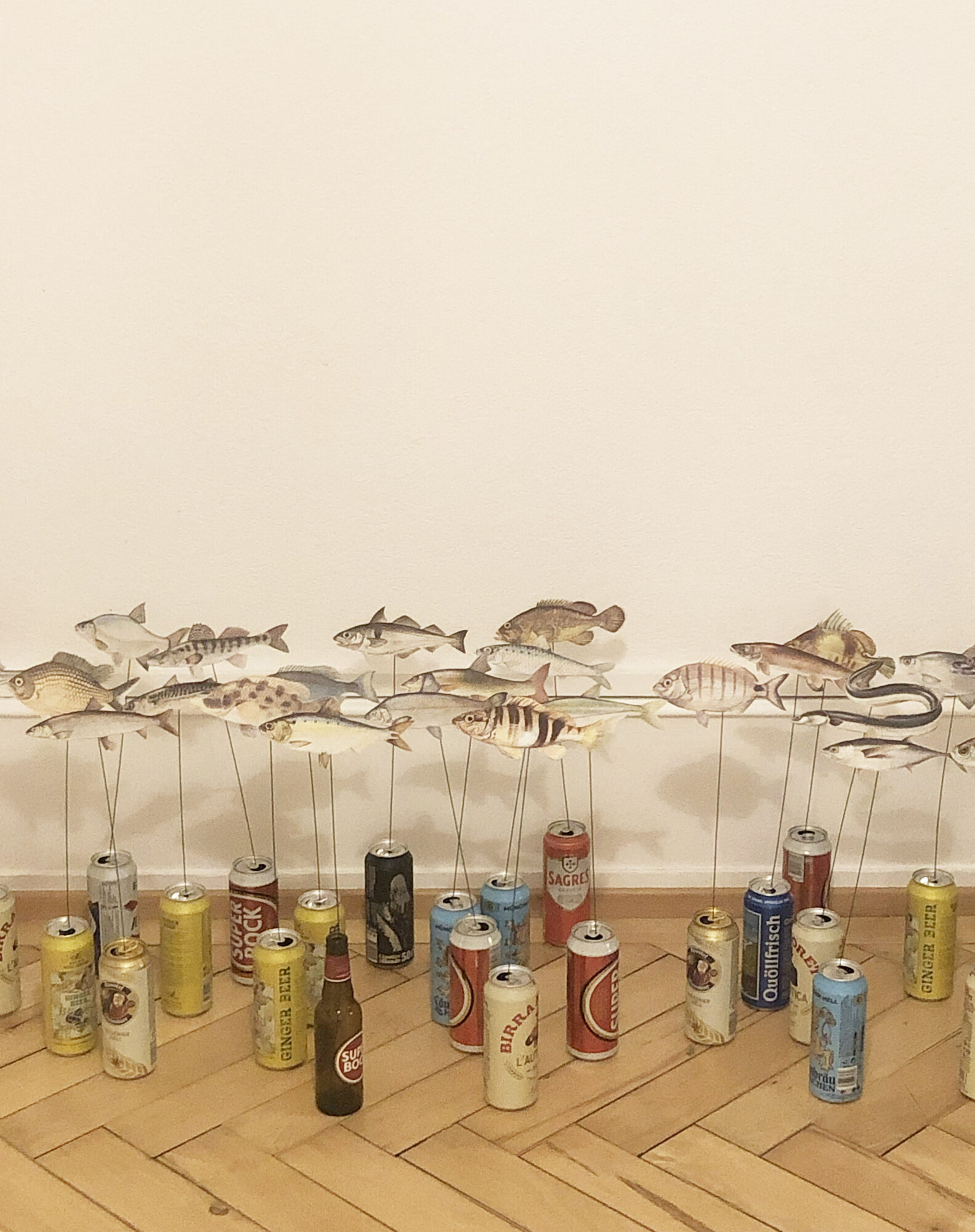
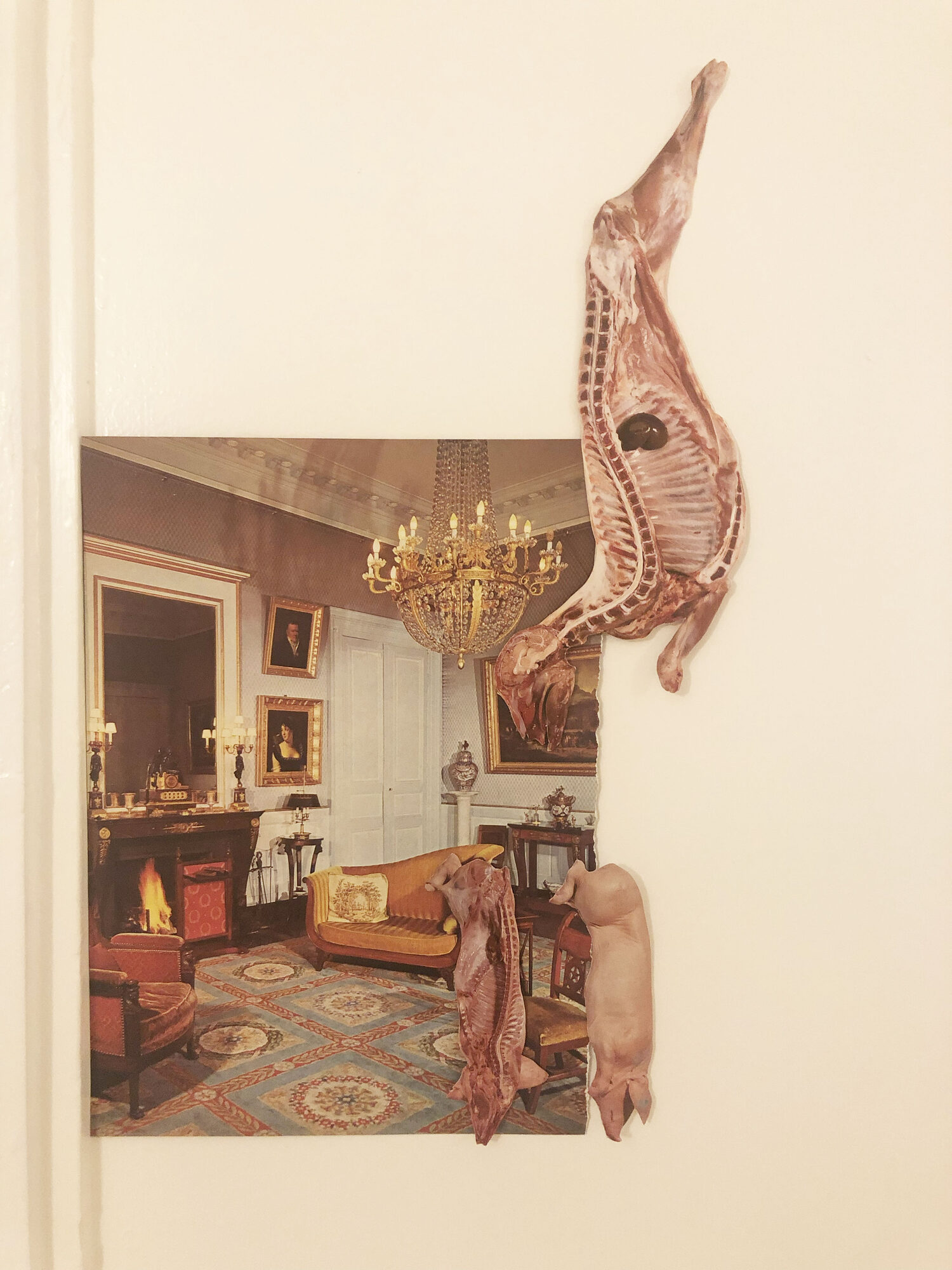
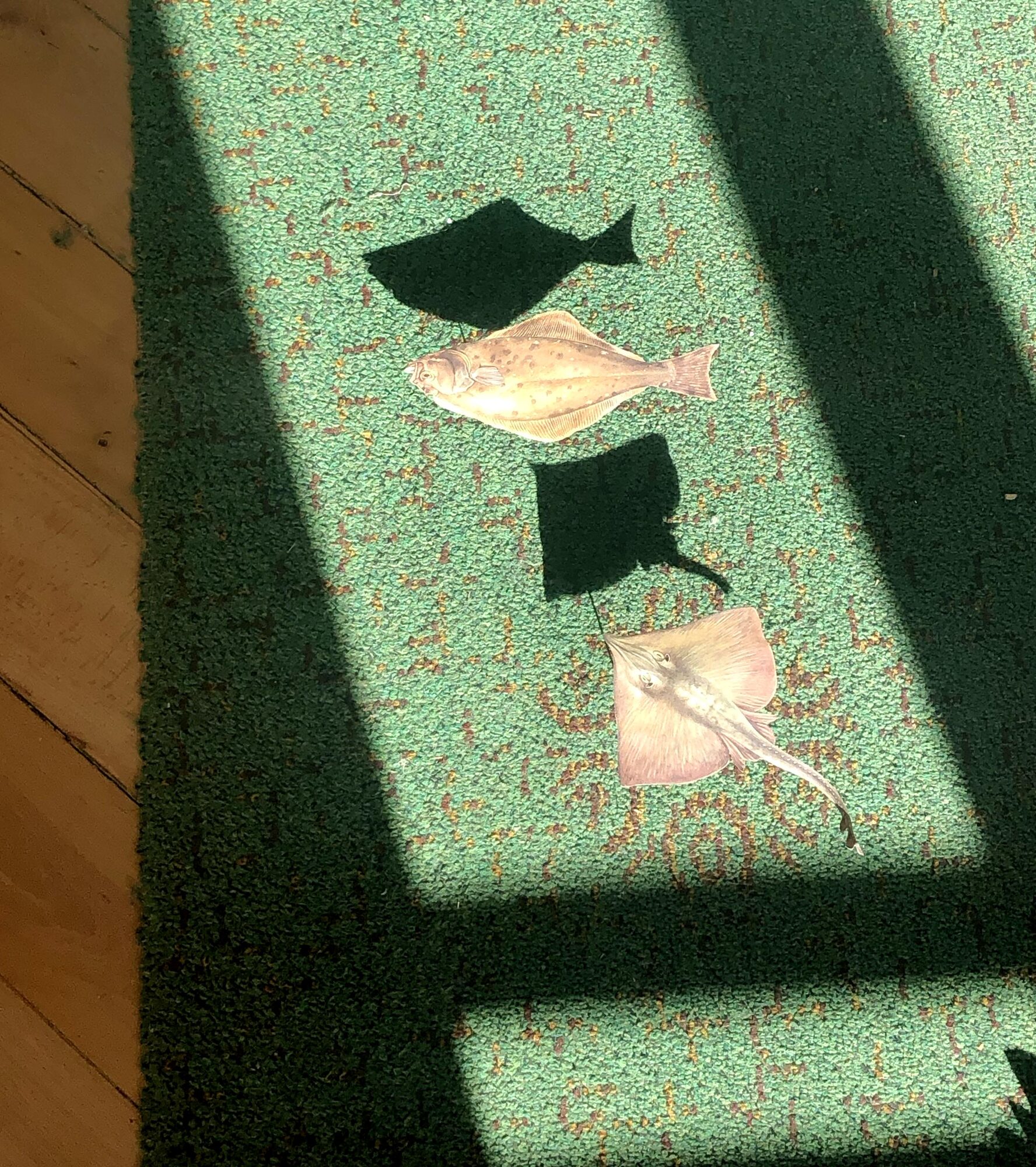
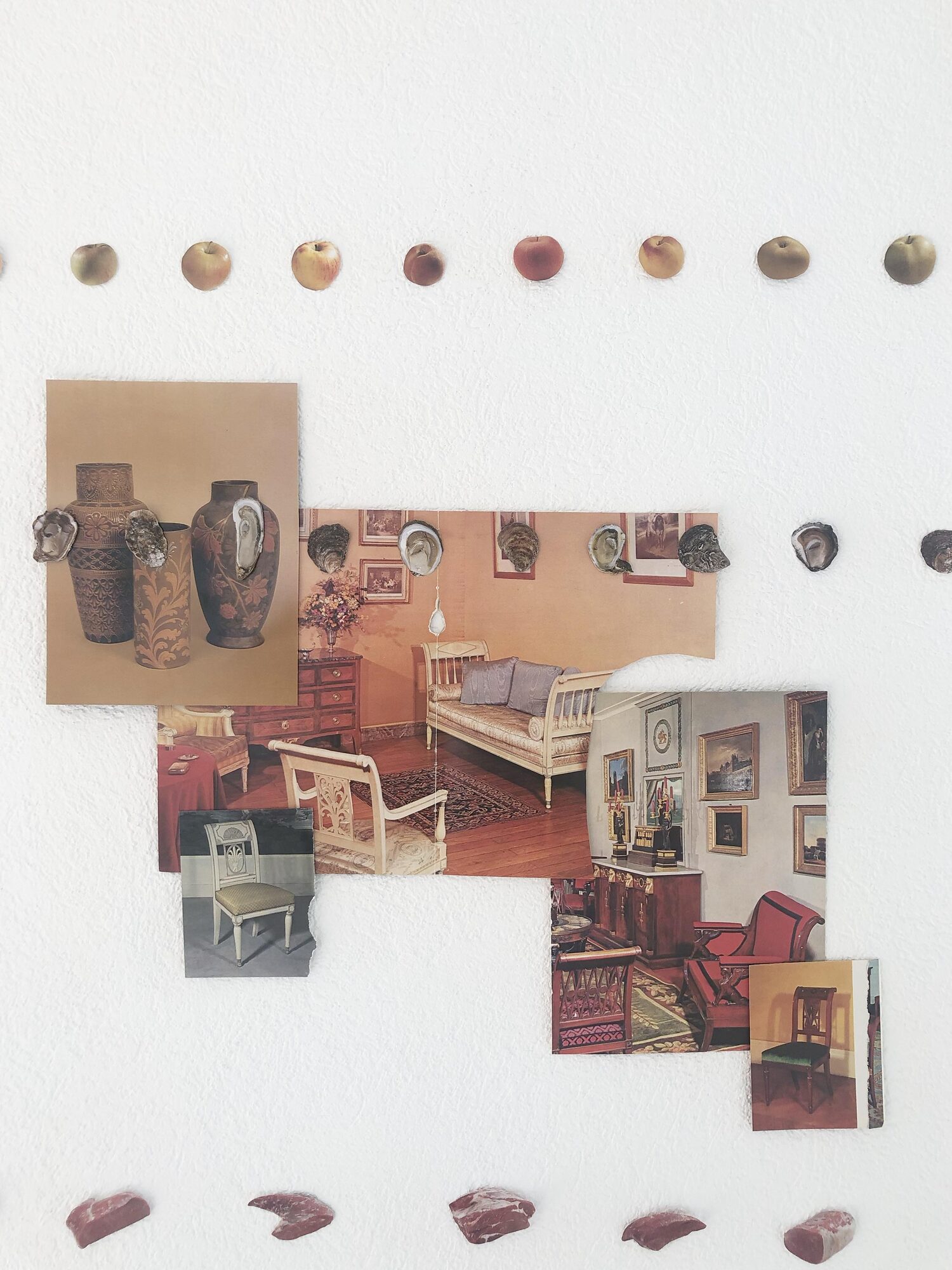
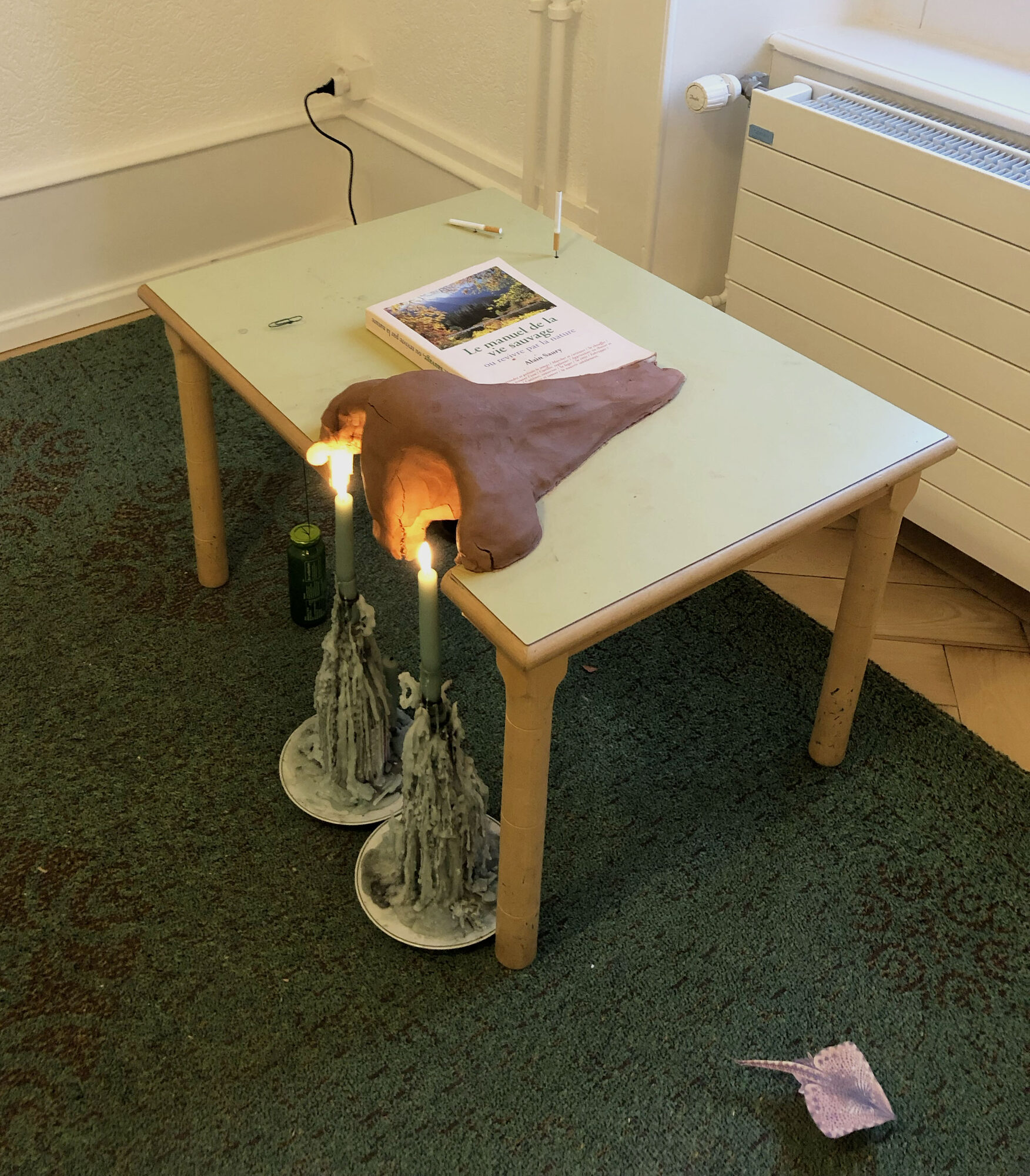
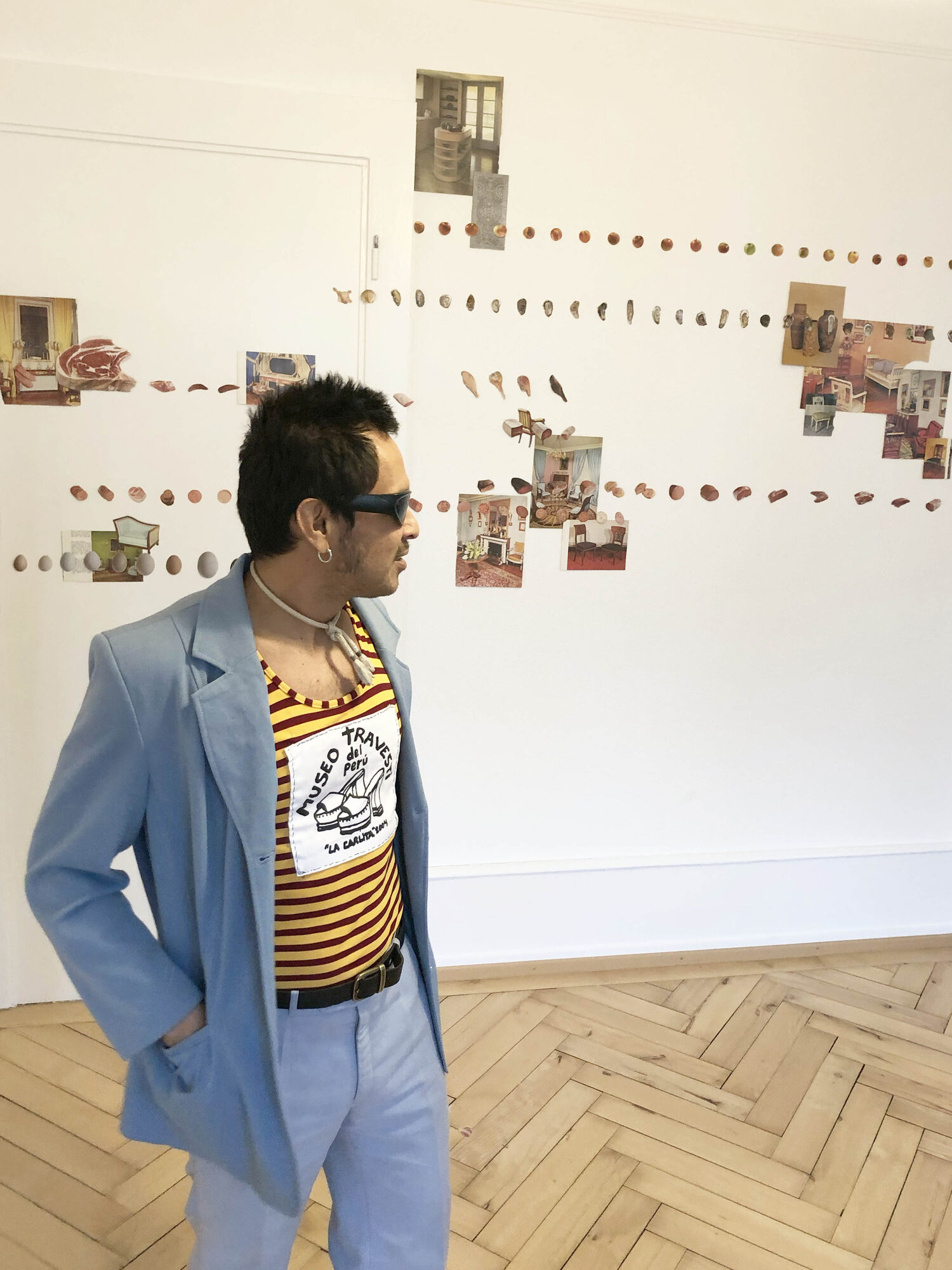
ALGUNAS FORMAS QUE LA NATURALEZA PUEDE ADOPTAR. Villa Numa, La Chaux des Fonds, Suiza, 2025.
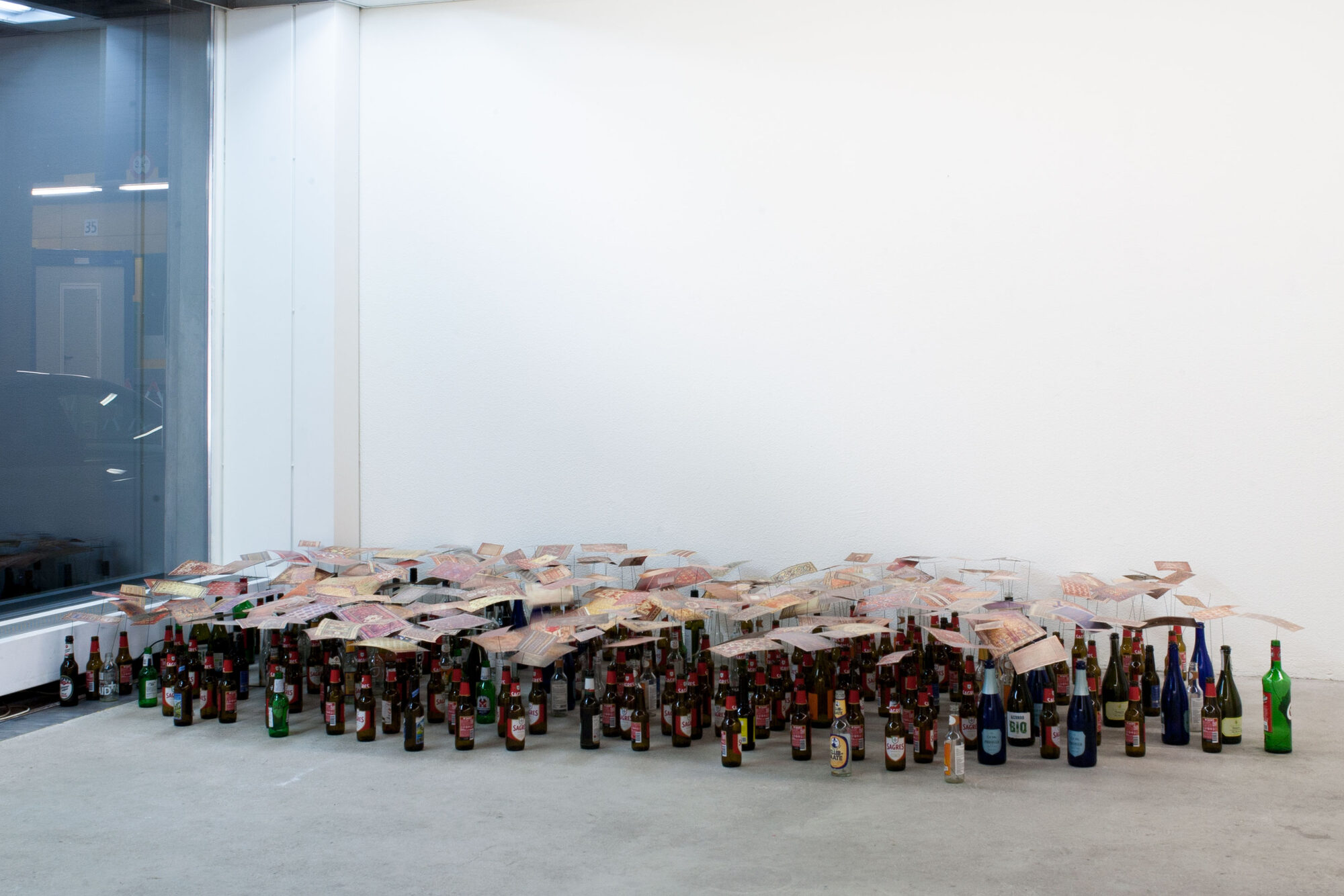
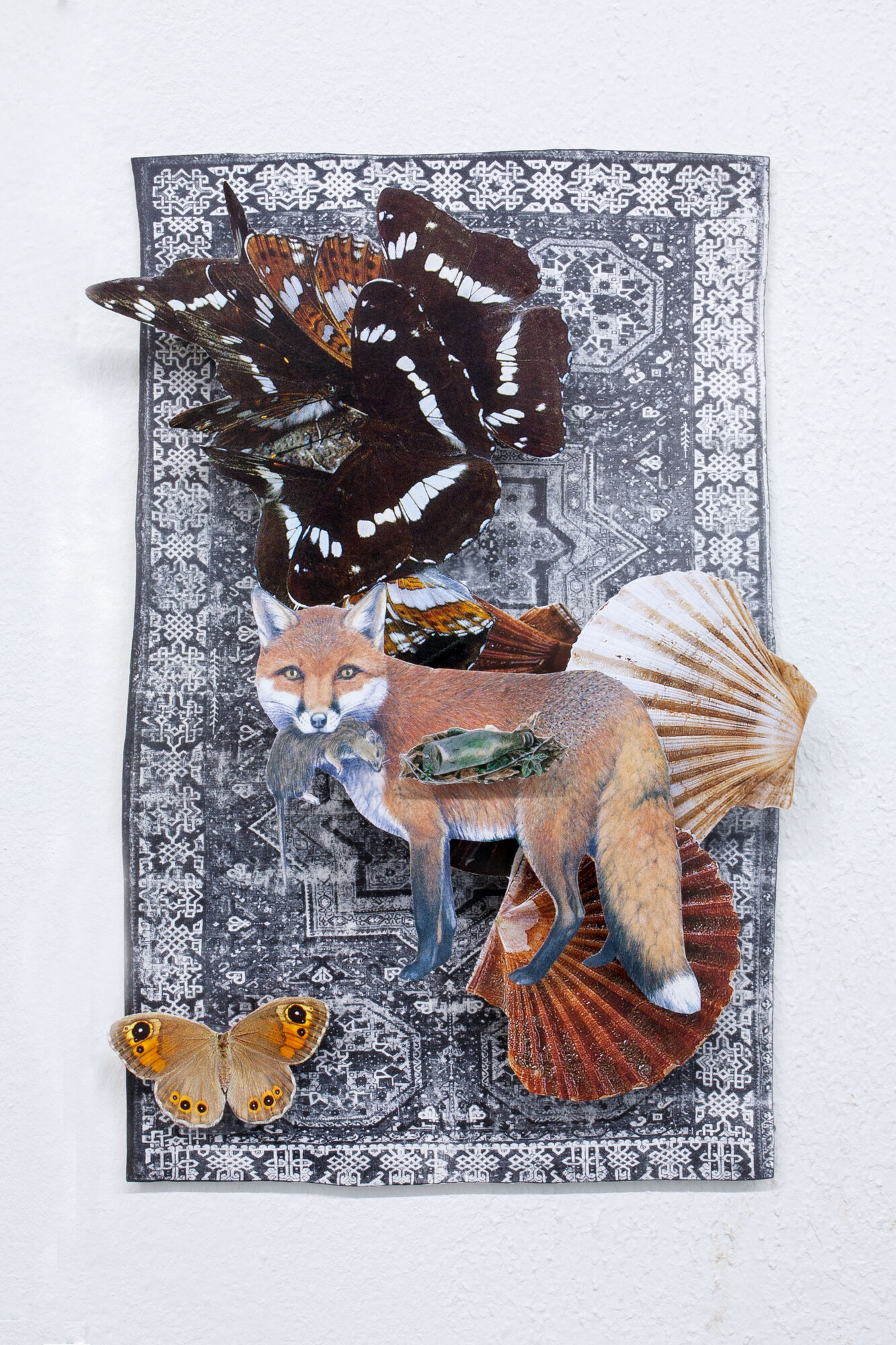
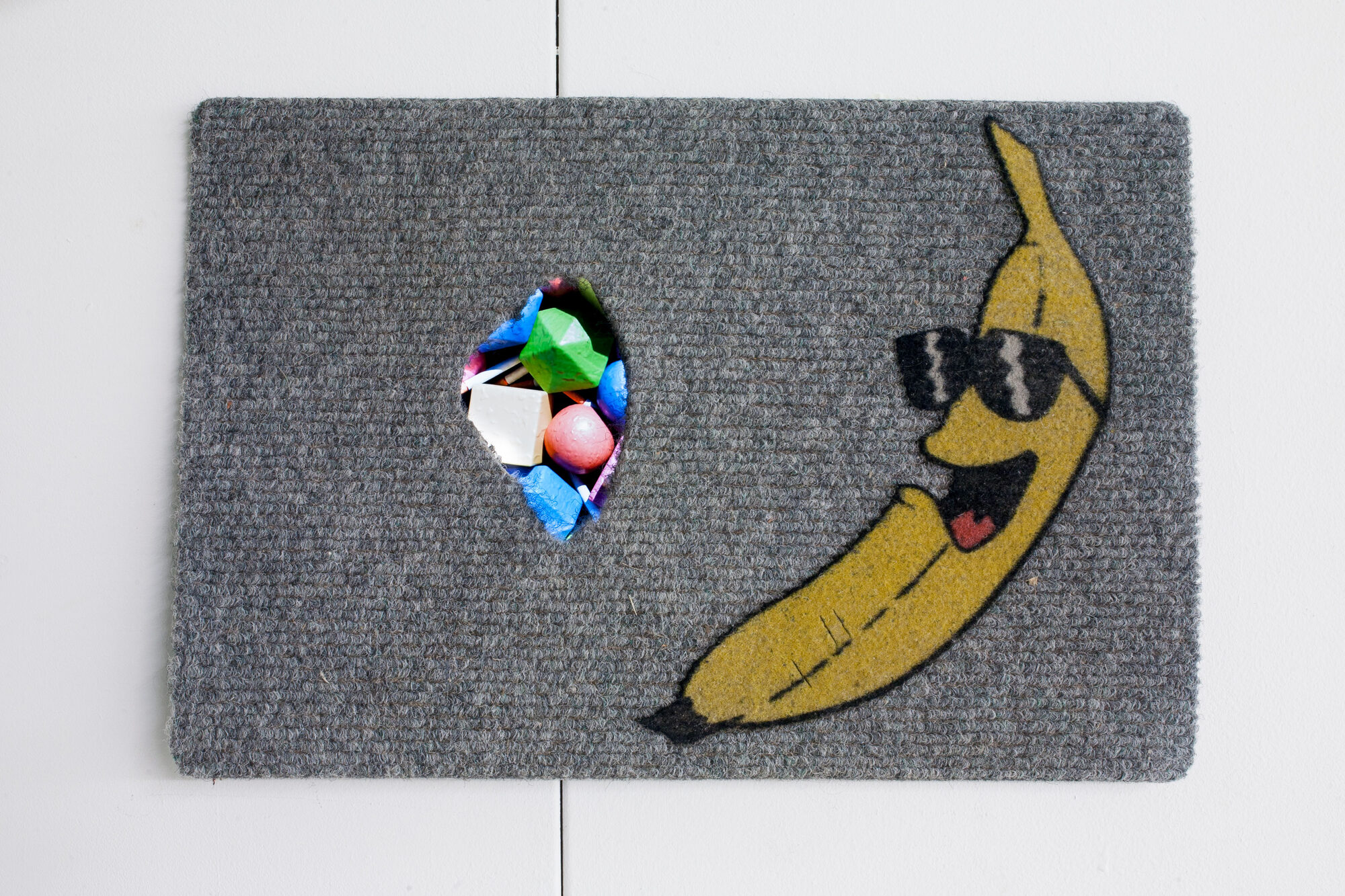
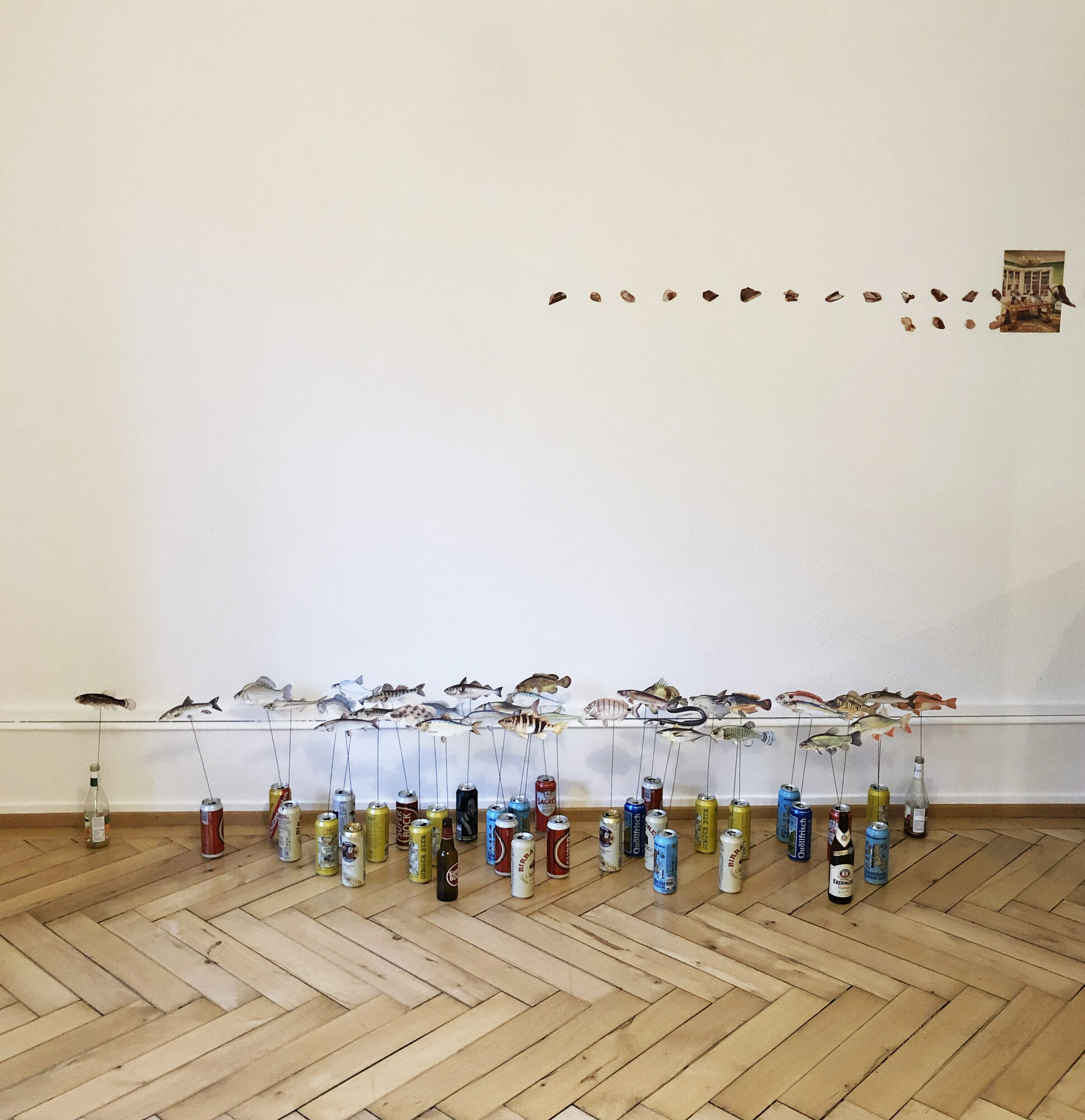
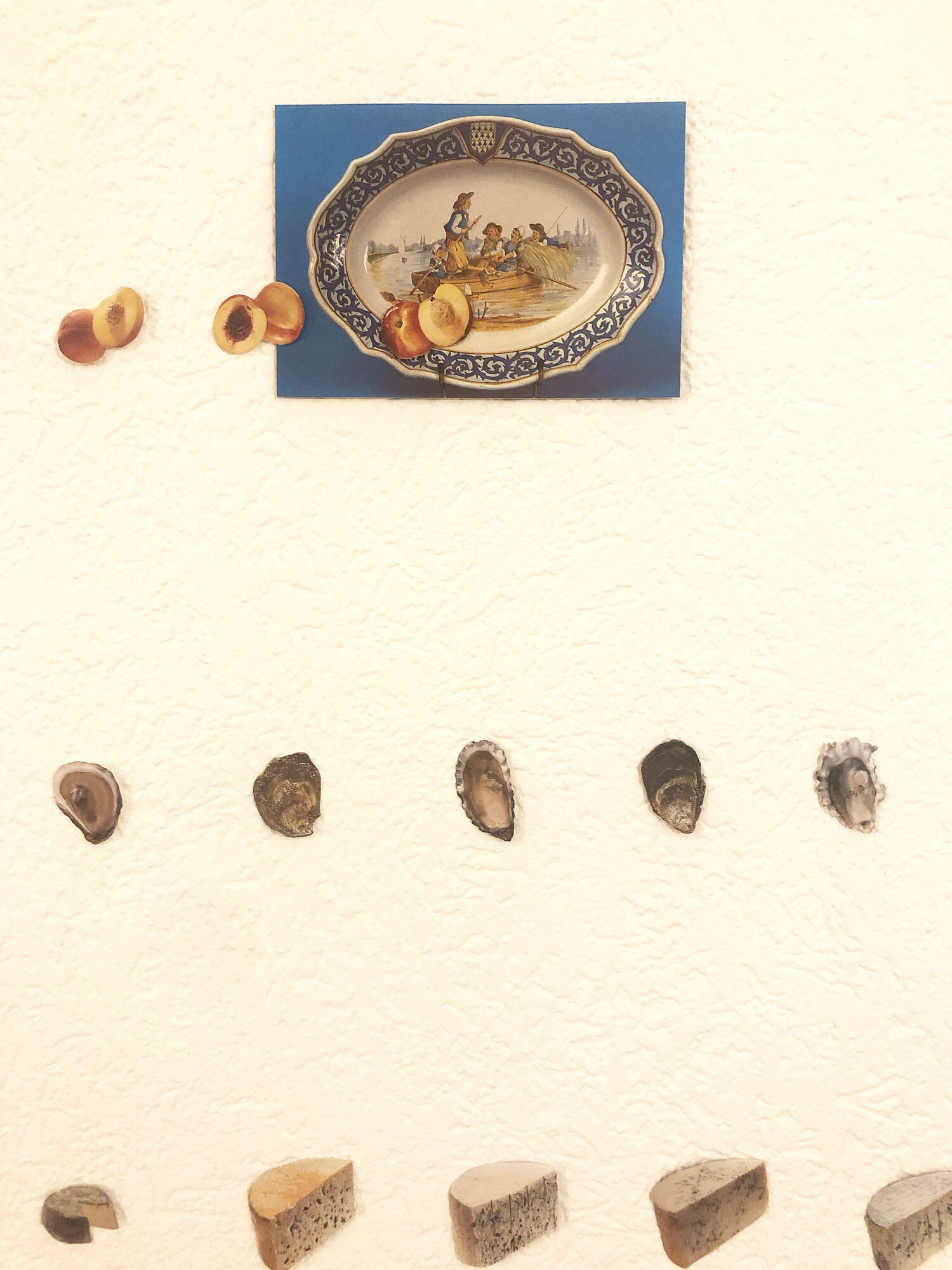
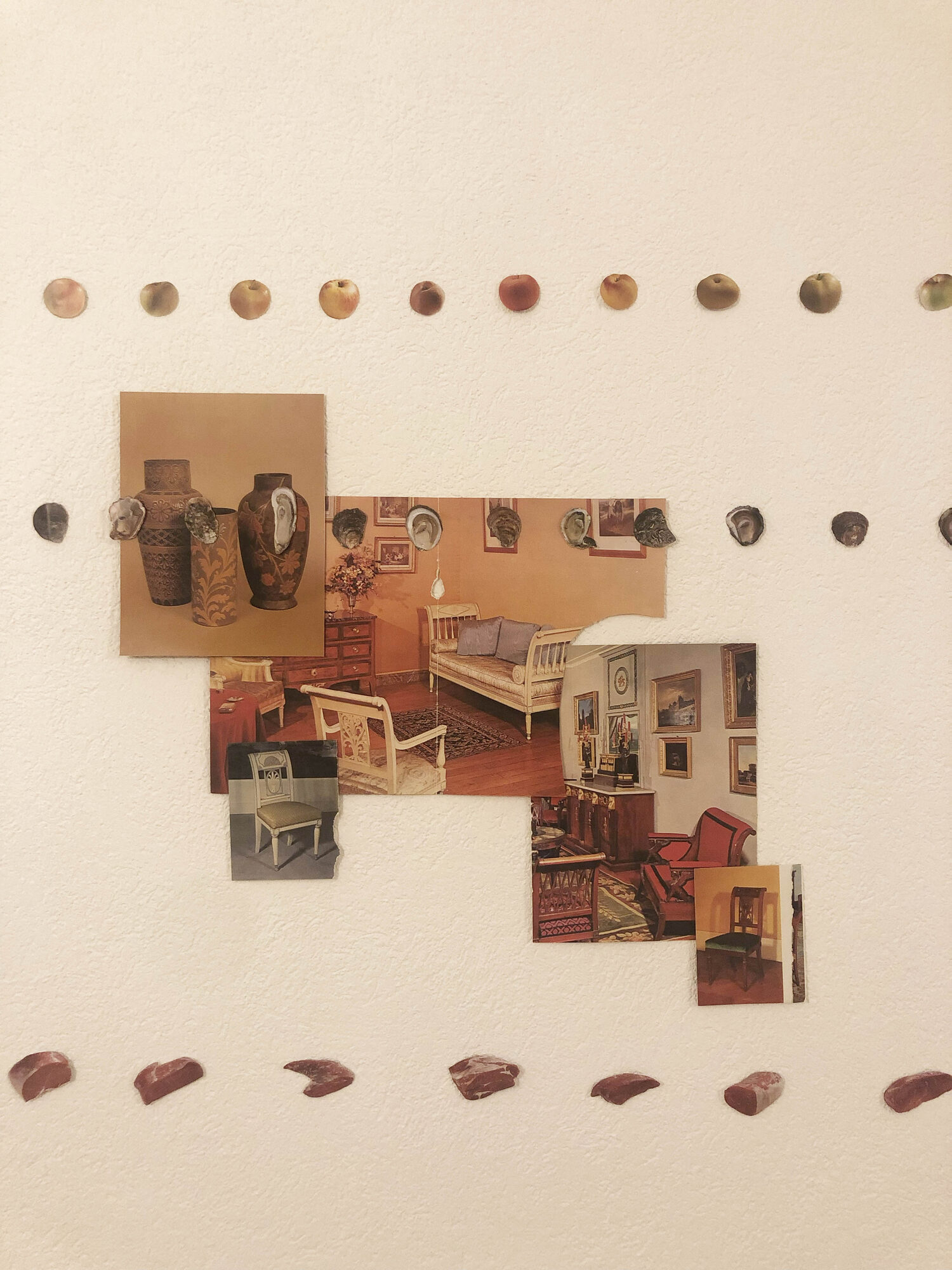
Desde un libro de cocina corté distintas imágenes las que luego organicé por categorías y en líneas que iban desde natural a procesado. Desde un libro de historia del diseño de espacios interiores en Europa corté imágenes de escenas. Instalé estas imágenes en la sala de exhibiciones asumiéndola como el soporte de un collage expandido. Desde libros de animales acuáticos extraje imágenes las que instalé en el espacio pinchadas sobre alfombras o en latas de cerveza. Me propuse generar un collage con las características espaciales de una instalación. Además, intervine una serie de objetos cotidianos, re configurándolos.
SOME FORMS NATURE CAN TAKE. Villa Numa, La Chaux des Fonds, Switzerland, 2025.
From a cookbook, I cut out various images, which I then organized into categories and arranged in a spectrum ranging from natural to processed. From a book on the history of interior design in Europe, I cut out images of scenes. I installed these images in the exhibition hall, treating it as the canvas for an expanded collage. From books about aquatic animals, I extracted images that I installed in the space by pinning them to rugs or beer cans. My aim was to create a collage with the spatial characteristics of an installation. In addition, I intervened in a series of everyday objects, reconfiguring them.
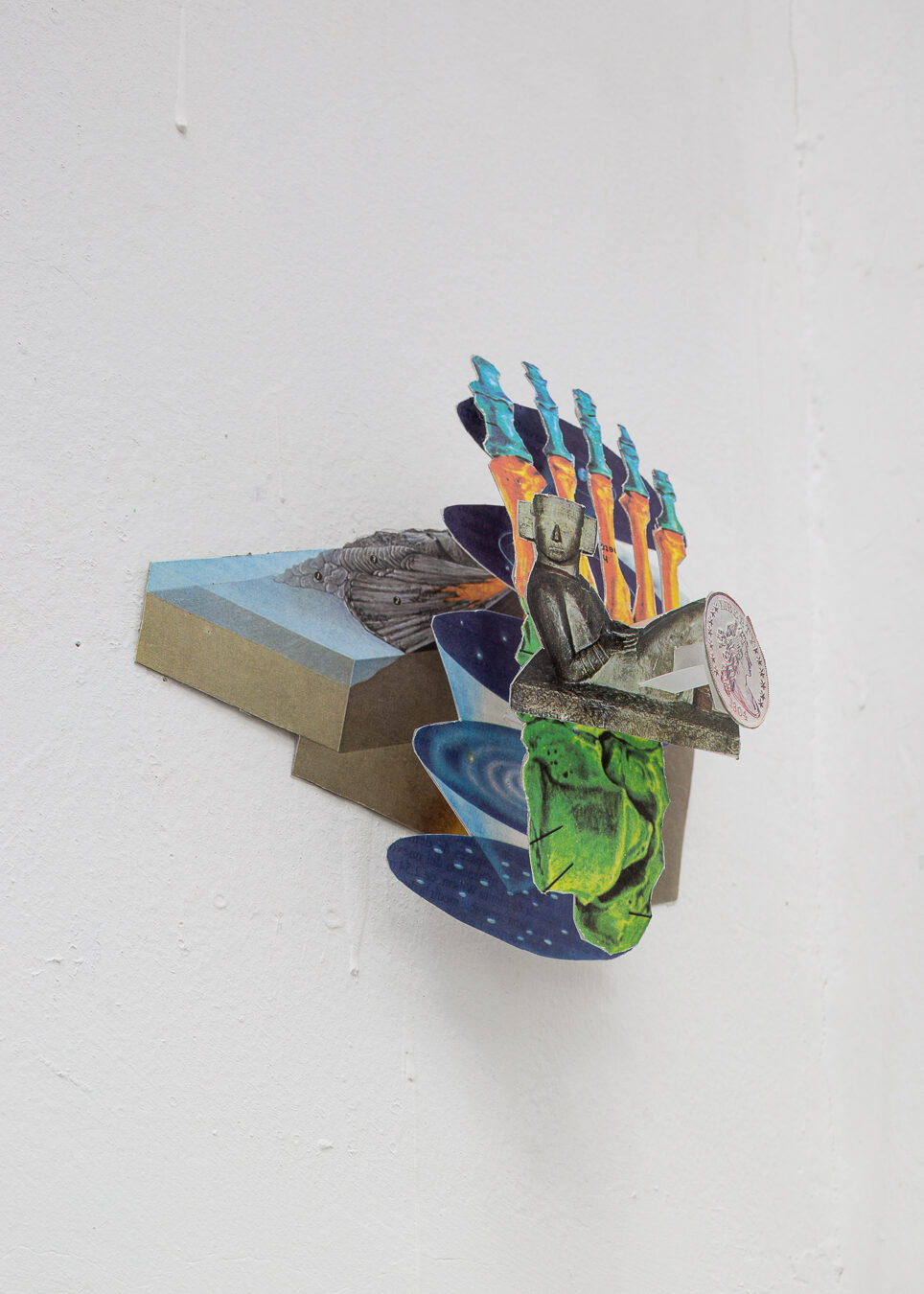
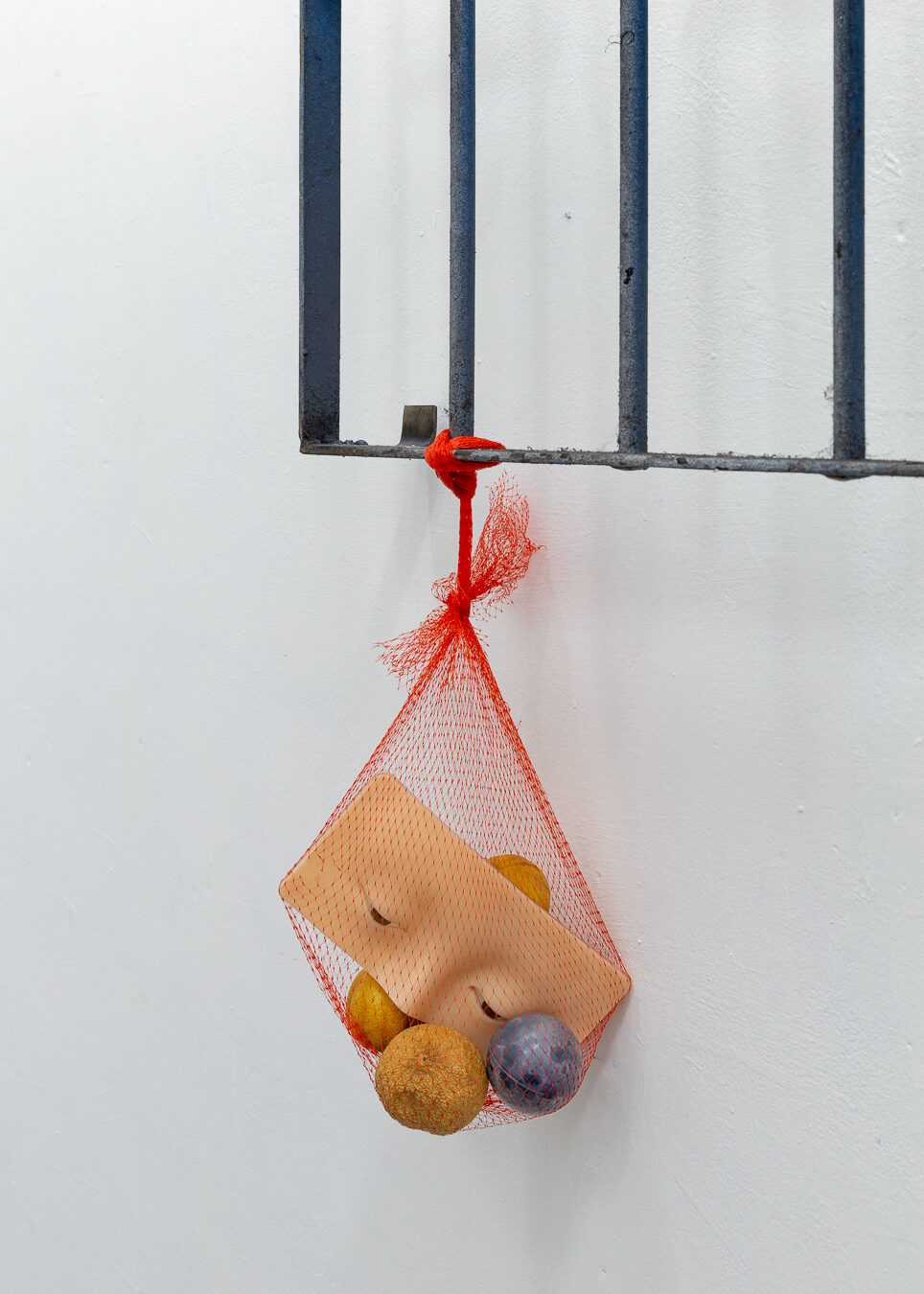
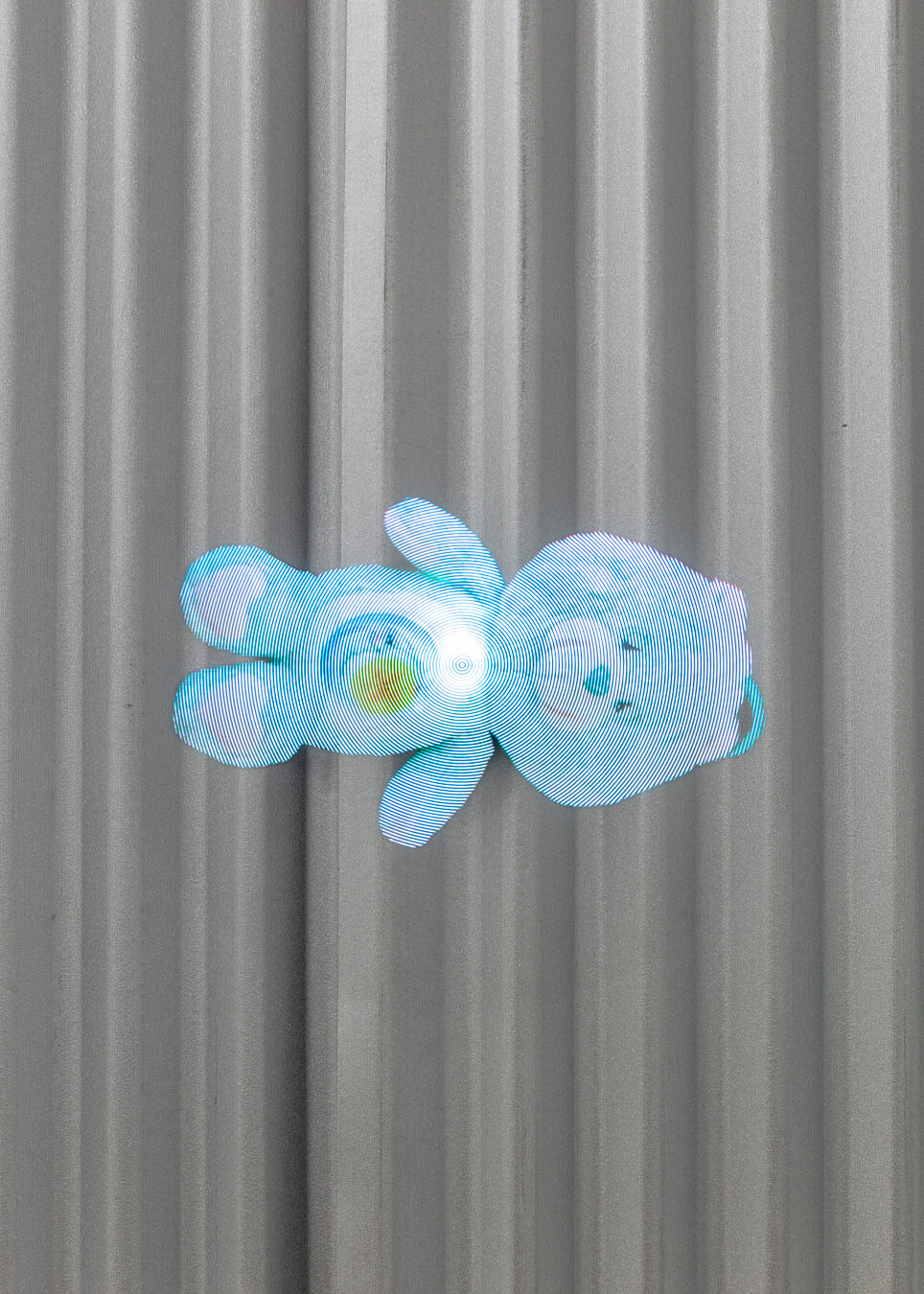
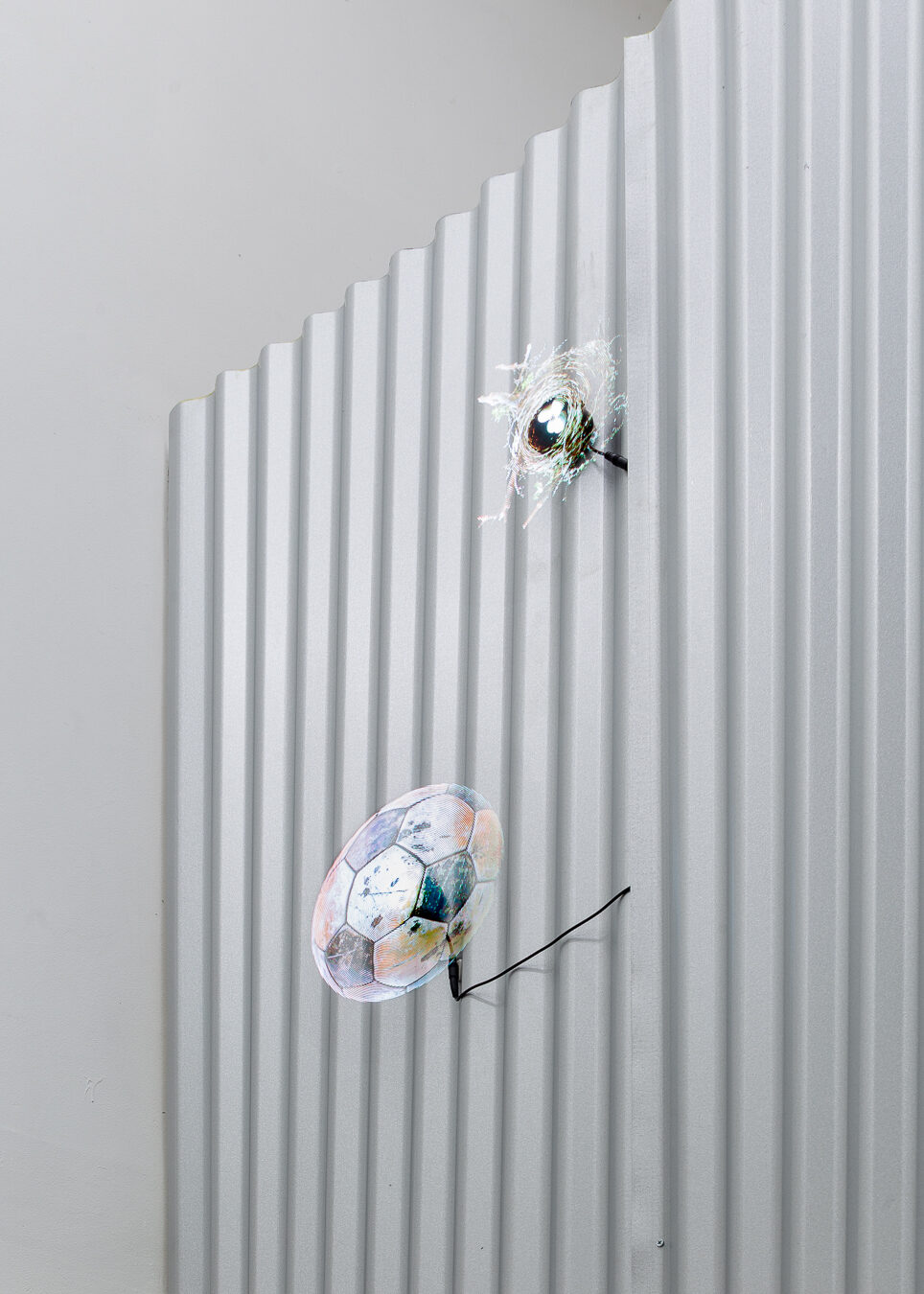
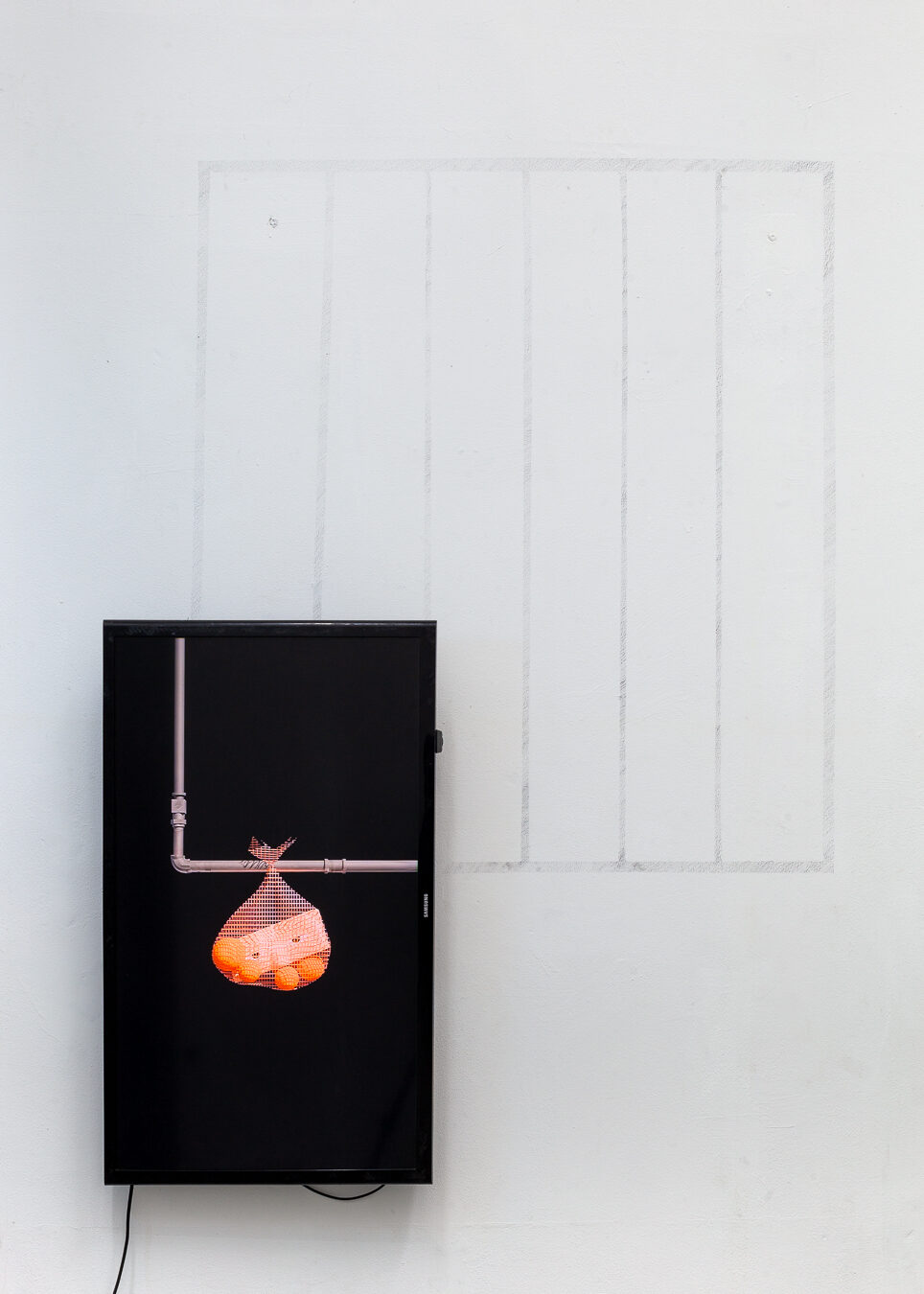
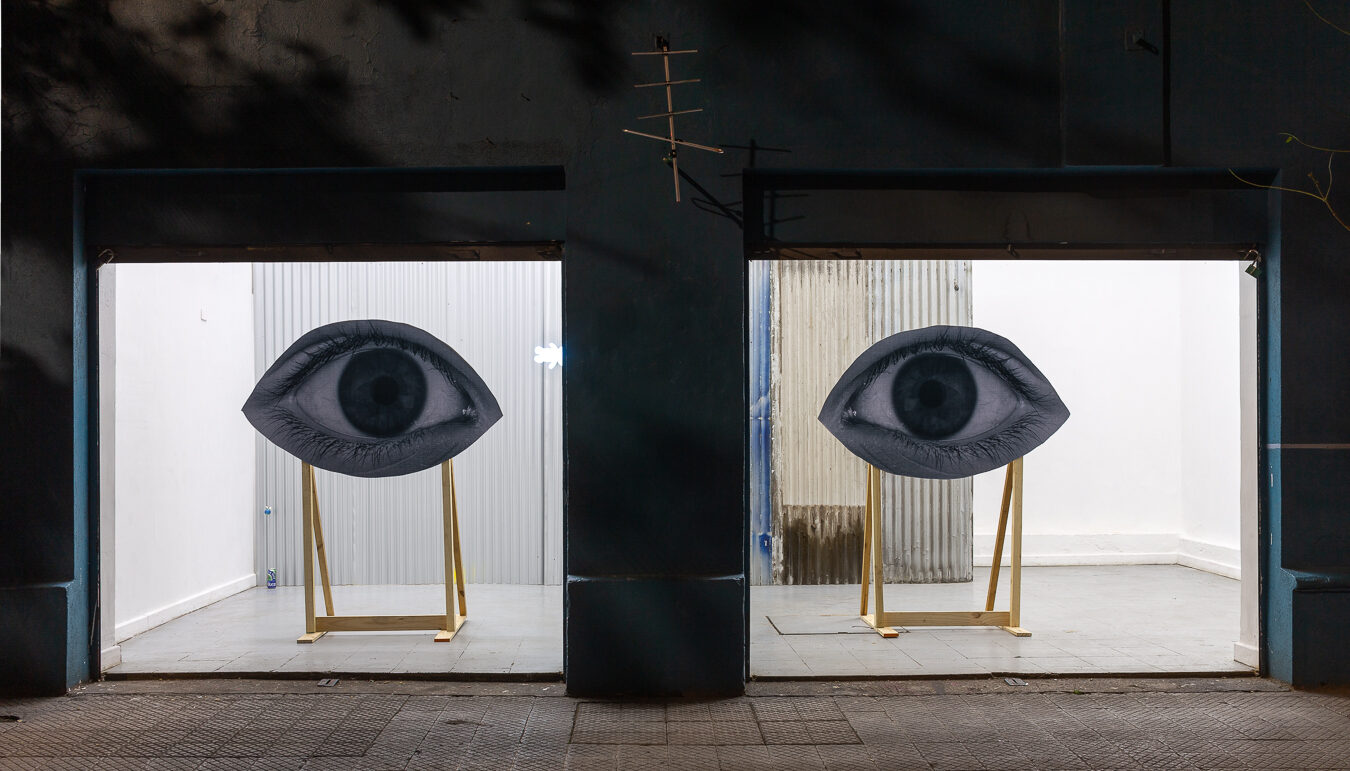
Telstar
Pensamientos en torno a lo quieto y lo que se mueve.
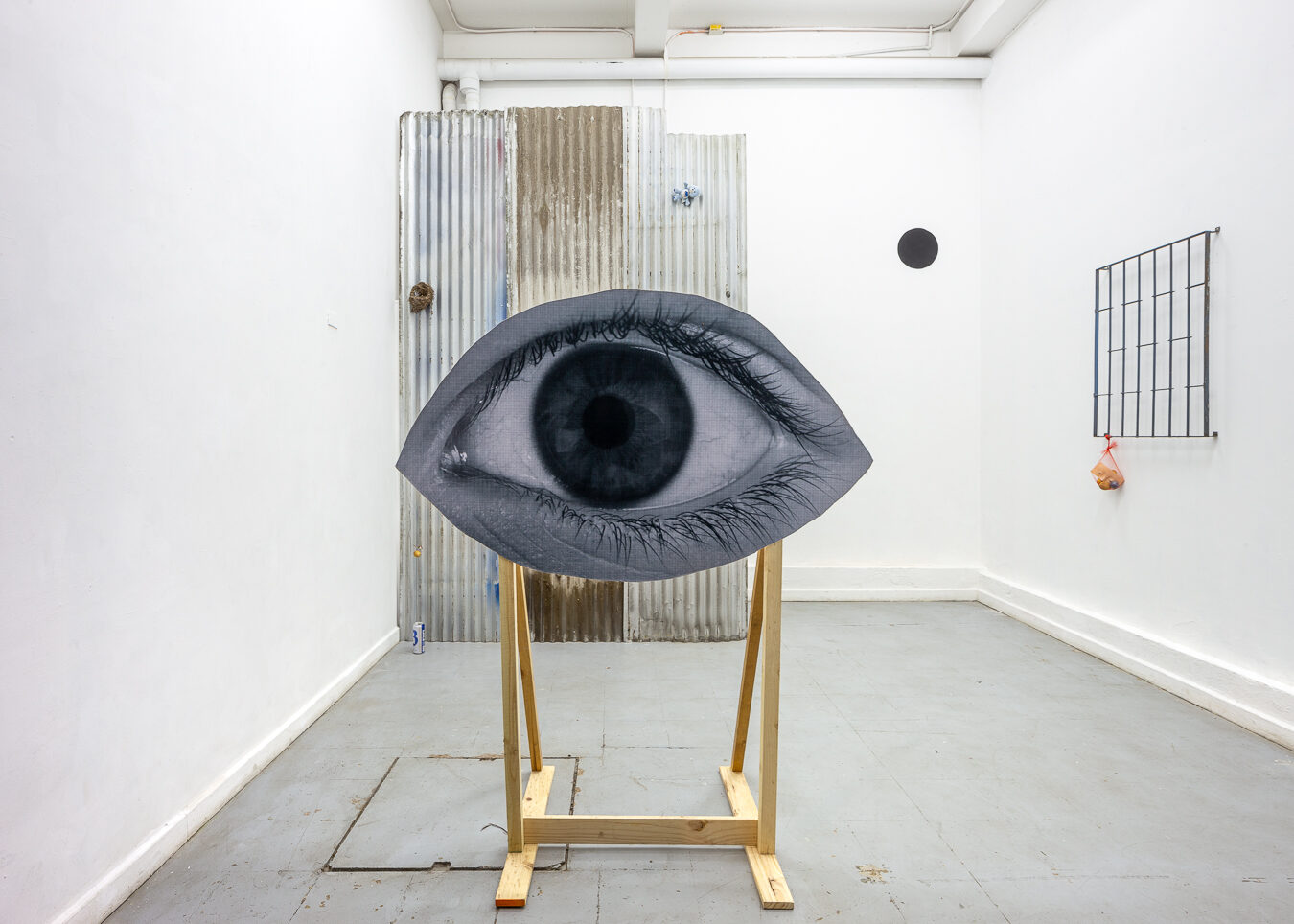
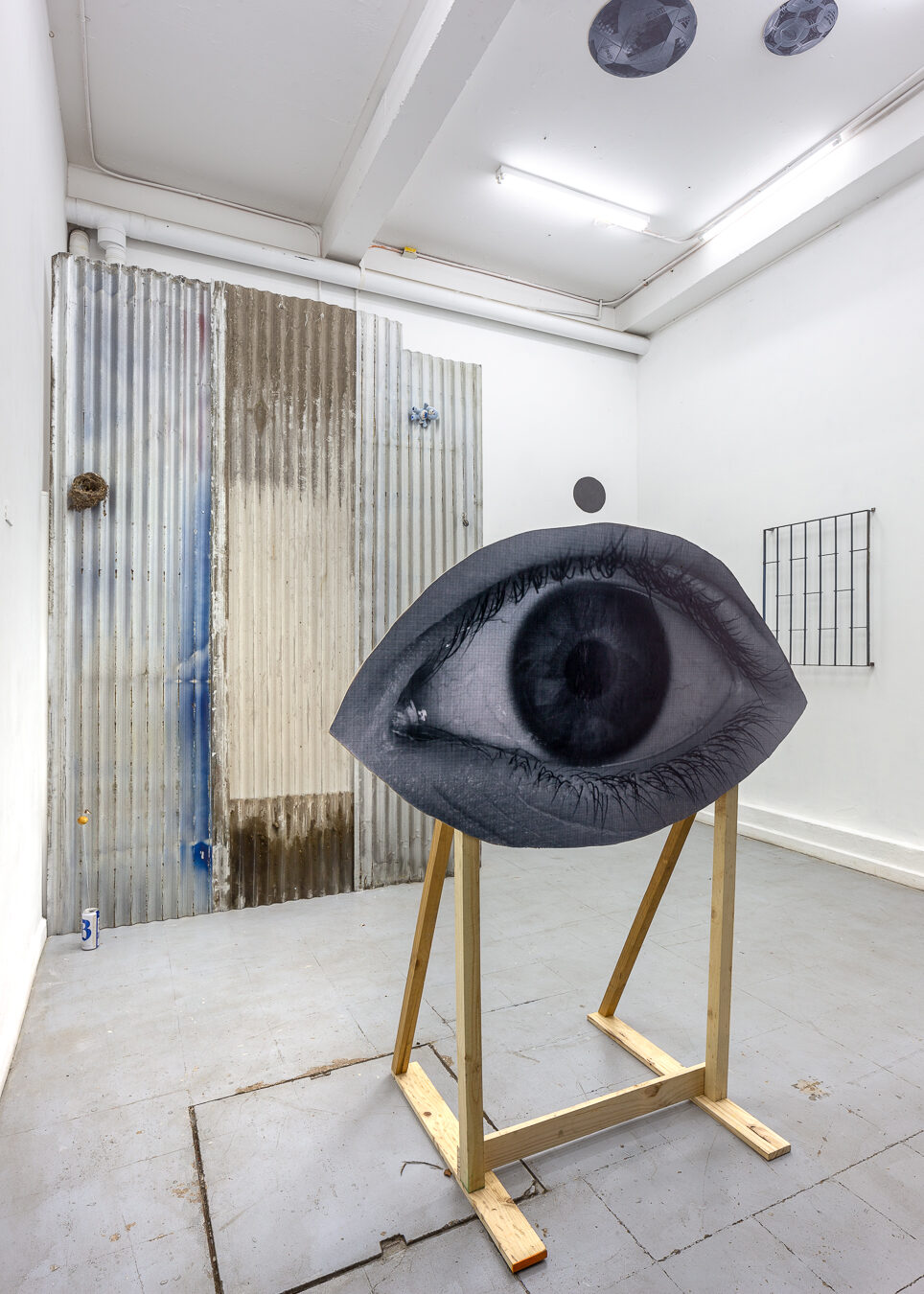
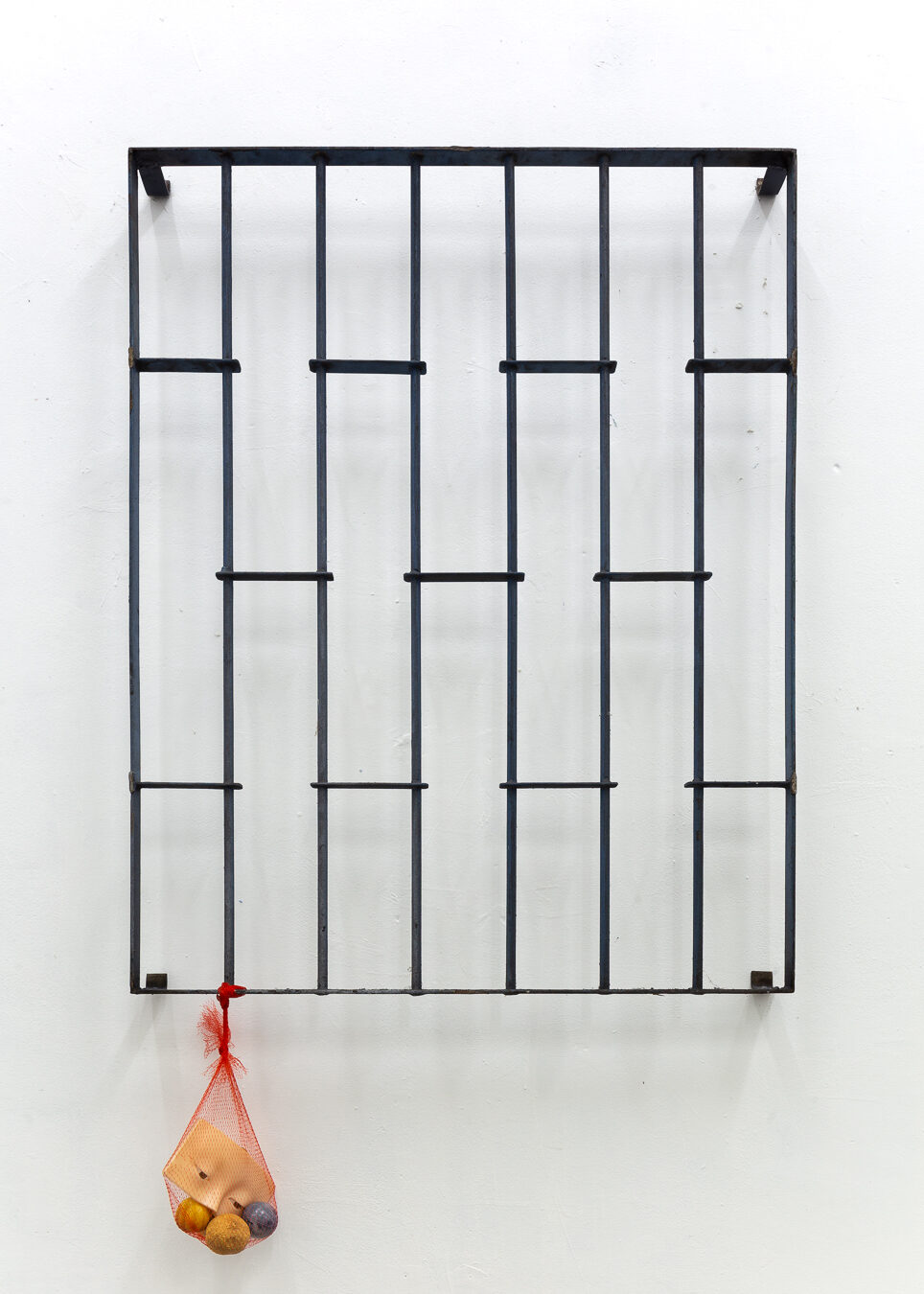
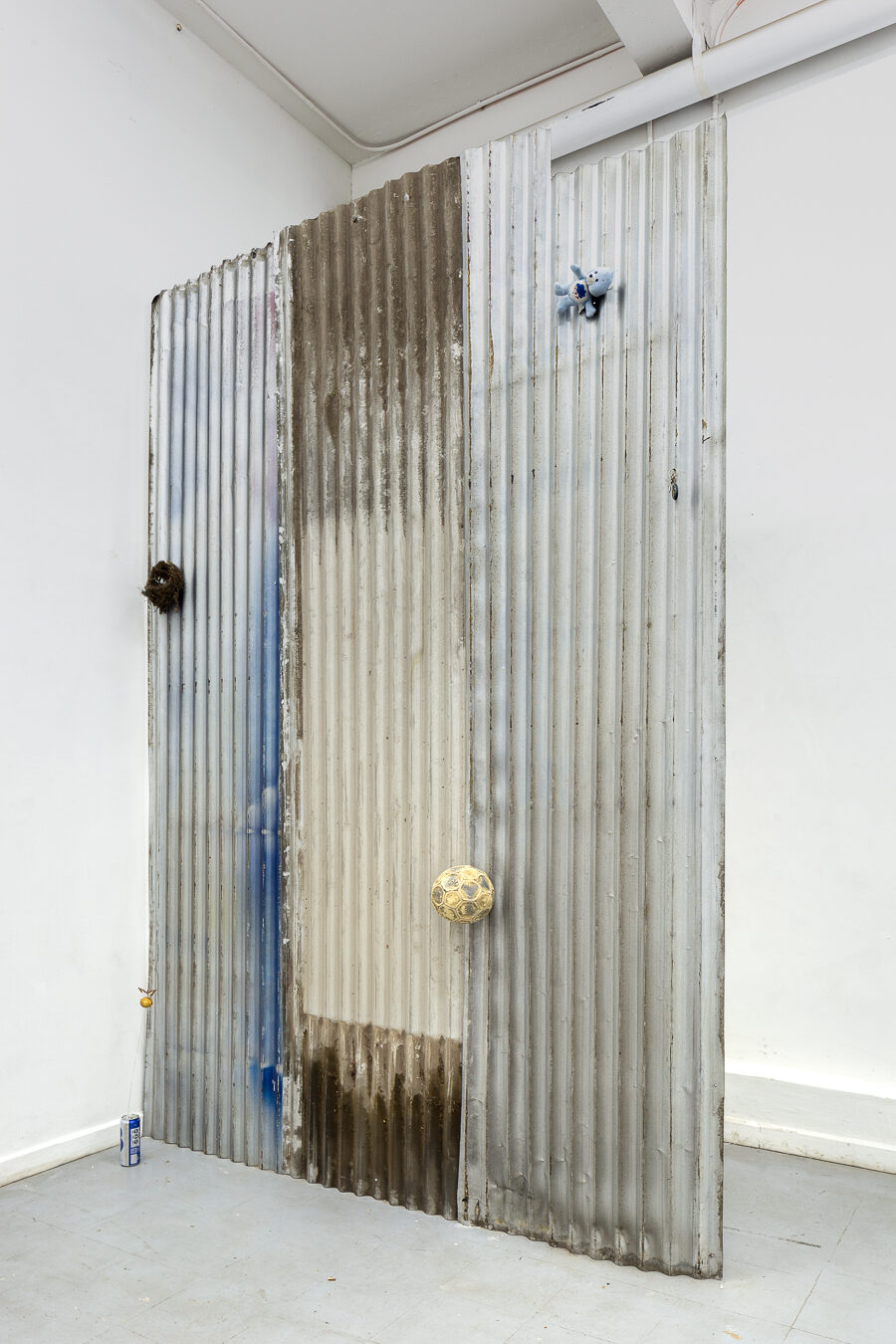
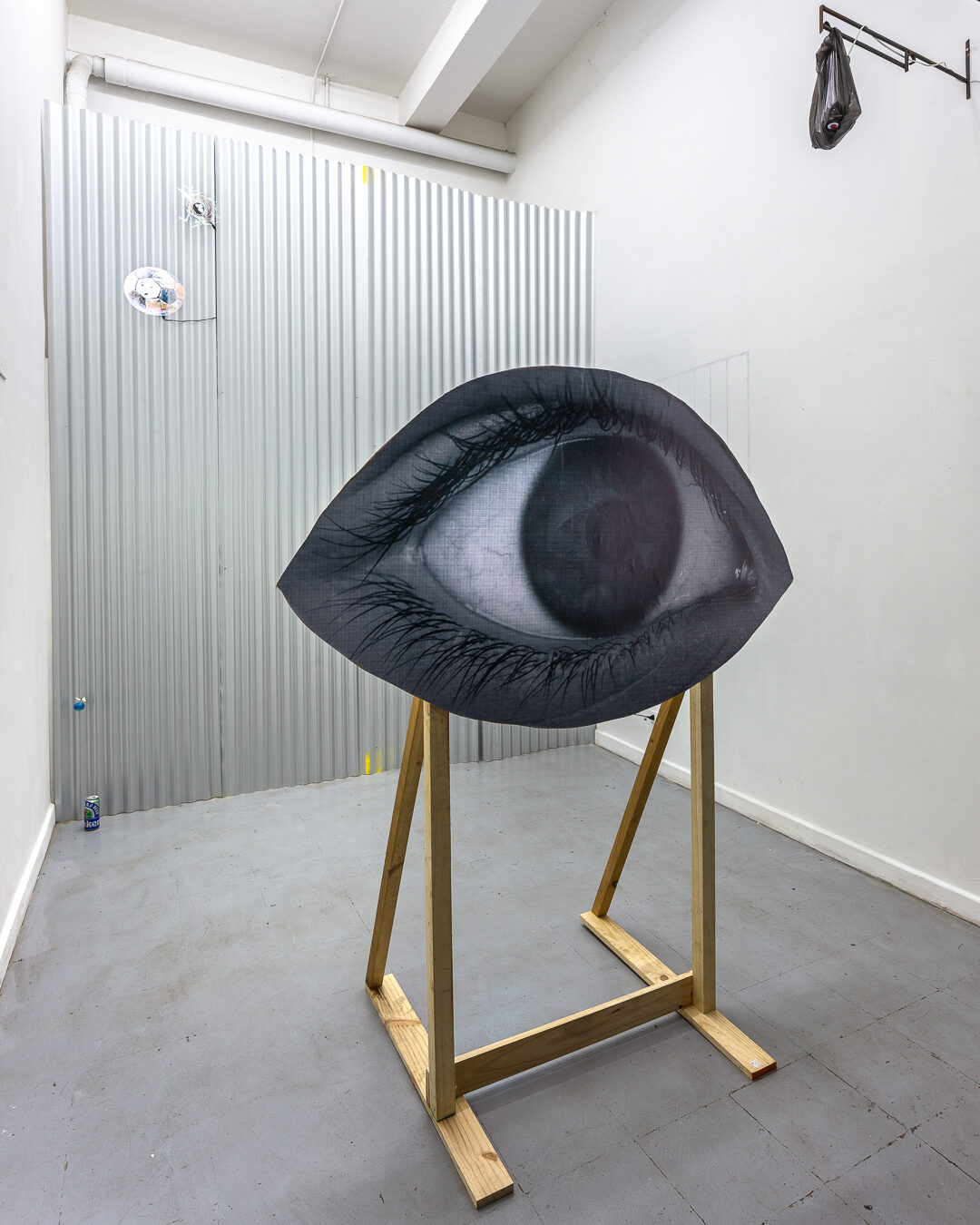
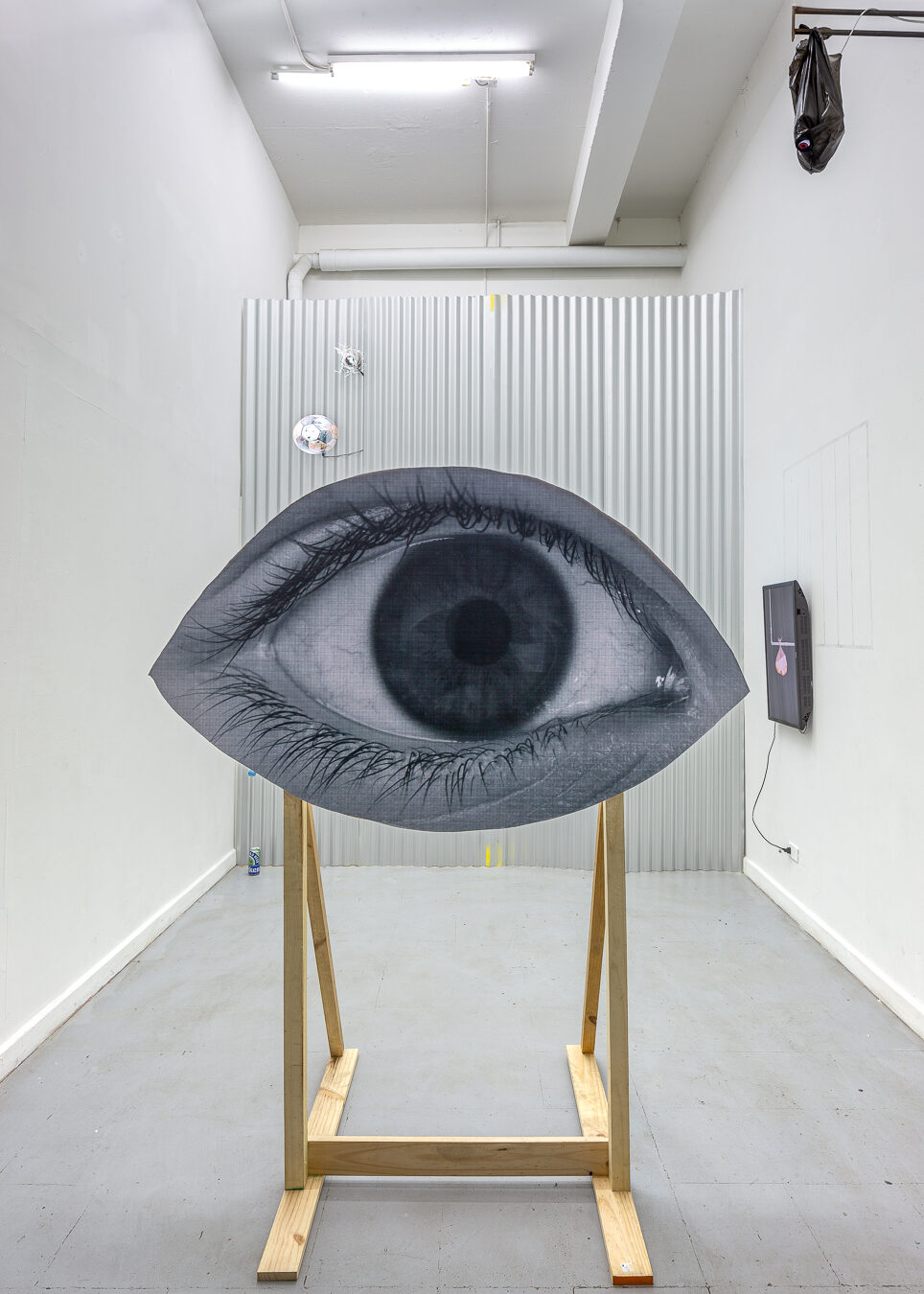
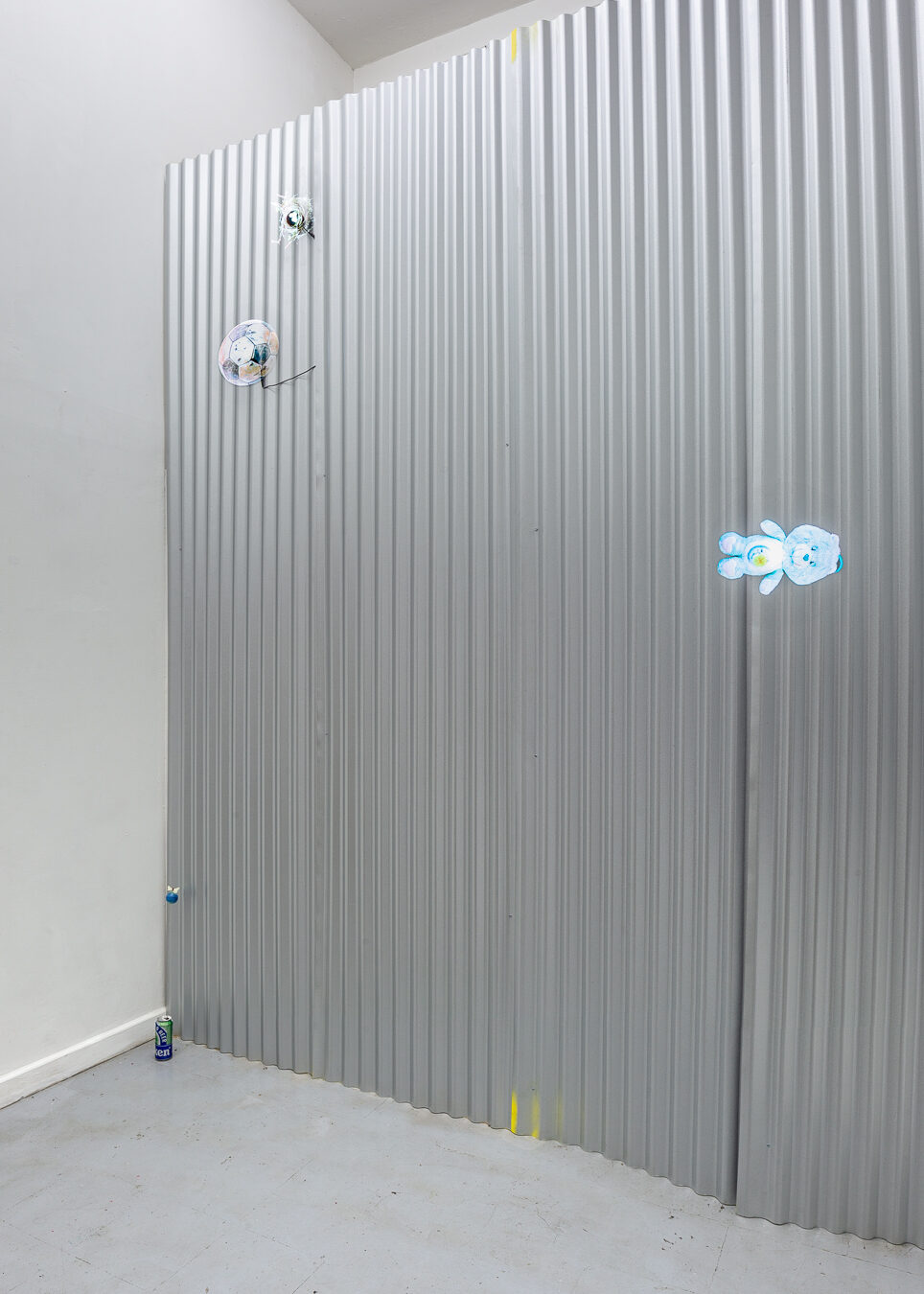
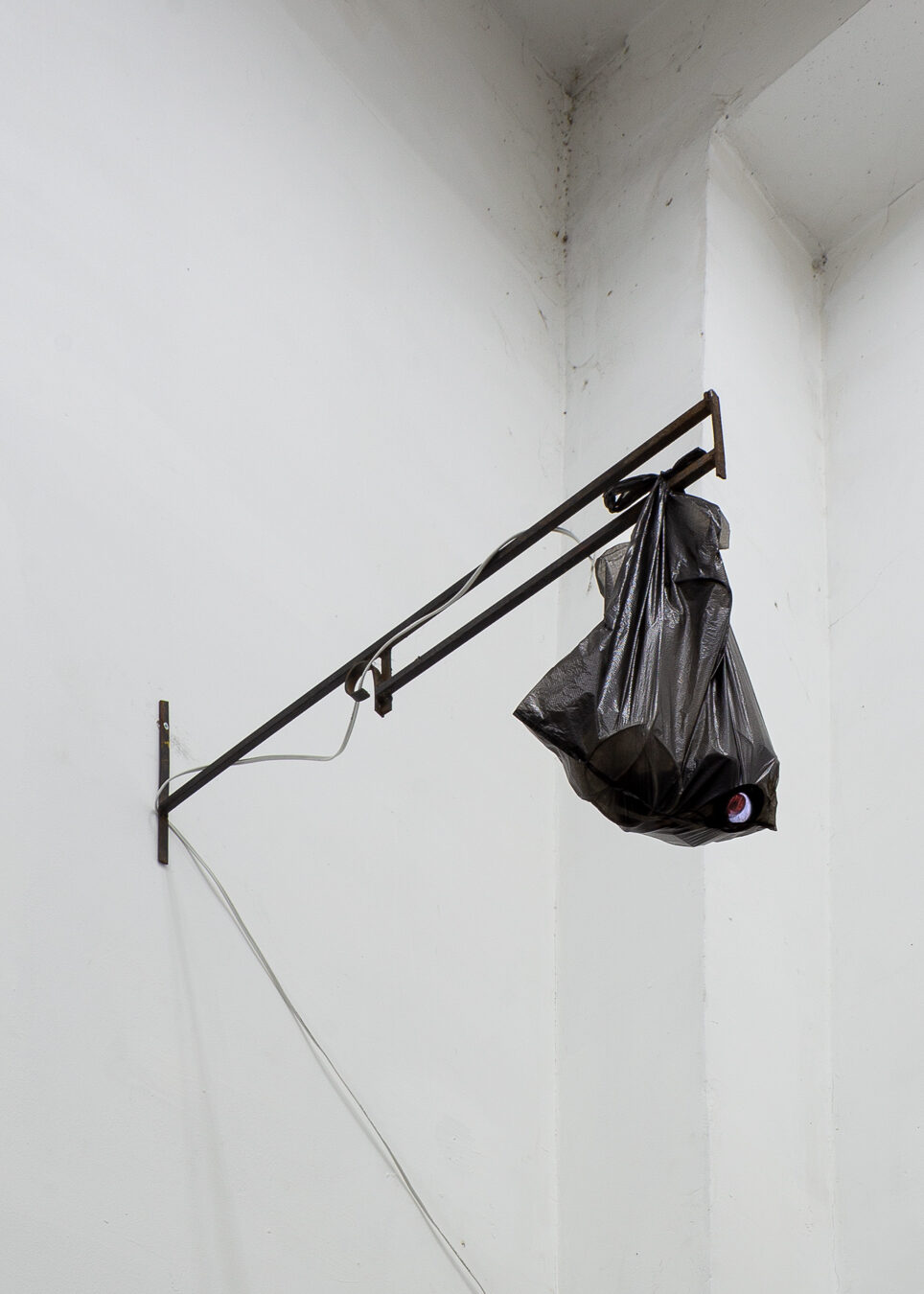
En Octubre de 2024 inauguré la exposición “Telstar” en el querido espacio Instituto Telearte. Para esta exhibición un asunto central de interés es la visión; lo real y lo aparente; lo análogo y lo virtual. Usando las dos salas de Instituto Tele Arte, la exposición funciona como un espejo, una mitad despliega elementos reales, mientras que en la otra se usan dispositivos y elementos o que remiten a una realidad virtual, inclusive ficcional, que solo puede ser observada por dispositivos que complementan la mirada natural de un cuerpo biológico y su percepción del mundo.
“Me gustaría abogar por un tipo de visión que combine actividad y pasividad. Si reafirmamos que el ser humano tiene una existencia tanto física como consciente, la visión no debe limitarse a un lado u otro. Mi cuerpo me pertenece, pero es una entidad intermediaria ambivalente que también pertenece al mundo exterior.... Adoptemos la postura de que el yo y el mundo exterior pueden crear un mundo entre ellos a través de una relación interactiva que conlleva diferencia y la no-identidad.”
Lee Ufan
Estando aún en el colegio, subía habitualmente al techo de la casa de mi mamá. Se sentía como estar descubriendo un territorio nuevo, un archipiélago hecho de techos, como icebergs de ciudad, donde la parte funcional de la casa es la parte sumergida. Me sentía como escapándome del mundo para habitar esta dimensión alta y árida, un horizonte sin personas, una altura que no se sabe defender de la insistencia abrasiva de la luz solar ni de la lluvia. En estos paseos fui encontrando objetos desteñidos, los recolecto desde entonces. Los admiraba; consideraba que habían escapado a los circuitos cíclicos de la funcionalidad humana. Todo objeto está preso en un loop de uso o funcionalidad; del cajón a la mesa, de la mesa al lavaplatos. Estos eran objetos que se habían escapado. Practicaban la flojera en las alturas. Inmóviles imitaban a las piedras, se comportaban como esculturas. Vivían en un espacio temporal estirado, indeterminado, de contemplación y quietud, que poco tenía que ver con sus tiempos de vida útil. La noche, el día, el frio o el calor son los hitos que dan cuenta de que el mundo no se ha detenido. Estos objetos de las alturas se revelaban ante una disposición pasiva y servil. En los techos -este territorio alternativo- practicaban la rebeldía de escapársenos, fundaban comunidades inertes y pacíficas, comunidades de objetos fugados del dominio de lo humano.
Mi colección fue creciendo; llaveros, pelotas, revistas porno, una billetera recién robada que alguien lanzó para desprenderse de la evidencia, reposaban junto a huesos de pájaro, frutos, semillas y nidos. Sistemas absurdos, sin otro vínculo que la quietud como promesa de paz. Espacios sin jerarquía u orden. Si nada se mueve, tampoco hay acción que desencadene la actividad. Esta parecía ser la norma, siempre obedecida, cautelada por la gravedad y el placer de ser rebelde al movimiento. Con el tiempo comencé a configurar pequeñas composiciones, estados de orden. No quiero importunar la rebeldía devolviendo a los objetos a funcionalidad alguna. A estas situaciones las llamo esculturas, operaciones a partir de objetos que resaltan su valiente retiro, procurando el permanente reposo sin tener que enfrentarse a las furias del cielo sin capacidad alguna de protección o reflejo. La escultura es una categoría objetual que tiene permitida la flojera, más que eso, a veces inclusive los humanos reaccionamos admiradores de la valentía de su -a veces- drástica inamovilidad. Nos movemos nosotros, las recorremos como si fuesen rocas conmovedoras, las contemplamos como si su silencio escondiera unas informaciones profundas y misteriosas.
Un día me encontré una pelota Adidas Telstar, uno de los objetos valiosos en la colección. El diseño de este balón está basado en el diseño del satélite del mismo nombre. Un enjambre de satélites Telstar que se encuentran suspendidos orbitando nuestro planeta permitieron las primeras comunicaciones satelitales, la conectividad mundial por medio de ondas y señales. El desarrollo de esta tecnología permite vistas frontales sobre la superficie del mundo (como miraría Dios). Espionajes, la hipervisibilidad de la superficie de la tierra; Google Street View. Esos techos como islas de objetos prófugos, son miradas ahora de frente, apareció una nueva forma de ver el mundo; la mirada cenital global a la que se puede acceder por medio de cualquier pantalla. El mundo se convirtió en objeto. Ahora flota sobre este una mirada que lo detiene, como si fuese una cosa grande pero no rebelde. El mundo ya no es infinito, y si lo es ahora hay algo que alcanzó su dimensión de infinidad, y lo observa sin descanso. El techo siempre me pareció territorio análogo, hoy un espacio visto por un gran ojo infinito que genera copias virtuales multiplicadas sin austeridad, como un scanner sin fin. Todo lo real es ahora matriz para la producción de una gran imagen, de una gran versión digital de todo lo que tiene cuerpo visible. Si los objetos querían escapar de lo humano, hoy, inclusive en el techo, se cruzan con nuestra mirada, que desciende cual rayo de sol absorbente. Si el sol golpéa, el satélite traduce, absorbe. Estamos en el mundo como una muestra bajo la lente de un microscopio, pasivamente filmados a perpetuidad. Lo que hoy habita el archipiélago-iceberg de ciudad, es, en el presente objeto pasivo de la mirada robot que flota más allá de las nubes como un ojo de mosca sin cuerpo, y con la capacidad de constituir una visión monumental.
Telstar es tanto la pelota como el satélite. Por una parte, un cuerpo esférico sujeto a las leyes de la física, mientras que el otro, las desafía para crear un mundo virtual que se posiciona dentro del mundo real. Usando ambas salas de Instituto Tele Arte, me propuse construir una exposición doble; en un lado (o hemisferio) hecho de realidades reales, mientras que en el otro de realidades aparentes.
Javier González Pesce, 2024.
Telstar
Reflections on the still and the moving.
In October 2024, I opened the exhibition “Telstar” at the beloved Space Instituto TeleArte. A central theme of this exhibition is vision: the real and the apparent; the analog and the virtual. Utilizing the two rooms at Instituto TeleArte, the exhibition functions as a mirror: one half displays real elements, while the other features devices and elements that refer to a virtual—even fictional—reality, which can only be observed through devices that complement the natural gaze of a biological body and its perception of the world.
“I would like to advocate for a type of vision that combines activity and passivity. If we affirm that human beings have both a physical and a conscious existence, vision should not be limited to one side or the other. My body belongs to me, but it is an ambivalent intermediary entity that also belongs to the outside world.... Let us adopt the stance that the self and the outside world can create a world between them through an interactive relationship that entails difference and non-identity.”
Lee Ufan
When I was still in school, I used to climb up onto the roof of my mother’s house. It felt like discovering new territory, an archipelago made of rooftops—like urban icebergs—where the functional part of the house is the submerged part. I felt as if I were escaping the world to inhabit this high, arid dimension—a horizon devoid of people, a height that cannot defend itself against the abrasive insistence of sunlight or rain. On these excursions, I came across faded objects; I’ve been collecting them ever since. I admired them; I believed they had escaped the cyclical circuits of human functionality. Every object is trapped in a loop of use or functionality—from the drawer to the table, from the table to the dishwasher. These were objects that had broken free. They indulged in idleness up high. Motionless, they mimicked stones; they behaved like sculptures. They existed in a stretched-out, indeterminate temporal space of contemplation and stillness, which had little to do with their useful lifespans. Night, day, cold, or heat are the landmarks that remind them the world has not stopped. These objects in the heights revealed themselves in a passive and submissive arrangement. On the rooftops—this alternative territory—they practiced the rebellion of slipping away from us, founding inert and peaceful communities, communities of objects that had escaped human dominion.
My collection grew; keychains, balls, porn magazines, a freshly stolen wallet that someone had thrown away to get rid of the evidence, all rested alongside bird bones, fruits, seeds, and nests. Absurd systems, linked by nothing but stillness as a promise of peace. Spaces without hierarchy or order. If nothing moves, there is no action to trigger activity. This seemed to be the norm, always obeyed, safeguarded by gravity and the pleasure of rebelling against movement. Over time, I began to arrange small compositions.
I do not wish to disturb this defiance by restoring any functionality to the objects. I call these situations “sculptures”—operations based on objects that highlight their courageous withdrawal, seeking permanent repose without having to face the fury of the sun, lacking any capacity for protection. Sculpture is an object-based category that allows laziness; more than that, sometimes even, we humans, react with admiration for the courage of its—at times—drastic immobility. We are the ones who move; we walk among them as if they were inspirational rocks, and we contemplate them as if their silence were concealing profound and mysterious information.
One day on a roof, I came across an Adidas Telstar soccer ball, one of the most valuable objects in the collection. The design of this ball is based on that of the satellite of the same name. A swarm of Telstar satellites suspended in orbit around our planet made the first satellite communications possible; global connectivity through waves and signals. The development of this technology allows for bird’s-eye views of the world’s surface (as God might see it). Espionage, the hypervisibility of the Earth’s surface; Google Street View. Those rooftops—like islands of fugitive objects—are now viewed head-on; a new way of seeing the world has emerged: the global bird’s-eye view accessible through any screen. The world has become an object. Now a gaze hovers over it, holding it in place, as if it were a vast but not rebellious thing. The world is no longer infinite, and if it is, there is now something that has reached its dimension of infinity and observes it ceaselessly. The roof has always struck me as analog territory; today, it is a space viewed by a great infinite eye that generates virtual copies multiplied without restraint, like an endless scanner. Everything real is now a matrix for the production of a vast image, a digital version of everything with a visible form. If objects sought to escape the human realm, today—even on the ceiling—they cross paths with our gaze, which descends like an absorbing ray of sunlight. If the sun beats down, the satellite translates and absorbs. We exist in the world like a specimen under a microscope’s lens, passively filmed in perpetuity. What now inhabits the city’s roof-archipelago is, in the present, the passive object of the robotic gaze that floats beyond the clouds like a bodiless fly’s eye, capable of creating a monumental vision.
Telstar is both the ball and the satellite. On the one hand, a spherical body subject to the laws of physics, while on the other, it defies them to create a virtual world that positions itself within the real world. Using both rooms at the Instituto TeleArte, I set out to construct a dual exhibition: on one side (or hemisphere) made of analogue realities, while on the other, of apparent virtual realities.
Javier González Pesce, 2024.
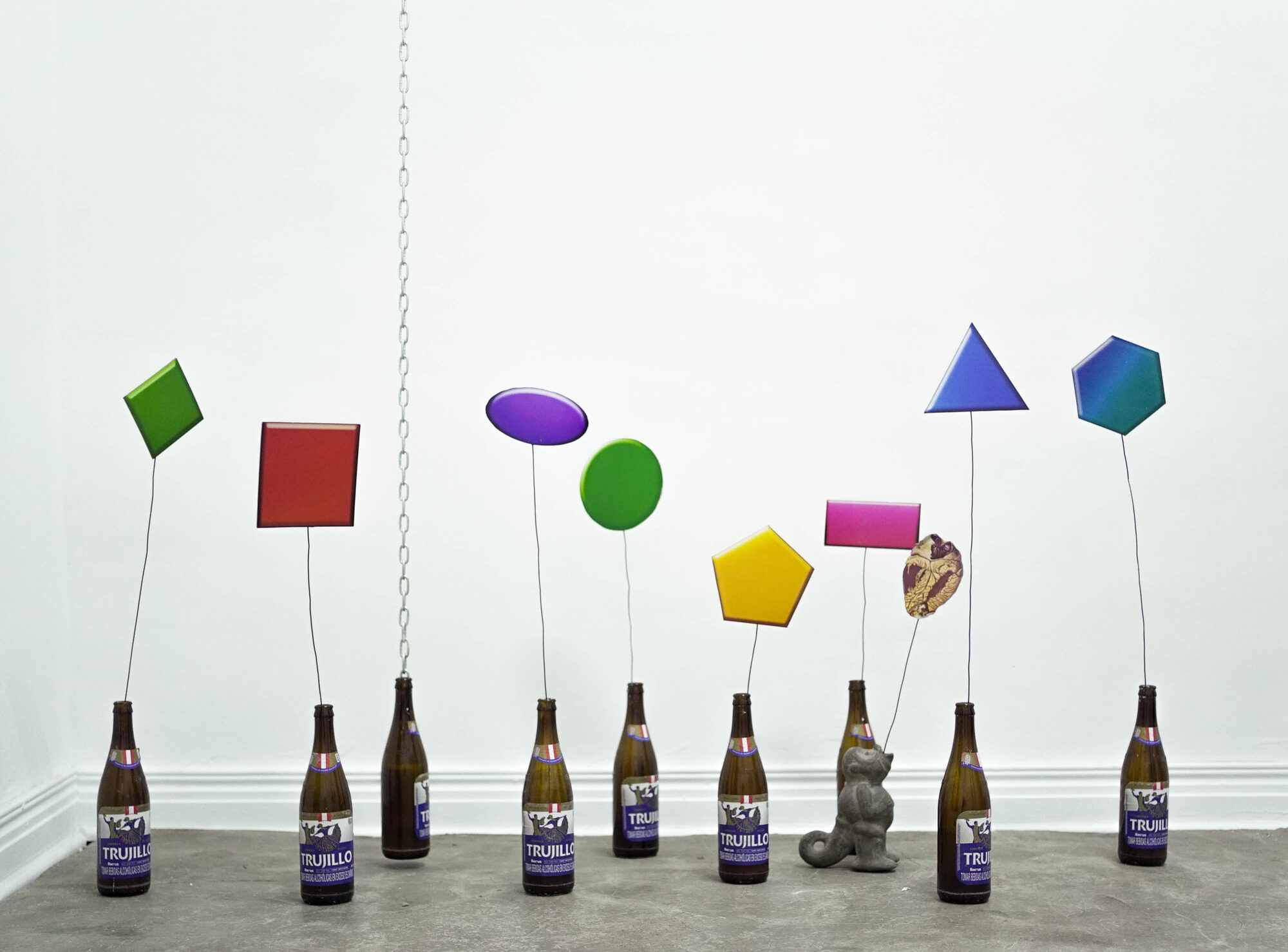
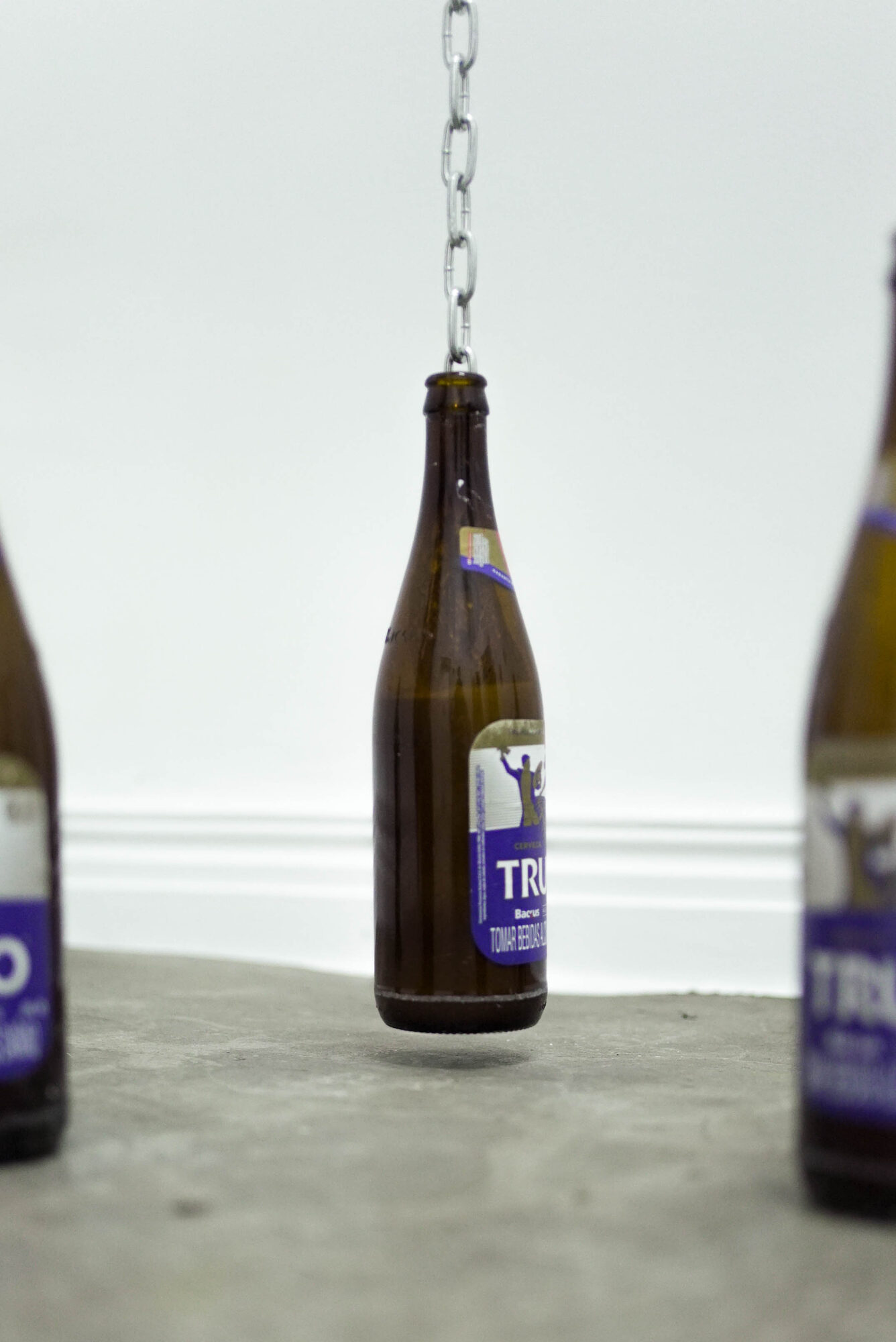
Lo que se de mi cuerpo; lo que mi cuerpo sabe de mí.
Entrevista por Mercedes Lopez.
“La unicidad, los bordes, las fronteras, es lo que menos tienen los seres vivos, dicho tanto de las partes como de las totalidades”
Bruno Latour
¿Cómo eran los días en Trujillo? ¿Qué sorpresas te trajo? ¿Qué cosas te esperabas de este lugar, qué ibas a buscar?
Los días eran muy estimulantes, traté de estar afuera lo más posible, caminar, comer, observar, conversar. Debo agradecer profundamente a Gerardo Chávez-Maza y Alberto Mendoza, quienes llevan Paijan y organizaron muchos paseos y actividades que me introdujeron a la ciudad. Cuando entraba al taller trabajaba muchísimo, hasta tarde. No tuve demasiado tiempo para producir, por lo que trabajé pensando poco, teniendo eso sí algunas ideas centrales en mente, pensamiento activo.
La verdad no tenía claro que es lo que estaba buscando, sin embargo reconocía en la ciudad de Trujillo un territorio en el que se superponen una serie de creencias, distintas cosmovisiones que comprenden el mundo y todo lo que lo compone -el paisaje, la biología, la espiritualidad, las creencias, la política, solo por nombrar algunas. Cada cosmovisión sitúa una realidad ideológica en el territorio, como ambientes que se superponen, en los que cada elemento es un rastro, como un signo para la emergencia de una capacidad interpretativa que, en nuestra visión, se manifiesta culturizada. El mundo material es una realidad que interpretamos, lo que vemos no está vaciado de creencias. Quería rastrear estas distintas realidades culturales superpuestas. Intenté ser una especie de arqueólogo que trabajó en las capas traslapadas de las ideas que ocupan el espacio de la ciudad. Pronto decidí centrarme en el “cuerpo” y las maneras en las que distintas formas culturales lo interpretan y perciben. Entonces la ciudad misma se me hizo una especie de cuerpo y yo me percibí como un cirujano ignorante, pero con el deseo de operar. Quise ser una mezcla de psicólogo y arqueólogo. Me moví ahí adentro, en esa corporalidad que es la ciudad, intentando rastrear elementos que me permitiesen generar un diagnóstico con la forma de una exhibición.
Durante la residencia, ¿se generaron nuevos aportes, reflexiones, pensamientos, cadenas de asociaciones con tus anteriores investigaciones?
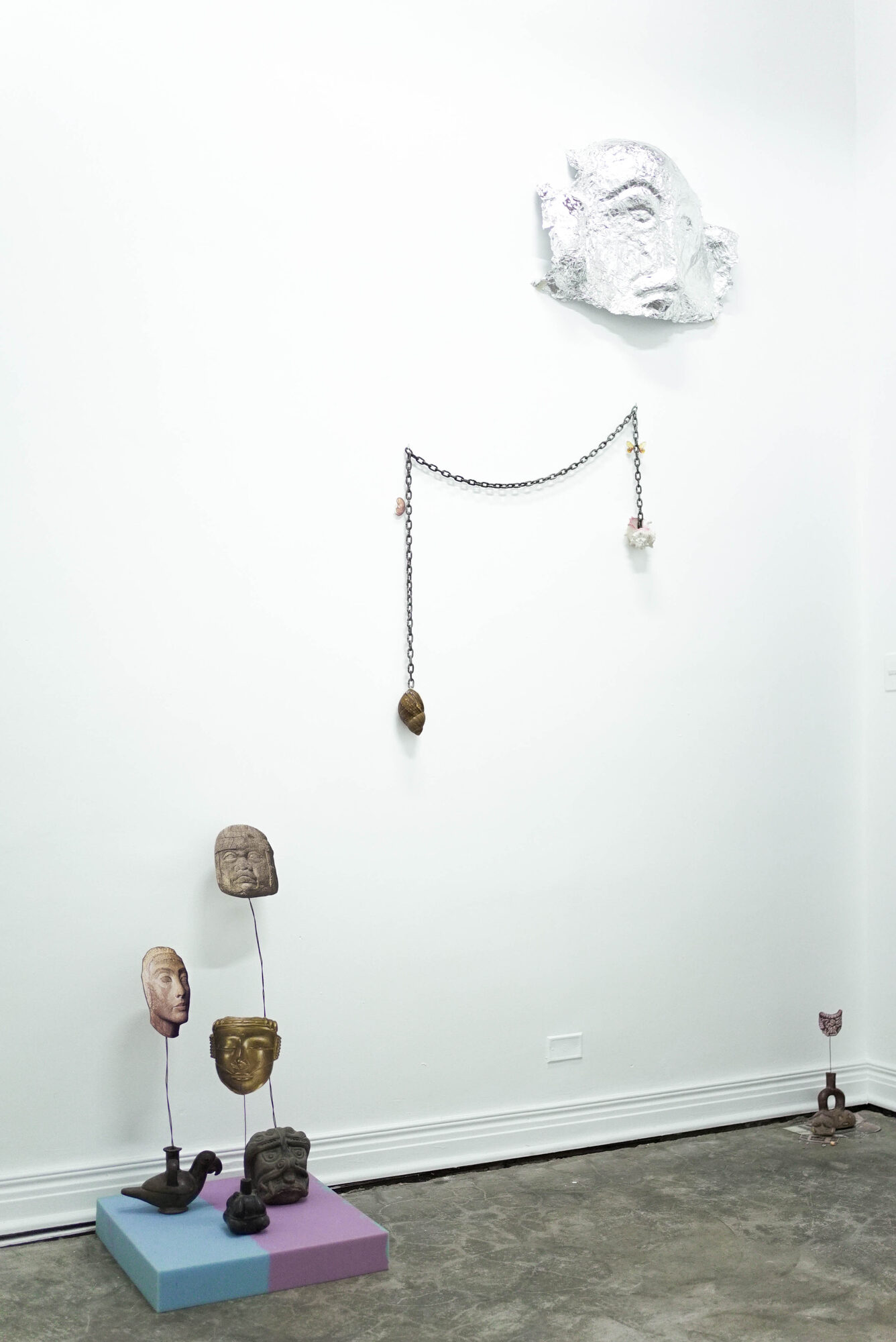
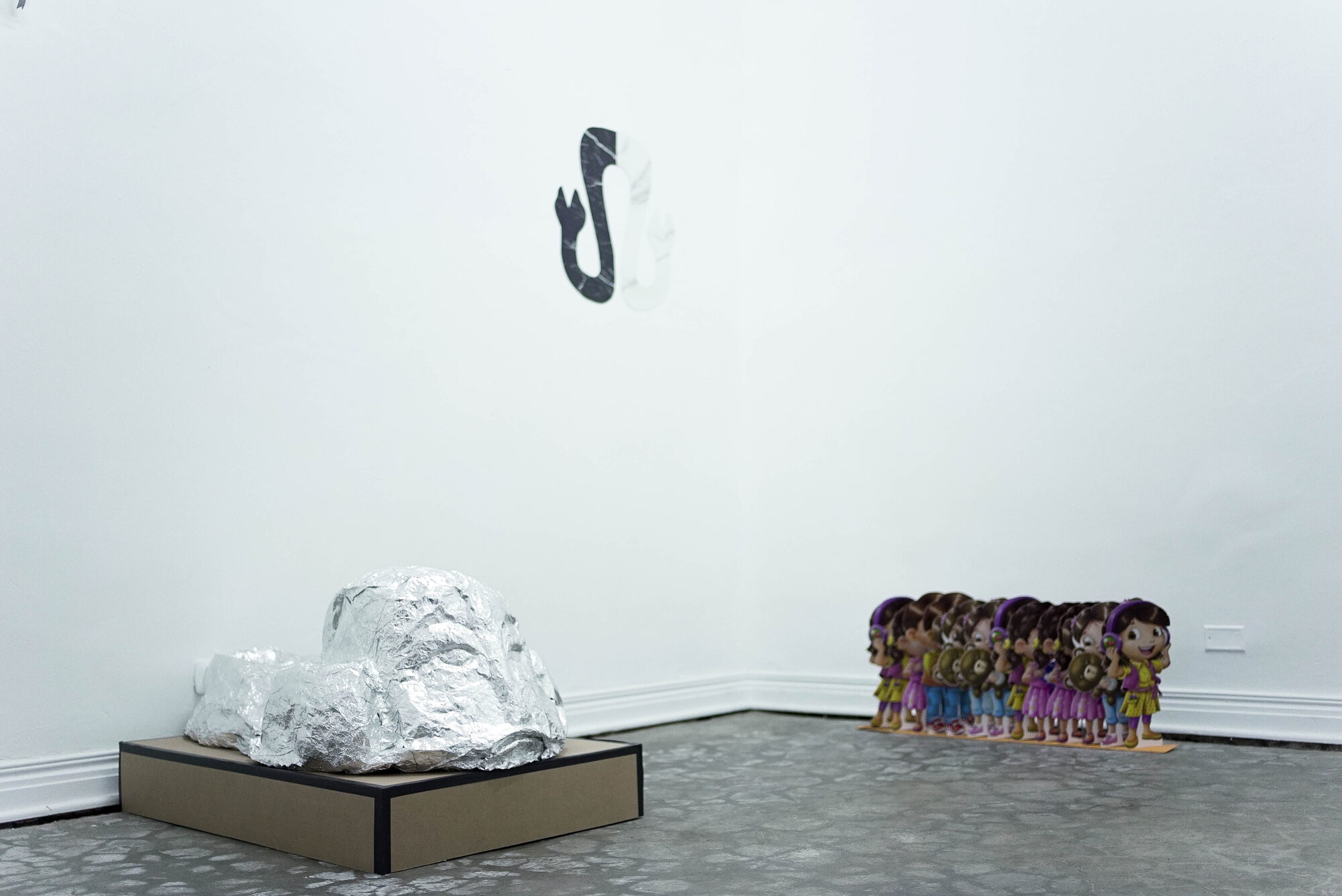
Sin duda. Ahora, hay algunas cosas que puedo comunicar y otras que se incorporan de maneras misteriosas, sensibles (que es la expectativa que uno tiene de las residencias). Trujillo mismo fue una influencia muy importante. Vengo hace un tiempo sintiendo que las formas propias de las culturas precolombinas son formas de arte muy valiosas, que hemos descontinuado de la linealidad de la producción de contenidos sensibles realizadas por humanos. Los vestigios de las culturas precolombinas son hoy elementos tratados como objetos pertenecientes a realidades culturales extintas, desconectadas del presente, asuntos que solo pueden habitar museos históricos. En Europa no tienen esta escisión, la línea de tiempo construida por los objetos artísticos que pertenecen a sus culturas, se encuentran enlazadas a su presente, su continuidad nunca fue detenida. Es por esto que me parece importante que los lenguajes contemporáneos vuelvan a conectar con las formas expresivas precolombinas, el lenguaje simbólico y formalista de las personas que ocuparon el territorio americano antes de la colonización. Sus objetos son de alguna manera un mensaje, como la botella con una carta lanzada al mar, que espera por ser detectada e interpretada. Estos elementos vitales nos pueden ayudar a reparar la distancia (como una herida) que sostenemos con culturas extintas Americanas, sus objetos son señas que resistieron al tiempo, formas materiales de su presencia, un testimonio cultural, pero también el acervo de un lenguaje simbólico. Hace un buen tiempo venía dibujando artesanía Moche. No me interesaba alterar su producción (deformarla artísticamente), más bien quiero usarla como un modelo, a modo de tributo, pero también para convertirme en un vehículo instrumental para la relocalización de estos imaginarios en nuestros espacios culturales. De esta manera me siento un colaborador trans-cultural. Un agente que puede traer una imagen producida por un artista del pasado, a los espacios de difusión de arte del presente. No me interesa tanto una alteración del objeto original, mi intensión no ha sido comentar o repensar, sino transportar al presente, enlazar esas formas de arte con sensibilidades actuales. En esta instancia trabajé de manera diferente, yo como productor estaba más confundido, en un estado más volcado a la experimentación. Sin embargo hay una pieza que realizamos en colaboración con el Museo Arqueológico Universitario, que me permitió tocar una escultura tallada en piedra que representa a un ser extraño, una especie de cabeza, con un cuerpo breve, como una babosa con orejas. Con ayuda de Gerardo y Alberto ja cubrimos de sucesivas capas de papel metálico de cocina. Esto nos permitió hacer una copia frágil de una piedra testimonial centenaria. La presencia de esa escultura duplicada desde el Museo (otro tiempo) me resulta muy valiosa. De alguna manera intenté recoger ideas en torno al cuerpo, intentando interpretar, dialogar y negociar con algunas ideas precolombinas situadas en Trujillo y traerlas a mi proceso de pensamiento, investigación y creación.
¿Existieron intercambios con la comunidad?
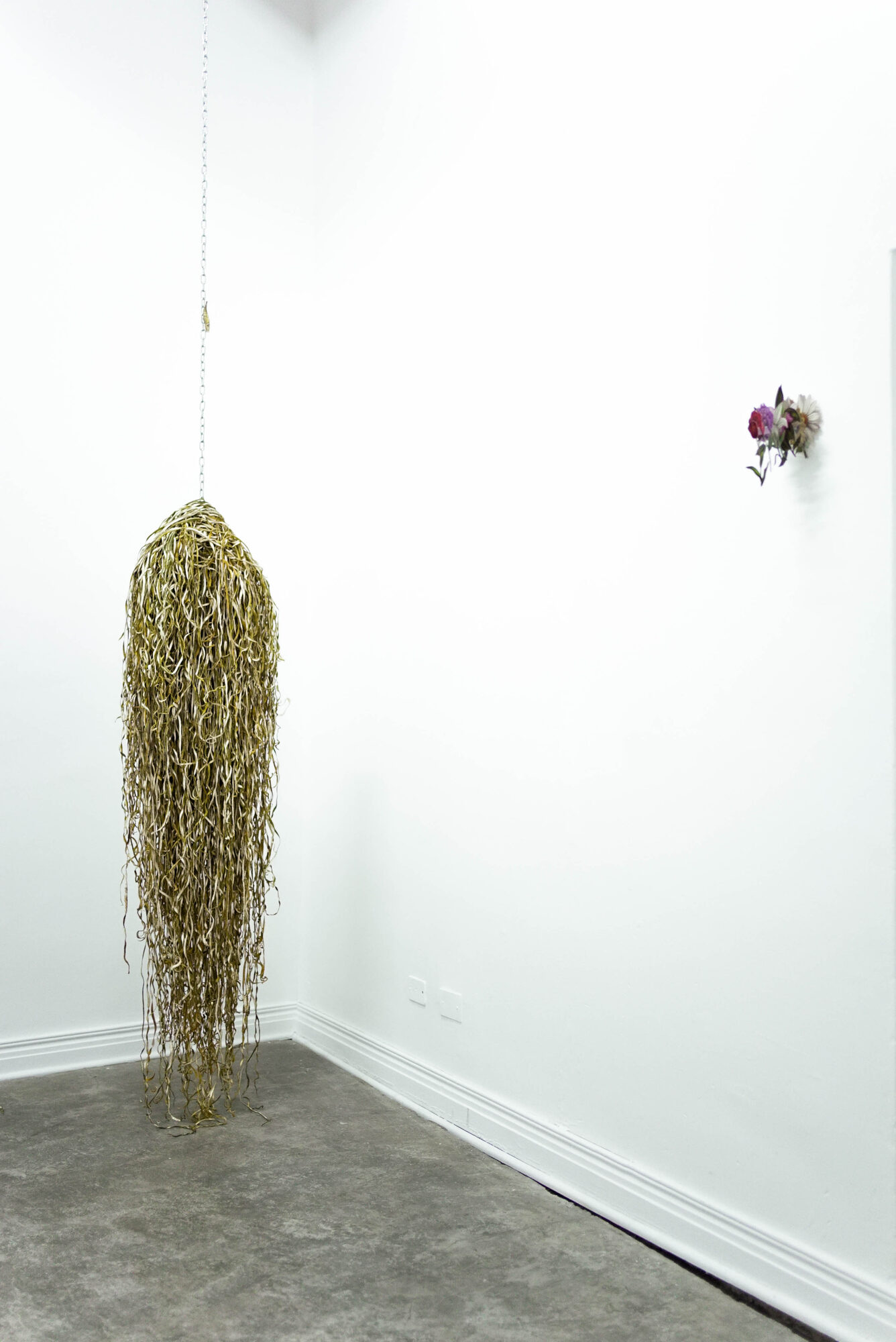
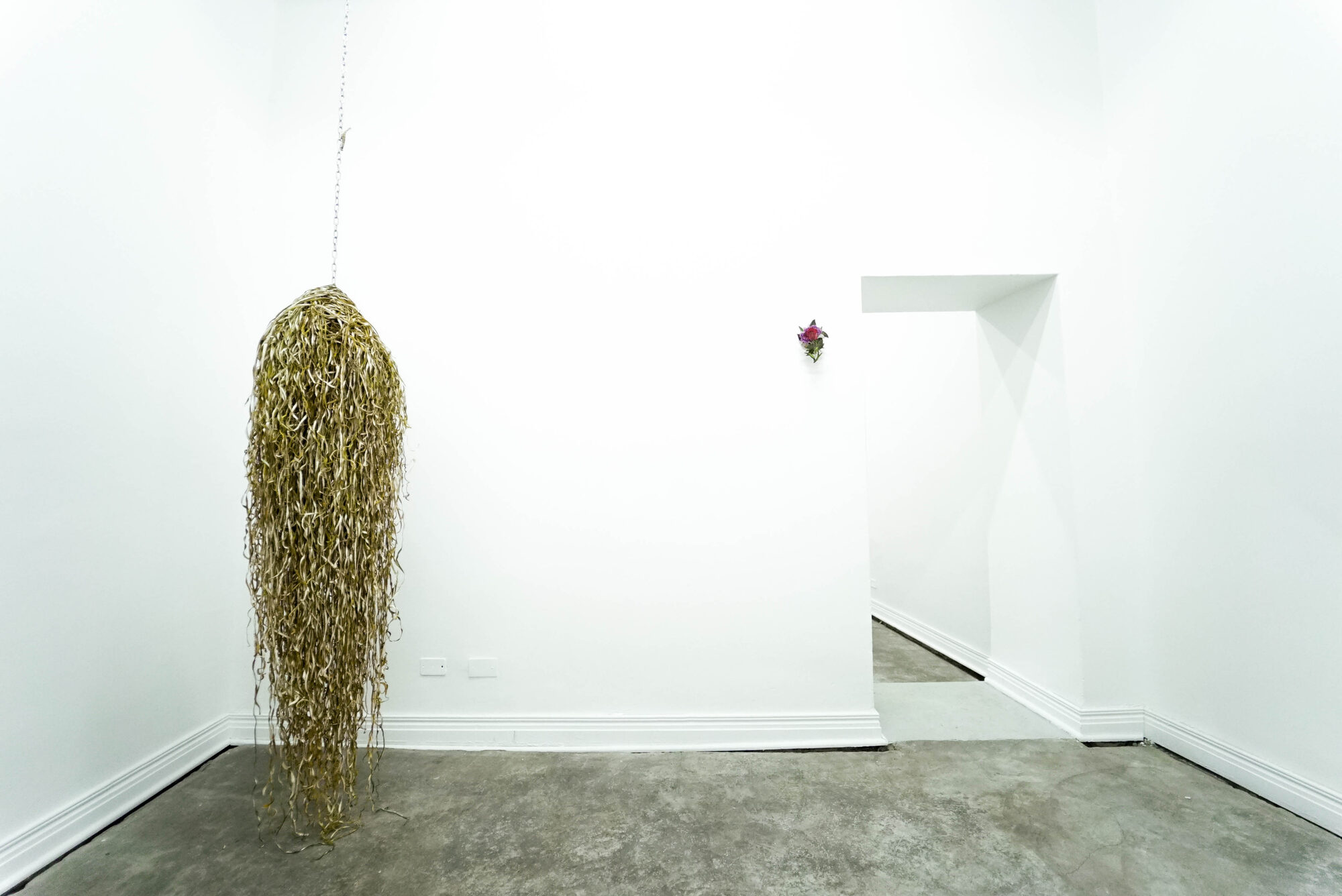
Todos los días tomaba un jugo de remolacha con manzana. De apoco comencé a conversar con las señoras que en el mercado los preparaban. Nos encariñamos. Usaban una máquina muy simple para pelar las naranjas, las que retiraban su cáscara por medio de una especie de cuchillo que la convertía en una gran línea, como pelo, una cuerda de piel de Naranja. Las amontonaban en unas especies de cabelleras, volúmenes frondosos de hebras hechas de cáscara de naranja, muy corporal. Por medio de este proceso dividen la naranja en pulpa (que ingresa en cuerpos humanos) y fibra (la cascara hecha melena). Me regalaban este volumen cítrico, me lo guardaban todos los días. Lo comencé a instalar en un colgador de ropa, como configurando una cabellera gigante, que luego se convirtió como en una especie de presencia, un cuerpo levitante con olor a naranja que me acompañaba a diario en el espacio que usaba como taller. En la medida que sumaba material, el fantasma se hacía robusto, como un músculo en desarrollo. La presencia parecía cada vez más tener las proporciones del cuerpo. Esta pieza entró a la exposición, un volumen cuya presencia parece la de una persona, hecha con la parte de una fruta que desechamos.
¿Cómo te encontraste con las formas y colores que componen la exposición?
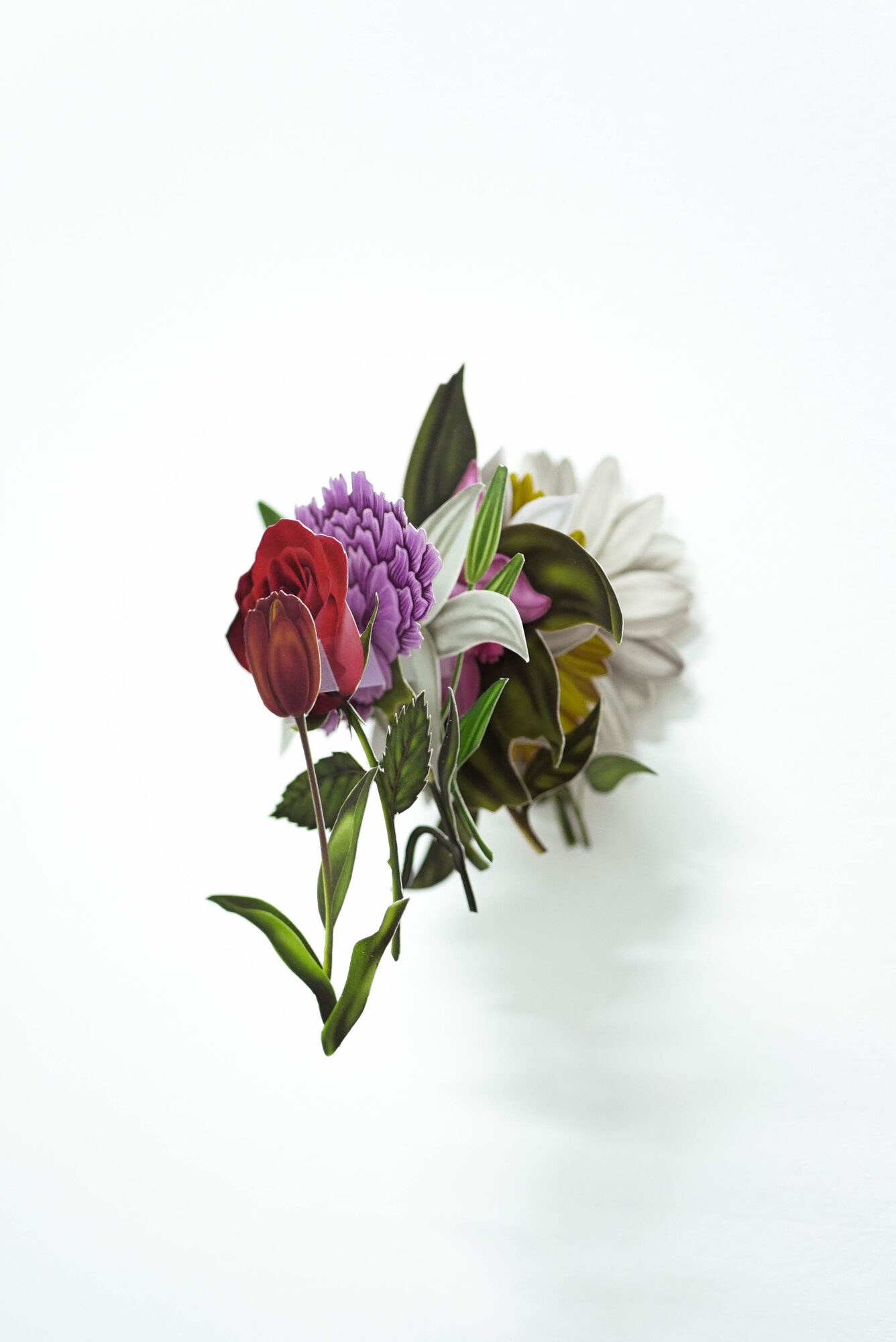
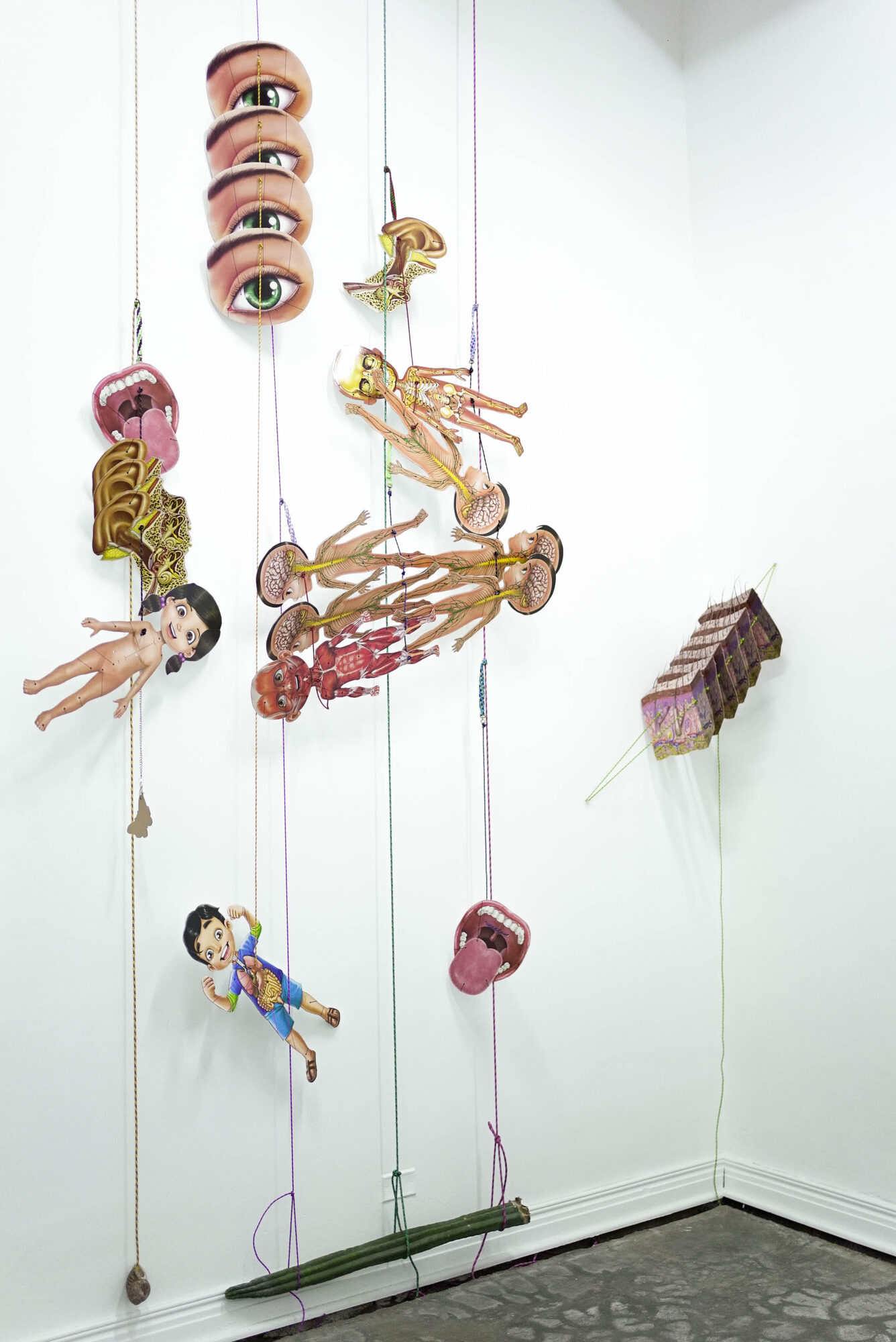
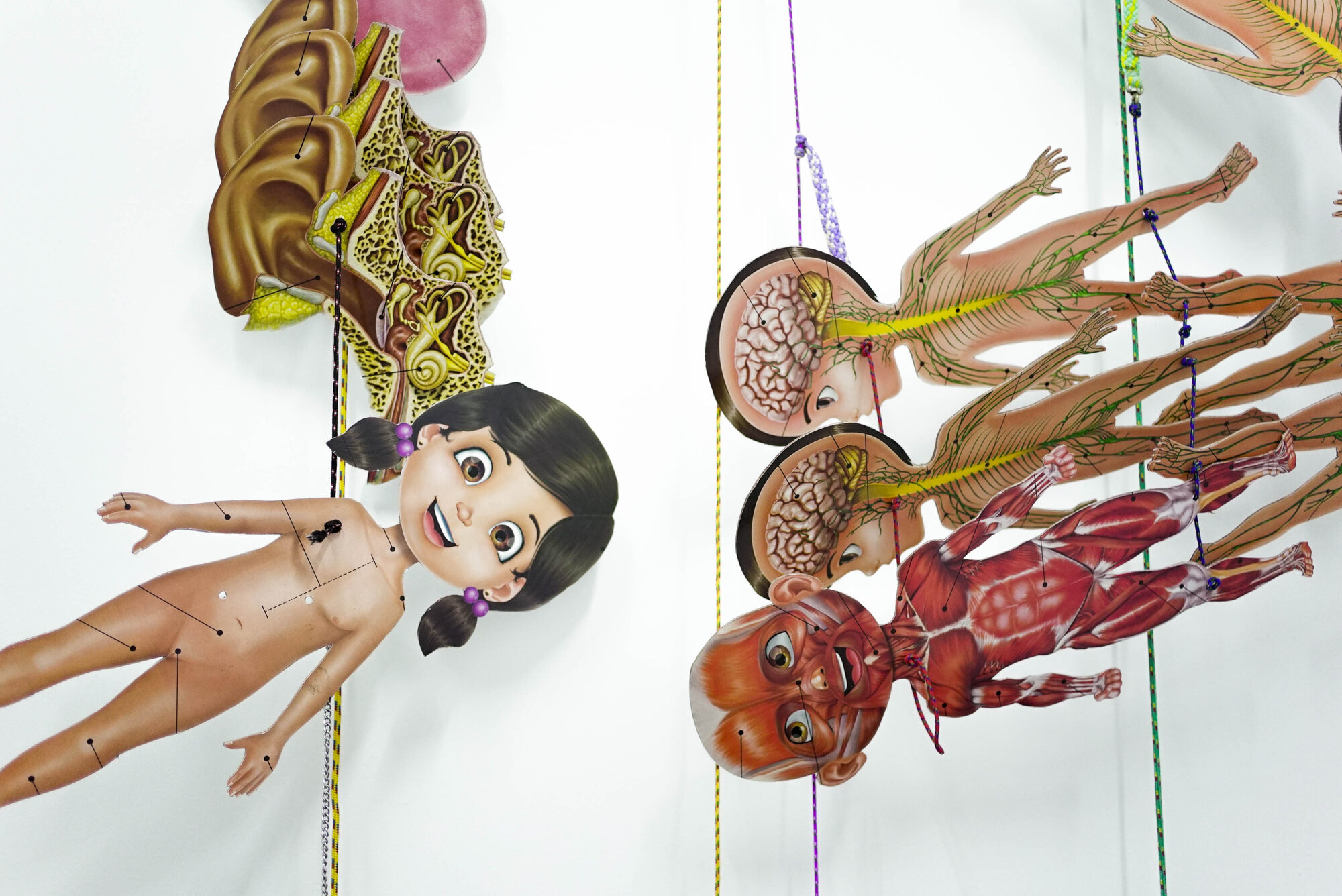
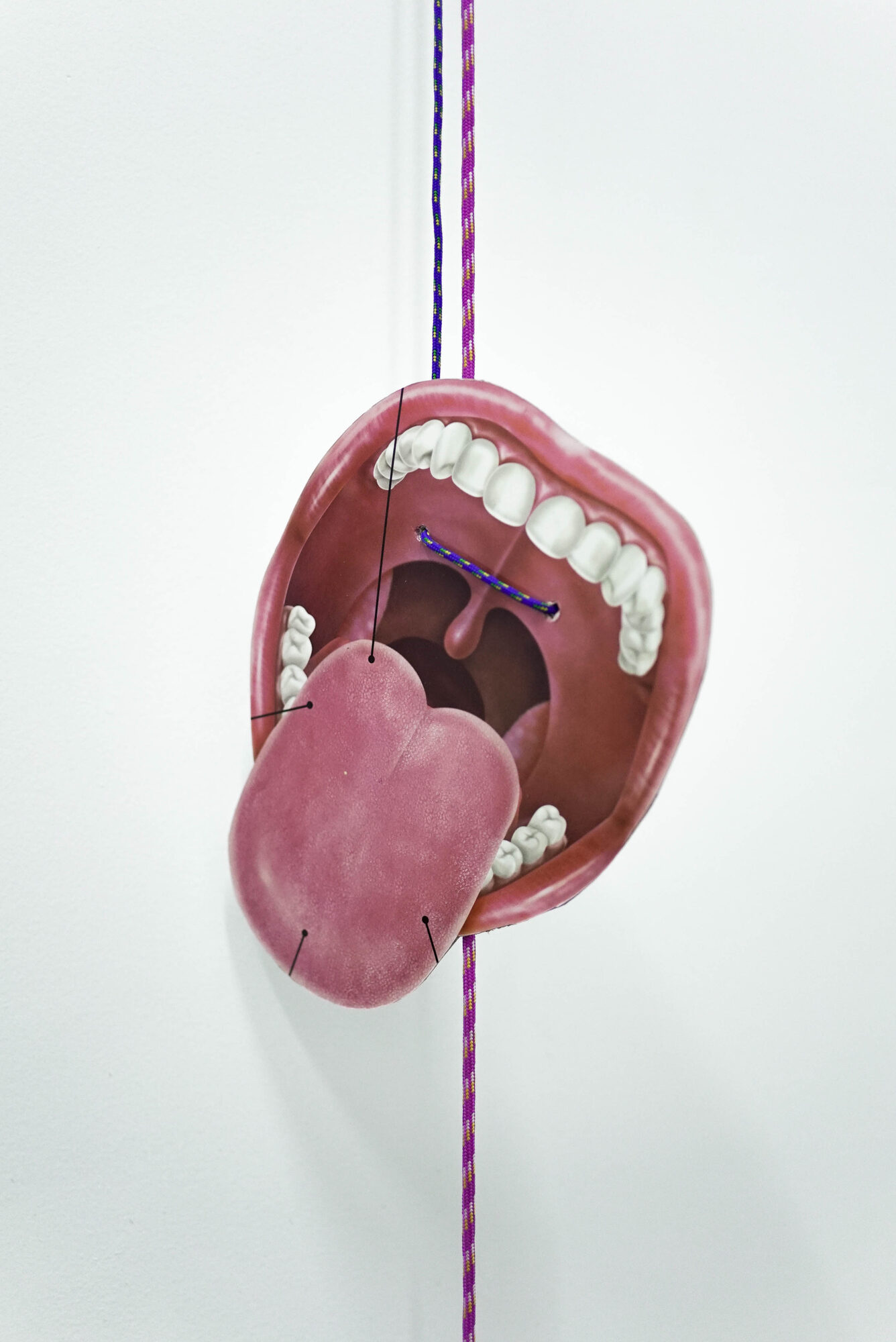
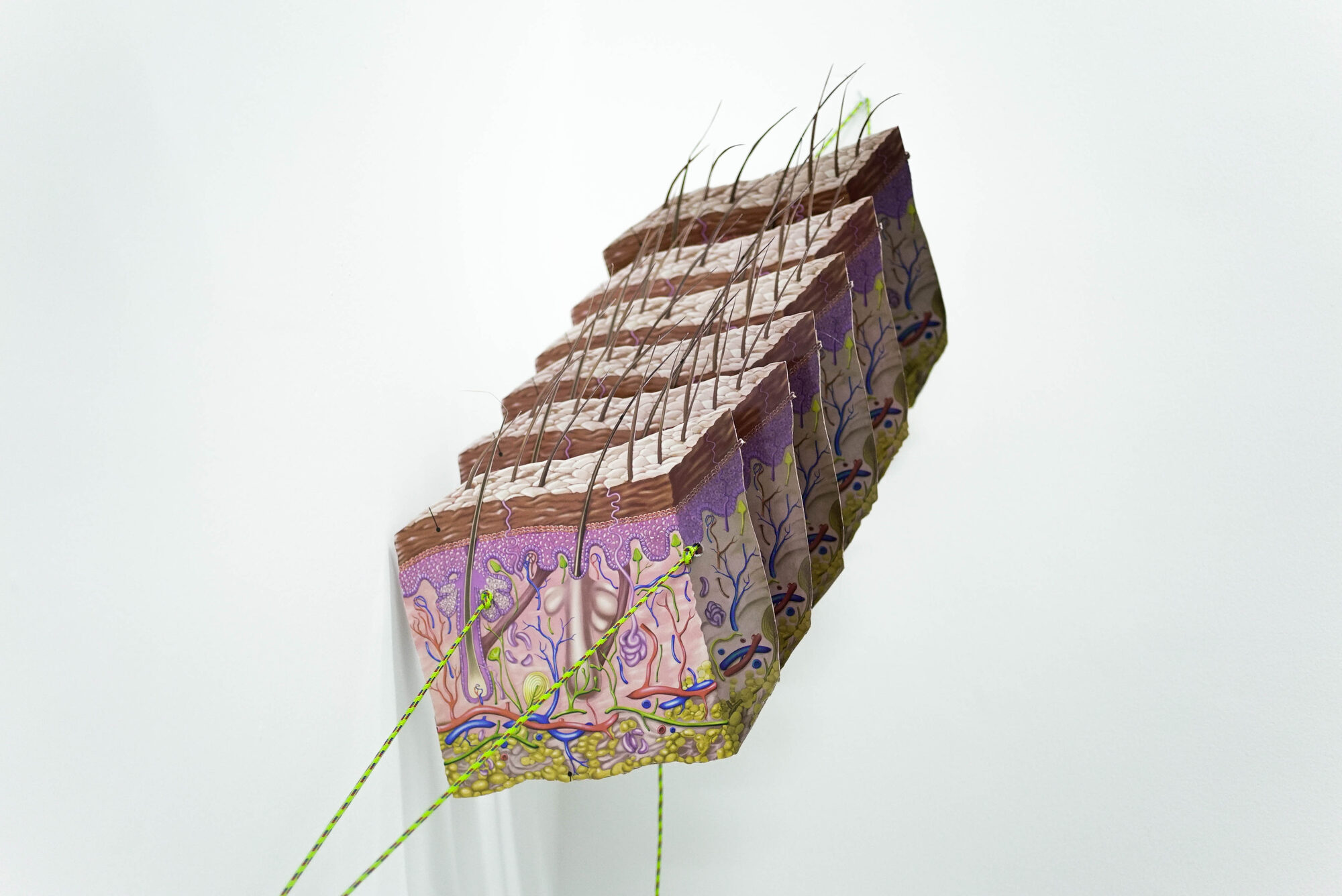
En una librería del centro me encontré una extensa colección de láminas pedagógicas ilustradas sobre diversos y variados temas. Muchas de estas láminas estaban dedicadas al cuerpo y a la biología en general. La impresión en serie me pareció una especie de símil de la reproducción de cuerpos (biología reproductiva), había algo físico y -al mismo tiempo- técnico y gráfico. Me propuse corporeizar esa información, jugar con las imágenes. Dotar a lo plano de una suerte robustez, intentando darle corporalidad. Hacer de lo plano algo tridimensional.
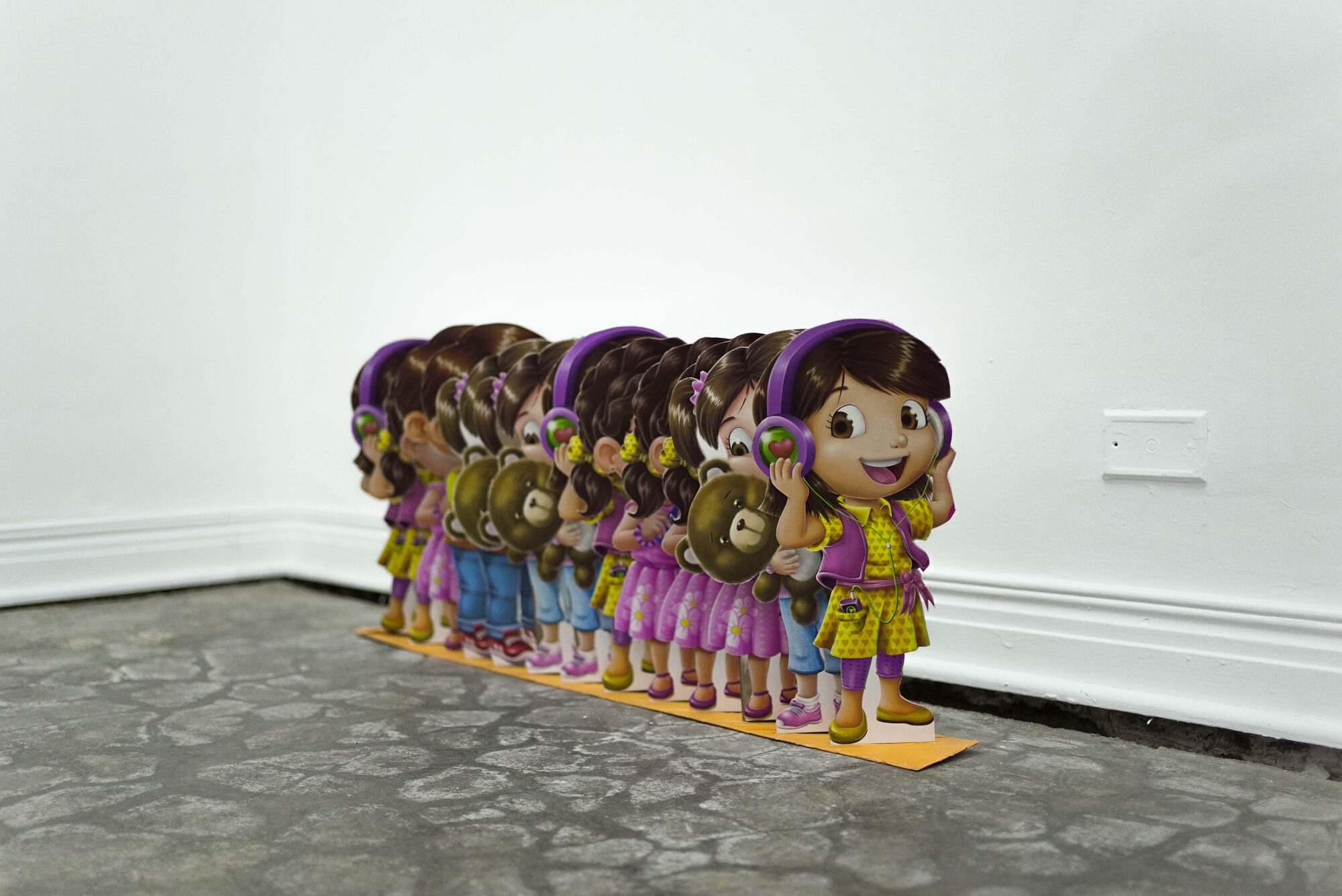
La imagen de seres mutantes es muy importante para la cultura Moche, seres un poco humanos, un poco animales. Cuerpos sobre -o hiper- naturales en los que convergen distintas biologías, híbridos físicos de anatomías revueltas. Los atributos de varias especies figuran seres extensamente representados en sus murales o piezas de cerámica. La serpiente aparecía con mucha frecuencia. La imagen impresa de estas caricaturas de niños me permitió repetir sus cuerpos, como estirándolos, multiplicados como un virus. “Serpiente” llamé a este primer collage volumétrico que es como una imagen tartamuda, que vuelve a aparecer, repetida y prolongada. Y así jugué a entrecruzar lo gráfico, como tratando de producir volúmenes a partir de la repetición y el recorte de imágenes.
Trujillo está lleno de información y estímulos. Es una ciudad colorida, ruidosa. Hay mercados (de todo tipo), olores, ruinas, una ciudad colonial a la que se le superponen imaginarios diversos. Actividades comerciales, festejos, todo en estado de convivencia y contigüidad.
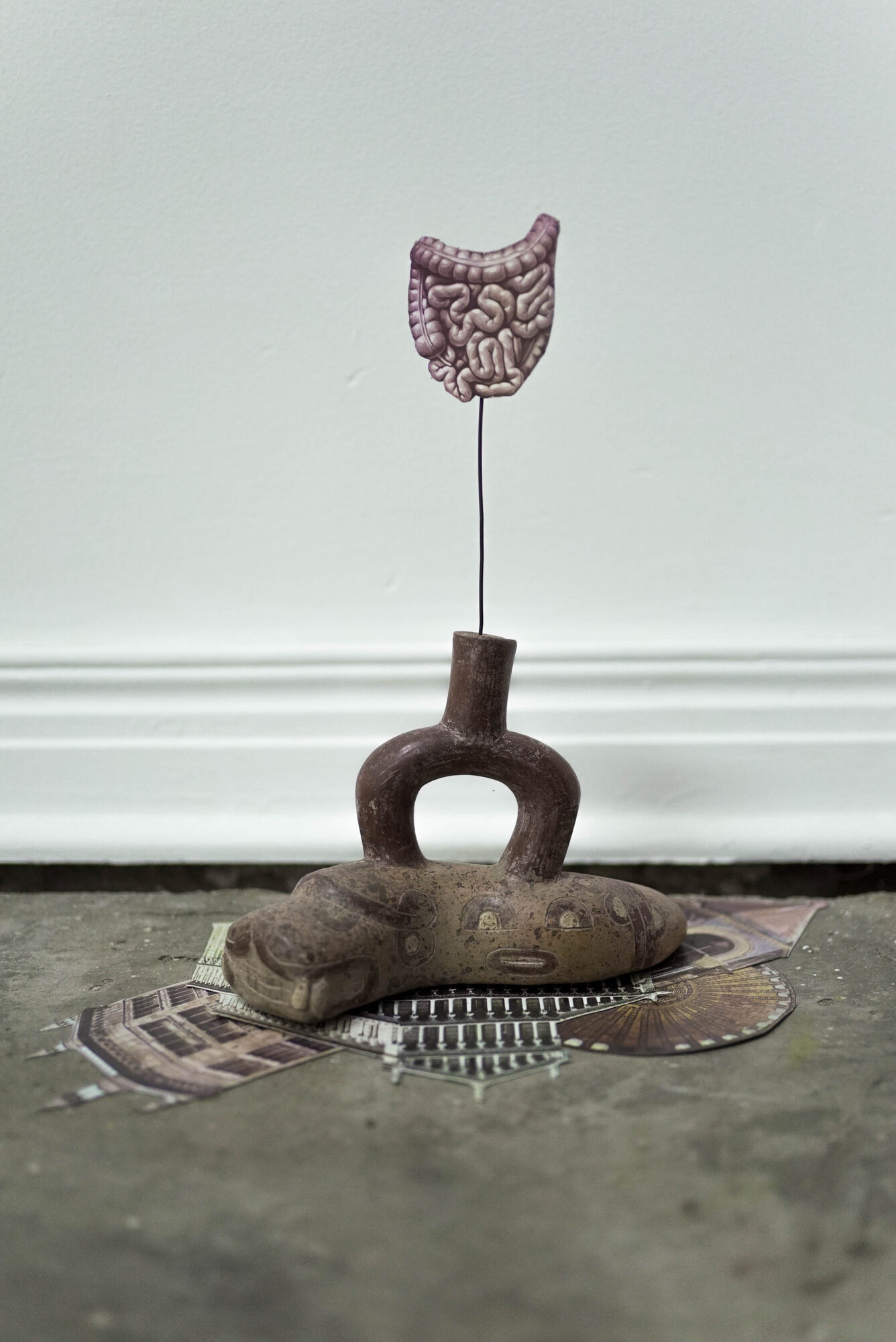
Hay un motivo de la cerámica Mochica denominado (por los arqueólogos) como “Mundo Horroroso”, que consiste en una especie de cuerpo híbrido. Son como unos tubérculos amorfos, en cuya superficie podemos reconocer partes animales, biologías diversas. Piernas, ojos, dientes se encuentran distribuidos en la superficie de estos cuerpos de apariencia subterránea, complejizándolos, incluso hacia lo deforme. Los arqueólogos bautizaron este género representativo, imagino que, reconociendo en este una suerte de angustia, un caos insurrecto, pero muchas ciudades sudamericanas son un poco así; unas estructuras vivas y extensas, en las que se superponen formas y anatomías diversas. Un poco como esta imagen que ya señalaba de Trujillo, una suerte de ciudad por capas, todas palpitantes, todas simbólicas, todas mezcladas.
¿Qué paseos, conversaciones, imágenes intercedieron o permanecen en tus recuerdos cuando revisas las piezas/investigaciones que se generaron?
La Plaza fue un lugar muy interesante de ocupar, un lugar muy popular, siempre lleno de gente, un especie de “mundo horroroso” (hermoso) en la realidad, un lugar múltiple. Está rodeada de iglesias, edificios administrativos, en el centro una enorme escultura donada por Rusia que despliega cuerpos atléticos en clave modernista. En este entorno vi acciones de arte, bandas musicales, comparsas, gente disfrazada de personajes de Disney y muchas situaciones inusuales.
Pero sin dudas los lugares más influyentes fueron el Mercado y las ruinas de Chan Chan. En el mercado vi situaciones corporales muy sorprendentes, animales abiertos, geometrías viscosas de órganos de colores, exhibidas sin pudor. El mercado es además un espacio de encuentro de los alimentos con el cuerpo, un espacio sanador, al que llegan las materias primas para luego ser ingeridas por los cuerpos de la ciudad. Todas las mañanas me tomaba un jugo de Betarraga con Manzana, mi pequeño ritual corporal, momento de salud para luego comenzara funcionar. En el mercado conocí gente y vi cosas muy estimulantes. Ya hablé de las vendedoras de jugo. Me interesaba ver también como los vendedores ordenaban sus productos usando criterios de forma, tamaño o color. Una importante influencia artística, el mercado despliega unas sensibilidades muy estimulantes.
La relación con los curadores fue muy rica, de verdad se preocuparon de que mi experiencia de la ciudad fuese de inmersión, me llevaron por barrios, mercados, museos, y muchos sitios arqueológicos. Conocí zonas costeras como Buenos Aires o Huanchaco. La huaca de la Luna, Chan Chan, el Brujo y la Huaca de la Dama de Cao. De verdad espacios muy fascinantes, que despliegan ciudades y templos a medio desenterrar con muchos vestigios culturales. Estando en Chan Chan tuve un momento muy importante y que influenció el proceso de trabajo. Desde la ruinosa ciudad se puede escuchar el mar constantemente pero no el sonido de Trujillo. De alguna manera hay una especie de puente sonoro que conecta la antigua ciudad con la costa. Esto me trajo nuevamente la imagen de la serpiente, una anatomía con dos extremos y sin otras ramificaciones (extremidades). Este vinculo entre naturaleza y cultura me influenció mucho, como una observación material que me permitió desarrollar algunas de las piezas que son parte de la exhibición.
What I know about my body; what my body knows about me.
Interview by Mercedes Lopez concerning the exhibition and residency period held at Paijan in Trujillo .
“Uniqueness, edges, and boundaries are what living beings have the least of—this applies to both parts and wholes.”
Bruno Latour
Mercedes: What were your days like in Trujillo? What surprises did the city hold for you? What did you expect from this place, and what were you looking for?
Javier: The days were very stimulating; I tried to be outside as much as possible—walking, eating, observing, and talking to people. I must express my deepest gratitude to Gerardo Chávez-Maza and Alberto Mendoza, who run Paijan and organized activities that introduced me to the city and its surroundings. When I went to the studio, I worked very hard, often late into the night. I didn’t have much time to create, so I worked without overthinking, though I did keep a few central ideas in mind.
To be honest, I wasn’t sure what I was looking for, but I recognized in the city of Trujillo a territory where a series of beliefs overlap—different worldviews that encompass the world and everything that makes it up: the landscape, biology, spirituality, beliefs, and politics, just to name a few. Each worldview establishes an ideological reality within the territory, like overlapping environments in which each element is a trace—a sign pointing to the emergence of an interpretive capacity that, in our view, manifests itself through culture. The material world is a reality we interpret; what we see is not devoid of beliefs. I wanted to trace these different overlapping cultural realities. I tried to be a kind of archaeologist working on the overlapping layers of ideas that occupy the city’s space. I soon decided to focus on the “body” and the ways in which different cultural forms interpret and perceive it. So the city itself became a kind of body to me, and I saw myself as an ignorant surgeon—yet one eager to operate. I wanted to be a blend of psychologist and archaeologist. I moved within it—within that corporeality that is the city—trying to trace elements that would allow me to formulate a diagnosis in the form of an exhibition.
Mercedes: During the residency, did new insights, reflections, thoughts, or chains of association emerge in relation to your previous research?
Javier: Without a doubt. Now, there are some things I can articulate and others that take root in mysterious, subtle ways (which is what one expects from residencies). Trujillo itself was a very important influence. For some time now, I’ve felt that the forms characteristic of pre-Columbian cultures are very valuable art forms that we’ve severed from the linear progression of human-made artistic production. The vestiges of pre-Columbian cultures are today treated as objects belonging to extinct cultural realities, disconnected from the present—matters that can only inhabit historical museums. In Europe, this disconnection is not so radical. They still inhabit medieval cities, the art they produced evolved into the present art forms, It was not abruptly discontinued as it happened here; the timeline constructed by the artistic objects belonging to their cultures is linked to their present—its continuity was never interrupted. This is why I believe it is important for contemporary languages to reconnect with pre-Columbian forms of expression—the symbolic and formalist language of the people who inhabited the American continent before colonization.
Their objects are, in a way, a message—like a bottle with a letter cast into the sea—waiting to be discovered and interpreted. These vital elements can help us bridge the gap (like a wound) that separates us from extinct American cultures; their objects are signs that have withstood the test of time, material manifestations of their presence, a cultural testimony, but also the legacy of a symbolic language. For quite some time now, I have been drawing Moche crafts. I was not interested in altering their form (artistically distorting them); rather, I want to use them as a model—as a tribute—but also to become an instrumental vehicle for relocating these imaginaries into our cultural spaces. In this way, I see myself as a cross-cultural collaborator. An agent who can bring an image created by an artist of the past into the art venues of the present. I’m not so much interested in altering the original object; my intention has not been to comment on or rethink it, but rather to transport it to the present, linking those art forms with contemporary sensibilities. In this instance, I worked differently—as a creator, I was more confused, in a state more inclined toward experimentation. However, there is one piece we created in collaboration with the University Archaeological Museum that allowed me to handle a stone sculpture depicting a strange being—a sort of head with a short body, like a slug with ears. With the help of Gerardo and Alberto, we covered it with successive layers of metallic kitchen foil. This enabled us to make a fragile copy of a centuries-old stone artifact. The presence of that replica of the sculpture from the museum (another time) is very valuable to me. In a way, I tried to gather ideas surrounding the body, attempting to interpret, engage in dialogue, and negotiate with certain pre-Columbian concepts rooted in Trujillo and bring them into my process of thought, research, and creation.
Mercedes: Were there any exchanges with the community?
Every day I drank beet and apple juice. Little by little, I began talking with the women who prepared it at the market. We grew fond of one another. They used a very simple machine to peel the oranges, removing the peel with a kind of knife that turned it into a long strand, like hair—a rope of orange peel. They piled them up into sort of “mounds of hair”—lush volumes of strands made of orange peel, very corporeal. Through this process, they separate the orange into pulp (which enters human bodies) and fiber (the peel turned into a mane). They gave me this citrus volume; they saved it for me every day. I began to arrange it on a clothes hanger, as if creating a giant head of hair, which then became a sort of presence—a levitating body with the scent of oranges that accompanied me daily in the space I used as a studio. As I added more material, the ghost grew sturdier, like a developing muscle. The presence seemed to take on more and more the proportions of a body. This piece was included in the exhibition—a volume whose presence resembles that of a person, made from the part of a fruit that we usually discard.
Mercedes: How did you come across the shapes and colors that make up the exhibition?
In a bookstore downtown, I came across an extensive collection of illustrated educational prints on a wide variety of topics. Many of these prints were devoted to the body and biology in general. The mass-produced prints struck me as a kind of metaphor for the reproduction of bodies (reproductive biology); there was something physical and—at the same time—technical and graphic in them. I set out to give that information a physical form, to play with the images. To endow the two-dimensional with a certain robustness, trying to give it corporeality. To turn the flat into something three-dimensional.
The image of mutant beings is very important in Moche culture—beings that are part human, part animal. Supernatural or hyper-natural bodies in which different biologies converge, physical hybrids of jumbled anatomies. Beings featuring attributes of various species are extensively depicted in their murals and ceramic pieces. The snake appeared very frequently. The printed image of these children’s caricatures allowed me to repeat their bodies, as if stretching them out, multiplied like a virus. I called this first volumetric collage “Serpent”; it is like a stuttering image that reappears, repeated and prolonged. And so I played with interweaving the graphic elements, as if trying to produce volumes through the repetition and cutting out of images.
Trujillo is full of information and stimuli. It is a colorful, noisy city. There are markets (of all kinds), smells, ruins, a colonial city overlaid with diverse imaginaries. Commercial activities, celebrations, all coexisting side by side.
There is a motif in Mochica pottery referred to (by archaeologists) as the “Horrid World,” which consists of a sort of hybrid body. They resemble amorphous tubers, on whose surface we can recognize animal parts and diverse biological forms. Legs, eyes, and teeth are distributed across the surface of these subterranean-looking bodies, adding complexity to them—even verging on the grotesque. Archaeologists named this representative genre—I imagine—because they recognized in it a kind of anguish, a rebellious chaos, but many South American cities are a bit like that: vast, living structures in which diverse forms and anatomies overlap, we could even say this suits as a depiction of a jungle or a lake. A bit like this image I mentioned earlier of Trujillo—a sort of layered city, all of them pulsating, all of them symbolic, all of them intertwined.
Mercedes: What walks, conversations, and images came to mind or linger in your memories when you look back at the works and research that emerged?
Javier: The Plaza was a very interesting place to spend time—a very popular spot, always full of people, a sort of (beautiful) “horrific world” in reality, a multifaceted place. It’s surrounded by churches and administrative buildings; in the center stands a massive sculpture donated by Russia that displays athletic bodies in a modernist style. In this setting, I witnessed art performances, musical bands, parades, people dressed as Disney characters, and many unusual situations.
But without a doubt, the most influential places were the Market and the Chan Chan Ruins. At the market, I saw some truly surprising bodily scenes—animals laid open, viscous geometries of colorful organs, displayed without shame. The market is also a space where food meets the body, a healing space, where raw ingredients arrive to be later consumed by the city’s inhabitants. Every morning I drank a beetroot and apple juice—my little bodily ritual, a moment of wellness to get me going. At the market, I met people and saw very stimulating things. I’ve already mentioned the juice vendors. I was also interested in seeing how the vendors arranged their products based on shape, size, or color. An important artistic influence, the market reveals some very stimulating sensibilities.
My relationship with the curators was very enriching; they truly made sure my experience of the city was one of immersion. They took me through neighborhoods, markets, museums, and many archaeological sites. I explored coastal areas like Buenos Aires and Huanchaco. The Huaca de la Luna, Chan Chan, El Brujo, and the Huaca de la Dama de Cao. Truly fascinating places, revealing half-unearthed cities and temples with many cultural relics. While in Chan Chan, I had a very significant moment that influenced my creative process. From the ruined city, you can constantly hear the sea but not the sounds of Trujillo. In a way, there’s a sort of sonic bridge connecting the ancient city to the coast. This brought the image of the serpent back to me—an anatomy with two ends and no other branches (limbs). This link between nature and culture influenced me deeply, serving as a material observation that allowed me to develop some of the pieces that are part of the exhibition.
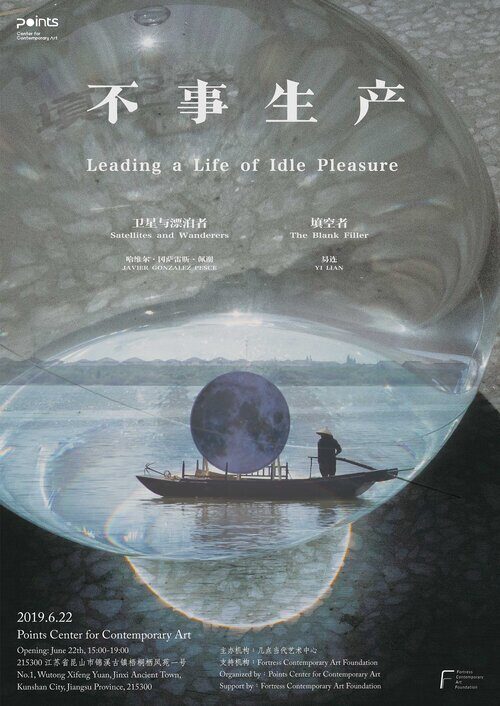
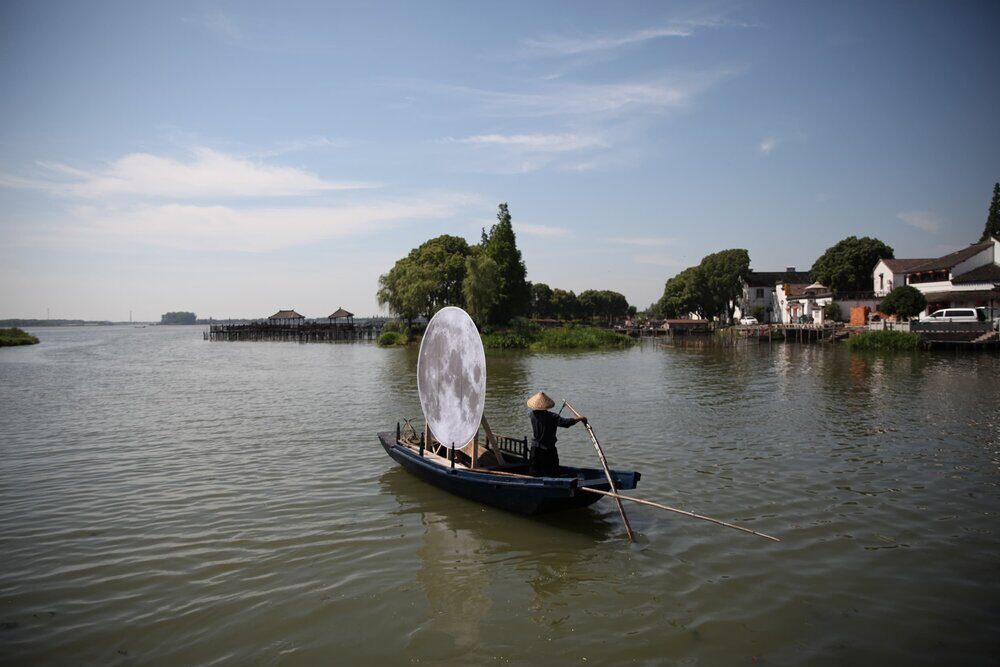
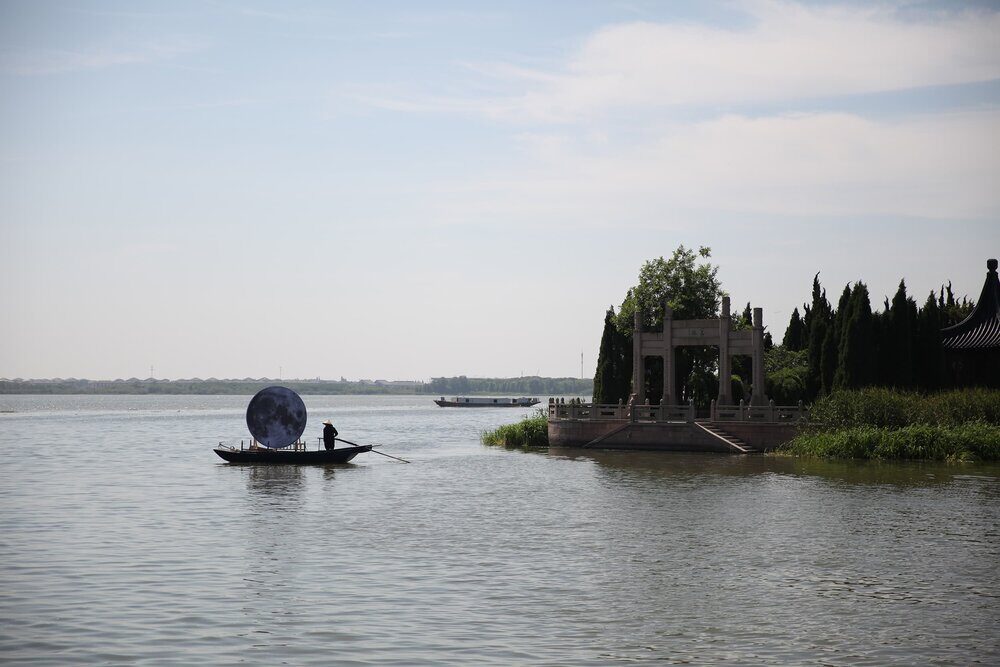
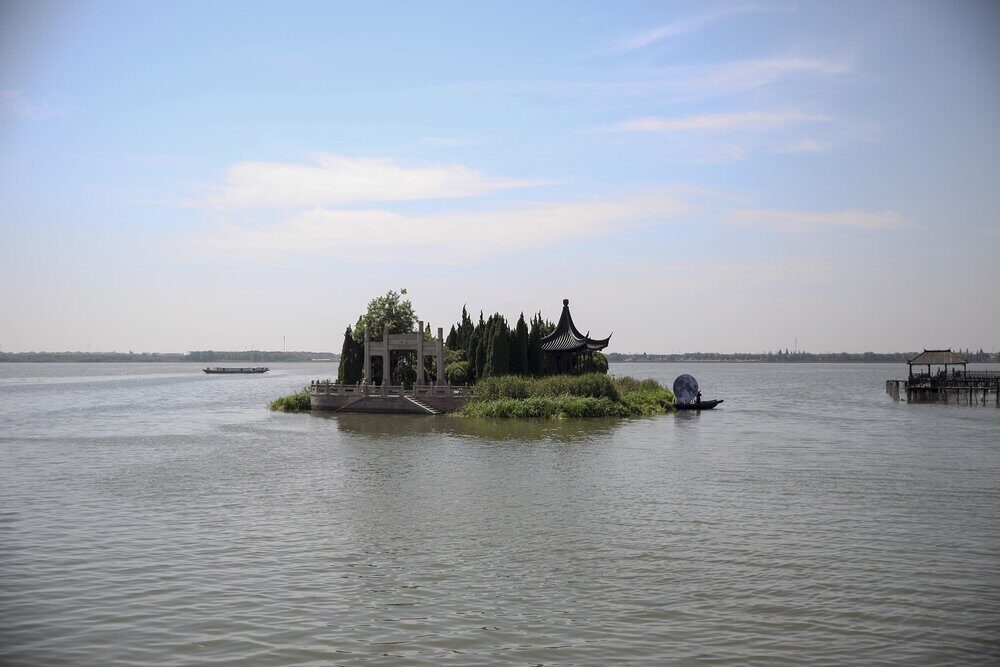
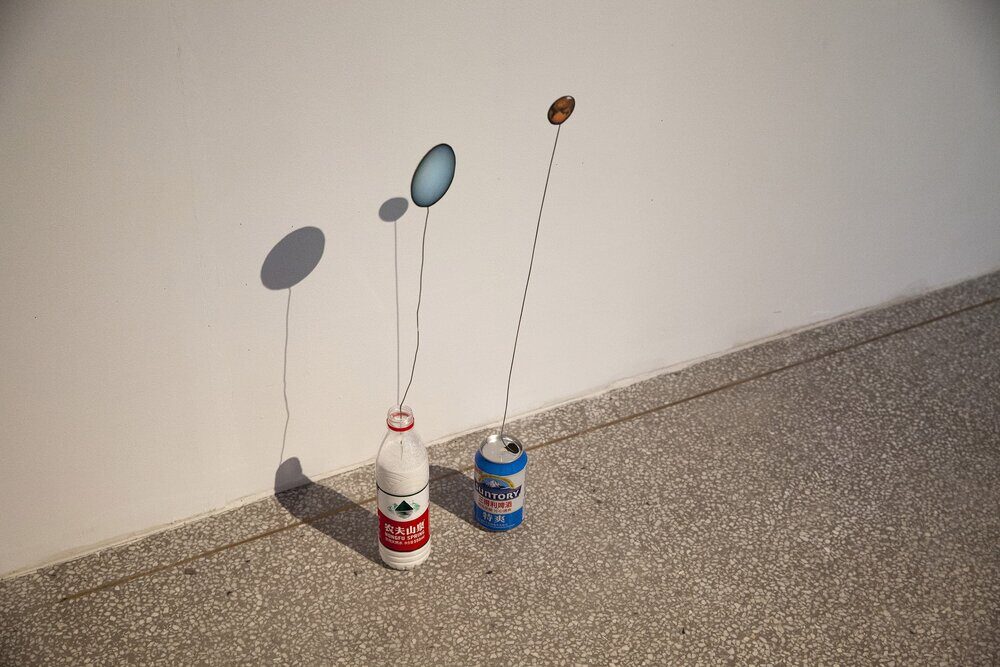
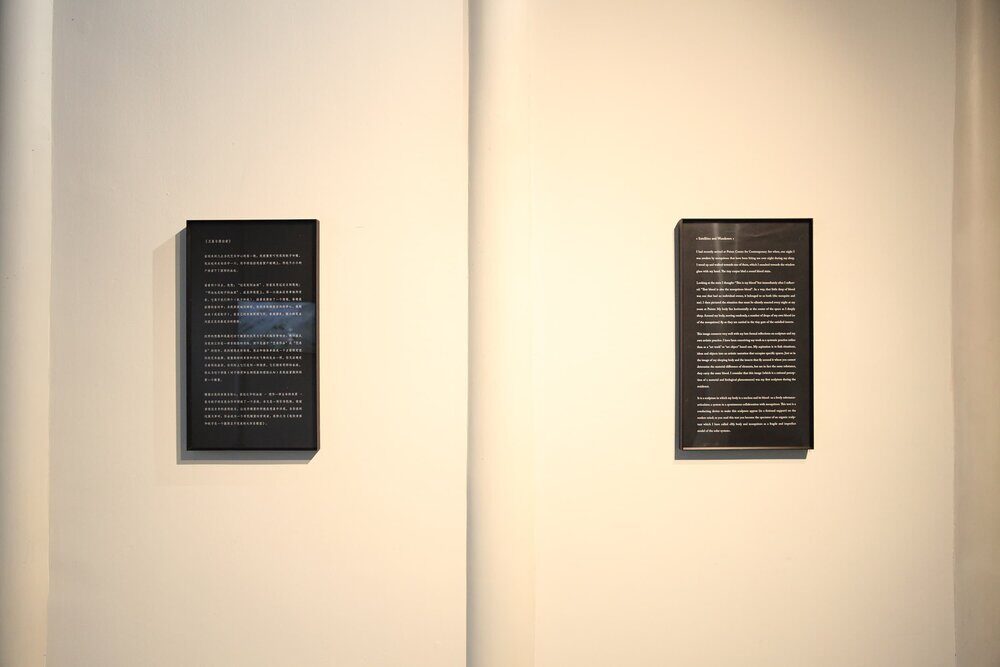
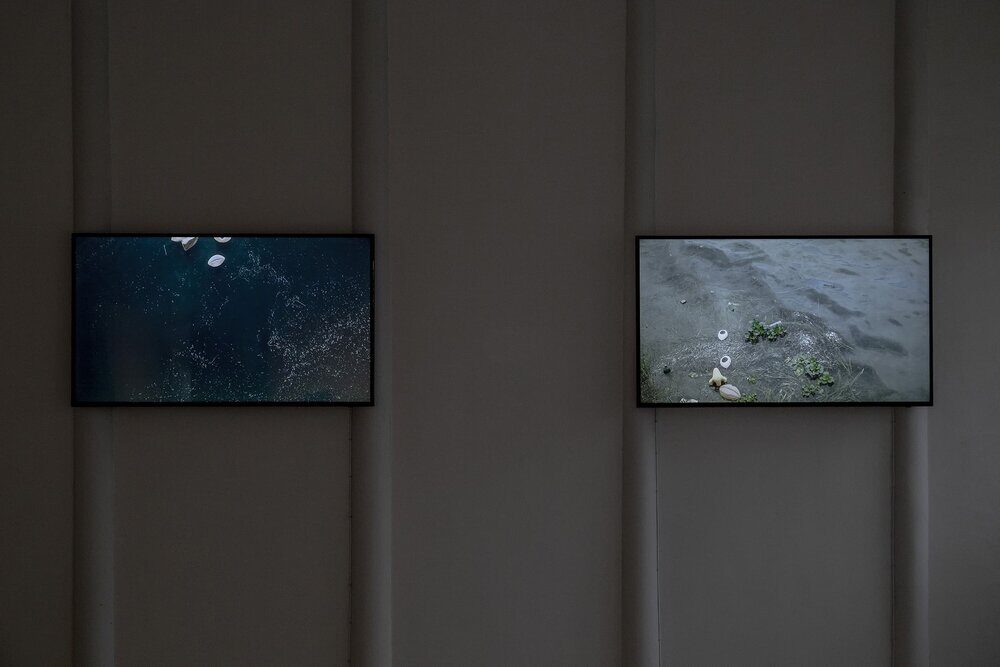
Satélites y errantes
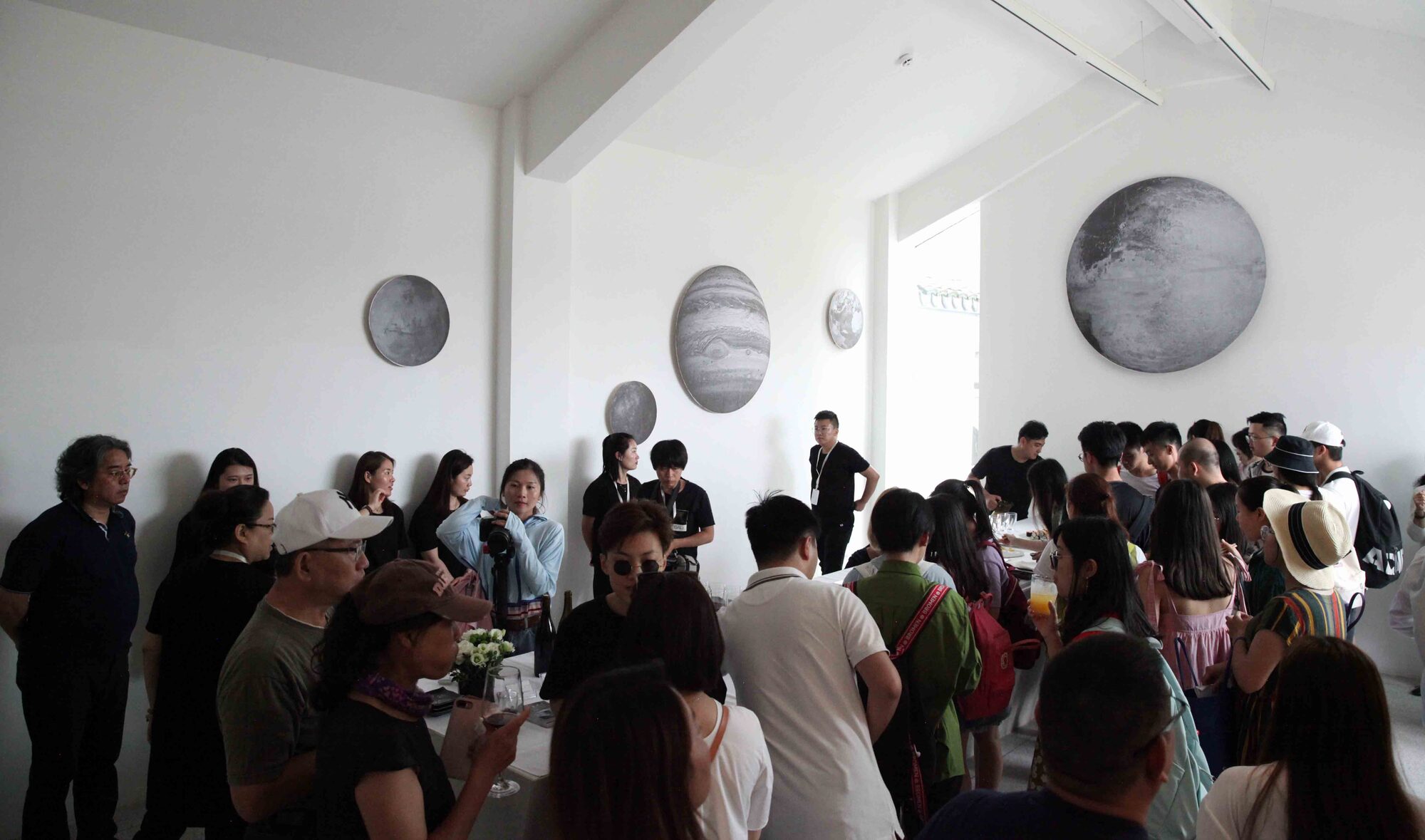
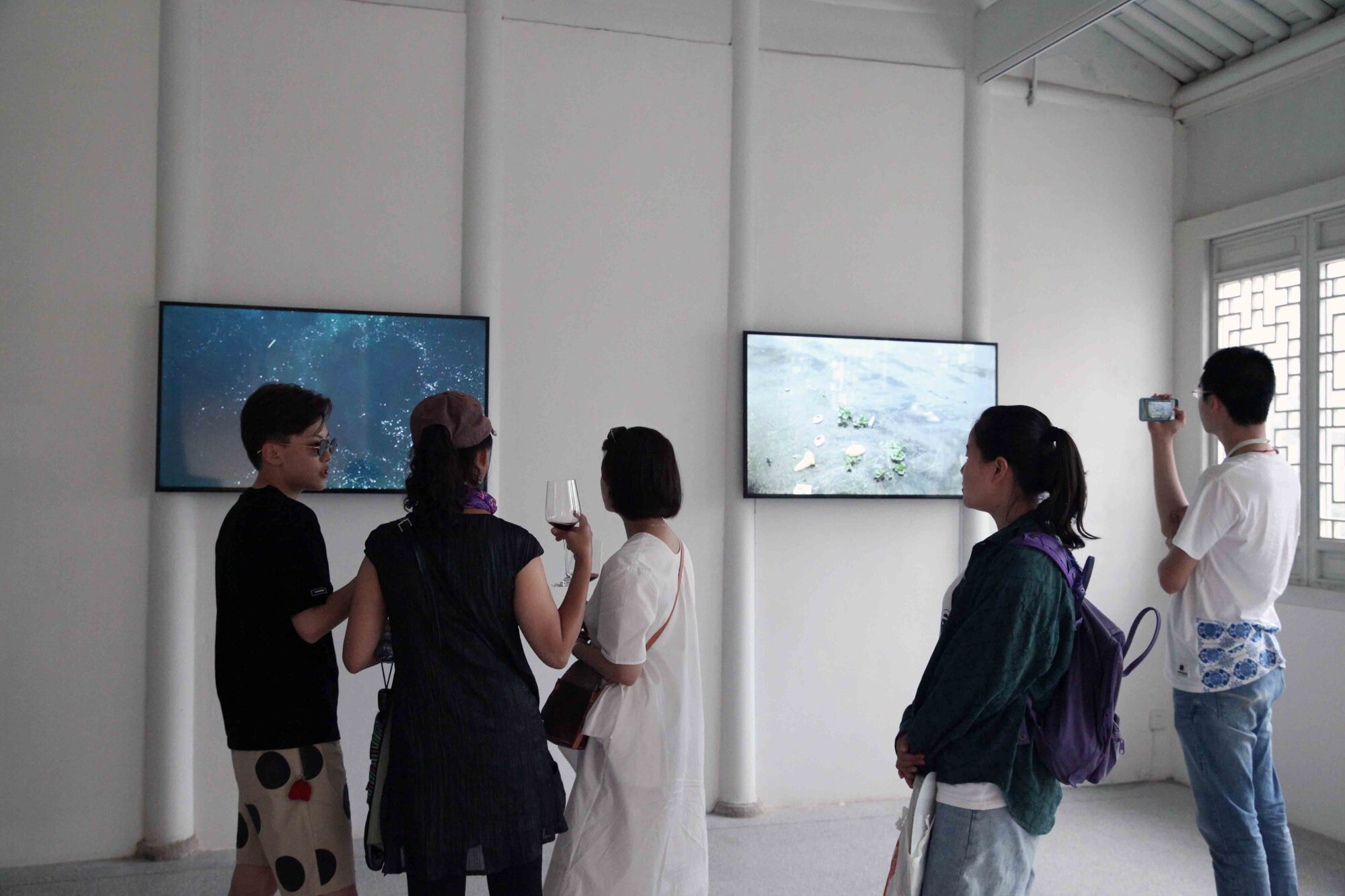
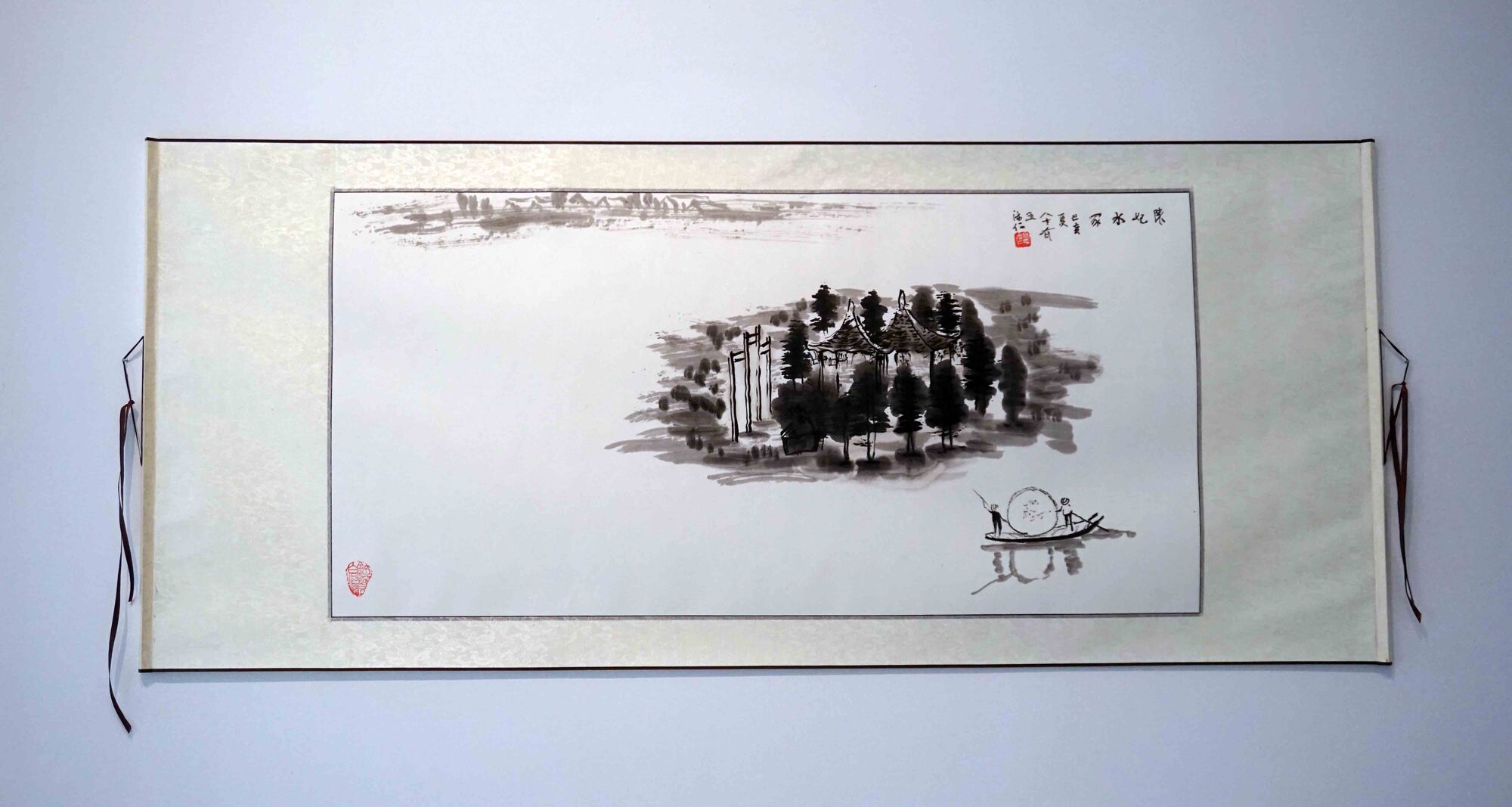
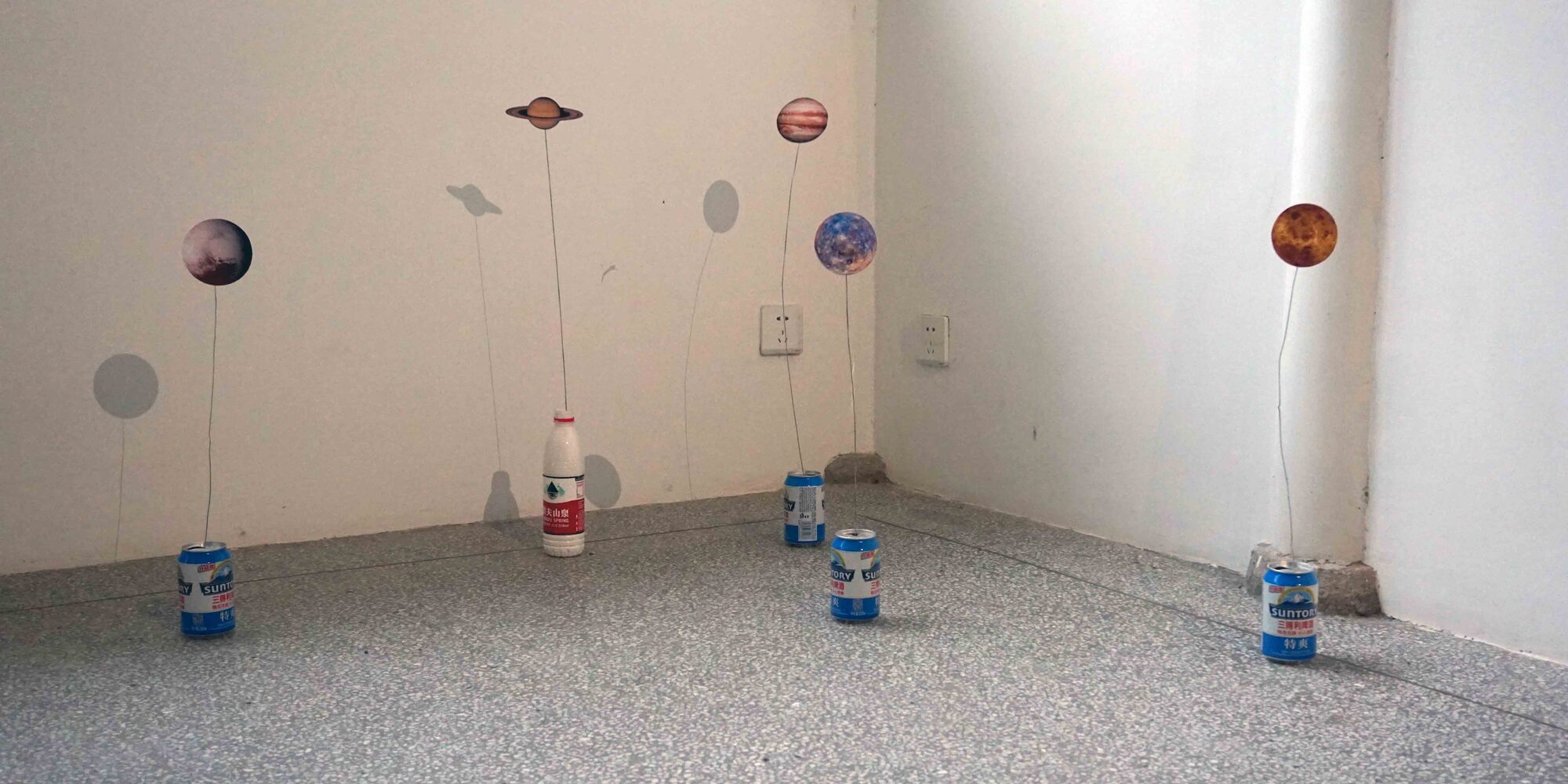
Entre los meses de mayo y junio fui invitado a realizar un periodo de residencia artística, culminando en una exhibición personal en el espacio Points Center for Contemporary Art, en el pueblo chino de Jinxi, entre Shanghai y Suzhou.
Debe haber sido en la primera semana de mi estadía, cuando en la mitad de una noche, me despertaron los desagradables zumbidos de un zancudo que revoloteaba cerca de mi cabeza. Un movimiento de mi mano lo reventó contra la superficie blanca de la pared. Cuando la luz de la mañana iluminó el espacio, logré constatar que, junto al diminuto y flaco cadáver, había una redonda mancha de sangre. “Esta sangre es mía”, pensé. La verdad es que esa gota de sangre no era mía, probablemente había sido mía hasta que el pequeño insecto la hubiese extraído desde mi cuerpo. Ese material orgánico, una sangre (de incierto dueño) había transitado desde el interior de un cuerpo hacia el interior de otro, siendo en ambos una sustancia vital del organismo. Esta pregunta por la propiedad de esta gota de sangre me llevó a pensar que no me pertenecía ni a mí ni al mosquito, sino al sistema del que ambos somos parte; la gota de sangre es del espacio que habitamos, más que del cuerpo de alguno de los dos, así como pasa con otras sustancias que circulan de manera más promiscua de cuerpo en cuerpo, de superficie en superficie, de esófago en esófago.
El aire es tragado y devuelto al ambiente para que quede a disposición de bocas, poros, narices y otras cavidades de quienes respiramos. Así pasa también con otras sustancias vaporosas que escapan de unos cuerpos para luego tocar otros o condensarse en el espacio cambiando su forma. Las ideas fluyen también de manera similar: transitan desde el interior intelectual de personas y se verbalizan o se vuelven gesto, encontrándose en el espacio, fluyendo. Y así también ocurre con otras sustancias o modos, el movimiento de cuerpos, la forma en que emitimos sonidos u ocupamos el espacio.
De alguna manera nos movemos en un espacio de transferencias, en el que desplegamos coreografías que se coordinan con la sola insistencia de nuestros cuerpos en espacios comunes que compartimos con otros cuerpos humanos, animales, vegetales, materiales y presencias sensibles de diversas categorías. Entre los cuerpos y las materias habría un sin fin de elementos (presencias químicas, ondas conductuales de comportamiento social, maneras de ejecutar sonidos y movimientos). Pensé entonces en eso en que me convierto cuando duermo (un cuerpo exudante y que alucina sueños mientras yace como un muerto que respira), y en ese espacio que me aloja obscuro, me convierto en una especie de órgano ensimismado en mis funciones vitales, alojado en un espacio que de alguna manera también duerme, se vuelve silencioso y quieto respecto de sus funciones.
Ambos nos apagamos, pero otros pequeños cuerpos inician rutinas noctámbulas. Ese espacio que habitamos (los mosquitos, algunas arañas y yo) se me hizo entonces la anatomía de un vínculo: el espacio en el que sistemas orgánicos se desarrollan más allá de mi conciencia y en contacto con mi cuerpo. Imaginé a mi cuerpo acostado al centro de la habitación, mientras pequeños organismos puntiagudos extraían gotas de mi sangre, para luego ponerse a revolotear a mi alrededor. Esto funcionaba entonces como una situación física (compuesta de un cuerpo central y varios cuerpos orbitantes) que operaba todas las noches, al margen de mi conciencia, pero con mi presencia física como núcleo. Mi cuerpo dormía mientras gotas de su sangre revoloteaban a su alrededor acarreadas en los estómagos de pequeños insectos.
Esta imagen se volvió una referencia importante para el proceso de trabajo que me aprontaba a realizar y resulta paradigmática para la manera en la que me encuentro actualmente (y desde algunos años) concibiendo mi trabajo. La noción de sistema como una alternativa formal para la configuración de piezas artísticas se empezó a consolidar dentro de mi proceso de obra. Siempre me he considerado (o más bien sentido como un) escultor, y en este sentido la noción de unidad o unicidad, siempre ha tenido relevancia. Sin embargo, muchas veces, esas unidades que configuro como parte de mi obra, se componen de partes, partes que constituyen sistemas. Esta imagen que relataba al comienzo del texto, es una buena referencia para dar cuenta de una manera en la que he operado formalmente en los últimos años, donde configuro esculturas como estructuras sistémicas. Esto quiere decir que una pieza específica pudiese, sin dejar de ser una unidad en términos de su estructura formal y de sentido, estar constituida en su unicidad por partes diferentes, e incluso distantes, sin dejar de ser la misma estructura, la misma cosa, constituir un mismo cuerpo. Esto quiere decir que las partes diferentes, no solo están conectadas, sino que son lo mismo, son partes constitutivas de una unidad. Para que esto pueda suceder –según mis observaciones- las partes deben constituir un sistema, poseer una misma materia constitutiva, la que debe proyectar el vínculo a través del espacio.
El cuerpo humano, un bosque o el sistema solar, son en sí unidades constituidas de elementos individualizables, pero interconectadas de manera tal que configuran unidades sistémicas, cuerpos en actividad. Esto quiere decir que el espacio entre una cosa y otra no es percibido como un agente de separación, esta distancia sería más bien una especie de pegamento sin materia visible, sin presencia continua y lineal; un puente que no se ve, pero que sin embargo conecta, sostiene. La falta de continuidad material no implica discontinuidad en términos de estructura, pero si de percepción visual. Creo que estos sistemas dependen de una energía atractiva que mantiene las cosas en su lugar, a una distancia y en una armonía (relativa).
Sistemas por tanto conforman los planetas en torno al sol, las piedras reposando contra el suelo mientras la fuerza gravedad las empuja hacia el fondo de la tierra, las aves que migran de continente en continente siguiendo las condiciones para la vida, un partido político como núcleo de atracción de sus adeptos o una pareja de enamorados. En todos estos casos existe una sustancia invisible que reúne, que procura un vínculo y, que independiente de los movimientos físicos en el espacio de los cuerpos que componen el sistema, estos mantienen una conexión particular, que hace que la distancia entre ellos sea de una cualidad particular.
Desde hace algún tiempo que este viene siendo el núcleo de mi investigación: las sustancias invisibles que tienen la capacidad de hacer que las cosas activen relaciones, la materia atractiva que procura que cuerpos se mantengan a distancias y en operaciones sistémicas. Entre estas materias sin cuerpo podemos enumerar al amor, las ideologías políticas, la gravedad o la economía (la más aterradora de todas), entre otras.
Me propuse ocupar la ciudad de Jinxi como un espacio físico para la instalación de modelos de sistemas. En la ciudad abundan los karaokes. Un primer gesto consistió en generar un modelo del sistema solar en torno a uno de ellos. Me acerqué a estos negocios y pregunté si tenían alguna canción que tuviese como tema central al sol. En occidente es muy usual que las canciones de amor utilicen al sol como una metáfora de la persona amada (lo que deja de manifiesto la condición atractiva tanto del amado como del sol). Sin embargo, la mayoría de las canciones sobre el sol en China hacen referencia metafórica a la figura de Mao (principalmente). Esta situación me pareció en extremo interesante, ya que creo que el amor y la política son dos formas polares que toma el impulso atractivo en la experiencia humana. Me sorprendió encontrarme con que la música popular china vincula a su máxima figura política (de la historia reciente) al núcleo de nuestro sistema solar, figura que sin duda da cuenta de una manera más colectiva de entender las pasiones en contraposición a Occidente.
De esta manera, me hizo sentido que, si el centro del sistema representaba doblemente a Mao y al sol, en torno a este núcleo orbitasen personal, trabajadores locales. Este modelo del sistema solar estaba compuesto, por tanto, por una situación en el centro (a modo de núcleo) en el que personas cantan una canción que trata simultáneamente sobre el sol y sobre Mao, en torno a la que unas personas orbitaban mientras acarreaban imágenes de los planetas del sistema solar. La duración de esta situación es la misma que la de la canción. Unos carteles con imágenes impresas de los planetas del sistema solar orbitaron al karaoke, así como los mosquitos revoloteaban en torno a mi cuerpo.
Una segunda situación consistió en reproducir la relación de la tierra y la luna. Para esto, un bote tripulado por dos personas acarreó la imagen de la luna en torno a una pequeña isla en las afueras de la ciudad. De esta manera, la luna orbitó en torno al pedazo de tierra que parecía flotar en el agua. Esta isla resulta ser además la tumba de la emperatriz Chen. Por muchos años este fue un espacio que convocaba a personas como un hito con contenido político e histórico, componentes que hoy (además de su belleza) lo convierten en un atractivo turístico. Produje un video de la situación, el que posteriormente usé como imagen referencial con el que un pintor tradicional local desarrolló una serie de pinturas que hoy se encuentran en su tienda, en la entrada a la ciudad. Me interesaba que esta situación –por medio de su colaboración- infiltrase el imaginario de la ciudad como una imagen surrealista con un carácter mítico, o como una situación habitual (la puesta de la luna en el horizonte del lago), como una situación construida e instalada materialmente en su espacio original.
Además, me propuse dar continuidad a otra línea de trabajo en la que me encontraba junto antes de partir a China. Estaba generando modelos del cuerpo humano por partes, las que instalo sobre la superficie de ríos o mares para luego observarlas desarticularse mientras son empujadas por vientos o corrientes. La ciudad de Jinxi se ofreció como un lugar perfecto para estos experimentos, considerando que tiene una alta presencia de ríos, canales y lagos. Edité y exhibí una pieza que había filmado anteriormente en la Laguna Piedra Roja en Santiago, junto a un video que generé especialmente en la residencia: Rostro Humano 1 y Rostro Humano 2.
En Rostro Humano 1 vemos reproducciones a gran escala de partes del rostro (una nariz, dos ojos y una boca) flotando empujados por vientos y corrientes. De esta manera, el rostro es desarticulado por fuerzas ambientales, las que re-editan la configuración de sus elementos. Un cuerpo humano entra en escena e insiste en organizar las piezas para volverlas a la versión ordenada de estas donde reconocemos al rostro. Siento que esta pieza nos exhibe una situación en la que vemos un áspero (sin embargo, fluido) diálogo antagónico entre la voluntad humana por dominar, controlar, regularizar e intervenir con el fin de producir códigos que le son propios, en oposición a una voluntad del medio natural por fluir y proponernos nuevas versiones de lo que conocemos. La voluntad humana de control se irrita ante el constante cambio que propone la naturaleza e insiste (de manera obstinada y poco fructífera) en devolver las cosas a la versión que le parece la adecuada. Las corrientes y ondas son gentiles pero constantes; parecieran insistir en que mirar las cosas desde otro orden es una necesidad.
Rostro Humano 2 nos muestra réplicas de los mismos elementos flotando entre la basura que navega en el lago. En este caso, el agua trae a la superficie una serie de desperdicios propios de la actividad humana que se encuentran y revuelven con la representación del rostro como en una cazuela de partes absurdas. En colaboración con las corrientes generé un collage de objetos en movimiento que sin duda nos entrega una visión muy falta de esperanza de la irrupción de la vida humana en espacios naturales.
Si bien las primeras dos piezas buscan reproducir sistemas en el contexto de la ciudad, estas últimas pretenden asociarse a medios acuáticos para proponer la identidad misma del hombre y su relación con el medio, como sistemas que debiésemos poner en crisis y también en movimiento, considerando a las energías propias del ambiente como materia en diálogo con las políticas y formas de la vida humana, sumándolas a un estado integral de convivencia y solidaridad.
Satellites and Wanderers
Between May and June, I was invited to participate in an artist residency, which culminated in a solo exhibition at the Points Center for Contemporary Art in the Chinese ancient town of Jinxi, between Shanghai and Suzhou.
It must have been during the first week of my stay, when, in the middle of the night, I was awakened by the unpleasant buzzing of a mosquito flitting near my head. A flick of my hand smashed it against the white surface of the wall. When morning light illuminated the room, I noticed that, next to the tiny, spindly corpse, there was a round bloodstain. “This blood is mine,” I thought. The truth is that that drop of blood wasn’t mine; it had probably been mine until the tiny insect had drawn it from my body. That organic material—blood (of uncertain origin)—had traveled from the interior of one body to the interior of another, serving as a vital substance for both organisms. This question of ownership of this drop of blood led me to think that it belonged neither to me nor to the mosquito, but rather to the system of which we are both a part; the drop of blood belongs to the space we inhabit, rather than to the body of either of us, just as is the case with other substances that circulate more promiscuously from body to body, from surface to surface, from esophagus to esophagus.
Air is swallowed and returned to the environment so that it remains available to the mouths, pores, noses, and other cavities of those of us who breathe. The same is true of other vaporous substances that escape from some bodies only to touch others or condense in space, changing their form. Ideas also flow in a similar way: they travel from the intellectual interior of people and are verbalized or become gestures, meeting in space, flowing. And so it is with other substances or modes—the movement of bodies, the way we emit sounds, or occupy space.
In a way, we move within a space of transfers, in which we unfold choreographies that are coordinated solely by the presence of our bodies in shared spaces—spaces we share with other human, animal, and plant bodies, as well as materials and sentient presences of various kinds. Between bodies and matter, there would be an endless array of elements (chemical presences, behavioral waves of social interaction, ways of producing sounds and movements). I then thought about what I become when I sleep—a sweating body hallucinating dreams while lying like a breathing corpse—and in that dark space that shelters me, I become a sort of organ absorbed in my vital functions, housed in a space that, in a way, also sleeps, becoming silent and still in its functions.
We both shut down, but other small bodies begin their nocturnal routines. That space we inhabit—the mosquitoes, a few spiders, and I—then struck me as the anatomy of a connection: the space in which organic systems unfold beyond my consciousness and in contact with my body. I imagined my body lying in the center of the room, while tiny, pointed organisms extracted drops of my blood, only to then flit around me. This functioned, then, as a physical situation—composed of a central body and several orbiting bodies—that played out every night, outside the bounds of my consciousness, yet with my physical presence at its core. My body slept while drops of its blood fluttered around it, carried in the stomachs of tiny insects.
This image became an important reference for the creative process I was about to undertake and is paradigmatic of the way in which I currently (and have for several years) been conceiving my work. The notion of a system as a formal alternative for the configuration of artistic pieces began to take shape within my creative process. I have always considered myself (or rather, felt like) a sculptor, and in this sense, the notion of unity or oneness has always been relevant. However, very often, the units I create as part of my work are composed of parts—parts that constitute systems. The image I described at the beginning of this text serves as a good illustration of one way I have been working formally in recent years, in which I construct sculptures as systemic structures. This means that a specific piece could—while remaining a unit in terms of its formal structure and meaning—be constituted in its uniqueness by different, and even distant, parts, while still being the same structure, the same thing, and constituting a single body. This means that the different parts are not only connected but are one and the same; they are constituent parts of a unit. For this to happen—according to my observations—the parts must constitute a system, be made of the same constituent material, which must project the connection across space.
The human body, a forest, or the solar system are, in themselves, units composed of distinguishable elements, yet interconnected in such a way that they form systemic units—bodies in motion. This means that the space between one thing and another is not perceived as a force of separation; rather, this distance is a kind of invisible glue, without a continuous, linear presence—a bridge that cannot be seen but nevertheless connects and sustains. The lack of material continuity does not imply discontinuity in terms of structure, but it does imply discontinuity in terms of visual perception. I believe these systems depend on an attractive force that keeps things in place, at a distance, and in (relative) harmony.
Systems, therefore, comprise the planets orbiting the sun, stones resting on the ground while the force of gravity pulls them toward the earth’s core, birds migrating from continent to continent in search of suitable living conditions, a political party as a center of attraction for its supporters, or a couple in love. In all these cases, there is an invisible substance that brings things together, that fosters a bond, and that—regardless of the physical movements in space of the bodies comprising the system—ensures they maintain a particular connection, giving the distance between them a unique quality.
For some time now, this has been the focus of my research: the invisible substances that have the capacity to enable things to form relationships—the attractive force that ensures bodies remain at certain distances and function within systemic operations. Among these bodiless forces, we can list love, political ideologies, gravity, or the economy (the most terrifying of all), among others.
I set out to use the city of Jinxi as a physical space for installing systemic models.. My first step was to create a model of the solar system around a Karaoke Bar. I approached these establishments and asked if they had any songs whichs lyrics talk about the sun as a central subject. In the West, it is very common for love songs to use the sun as a metaphor for the beloved (which highlights the attractive nature of both the beloved and the sun). However, most songs about the sun in China make metaphorical reference to the figure of Mao (primarily). I found this situation extremely interesting, as I believe that love and politics are two polar forms that the impulse of attraction takes in the human experience. I was surprised to discover that Chinese popular music links its most prominent political figure (in recent history) to the core of our solar system—a figure that undoubtedly reflects a more collective way of understanding passions, in contrast to the West.
Thus, it made sense to me that, if the center of the system represented both Mao and the sun, local workers would orbit around this core. This model of the solar system was thus composed of a central scene (serving as the nucleus) in which people sang a song that dealt simultaneously with the sun and Mao, around which others orbited while carrying images of the planets of the solar system. The duration of this scene is the same as that of the song. Printed images of the planets of the solar system orbited the karaoke performance, just as mosquitoes fluttered around my body.
A second situation consisted of recreating the relationship between the Earth and the Moon. To do this, a boat manned by two people carried an image of the Moon around a small island on the outskirts of the city. In this way, the Moon orbited the piece of land that seemed to float on the water. This island also happens to be the tomb of Empress Chen. For many years, this was a space that drew people in as a landmark with political and historical significance—elements that today (in addition to its beauty) make it a tourist attraction. I produced a video of the situation, which I later used as reference material for a local traditional painter to create a series of paintings that are now on display in his shop at the entrance to the town. I wanted this scene—through our collaboration—to infiltrate the city’s collective imagination as a surreal image with a mythical quality, or as an everyday scene (the moon setting on the lake’s horizon), as a situation constructed and physically installed in its original setting.
In addition, I set out to continue another line of work I had been pursuing just before leaving for China. I was creating models of the human body in parts, which I install on the surface of the sea or lakes to then observe them come apart as they are pushed by winds or currents. The city of Jinxi proved to be the perfect setting for these experiments, given its abundance of rivers, canals, and lakes. I edited and exhibited a piece I had previously filmed at Laguna Piedra Roja in Santiago, alongside a video I created specifically during the residency: Human Face 1 and Human Face 2.
In Human Face 1, we see large-scale reproductions of facial features (a nose, two eyes, and a mouth) floating as they are carried by winds and currents. In this way, the face is dismembered by environmental forces, which rearrange the configuration of its elements. A human figure enters the scene and insists on organizing the pieces to restore them to the orderly version in which we recognize the face. I feel that this piece presents us with a situation in which we witness a harsh (yet fluid) antagonistic dialogue between the human will to dominate, control, regulate, and intervene—in order to produce codes of its own—and the natural environment’s will to flow and propose new versions of what we know. The human will to control is irritated by the constant change proposed by nature and insists (stubbornly and to little avail) on returning things to the version it deems appropriate. The currents and waves are gentle but constant; they seem to insist that viewing things from a different perspective is a necessity.
Human Face 2 shows us replicas of the same elements floating among the trash drifting on the lake. In this case, the water brings to the surface a series of waste products typical of human activity that mingle with the representation of the face, as if in a cauldron of absurd parts. In collaboration with the currents, I created a collage of moving objects that undoubtedly presents a deeply hopeless vision of the intrusion of human life into natural spaces.
While the first two pieces seek to reproduce systems within the urban context, these latter works aim to engage with aquatic environments to explore the very identity of humankind and its relationship with the environment—as systems we should challenge and set in motion, considering the environment’s inherent energies as matter in dialogue with the policies and forms of human life, integrating them into a holistic state of coexistence and solidarity.
Javier González Pesce
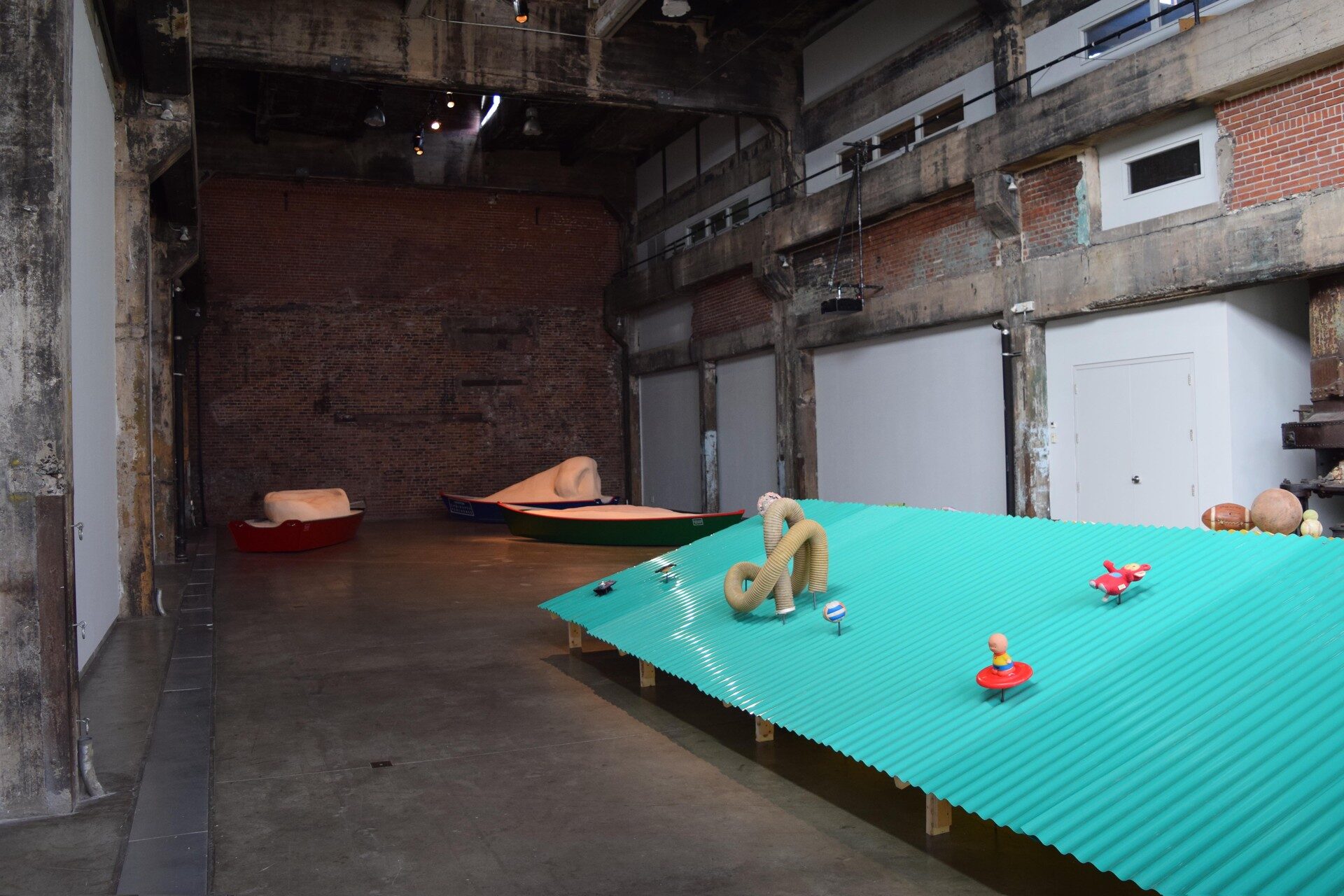
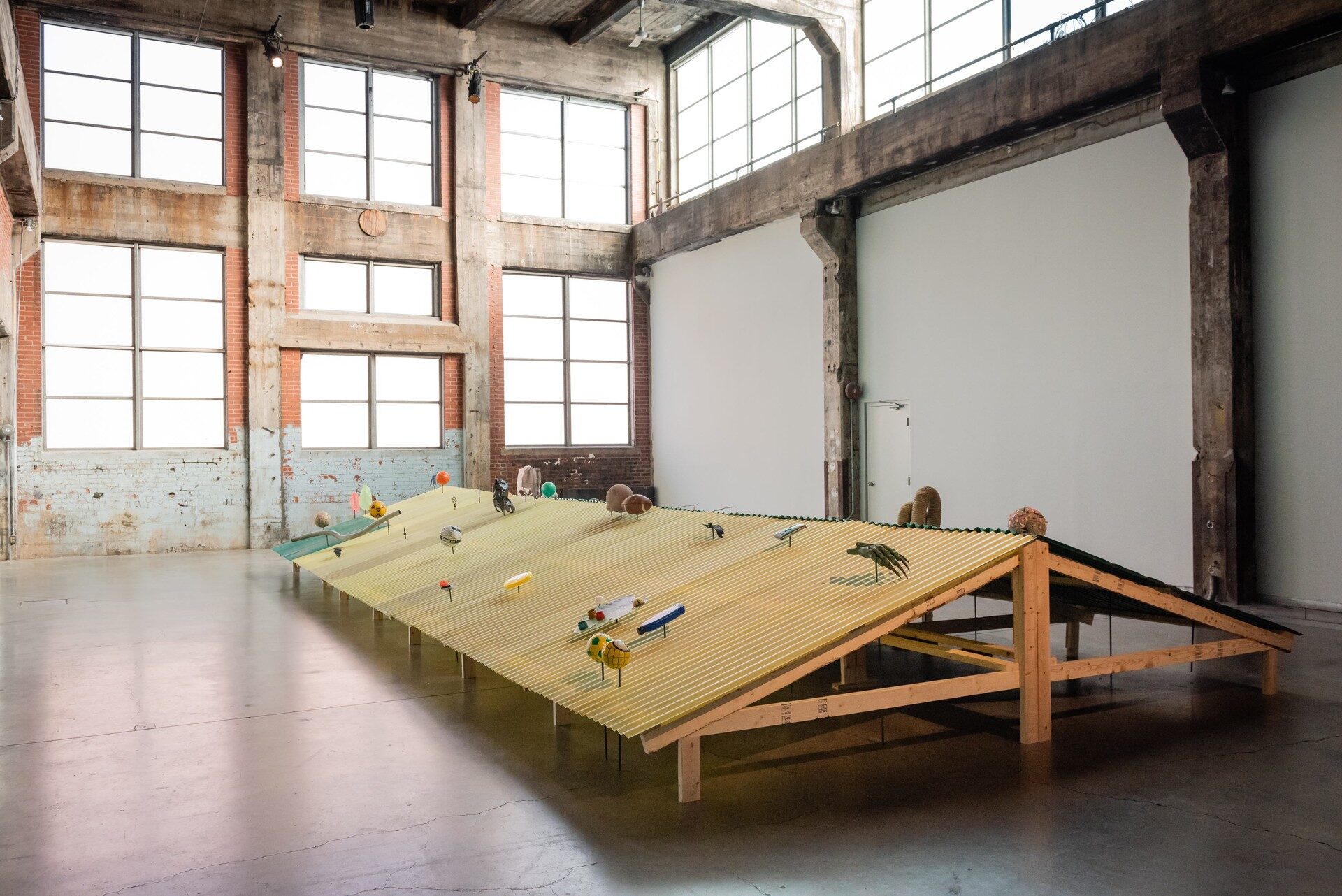
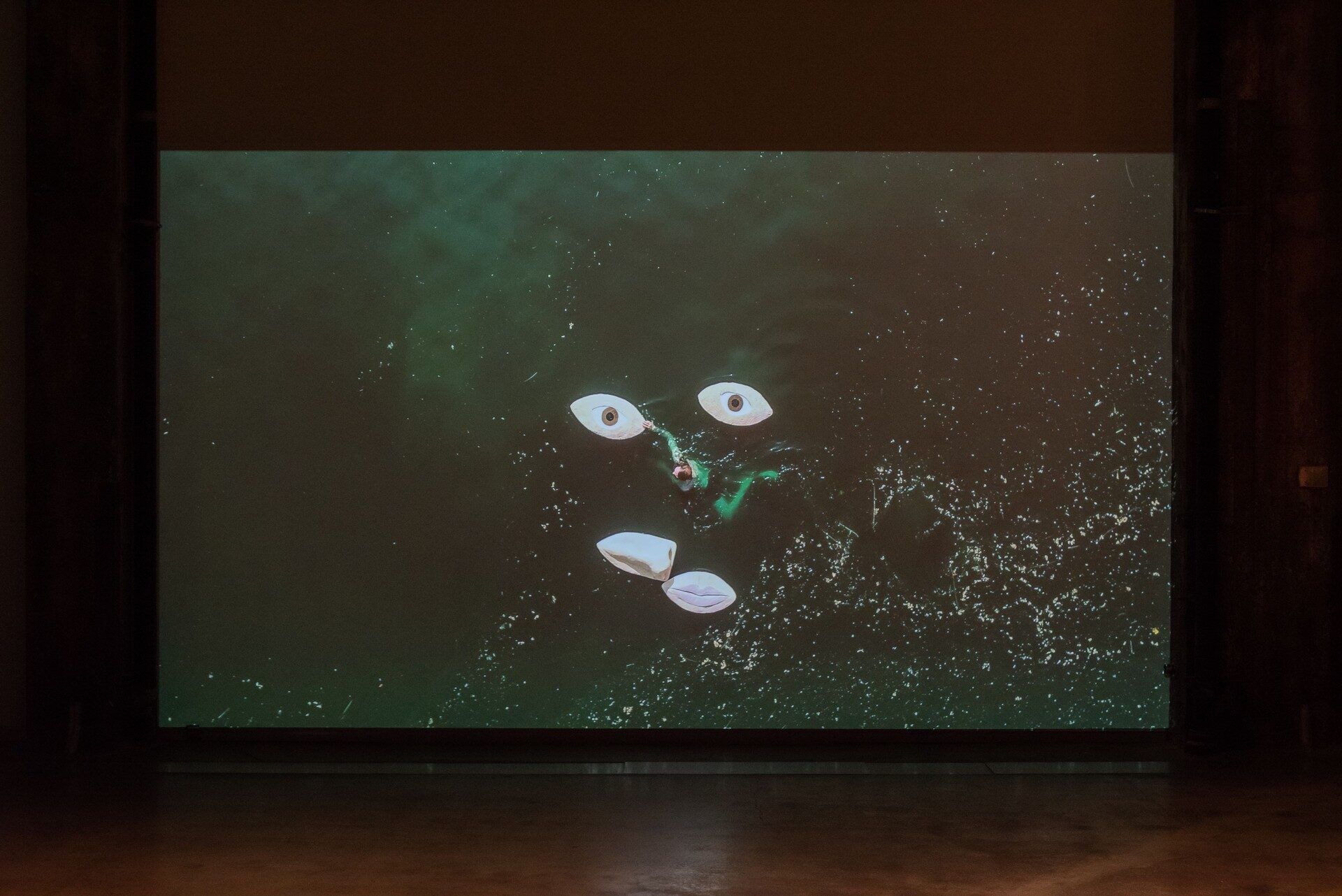
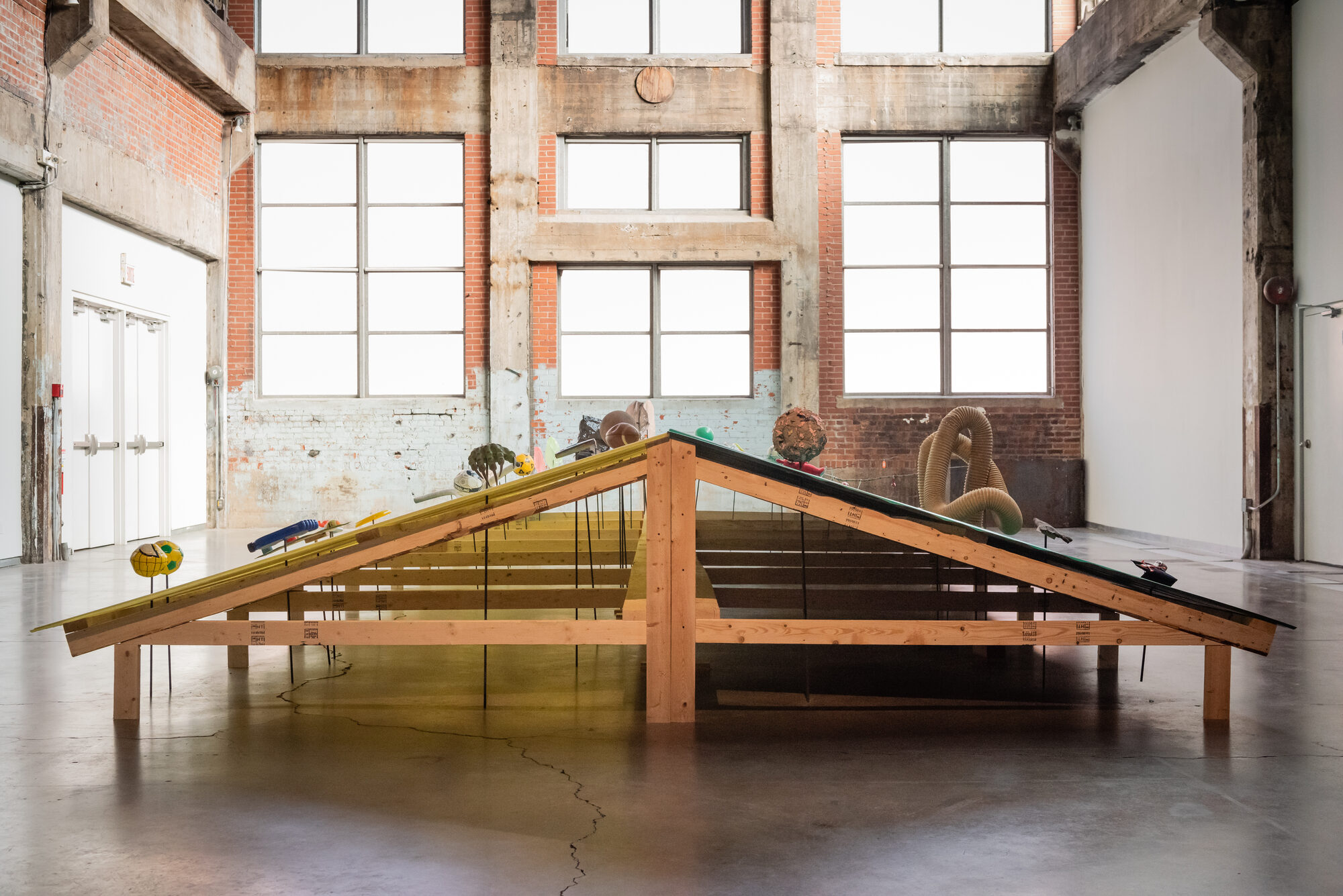
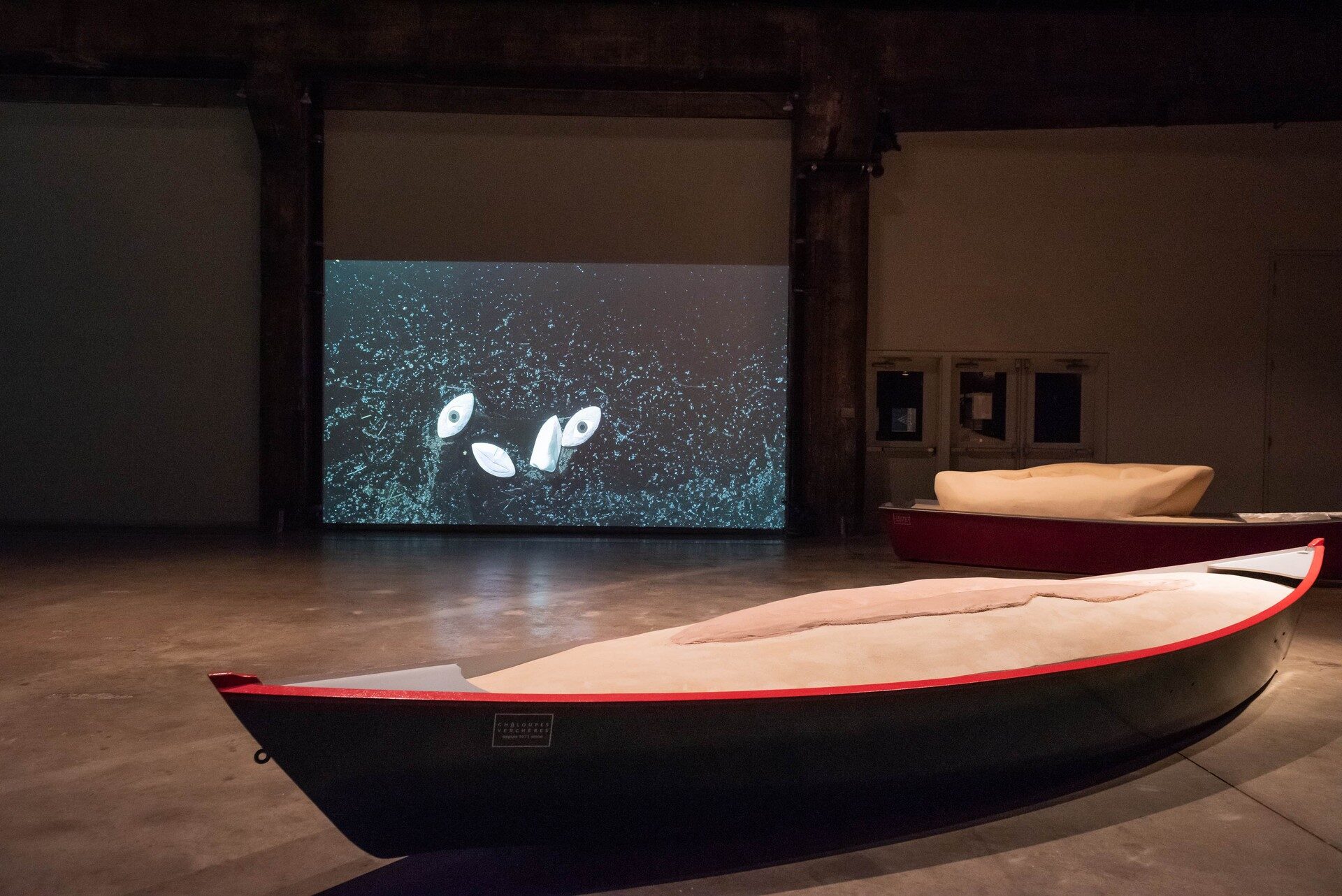
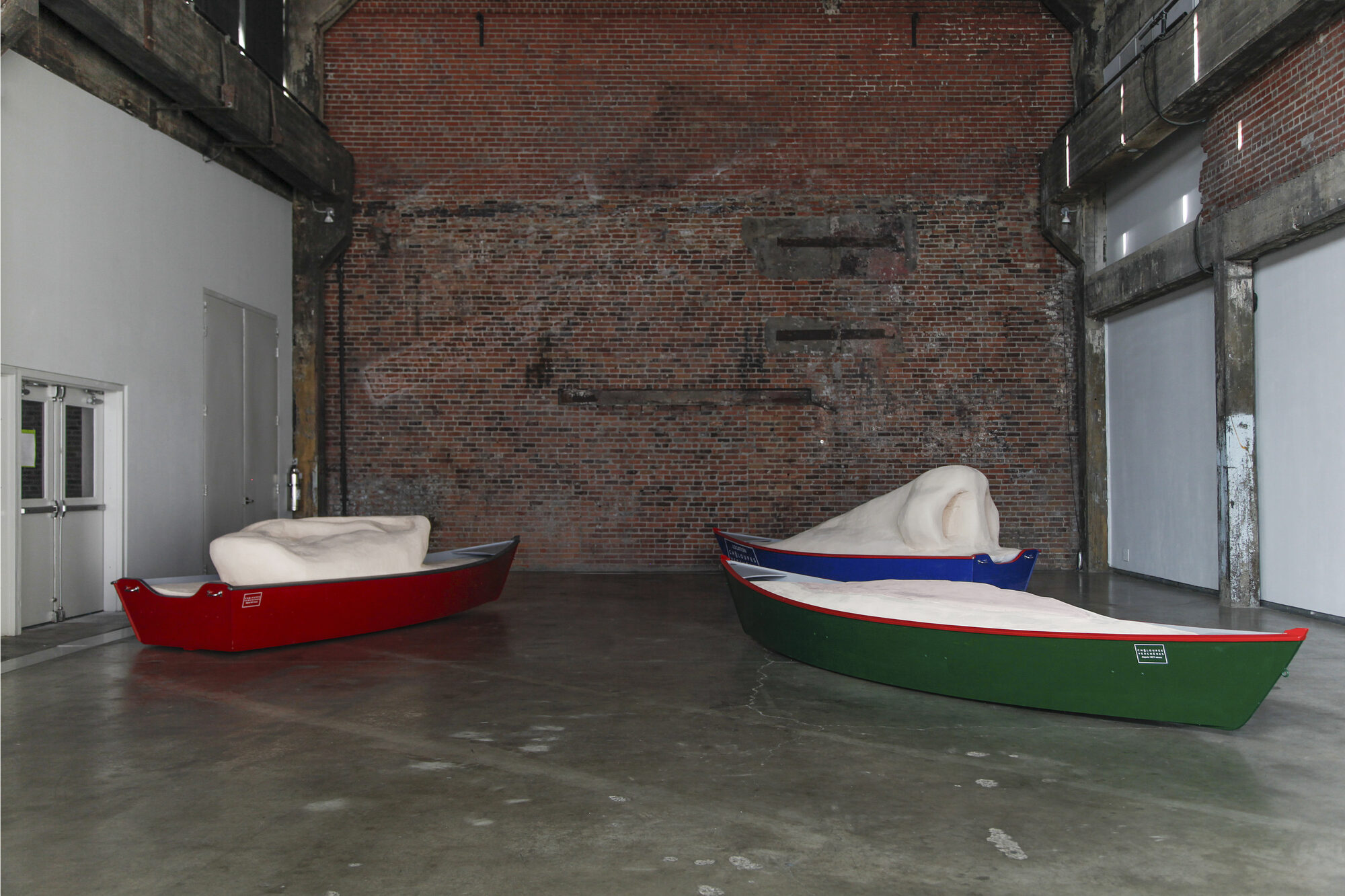
LAS MULTIPLES CARAS DE LO ANÓNIMO
"Cuanto más la gente es representada, menos queda de ellos en la realidad."
Hito Steyerl[1]
¿Cómo pensar – en este mundo en que las imágenes y los objetos están en competición perpetua por captar nuestra atención, frecuentemente anestesiada debido al exceso de estímulos - cómo pensar y mostrar aquello que carece de visibilidad, que está oculto y por tanto cae en el olvido? Esta pregunta, es sospechable, acecha hoy particularmente el campo de las artes visuales, comprometido con la producción de imágenes e investido en la visibilidad como proceso artístico. Y cobra aun más agudeza en el contexto de la programación del décimo aniversario de la Residencia de las Américas, marcada por el deseo de dar visibilidad a los artistas de la diversidad cultural. ¿Cómo se articulan hoy los problemas de representatividad y visibilidad? ¿Cómo podemos y debemos responder a ellos?
Con la exposición Dos formas de desaparecer sin perder la forma física, el artista chileno Javier González Pesce presenta dos trabajos recientes, que se centran en estos temas a partir de una investigación escultural del acto de desaparecer. Por un lado, una nueva versión de la instalación La isla de los no adaptados (2018/2019) recrea un techo de paneles corrugados en el piso de la sala grande, en el que el artista compuso microcosmos de objetos perdidos, a menudo robados, abandonados, o "encontrados" finalmente en los tejados de Santiago de Chile y reunidos aquí en archipiélagos improbables. Por otro lado, el proyecto Sin título (Rostro humano) (2017/2019) se desarrolla a través de tres esculturas y un video, cuyo fin es componer los elementos de una cara en una superficie en constante movimiento: el mar.
El diálogo entre las dos obras nos refiere a las realidades pasadas y presentes de Chile, evocando tensiones sociales y de memoria que no dejan de ser actuales. Las "desapariciones" de origen a menudo violento que fueron la realidad del país hace unas décadas, constituyen un punto de partida para una especie de deriva imaginaria. González Pesce se empeña en inventar nuevas formas de vida para estos objetos y seres alejados del mundo visible. Este esfuerzo se realiza a través de materiales utilizados para fines de transporte o protección: marco de madera, techo de PVC corrugado, polietileno, botes de madera. Una vida de ocio se abre así a los objetos liberados de sus dueños y sus funciones. Globos pinchados, teléfonos celulares rotos, bolsas de plástico arrugadas y hasta juguetes de peluche huérfanos: estos son los que interrumpieron su frenética carrera en el mundo de los humanos y se reunieron a matar el tiempo en los flancos inclinados y brillantes del techo, sujetos a la sola acción de la gravedad e inmóviles a partir de ahora.
A esta maraña de pequeños objetos cotidianos que finalmente encuentran su tranquilidad al "desaparecer", responde un gesto opuesto en el proyecto Sin título (Rostro humano): se trata más bien de mostrar una cara monumental que se desfigura y reconfigura perpetuamente. El artista talló los fragmentos incompletos de una cara (un ojo, una nariz, una oreja) del tamaño de botes de madera con la esperanza algo disparatada de meterlos al agua y dejarlos a la deriva, a la voluntad de las corrientes marinas. Esta cara en sí misma no es la representación de nadie. Es una cara sin nombre, sin cualidades, invisible de alguna manera. Es mas bien una ruina flotante, o en su defecto una máscara a prueba de inmersión.
De una obra a la otra se dibuja un camino que entrelaza lo visible y lo invisible, y resalta una imagen singular de lo anónimo. Mostrar lo anónimo: manifestar en el campo de lo visible a alguien, o a algo, que no hemos podido identificar. Precisamente aquí se trata de objetos, de una cara, que han sido despojados de su identidad y su uso, pero que paradójicamente adquieren más fuerza en esta condición de desclasificación. Así, rehúyen cualquier asignación de identidad. La pieza de video Sin título (Rostro humano) 2 ofrece un testimonio sorprendente: a pesar de los repetidos intentos del artista que, como un Sísifo de las aguas, se esfuerza por mantener juntas las piezas de la cara para darles orden, estas escapan continuamente a todo afán de control, trasportadas por las corrientes marinas. Derivemos un poco nosotros también, y podremos imaginar fácilmente que este "rostro humano", sujeto únicamente a fuerzas naturales, tiene el don de evadir radares, sistemas de reconocimiento facial y otros algoritmos de detección.
En su ensayo "The Spam of the Earth: Withdrawal from Representation" (2012), la artista y teórica Hito Steyerl analiza cómo la relación entre la representación visual y la representación política ha evolucionado con la multiplicación al extremo de imágenes, agravada por las tecnologías digitales. Si bien hasta hace poco la representación había sido considerada como un lugar privilegiado de protesta por la política y la estética, Steyerl hace hoy la siguiente observación:
En tanto las minorías de todas las franjas fueron identificadas como consumidoras potenciales y representadas visualmente (hasta cierto punto), la participación política y económica de la gente se ha vuelto cada vez más desigual. El contrato social de la representación visual contemporánea al comienzo del milenio presenta, por tanto, todas las características de un esquema Ponzi, o incluso de los juegos de participación de programas televisivos, cuyas consecuencias son imposibles de predecir[2].
Hoy en día el anonimato — o la retirada voluntaria de toda visibilidad (Steyerl piensa en un contexto en el que un número creciente de personas se niega a que una cámara tome su imagen, para escapar de la vigilancia generalizada) — o incluso la desaparición sin perder la apariencia física, se presentan como posibles estrategias para simplemente "sobrevivir".
Bien que integradas al flujo perpetuo de la producción material del mundo, las obras de González Pesce dibujan, no sin cierto humor negro, islotes de esperanza: los objetos tienen la oportunidad de desarrollar una segunda vida en los techos de las casas, entregados a la lluvia y al buen tiempo, precisamente porque se independizaron de los humanos ; en cuanto a los botes, son tanto el vehículo del desmembramiento de una cara anónima, como el único medio confiable de flotar en el mar y, en consecuencia, de cualquier supervivencia posible. Para Édouard Glissant "todo pensamiento archipélico es pensamiento sobre el temblor, la no presunción, pero también sobre la apertura y el intercambio", en consecuencia González Pesce se centra en la deriva y el vagar como operaciones que le permiten desplegar su propio archipiélago escultórico. Dicha deriva continúa luego a través de su trayectoria por el continente americano, de Sur a Norte. He aquí, entonces, una invitación a abrir el diálogo.
Ji-Yoon Han
[1] « The Spam of the Earth : Withdrawal from Representation », e-flux Journal #32 – Febrero de 2012 : The more people are represented the less is left of them in reality.
[2] While every possible minority was acknowledged as a potential consumer and visually represented (to a certain extent), people’s participation in the political and economic realms became more uneven. The social
Two Ways to Disappear Without Losing the Physical Form
Commissaire : Ji-Yoon Han
Grande salle
The Many Faces of Anonymity
“The more people are represented the less is left of them in reality.”
Hito Steyerl
How to think in a world where images and objects are constantly competing to draw our attention—often desensitized by being over-solicited; how to think and reveal what no longer has access to visibility, is obscured and thus consigned to oblivion?
As one might imagine today, this question haunts the visual arts, a field that is particularly invested in producing images and capitalizing on the visible. The question becomes even more critical in the context that concerns us here, namely the programming for the ten-year anniversary of the Residency of the Americas, which aims to give visibility to culturally diverse artists. How do the issues of representation and visibility intersect today? How can we—should we—address them?
In the exhibition Two Ways to Disappear Without Losing the Physical Form, Chilean artist Javier González Pesce presents two recent bodies of work that engage these contemporary issues by investigating the act of disappearing through sculpture. On the one hand, in a new version of the installation The Island of the Un-adapted (2018/2019), recreated out of corrugated roofing sheets on the floor of the Main Hall, the artist composes microcosms with lost objects—often stolen, abandoned, and then “found” on the rooftops of Santiago and assembled into improbable archipelagos.
On the other hand, the project Untitled (Human Face) (2017/2019), composed of three sculptures and a video, represents the elements of a face on a constantly changing surface: the ocean.
The dialogue created between the two works refers to Chile’s past and present reality, evoking the country’s all-too-real social tensions as well as those related to remembering. Yet these often violent “disappearances” provide a starting point for a kind of imaginary drift. González Pesce strives to invent new modes of existence for the things and beings that have been removed from the visible world. This effort is realized through materials used for transportation or protection: a wood frame, corrugated roofing sheets, styrofoam, a rowboat. Freed from their owners and functions, the objects embark on a life of leisure. Slashed sports balls, broken cellphones, crumpled plastic bags, and other orphaned stuffed toys have stopped their frantic race in the human world and assembled to lie idle—and immobile thanks to gravity—on the corrugated slopes of brightly coloured roofs.
In response to this swarm of small, commonplace objects that ultimately find peace by “disappearing,” Untitled (Human Face) makes the opposite gesture: it renders visible a monumental face that is constantly being disfigured and reconfigured, and which ultimately disperses in the surf of the waves.
The artist has sculpted fragments of a face (a mouth, a nose, an ear) scaled to the size of rowboats in the somewhat wild hope of launching them at sea and letting them drift in the current. In itself, this face does not represent anyone specific. It is a nameless, featureless face, in a sense, invisible. From the onset, it is a floating ruin, but also a mask resisting any kind of submersion or forgetting.
A trajectory emerges between the two works that interweaves the visible and the invisible, giving rise to a unique image of anonymity.
Revealing anonymity: placing someone or something in the visual field that we could not previously identify. In this case, certain objects and a face have been stripped of their identity and use, yet paradoxically, they find a kind of strength in this downgraded condition. They eschew any assignation of identity. The video Untitled (Human Face) 2 offers a striking demonstration: despite the repeated attempts of the artist, who like a swimming Sisyphus endeavours to hold together the facial fragments in order to draw a picture, these fragments, borne by the ocean current, elude any urge to control.
If we allow ourselves to drift a little, we might easily imagine that this “human face,” subject only to natural forces, has a way of circumventing radar, facial recognition systems, and other detection algorithms.
In her essay “The Spam of the Earth: Withdrawal from Representation,” artist and theorist Hito Steyerl discusses how the relation between visual and political representation has evolved with the excessive proliferation of images, exacerbated by digital technologies. Although until recently, representation was considered to be a valued site of protest for politics and aesthetics, Steyerl makes the following observation:
While every possible minority was acknowledged as a potential consumer and visually represented (to a certain extent), people’s participation in the political and economic realms became more uneven. The social contract of contemporary visual representation thus somewhat resembles the ponzi schemes of the early twenty-first century, or, more precisely, participation in a game show with unpredictable consequences1.
Today, anonymity—or the deliberate withdrawal from any visibility (Steyerl considers a context in which an increasing number of people refuse to have their image captured on camera in order to escape mass surveillance)—or disappearance without losing physical appearance become possible strategies for simply “getting away.”
Although carried on the perpetual tide of the world, like any other material production, González Pesce’s works trace small islands of hope, not without some dark humour: since they have lost their human use, the objects get a chance to have a second life of leisure on the rooftops of houses, left out in the sun and rain; as for rowboats, they become both vehicles for the dismemberment of an anonymous face and the only reliable means of floating on the ocean and therefore, possibly surviving.
As with Édouard Glissant for whom “any archipelagic thinking is a thinking of tremors and no assumptions, but also of openness and sharing”,2 González Pesce builds on the gestures of drifting and wandering to make his own sculptural archipelago. From the South to the North, across the American continents, the drift follows its trajectory.
It is an invitation to begin a dialogue.
Ji-Yoon Han
Translated by Oana Avasilichioaei
Notes
1. Hito Steyerl, “The Spam of the Earth: Withdrawal from Representation,” e-flux Journal #32, February 2012, https://www.e-flux.com/journal/32/68260/the-spam-of-the-earth-withdrawal-from-representation/.
2. Édouard Glissant, Traité du Tout-Monde. Poétique IV, Paris, Gallimard, 1997, 231 (our translation).
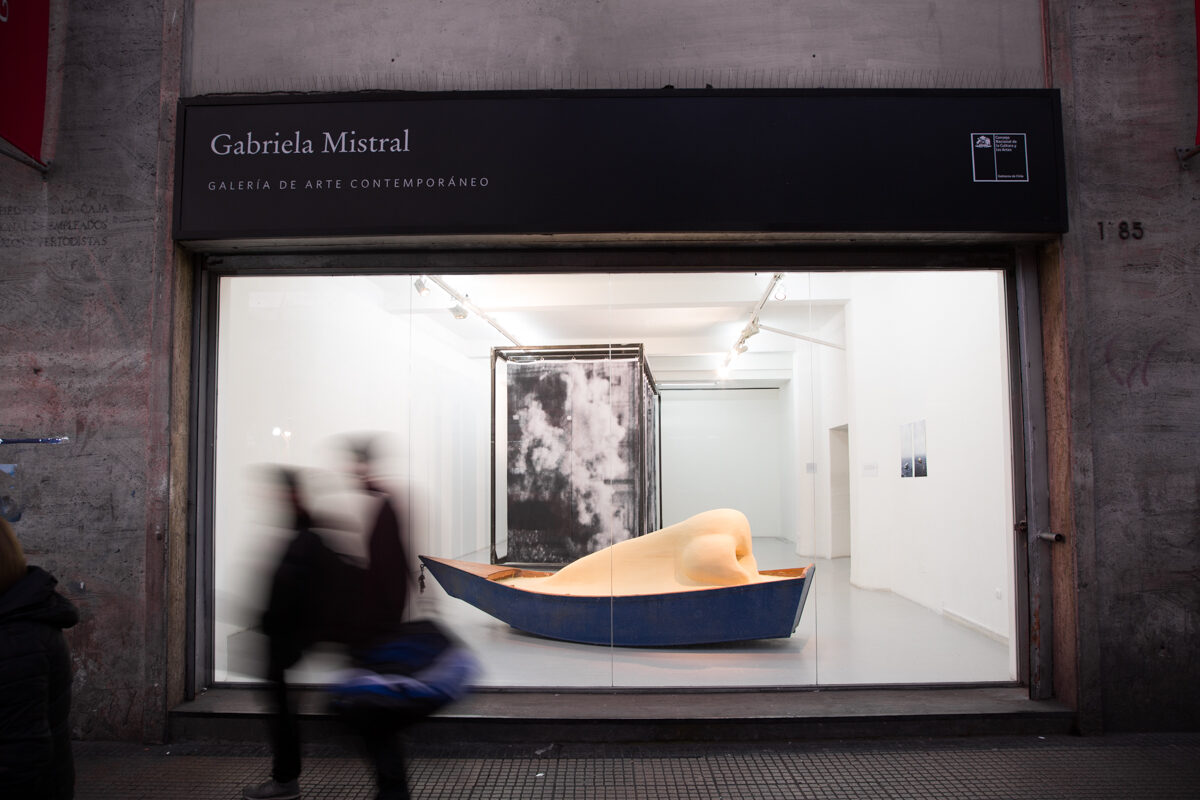
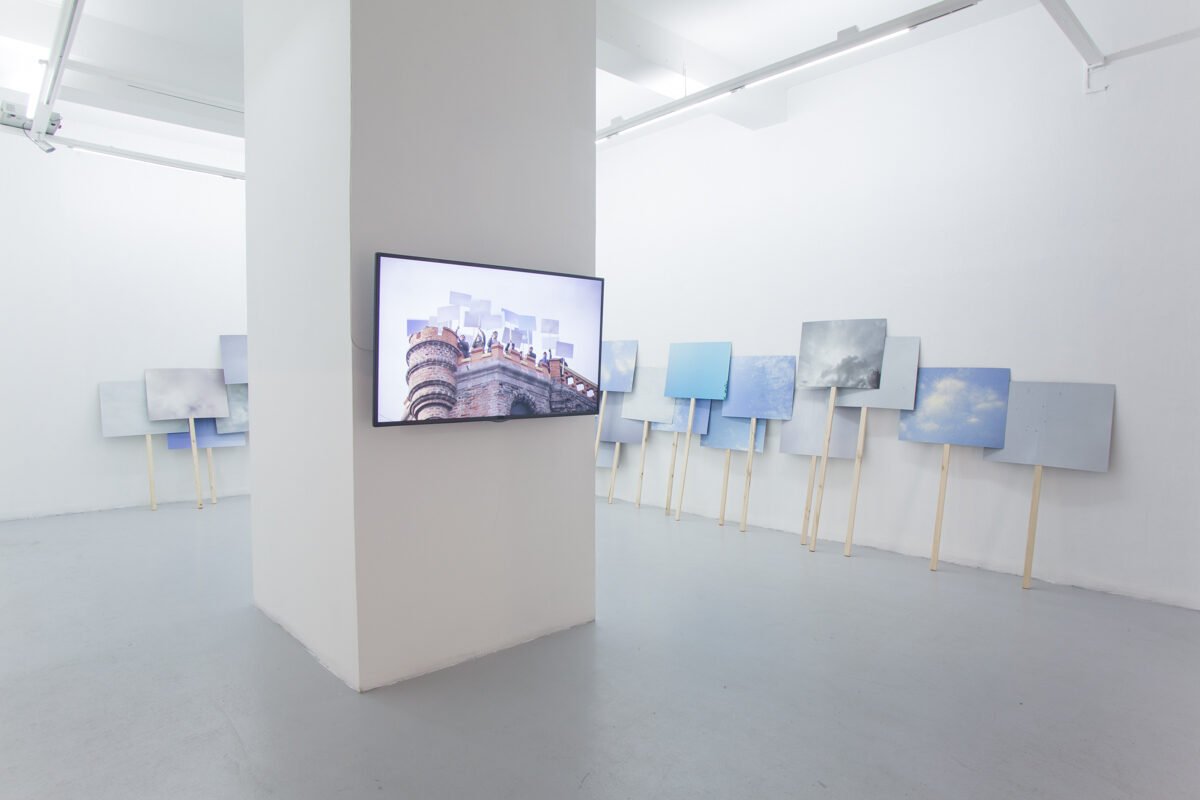
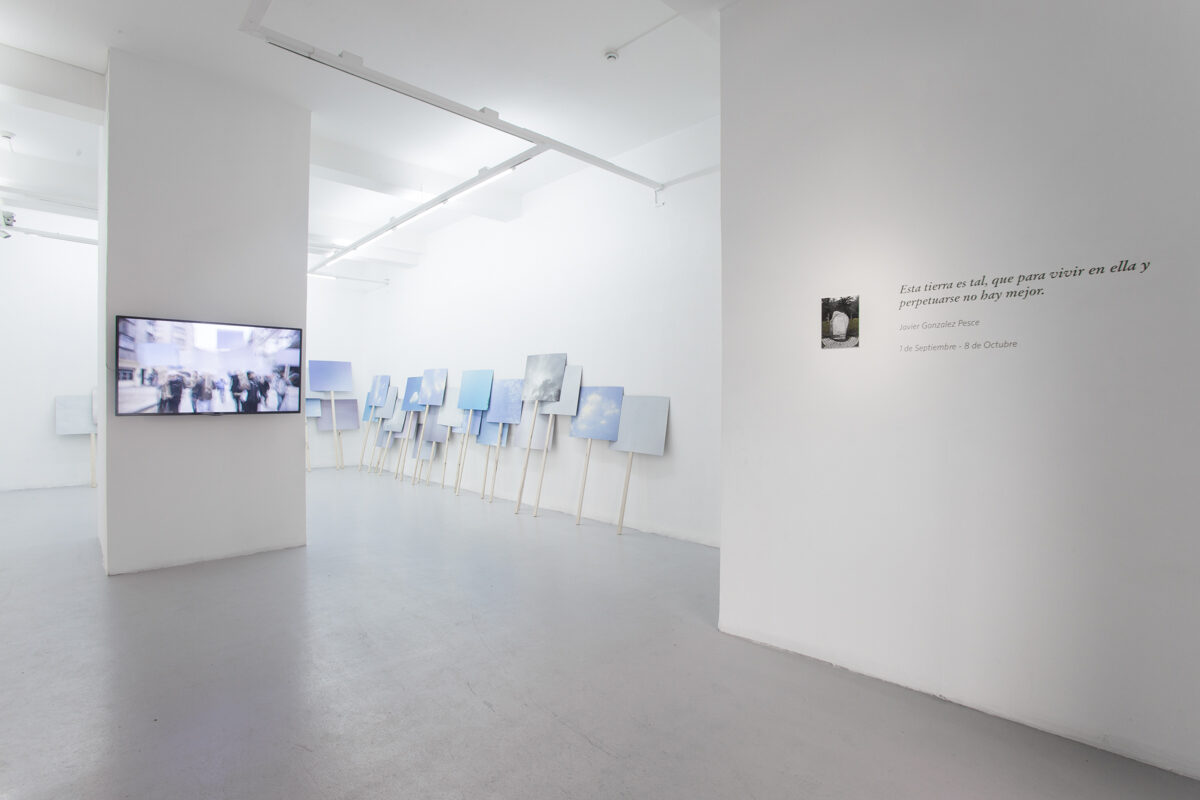
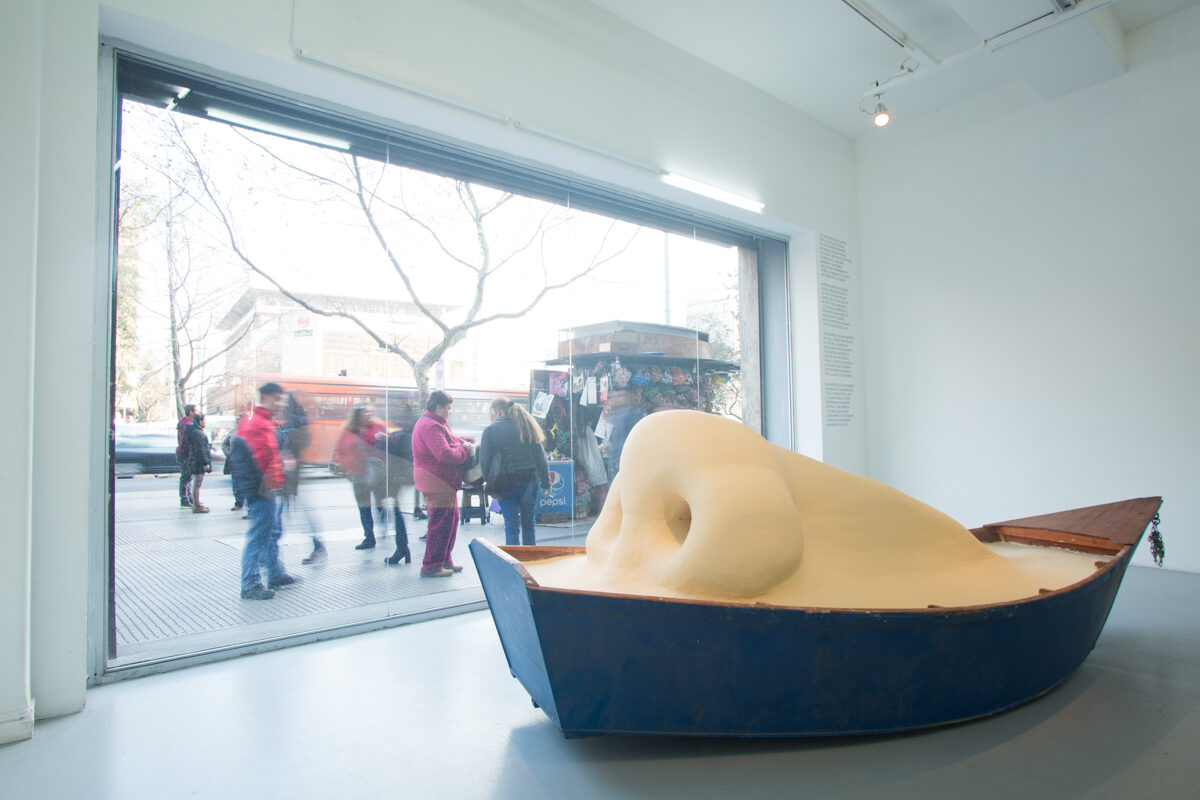
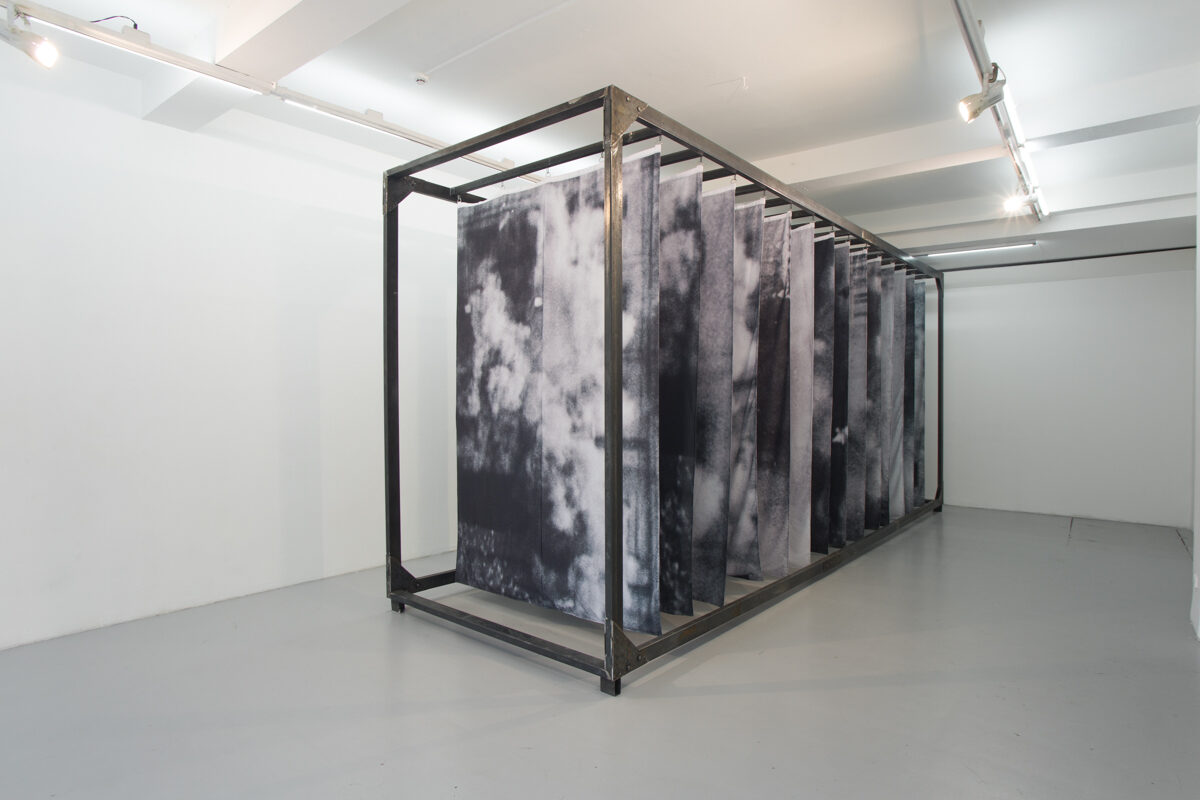
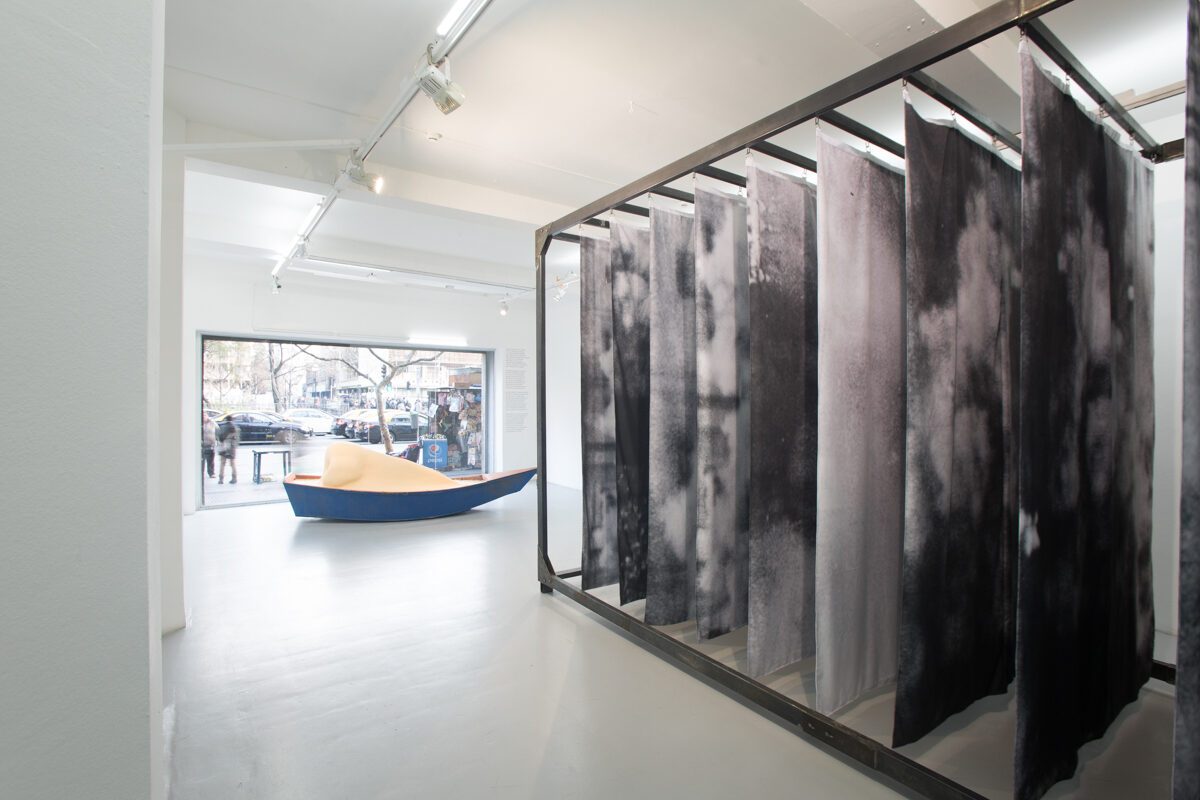
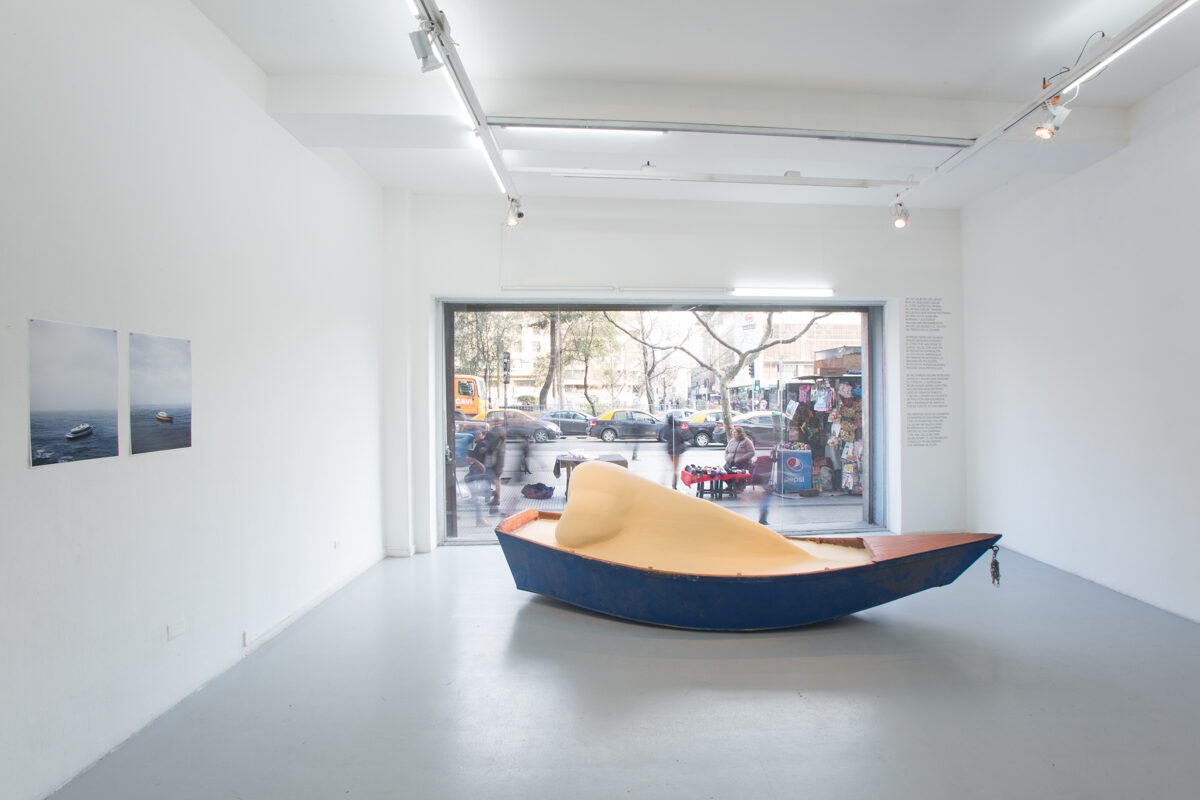
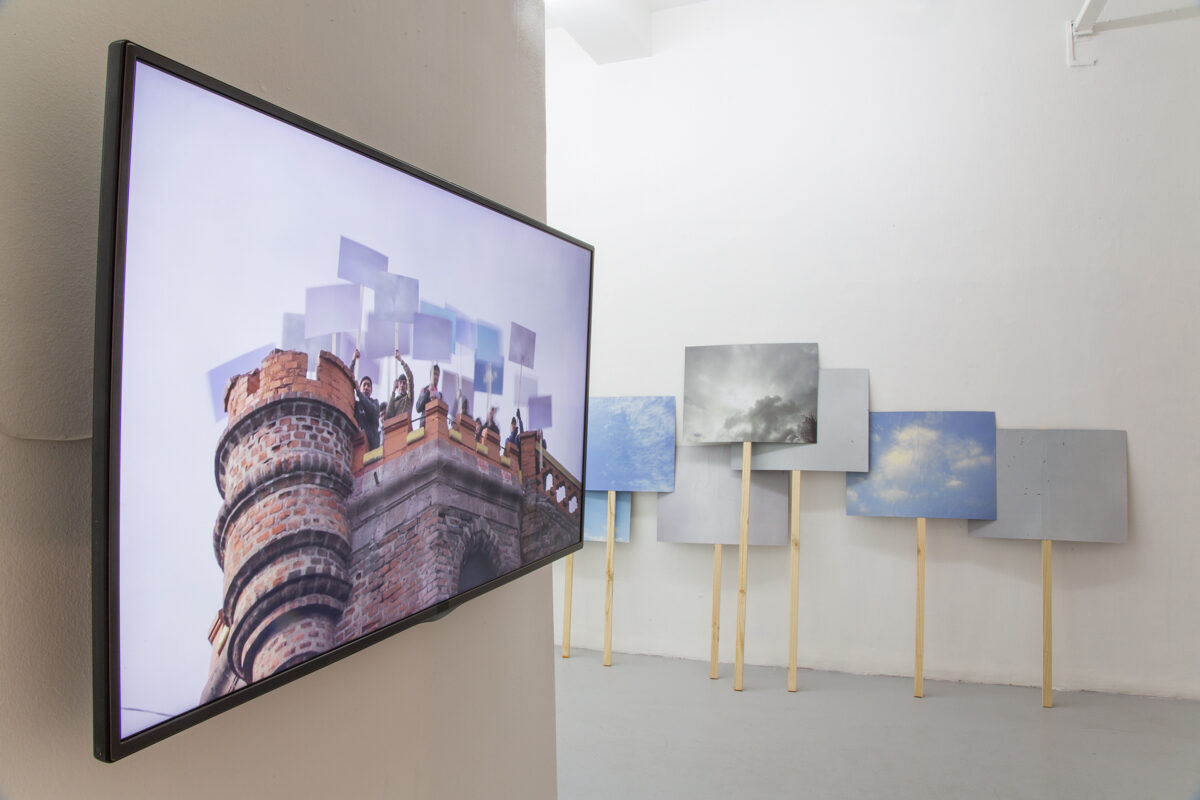
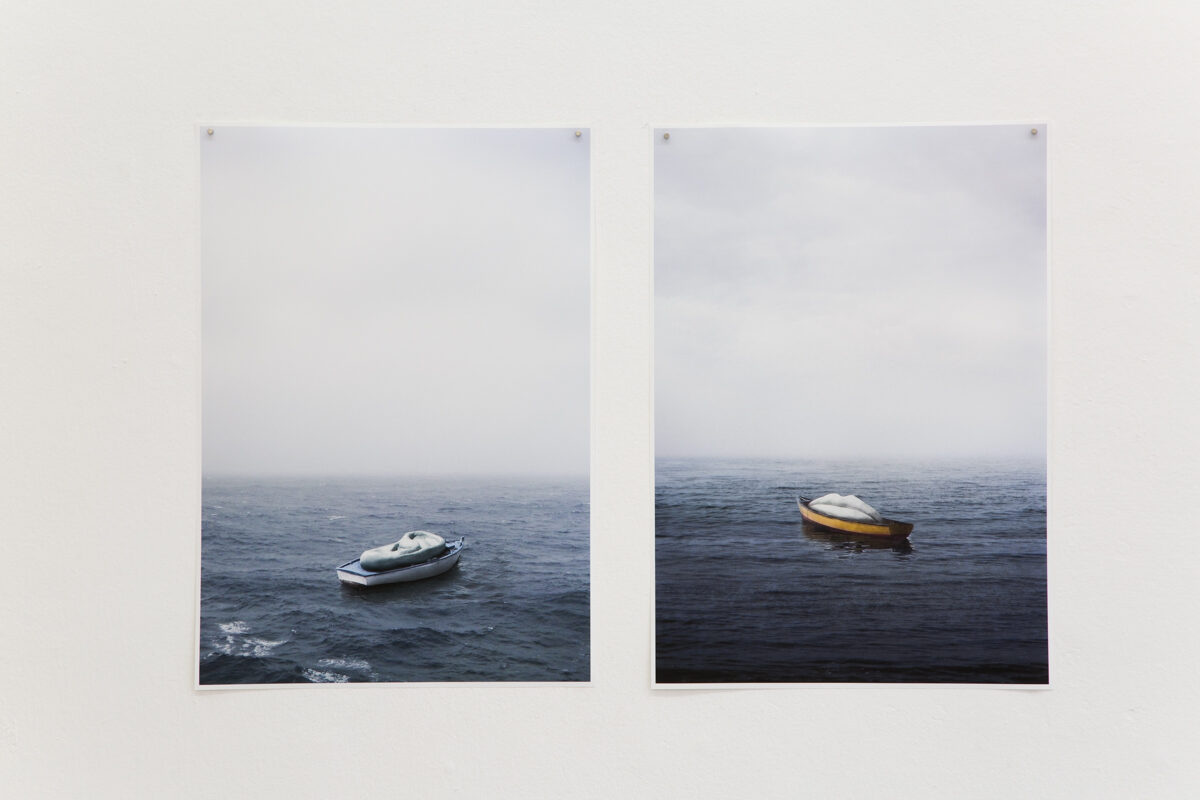
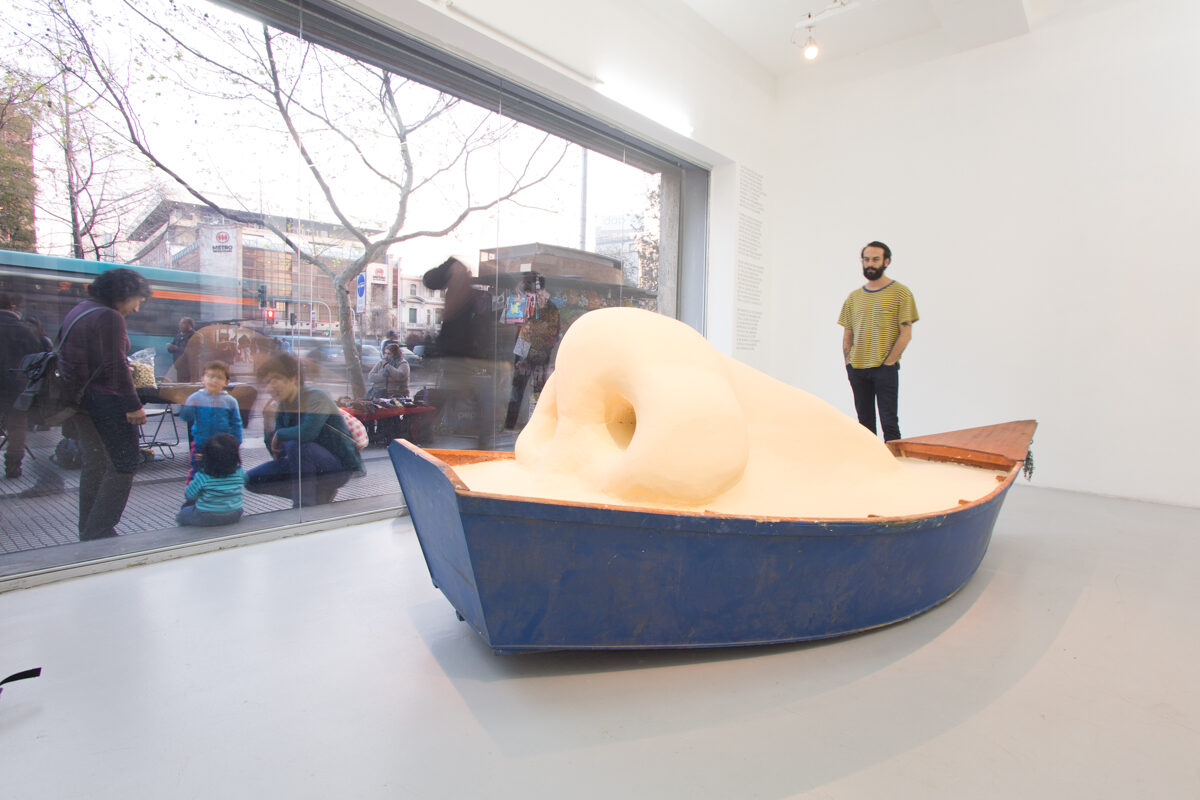
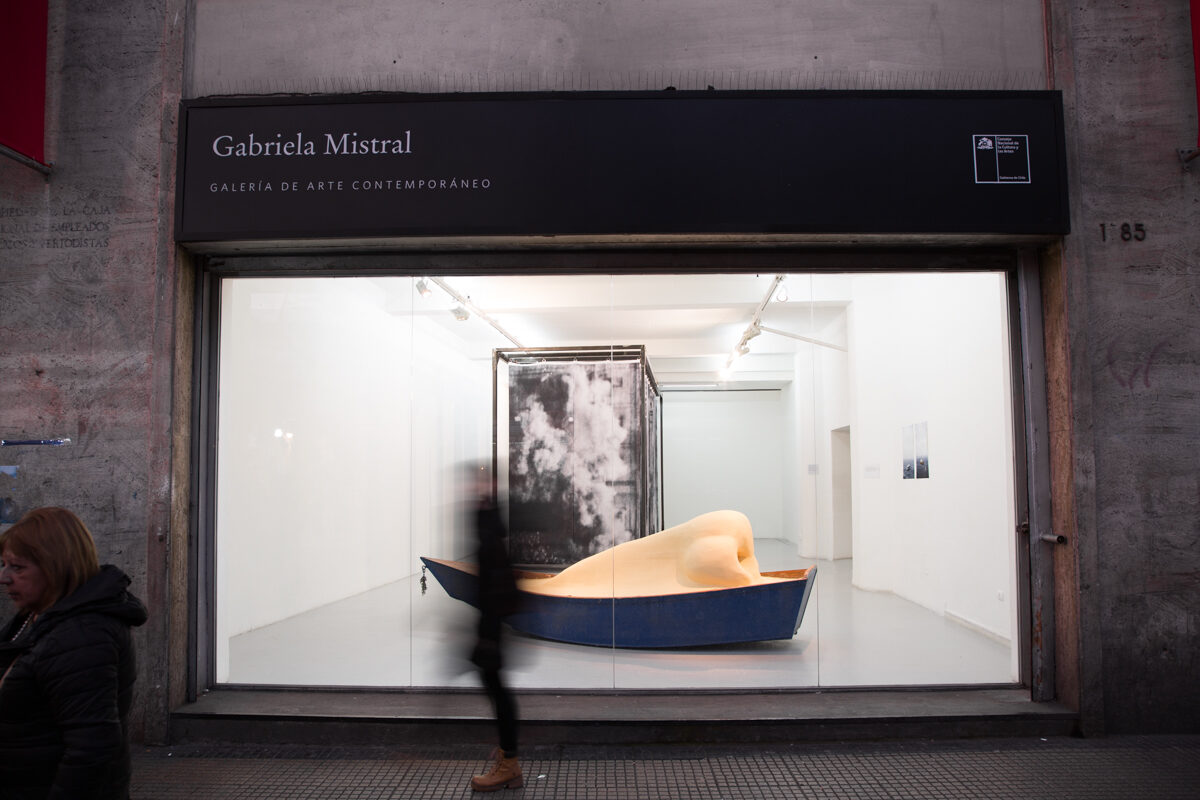
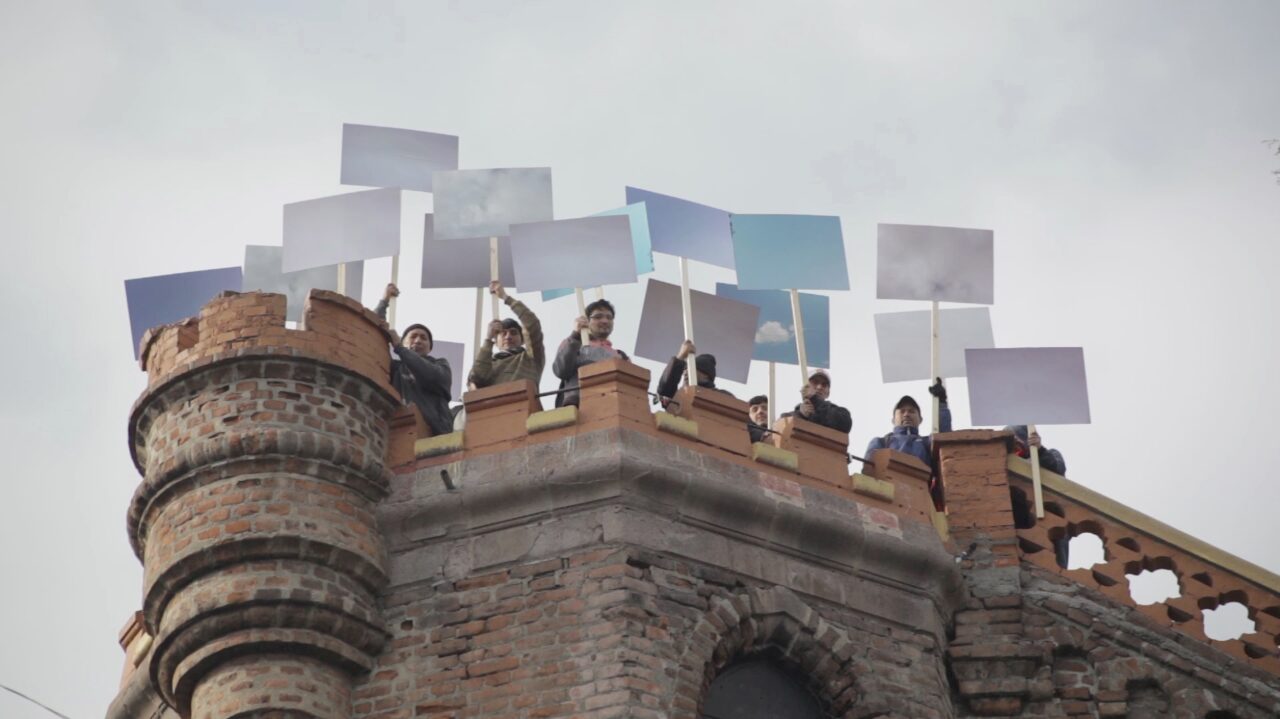
Al pasar por la vereda que da con la gran vitrina de la Galería Gabriela Mistral (GGM), en pleno centro de Santiago, la mirada advierte una imagen surrealista: la de un bote pesquero artesanal a escala real con el perfil de una gran nariz incrustada en su superficie. Lúdica y seductora vista desde la calle, su significado cambia radicalmente cuando, al entrar a la exposición, nos enteramos de que la imagen, del artista chileno Javier González Pesce (1984), es una metáfora de la tortura.
La pieza forma parte de un proyecto más amplio del artista que incluye varias embarcaciones transportando otros elementos del rostro: dos ojos y dos orejas, para ser liberados en las costas del norte de Chile; una boca, para ser liberada en el centro; y la nariz, en el sur. Partes del cuerpo que, agrandadas como para resaltar su importancia vital, habrían pertenecido a las víctimas de la dictadura militar chilena que fueron arrojadas al mar.
“El mar no comprende una superficie estática (como la habitualmente habitada por proyectos escultóricos), por lo que esta configuración de un rostro va a ser desarticulada por el movimiento del mar. El naufragio de las partes del rostro en una relación plácida pero desfragmentada por el mar pretenden citar una triste historia nacional de esta relación (la del mar y el cuerpo)”, señala González Pesce.
Titulada Esta tierra es tal que para vivir en ella y perpetuarse no hay mejor -frase tomada de un extracto de la carta enviada por Pedro de Valdivia para informar al Rey de España de la situación local-, la muestra está compuesta por un conjunto de obras que, según el artista, buscan “instalar en paisajes determinados realidades territoriales silenciosas, olvidadas, escondidas”, e “invocar unas presencias discretas al hacerlas visibles en el territorio por medio de operaciones e intervenciones artísticas”.
La obra de González Pesce suele tener un carácter que oscila entre lo escultórico y lo teatral, lo lúdico y lo perturbador, siempre aferrado al sentido del humor (un humor negro) para abordar temas que nos inquietan a todos. En su muestra del 2012 en el Museo de Artes Visuales (MAVI) –a propósito de haber ganado el Concurso Arte Joven MAVI-Minera Escondida- el artista transformaba el desamor en la perfecta excusa para invocar diversos medios de disrupción a partir de íconos, aproximaciones juguetonas y soluciones formales. A través de varios objetos e instalaciones de aspecto llamativo, aludía al amor (juvenil), el desamor (el despecho) y el sufrimiento.
Pocos años después, Javier González Pesce se fue a estudiar a Suiza. Ahora que regresa para esta individual nos sorprende con un trabajo mucho más maduro. Acaso por el mismo hecho de haber tomado distancia de su país, el artista vuelve y toca temas precisamente relacionados con su territorio y su pasado violento, así como de su historia política reciente, deteniéndose aquí en una problemática subyacente y urgente, como es el rápido y súbito crecimiento de la inmigración.
Este asunto lo aborda en un registro audiovisual de una acción que involucró a un grupo de ciudadanos peruanos residentes en Santiago que, portando carteles con imágenes del cielo de Perú, caminaron desde la simbólica Plaza de Armas hasta la cima del -también simbólico- cerro Santa Lucía, instalando así el cielo del país vecino en el paisaje del centro de la capital. “Ese día, a modo de un collage activo gracias a la acción de estas personas, una imagen del cielo de su nación de origen fue infiltrada en el cielo del país en el que viven actualmente”, dice el texto museográfico que acompaña a la muestra. Las 33 pancartas utilizadas en la acción se exhiben también en el espacio de la galería.
La tercera obra que compone esta exhibición es un rack con 14 banderas impresas con close ups de stills del video del bombardeo de La Moneda el 11 de septiembre de 1973. Las impresiones fueron diseñadas de tal manera que la violenta imagen icónica se abstrae en manchones en blanco y negro, como masas de humo, polvo o alguna materia indefinida. Inicialmente, las 14 banderas tenían como destino original los 14 mástiles que se encuentran en la Plaza de la Constitución desplegando banderas chilenas en representación de las regiones. La idea era reinstalar estas imágenes para devolver las explosiones a su lugar de origen (no así a su tiempo original), en un gesto poético de memoria. En cualquier caso, el proyecto será articulado gracias a la colaboración de algunos espacios institucionales de Santiago, que han facilitado sus mástiles. Posteriormente, las banderas itinerarán por los cielos de las 15 regiones de Chile.
“Esta muestra es política porque se trata de este territorio. Este territorio es doloroso porque contiene una historia. Esta historia es materialidad porque se condensa habitando, con fricción, espacios reales”, concluye el artista.
Alejandra Villasmil.
As you walk along the sidewalk that leads to the large display window of the Gabriela Mistral Gallery (GGM), right in the heart of Santiago, your gaze is drawn to a surreal image: that of a full-scale traditional fishing boat with the outline of a large nose embedded in its surface. Playful and alluring when viewed from the street, its meaning changes radically when, upon entering the exhibition, we learn that the image, by Chilean artist Javier González Pesce (1984), is a metaphor for torture.
The piece is part of a broader project by the artist that includes several boats carrying other facial features: two eyes and two ears, to be released on the northern coast of Chile; a mouth, to be released in the center; and the nose, in the south. These body parts—enlarged as if to highlight their vital importance—would have belonged to victims of the Chilean military dictatorship who were thrown into the sea.
“The sea does not have a static surface (as is typically the case with sculptural projects), so this configuration of a face will be disjointed by the movement of the sea. The drifting of the facial parts in a placid yet fragmented relationship with the sea aims to evoke a sad national history of this relationship (that between the sea and the body),” notes González Pesce.
Titled This land is such that to live in it and perpetuate oneself, there is no better—a phrase taken from an excerpt of the letter sent by Pedro de Valdivia to inform the King of Spain of the local situation—the exhibition consists of a collection of works that, according to the artist, seek to “embed in specific landscapes silent, forgotten, hidden territorial realities,” and “to invoke discreet presences by making them visible in the territory through artistic operations and interventions.”
González Pesce’s work often oscillates between the sculptural and the theatrical, the playful and the unsettling, always drawing on a sense of humor—a dark humor—to address issues that trouble us all. In his 2012 exhibition at the Museum of Visual Arts (MAVI)—following his win in the MAVI-Minera Escondida Young Artists Competition—the artist transformed heartbreak into the perfect excuse to invoke various forms of disruption through icons, playful approaches, and formal solutions. Through various eye-catching objects and installations, he alluded to (youthful) love, heartbreak (spite), and suffering.
A few years later, Javier González Pesce left to study in Switzerland. Now that he has returned for this solo exhibition, he surprises us with a much more mature body of work. Perhaps precisely because he has distanced himself from his country, the artist returns to address themes closely tied to his homeland and its violent past, as well as its recent political history, focusing here on an underlying and urgent issue: the rapid and sudden growth of immigration.
He addresses this issue through an audiovisual recording of a performance involving a group of Peruvian citizens living in Santiago who, carrying signs with images of the Peruvian sky, walked from the symbolic Plaza de Armas to the summit of the—equally symbolic—Santa Lucía Hill, thereby installing the sky of their neighboring country into the landscape of the capital’s downtown. “That day, as a kind of active collage brought to life by the actions of these people, an image of the sky of their country of origin was superimposed onto the sky of the country where they currently live,” reads the exhibition text accompanying the display. The 33 banners used in the performance are also on display in the gallery space.
The third work in this exhibition is a rack holding 14 flags printed with close-ups of stills from the video of the bombing of La Moneda on September 11, 1973. The prints were designed in such a way that the iconic, violent image is abstracted into black-and-white blobs, resembling masses of smoke, dust, or some undefined substance. Initially, the 14 flags were originally intended for the 14 flagpoles located in Plaza de la Constitución, which fly Chilean flags representing the regions. The idea was to reinstall these images to return the explosions to their place of origin (though not to their original time), in a poetic gesture of remembrance. In any case, the project will be carried out thanks to the collaboration of several institutional spaces in Santiago, which have provided their flagpoles. Subsequently, the flags will travel through the skies of Chile’s 15 regions.
“This exhibition is political because it deals with this territory. This territory is painful because it contains a history. This history is materiality because it condenses by inhabiting—with friction—real spaces,” concludes the artist.
Alejandra Villasmil.