PROYECTOS CURATORIALES
  • 1 MUNDO TOKAS
    2025 — Tokio, Japón
  • 2 Museo en campaña
    2021 — Santiago, Chile
  • 3 LOCAL Arte Contemporáneo
    Desde 2011 — Santiago, Chile
1 — MUNDO TOKAS
2025, Tokio, Japón
Fotografía Instalación
Registro
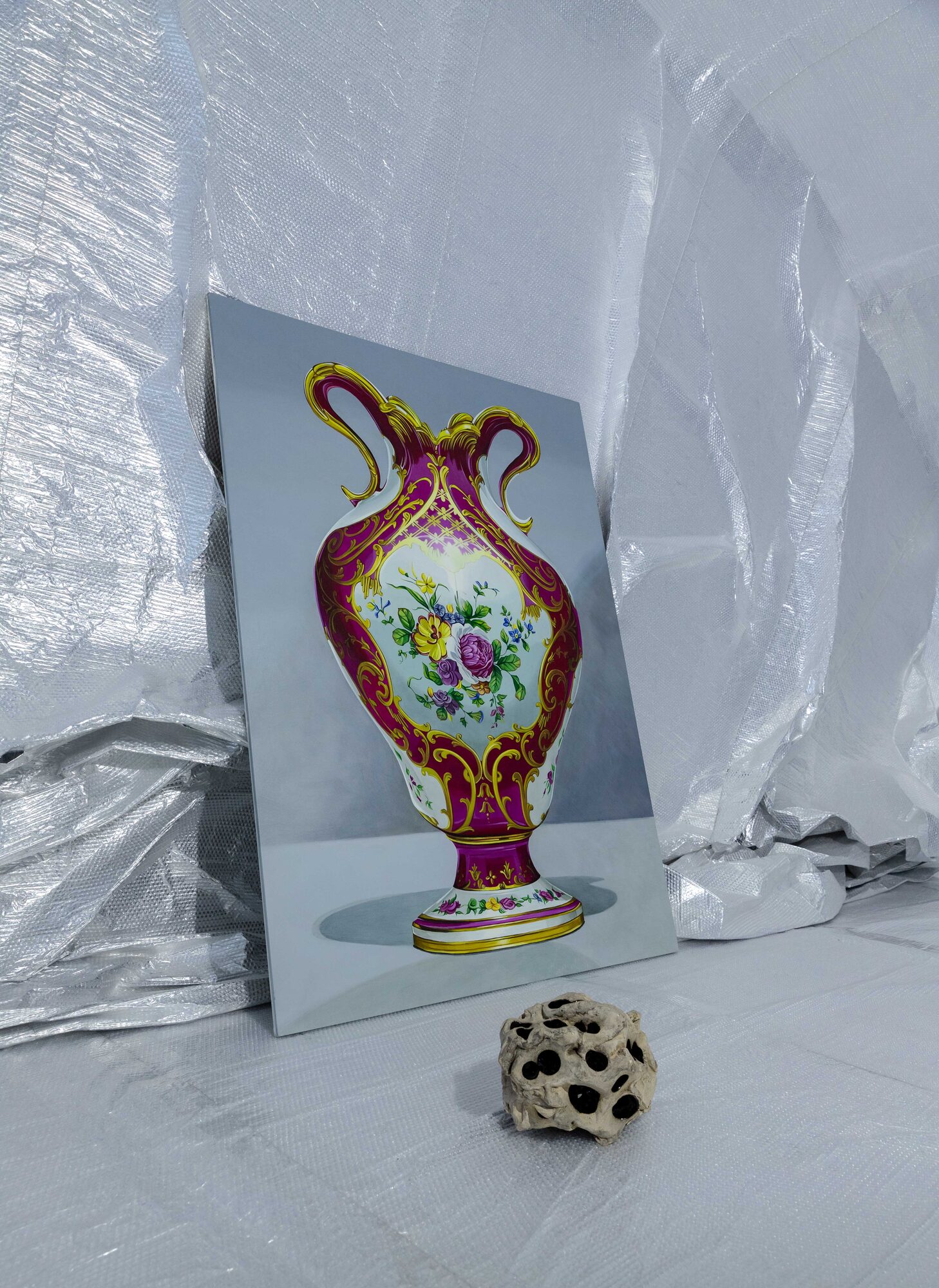
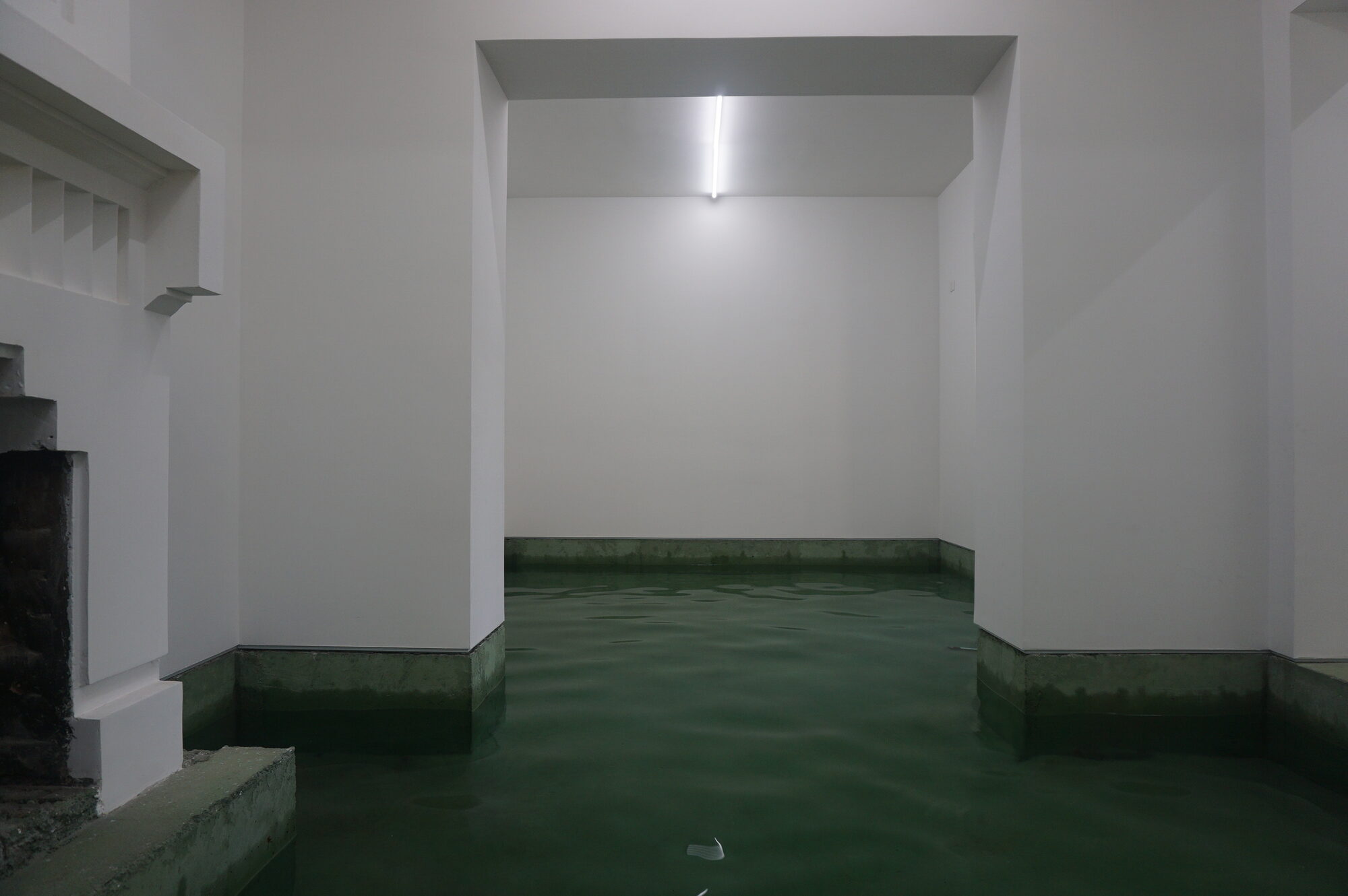
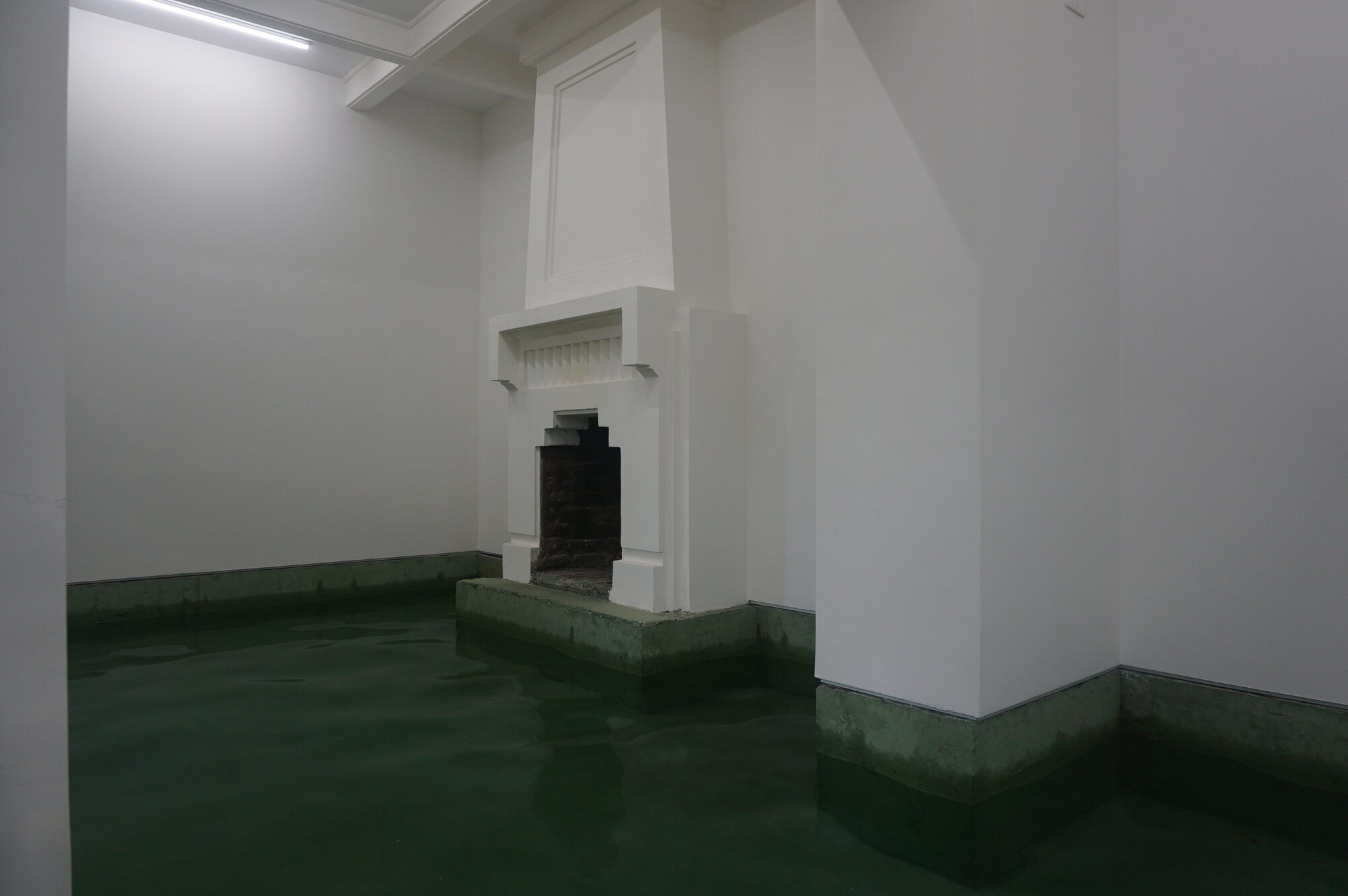
MUNDO TOKAS — foto 1
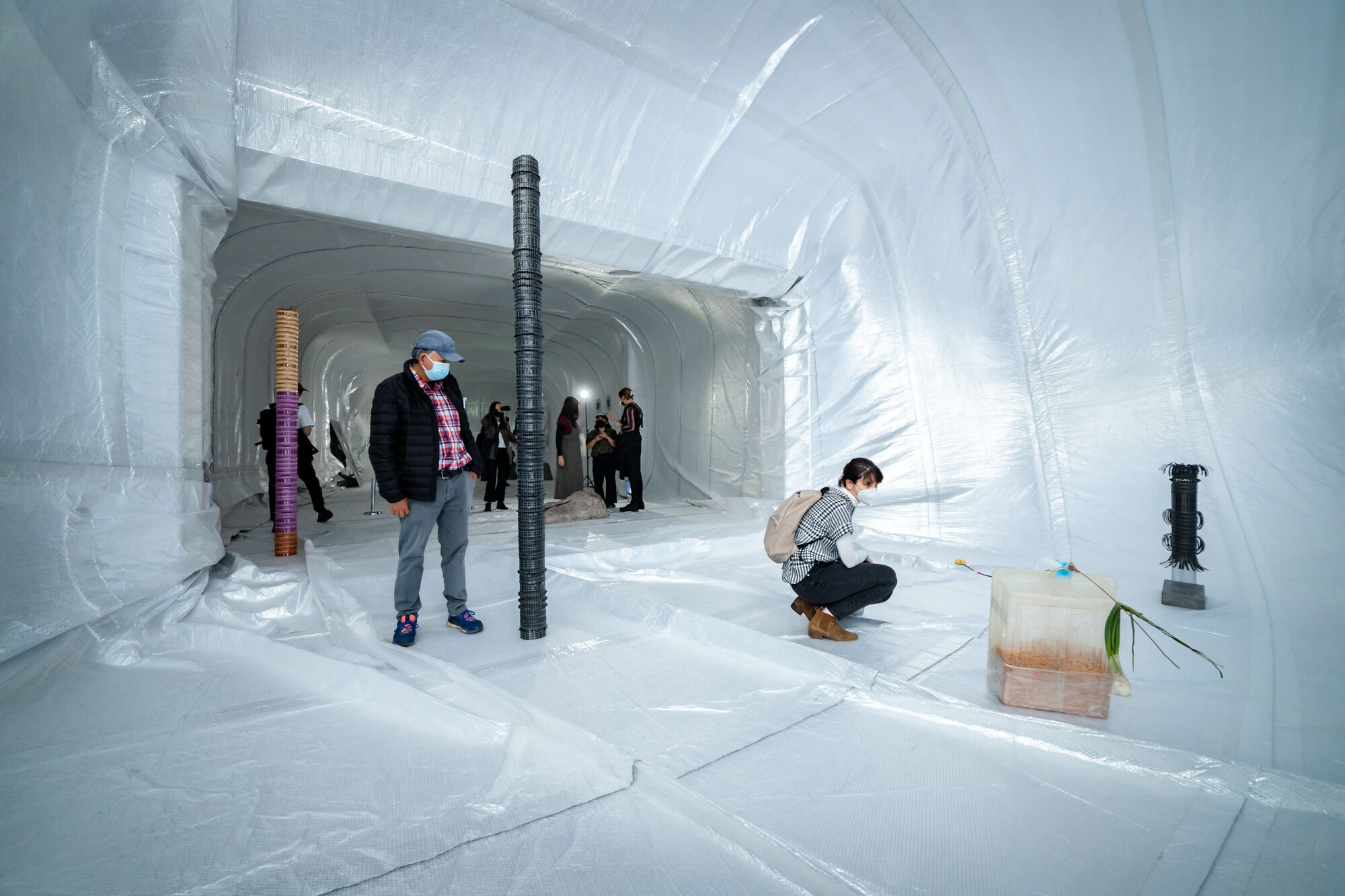
MUNDO TOKAS — foto 2
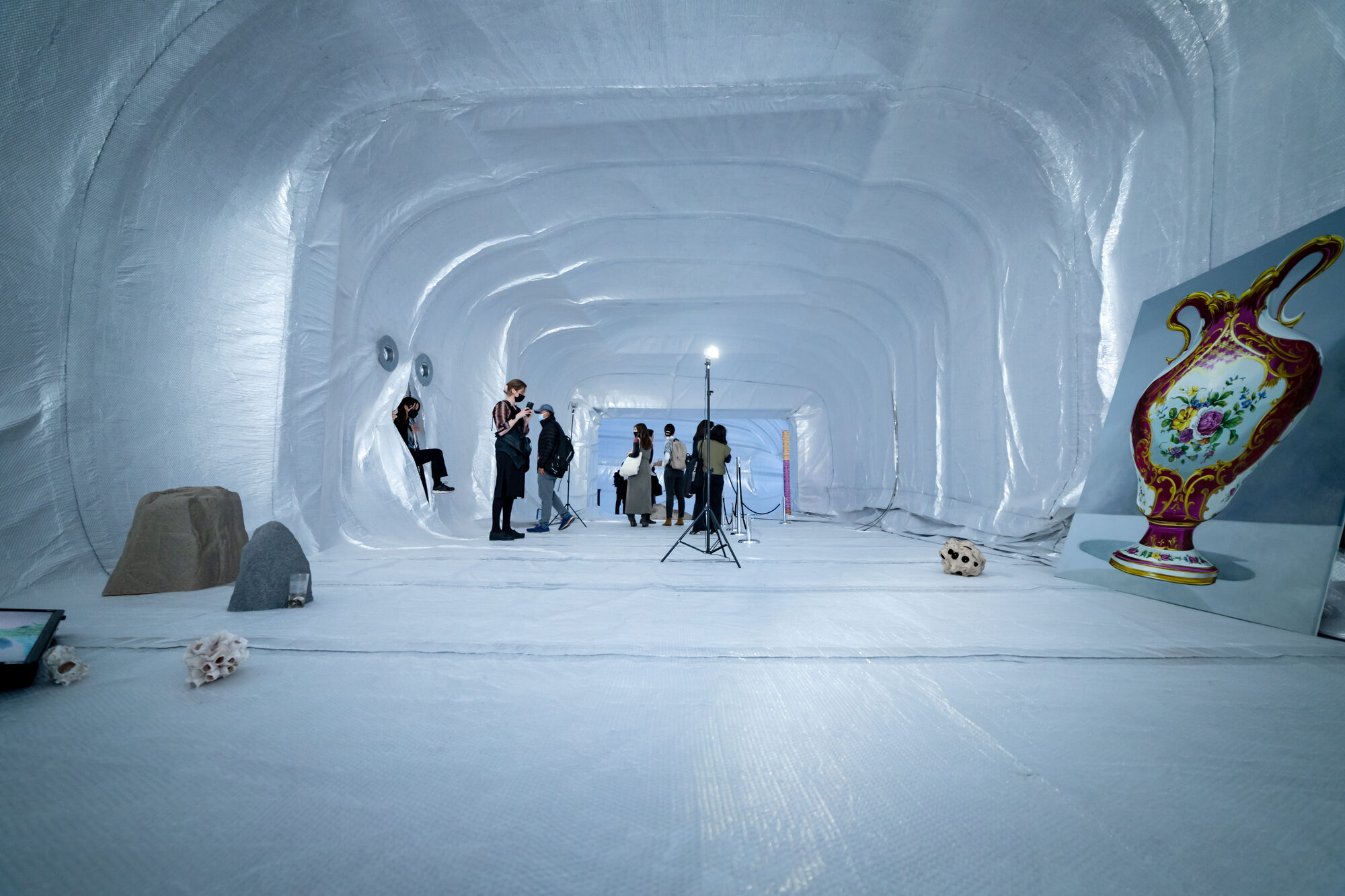
MUNDO TOKAS — foto 3
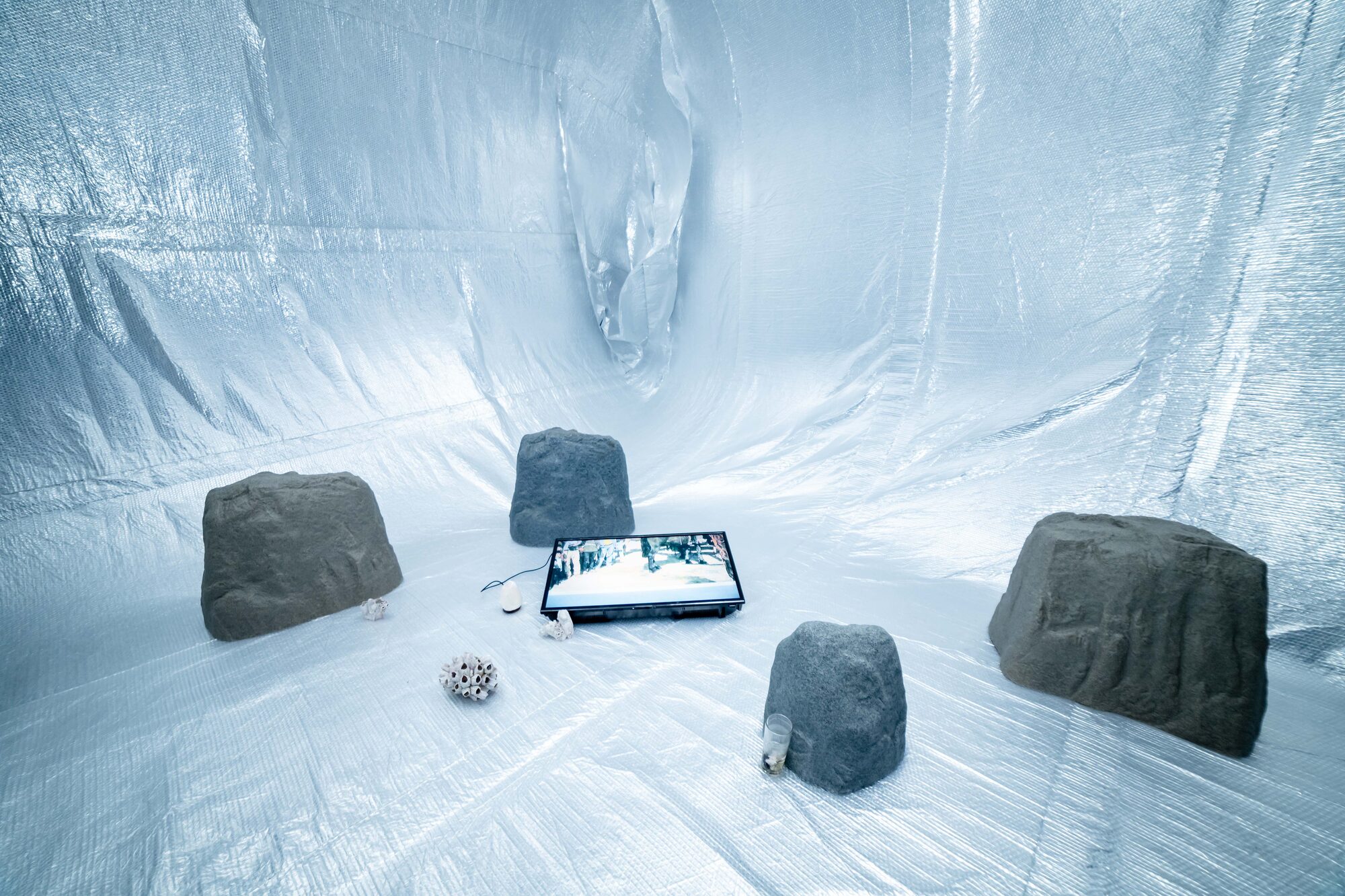
MUNDO TOKAS — foto 4
MUNDO TOKAS — foto 5
MUNDO TOKAS — foto 6
MUNDO TOKAS — foto 7
MUNDO TOKAS — foto 8
MUNDO TOKAS — foto 9
MUNDO TOKAS — foto 10
MUNDO TOKAS — foto 11
MUNDO TOKAS — foto 12
MUNDO TOKAS — foto 13
MUNDO TOKAS — foto 14
MUNDO TOKAS — foto 15
MUNDO TOKAS — foto 16
MUNDO TOKAS — foto 17
MUNDO TOKAS — foto 18
MUNDO TOKAS — foto 19
MUNDO TOKAS — foto 20
MUNDO TOKAS — foto 21
MUNDO TOKAS — foto 22
MUNDO TOKAS — foto 23
MUNDO TOKAS — foto 24
MUNDO TOKAS — foto 25
MUNDO TOKAS — foto 26
MUNDO TOKAS — foto 27
MUNDO TOKAS — foto 28
MUNDO TOKAS — foto 29
MUNDO TOKAS — foto 30
MUNDO TOKAS — foto 31
MUNDO TOKAS — foto 32
Descripción
ES

MUNDO I (DESHIDRATACIÓN)

“La tierra ofrece lo suficiente como para satisfacer lo que cada persona necesita, pero no para lo que cada persona codicia”

Mahatma Gandhi.

“Si todo es humano entonces todo es peligroso”

Eduardo Viveiros de Castro.

Esta es una exposición que proviene de Chile, pero que se trata del mundo. Es desde una serie de experiencias Chilenas que emerge la exposición como un aparato para el pensamiento en torno a la relación de la biología y la política. El cuerpo humano es un organismo que se encuentra dividido entre una dimensión política o social y una dimensión corpórea u orgánica, o eso es lo que a veces creemos. ¿Desde donde habitamos y percibimos el mundo? ¿cual facultad es la que nos conecta a la realidad? Dos ejemplos simples para visualizar esta escisión, podrían ser la respiración y el pensamiento. Ambas acciones parecen acontecer casi como un acto reflejo. Son cosas que el cuerpo sabe hacer sin dificultad y, muchas veces, no necesita de la activación de una conciencia voluntariosa para llevar adelante estas tareas. Ambas acciones parecen lidiar con sustancias invisibles, pero que de alguna manera son testimonio de que el cuerpo entra en contacto con el medio (el Mundo). El pensamiento pareciera nutrir al ideario humano, de ahí su asociación natural al dominio de lo “político”. En su contraparte la respiración oxigena al cuerpo, manteniendo el flujo vital de partículas de oxígeno en el organismo, procurando la sobrevivencia de este; la respiración es una acción de la biología del cuerpo. Pero, ¿suceden el pensamiento y la respiración en dominios separados? Se puede escindir el cuerpo entre ese aparato que respira y un aparato que piensa? Son estas actividades -por una parte racional, por otra biológica-, unas que se alojan en compartimientos del cuerpo que a veces nos parecieran existen en dimensiones desconectadas. En este punto propondré que a la tradición política occidental reciente le ha faltado integrar la consigna de Spinoza que señala que todo está compuesto de “una sola substancia que consta de una infinidad de atributos”[1]. Los desarrollos técnicos de los últimos siglos de existencia humana nos han permitido levantar esta ficción de que el cuerpo humano no experimenta con el resto del mundo un estado de continuidad. Muchas veces los documentos de la política (bastaría revisar por ejemplo la constitución política vigente en Chile) parecen ignorar que el sistema de relaciones que regulan (humanas), se encuentran alojadas en un ambiente (no humano) que se ve afectado por los efectos de su regulación. Dicho de otra manera; la política regula las relaciones entre los cuerpos que razonan, dejando relegado a un segundo (inclusive tercero o cuarto o quinto) estrato de importancia la cautela de los cuerpos que respiran sin razonar -creemos. La política reciente (desde nuestro percibido estado de emancipación respecto de lo natural) ha ignorado que sus efectos (al ser estos los de una vida humana regulada políticamente) dejan huella sobre el mundo no humano, con el que precisamente colinda, o, inclusive, dentro del cual existe. Me propongo a pensar inclusive que, aquellos cuerpos no humanos, pero que son combustible directo para la vida humana (ya sea su dimensión biológica, material o simbólica), están primero para la política, que inclusive otras entidades vivas. Ya hemos visto cómo es que aparatos políticos han privilegiado la existencia de una maderera por sobre la existencia de un bosque o de la industria del petróleo por sobre la cautela de un aire descontaminado. De esta manera hemos propuesto una especie de antagonismo contra una parte de nuestra vitalidad, haciendo de la política herramienta de nuestra propia destrucción, ya que no considera los impactos de los efectos de su regulación. De esta manera el mundo como organismo se ha dividido. Una parte de su continuidad (nosotros mismos como especie), se ha percibido, erróneamente como suficiente e independiente de su otra mitad vital (la naturaleza misma), y de esta manera hemos diseñado las regulaciones para nuestra existencia (la política) como un atentado a la biología del entorno vital que nos permite existir. Lo ejemplifico de la siguiente manera; este es el cerebro declarándole la guerra a los pulmones. Para el ejemplo que propongo, el Mundo sería el cuerpo, el cerebro la humanidad, los pulmones, son todo lo demás que respira, cuya disfunción es el envenenamiento de todo lo que existe en nuestro dominio (inclusive el cerebro y las ideas que este origina). Al mundo no le ha quedado otra forma de subsistencia que adaptarse a la muerte, aprender a nutrirse de veneno, pero este es un proceso adaptativo que pudiese ser más lento que la capacidad de adaptación del propio cuerpo humano o, inclusive, nuestra huida del planeta. Que vamos a hacer, si cuando nos demos cuenta de que eso que hemos venido depredando, no es otra cosa, que una parte vital de un organismo que es el propio? Que contingencia vamos a inventar cuando el aire ya no tenga la capacidad de levantar las partículas de oxígeno, o estas se encuentren tan empobrecidas que no haya pulmón capacitado de extraer su contenido vital? Si envenenamos el aire, este nos embriagará? La humanidad practica la ingesta de venenos no mortales, como el alcohol. Este envenenamiento controlado altera nuestros estados de percepción, ¿pasará lo mismo con un aire envenenado? Podremos distinguir la embriaguez cuando sea el aire que nos altere los estados de conciencia, cuando sea el medio en el que respiramos el que se encuentre alterado de manera de generarnos una alucinación de la cual la colectividad de seres respirantes no pueda escapar? Será que ya hemos entrado a ese estado? Envenenarse es mortal, nocivo, pero (y dependiendo de la sustancia y la cantidad que se use para este fin), es también una manera de enfrentarse a la muerte como si esta fuese un pasatiempo embriagante. Cuanto nos queda como especie para vivir colectivamente en la embriaguez del envenenamiento lento y Mundial? Como todo consumo de sustancias alucinatorias, el proceso puede ser recreativo, estimulante, hasta que cruzamos el punto de no retorno; la sobredosis. Me aterra imaginarnos compartiendo ese momento, a la humanidad por completo, un viaje colectivo angustioso y delirante. Lo más perturbador es que es posible que ya hayamos ingresado a este estado sin haberlo concientizado.

En la creencia de que la política es nuestra herramienta regulatoria para diseñar la trama de relaciones humanas, hemos hecho de nuestra existencia una sustancia envenenante de la que hemos preferido ignorar sus efectos hasta que ya se han vuelto innegables (Antropoceno). El cuerpo humano se encuentra en el centro del diseño de esta estructura (la política), por ahora concebido más como un cuerpo pensante que como uno que respira, se hace urgente ajustar la medida de esta creencia en un ejercicio de conciencia que nos redefina como entidad biológica. Necesitamos volver a pensarnos como organismos de continuidad ambiental y, desde esta nueva visión de mundo, re-articular un proyecto político que sepa procurar protección a todo lo que respira. De alguna manera, el proceso de reescritura de la constitución política de Chile, fue un esfuerzo de conciencia colectiva que se orientó en esta dirección, para luego retraer todo el volumen de su avanzada. Me parece natural que las colectividades humanas inicien estos procesos de redefinición política, considerando que las condiciones ambientales para un correcto respirar se encuentran amenazadas. Pero antes de entrar en el caso específico de Chile quisiera plantear una idea como un modelo para pensar en este problema; el modelo es la ubicación del agua.

Donde Está el Agua?

Una cosa que he tenido que aprender con algo de incredulidad, es que nuestros cuerpos están compuestos principalmente de agua (más del 50 %). Esta idea me la refuerzan desde que soy niño y siempre me ha parecido fascinante y rara. Como es que el agua puede edificar? volverse corporal? Una célula es la unidad fundamental para esta operación, el ladrillo de agua, podríamos decir. Un líquido encapsulado, convertido en organismo microscópico, con una membrana (un agua que sabe ser piel) como límite y soporte. Pero esta piel (la membrana) es un contorno conectivo, que permite el flujo y la circulación. De esta manera la célula no es solo una forma modular y viva de lo líquido, sino que es, también una unidad social, que le permite, inclusive en un estado corporeizado, la realización de las dinámicas propias del agua como las ejecuta, por ejemplo en un rio (el flujo). El cuerpo humano es entonces una forma del agua (no de un agua pura, pero si de un líquido que, asociado a otras substancias se sabe erguir y ser organismo). La células son unidades acuosas que como una frágil arquitectura sabe producir seres de distinta naturaleza, entre estos, nosotros los humanos.

Pero, y volviendo a esta idea inicial, si el cuerpo es agua, debe ser que la aceleración del crecimiento de la especie humana implica la deshidratación de algún otro cuerpo (macro escala). La colectividad humana es entonces como una gran esponja sedienta, deshidratante de los espacios con los que hace contacto. No es de extrañar que el crecimiento de la demografía humana esté en estrecha relación con los procesos de sequía a nivel planetario. Y es que, el crecimiento en número de nuestra especie, no significa solamente que hay más agua localizada dentro de cuerpos humanos (que de no estar ahí podría estar en el ambiente o la materia de alguna otra forma en base a agua), sino que también hay volúmenes de líquido muy significativos que ya no se encuentran localizadas en zonas de naturaleza biológica per-se, pero que ahora conforman parte de un sistema que nutre las formas de la vida humana. Con esto quiero decir que, la esponja humana no es solo la colectividad de cuerpos humanos, sino también, todas esas formas de la existencia intervenida por la humanidad para su uso (exclusivo como especie) y que, muchas veces involucra a otros cuerpos naturales distintos del cuerpo humano. El caso por ejemplo de los cuerpos de las gallinas en un criadero o la infinidad de partículas de agua y minerales involucradas en la industria minera. ¿Qué porcentaje de las partículas de agua del mundo están invertidas en los procesos de vida humana? Cuantas de estas partículas de agua han sido desviadas desde otros ciclos y procesos de vida orgánica no-humana, estando entonces la humanidad comportándose como un gran agujero de succión? ¿Cuantas formas de vida han sido extinguidas (deshidratadas) en este proceso de convivencia con una humanidad que no considera su regulación como una forma de auto control, sino, más bien por el contrario, como una maquinaria devastadora de expansión? La colectividad humana es un gran sistema-ser de agua que tiene una sed que no sabe controlar, su deseo de agua es crecientemente exponencial.

Retomemos la pregunta inicial: ¿Dónde está el agua? Esta parecía circular por un sistema orgánico de escala planetaria. Mi propuesta es que lo humano (que siempre fue parte de este ciclo), se produjo ecológicamente, como un aparato para el desequilibrio de este sistema, capturando más partículas de vitalidad de lo que resulta sustentable.

MUNDO

(La exhibición).

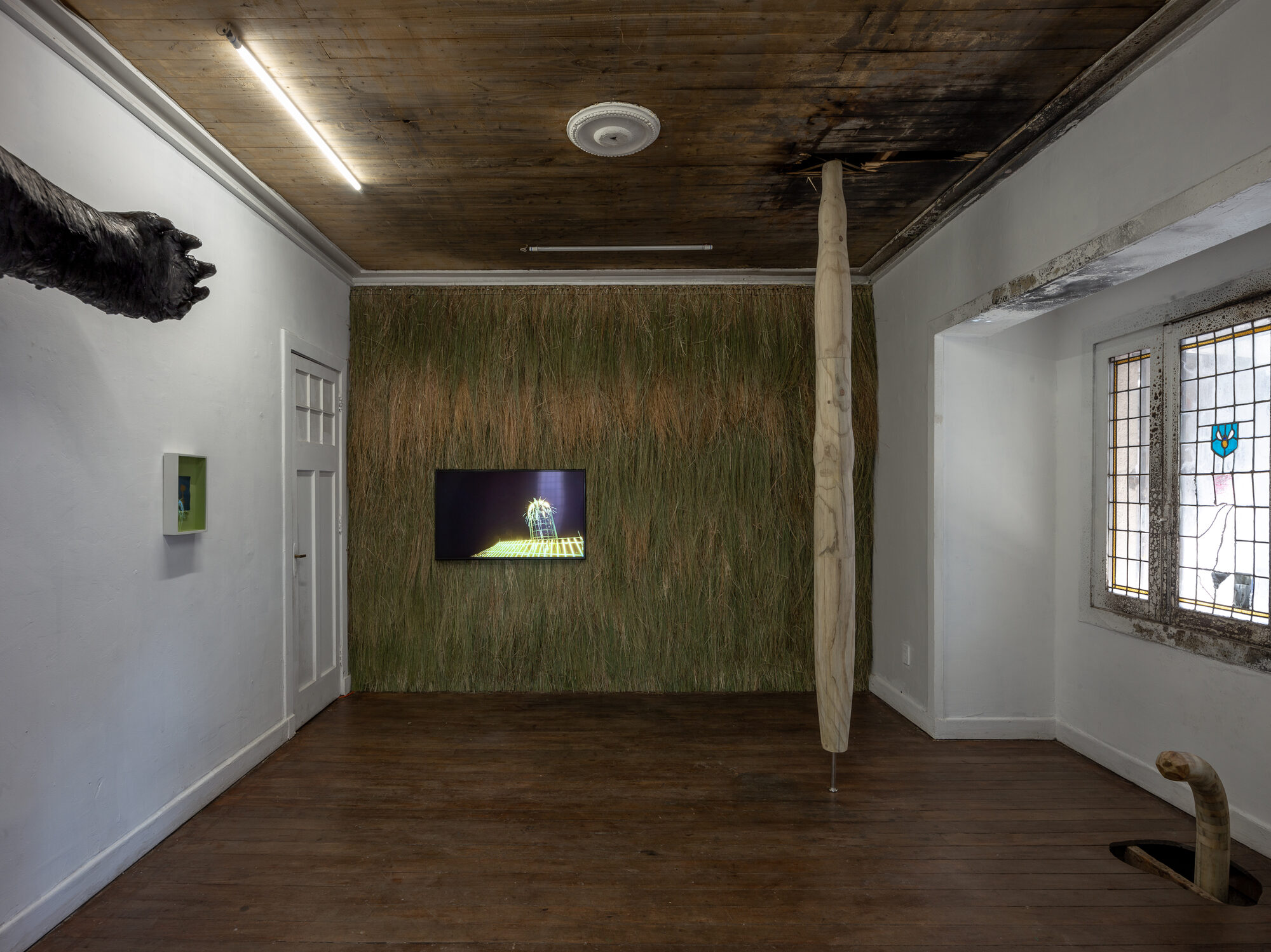
Esta exposición tiene, en su diseño, una voluntad bifurcada, la de hablarle a un cuerpo doble; por una parte pensante, por otra sensible desde su biología (en mi creencia profunda estas dos “partes” no se separan y sus facultades son las mismas pero experimentamos sus manifestaciones como si se tratara de asuntos sustancialmente distintos). Pensé en el diseño de montaje como un recorrido que es, a ratos cerebral (narrativo) y a otros estomacal (emotivo). Hay de alguna manera una voluntad de ordenar cosas como si estas estuviesen dispuestas para ser percibidas por el cerebro, en otros momentos la exposición propone un ordenamiento de elementos como el que podría existir al interior de las obscuras cavidades de un cuerpo. La exhibición entonces, parte narrativa (LOS HUESOS) y termina narrativa (MADRE DRON), como si estos extremos fuesen un paréntesis de sentido que le dan contexto al resto de las cosas que contienen (el resto de las piezas en la exhibición). Este paréntesis funciona entonces como una bolsa contenedora (una tripa), que tolera formas disímiles, pero que se asocian desde distintas perspectivas a los contenidos de la propuesta de exhibición. De esta manera, los extremos de la exhibición, el ingreso y la salida (podríamos decir su boca y su ano), son polos de un recorrido diverso, pero que propone miradas en torno al asunto ecológico desde Chile. Cada pieza funciona como una isla enterrada en una sustancia que es de alguna manera el espacio afectado por la exhibición.

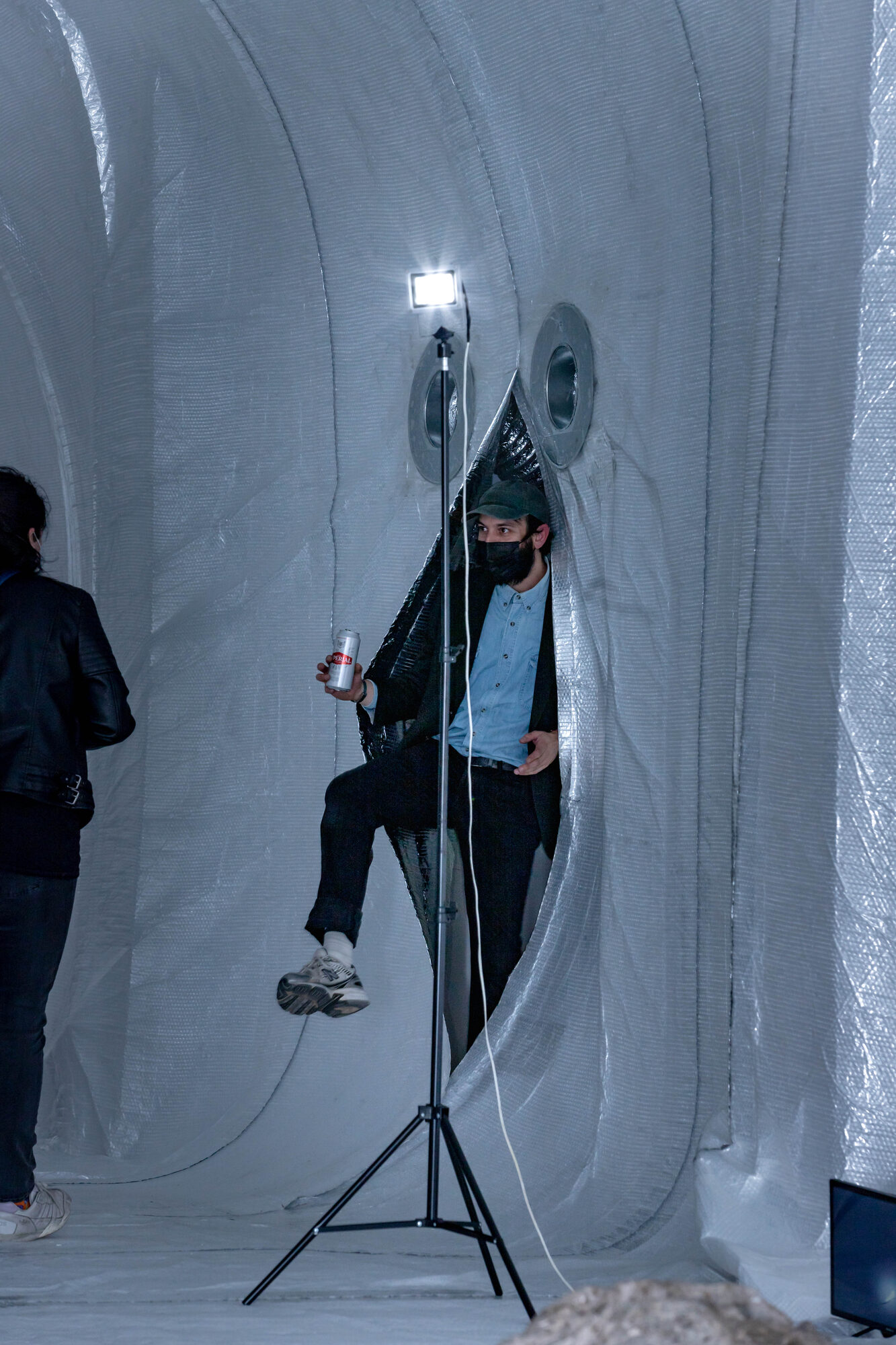
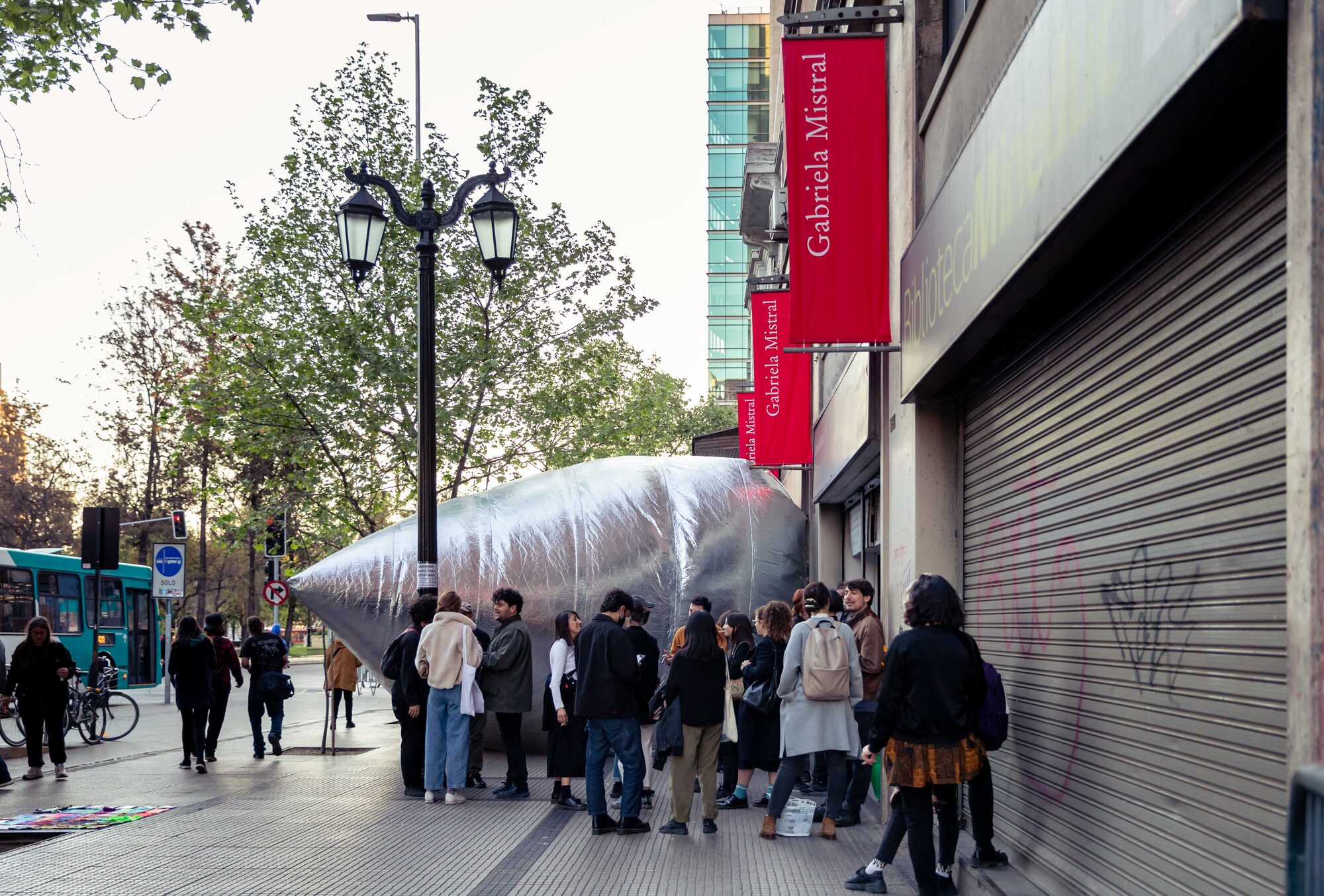
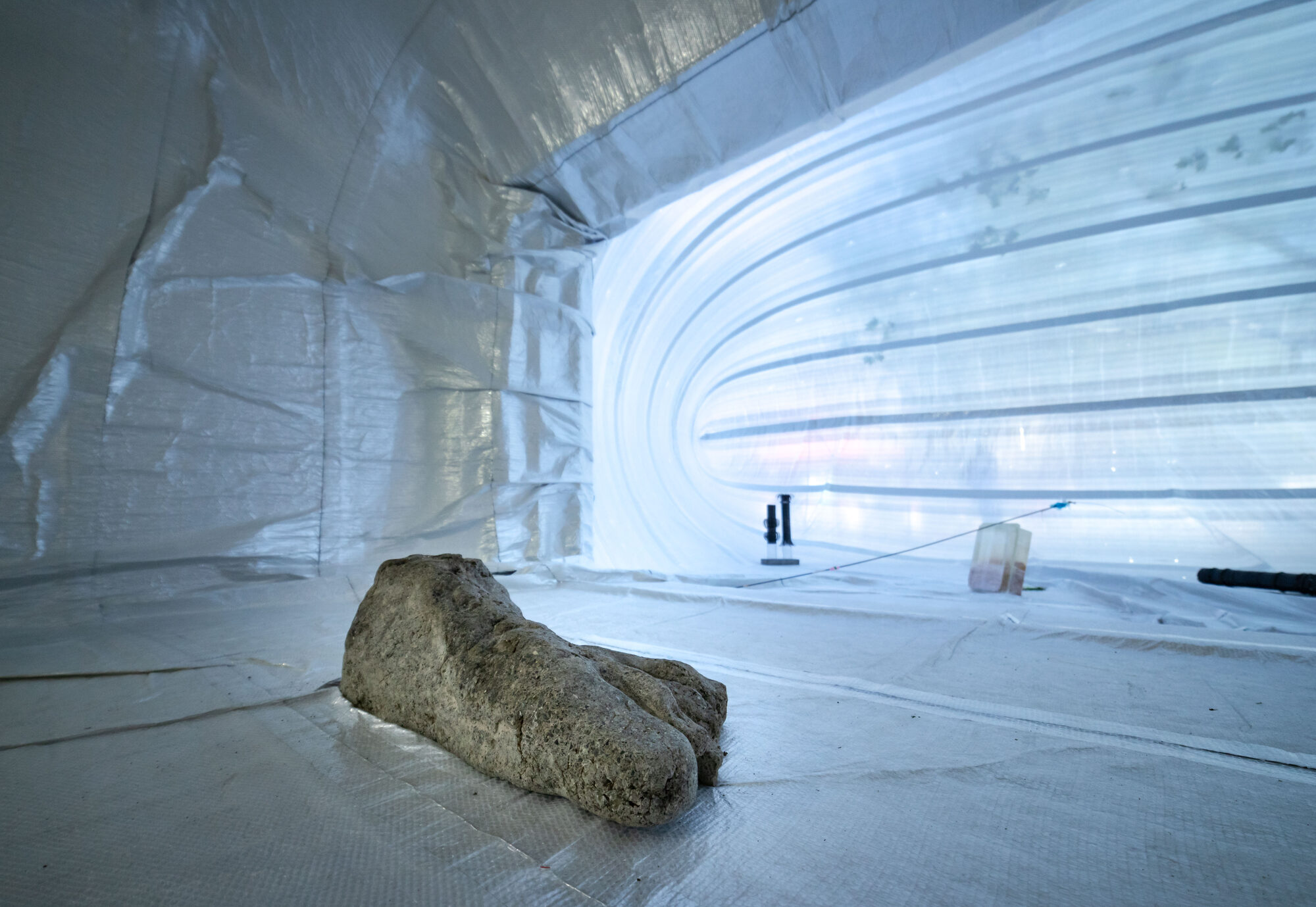
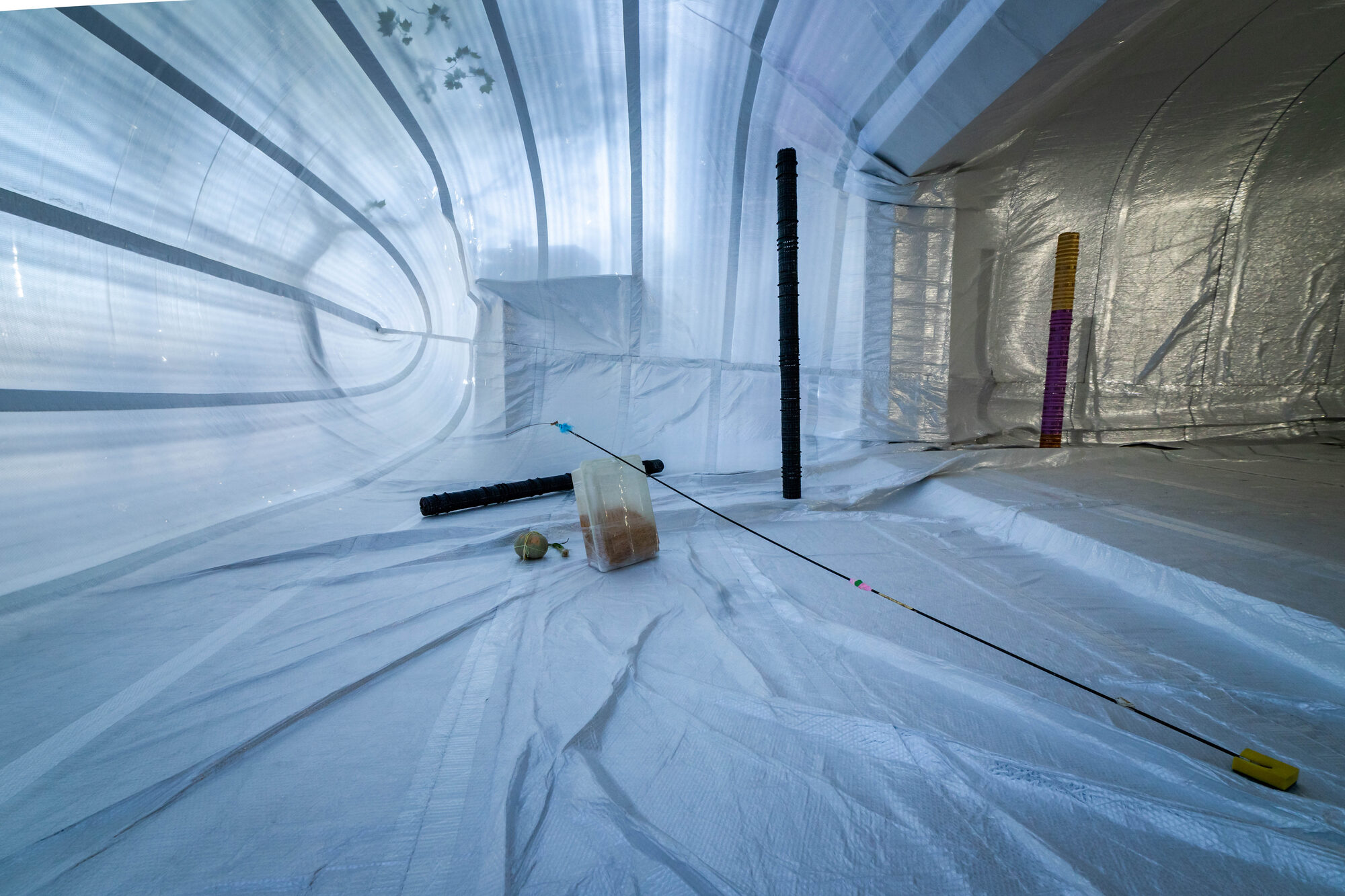
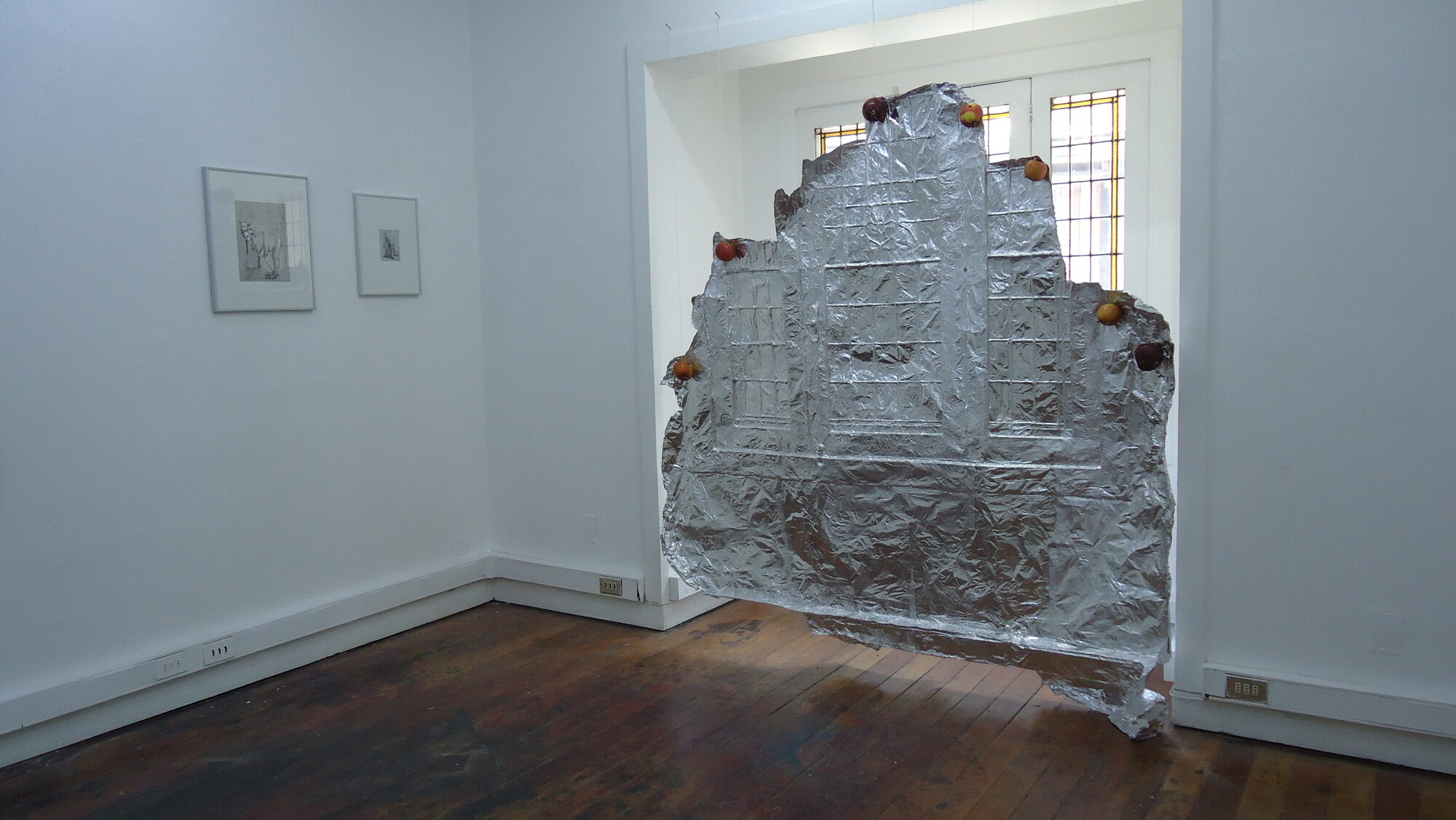
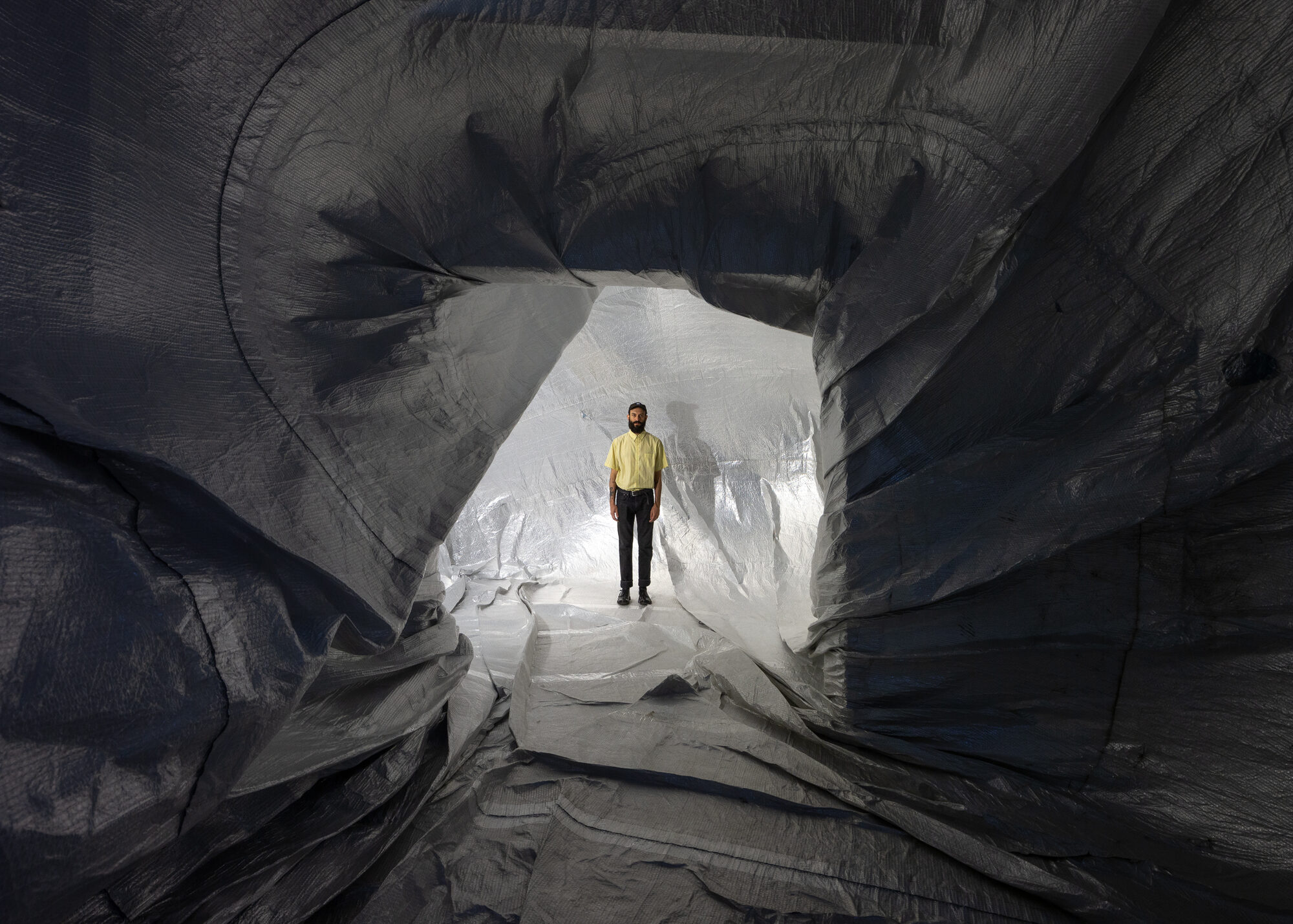
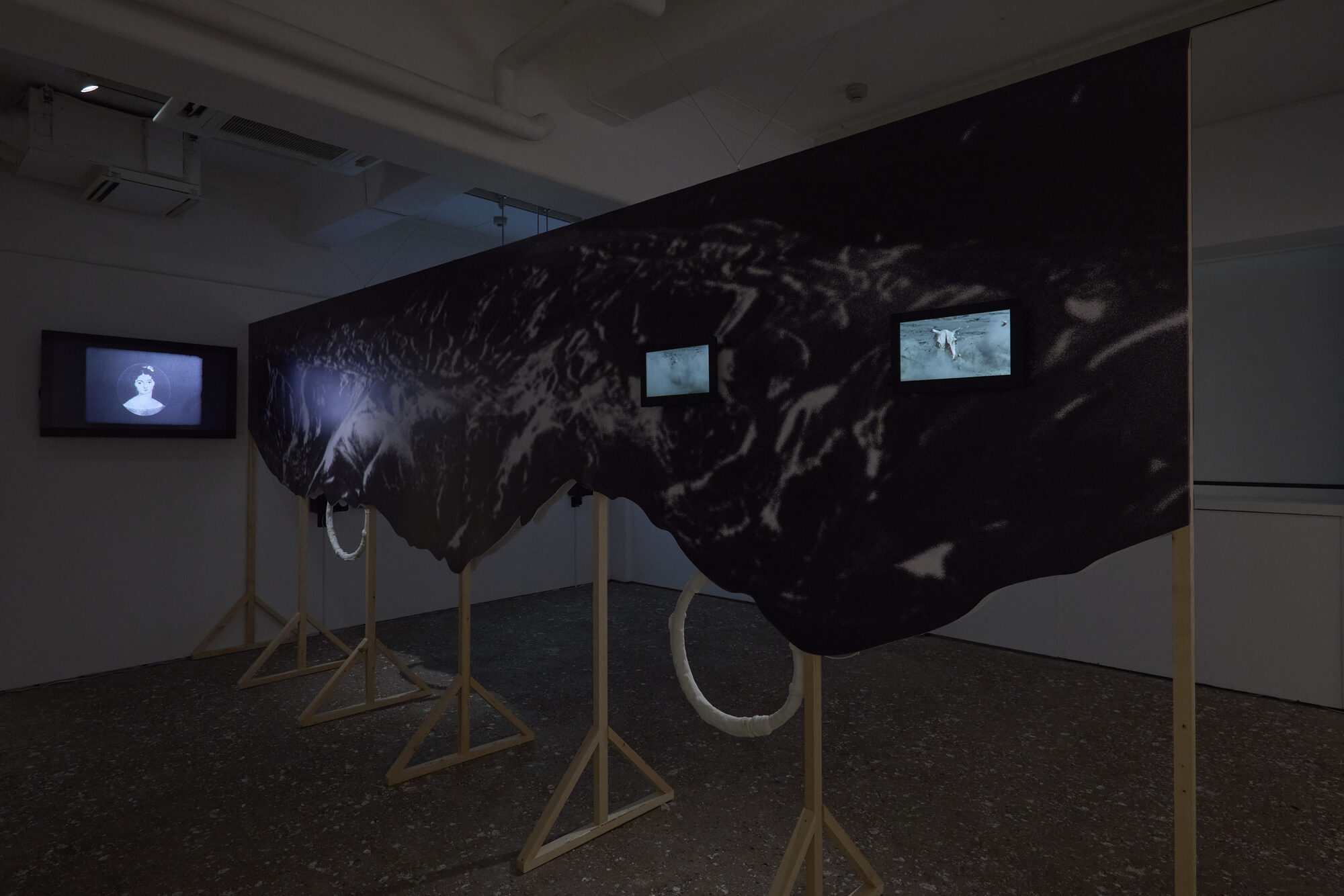
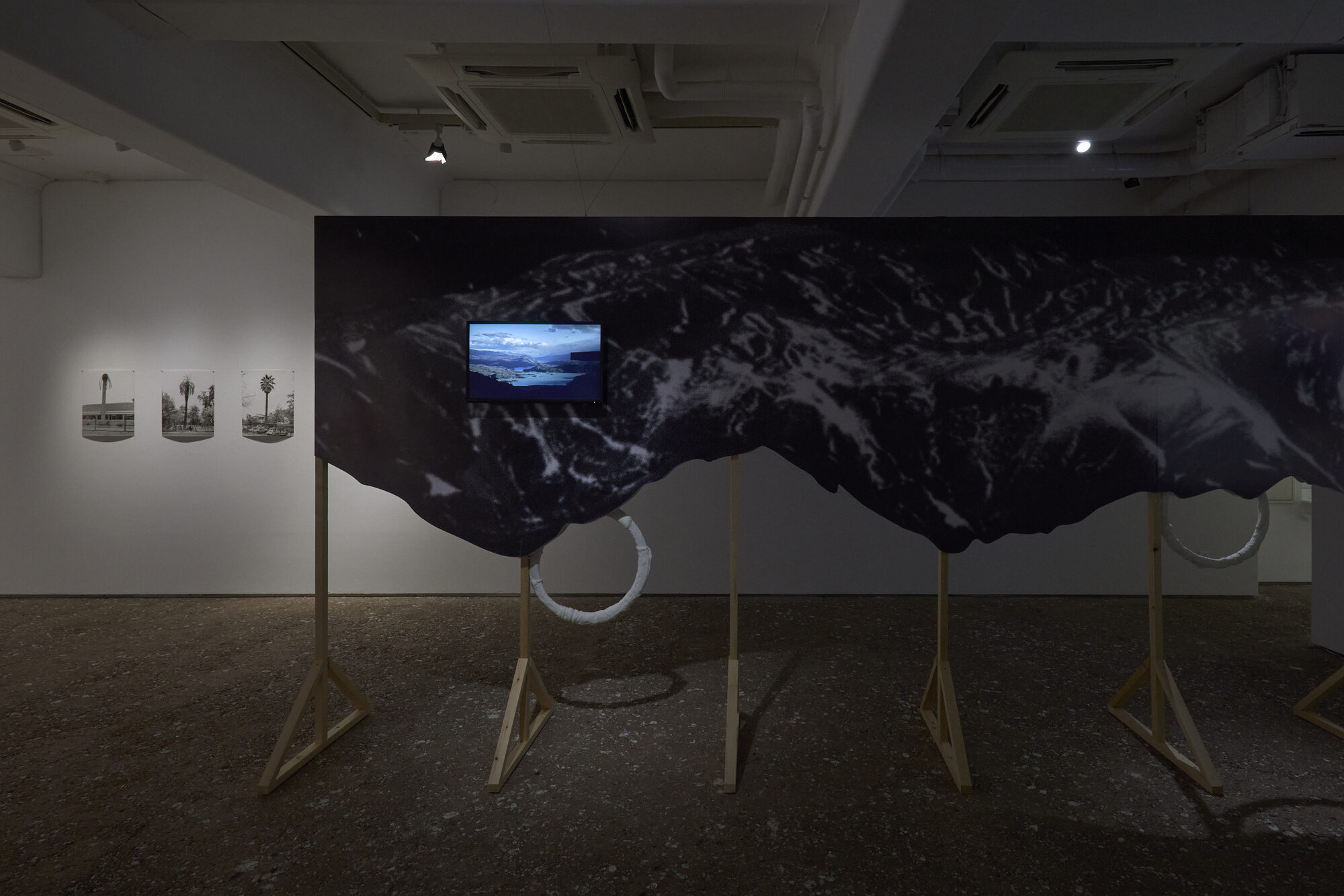
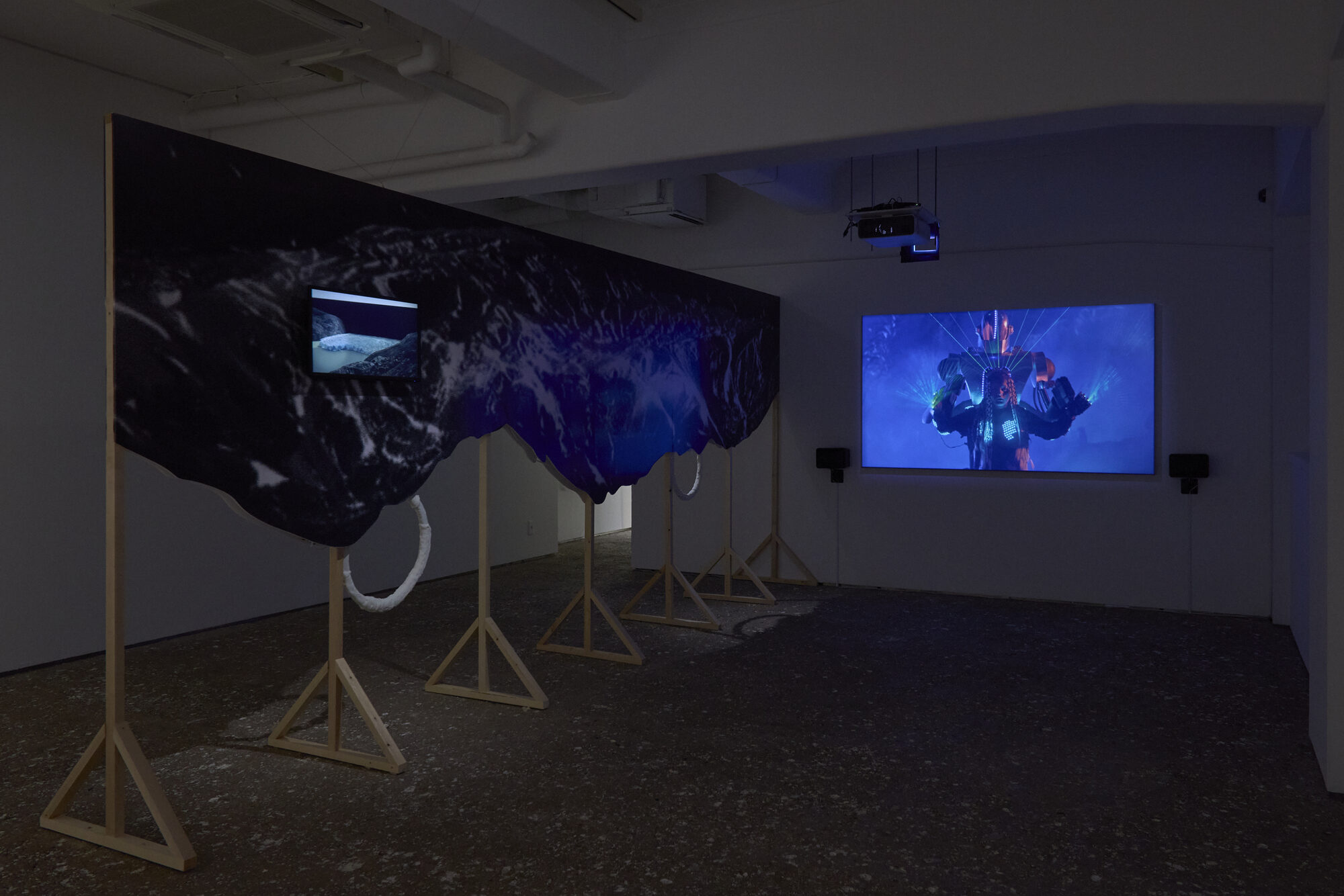
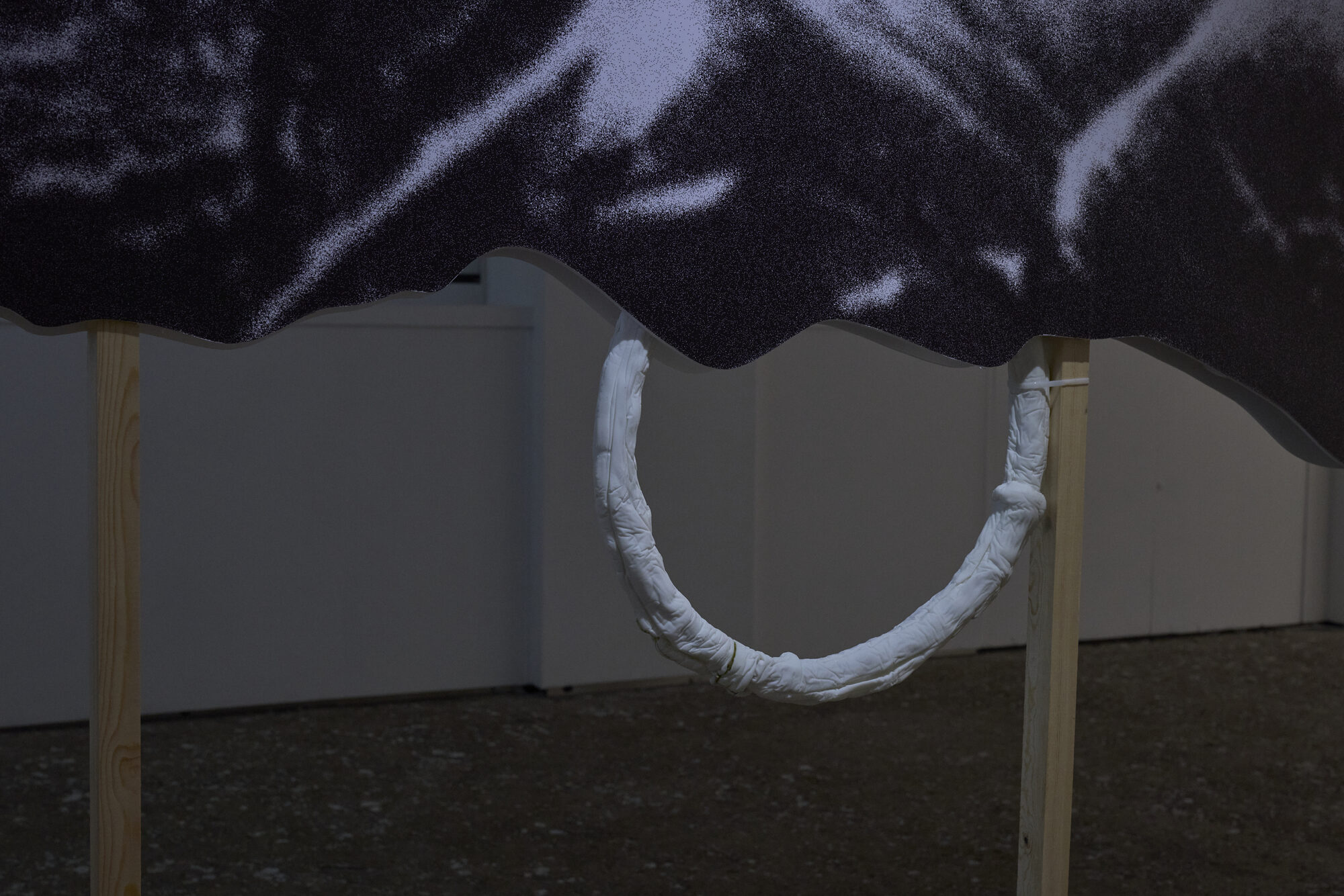
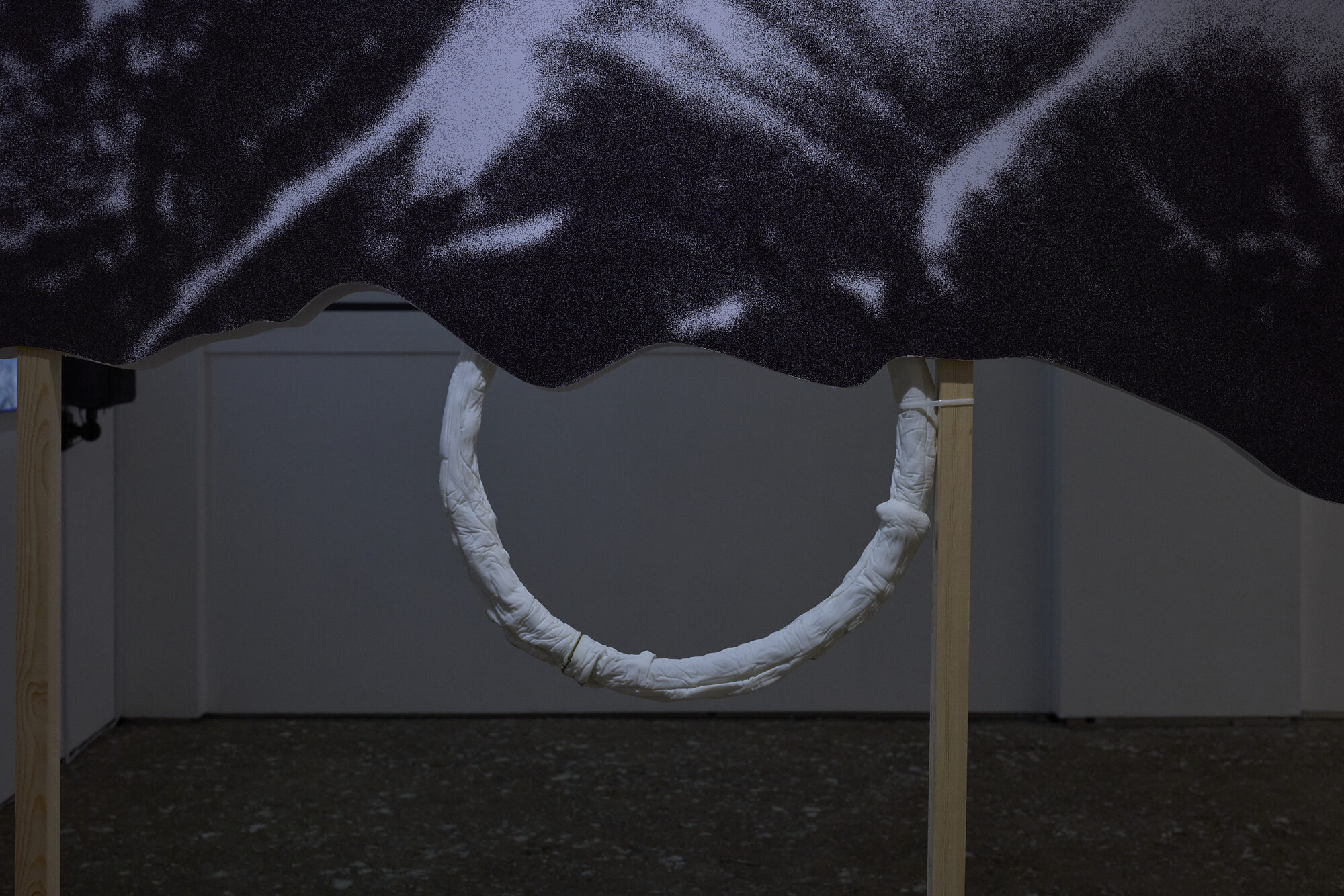
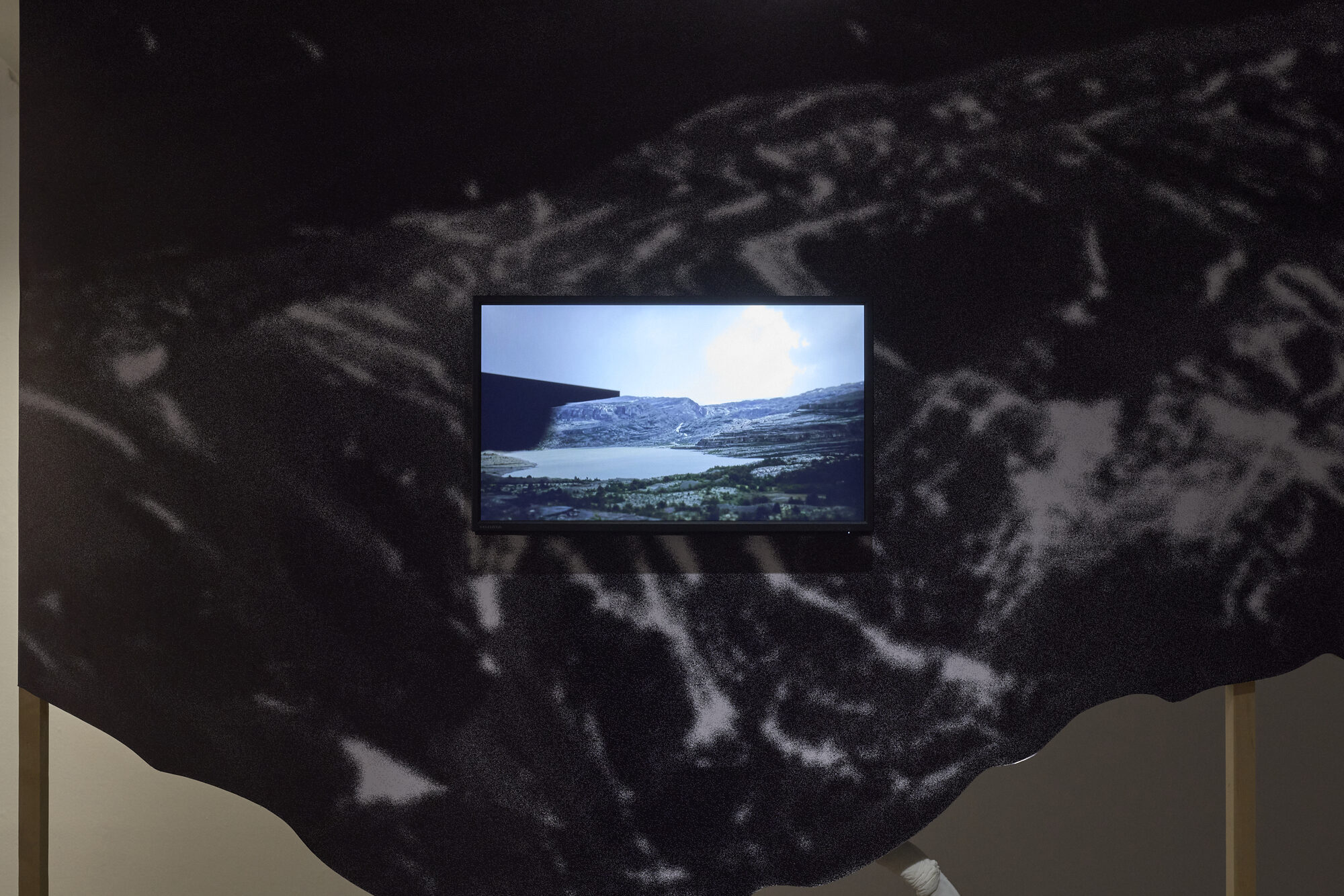
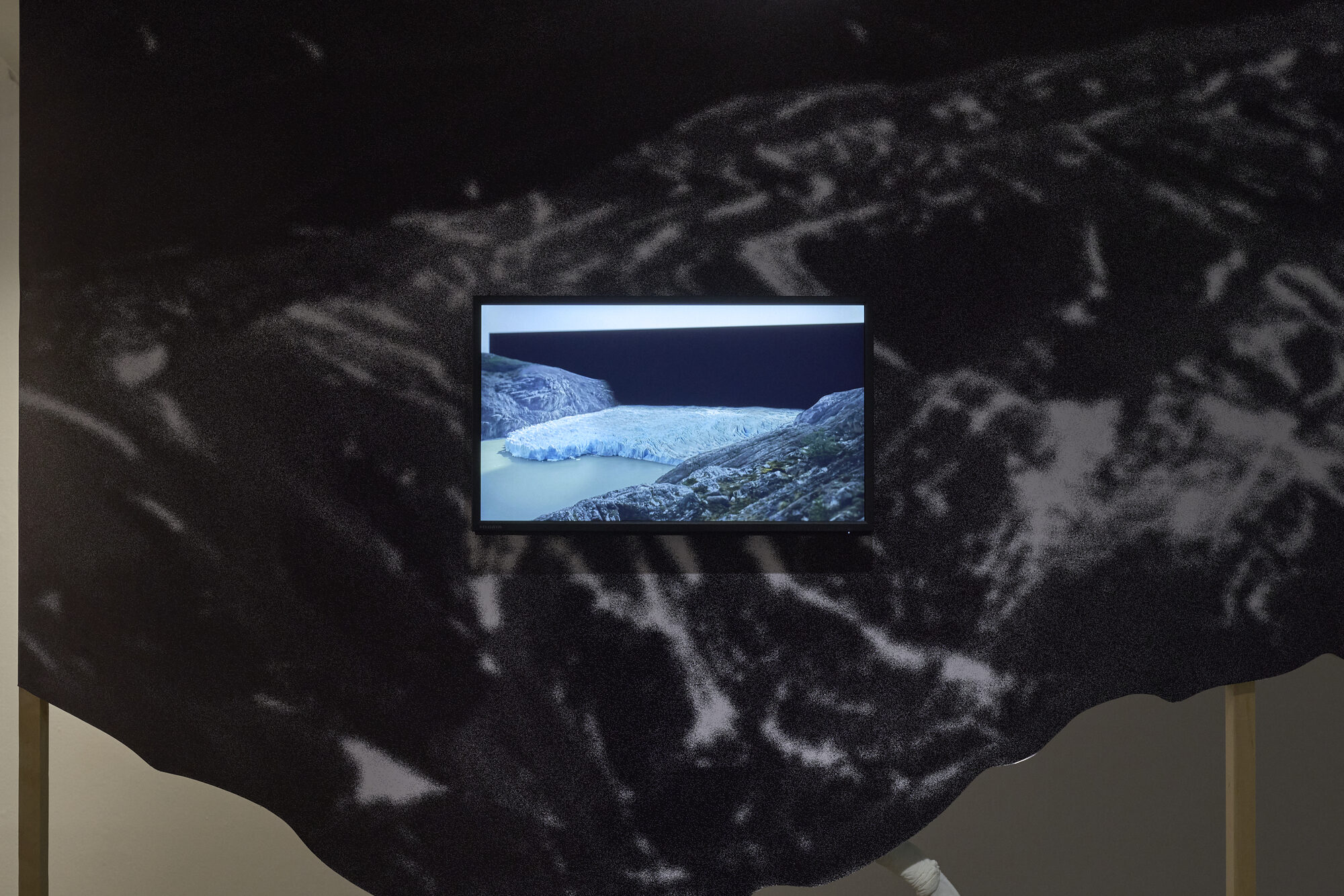
Además la exhibición contiene un elemento museográfico que es por una parte un elemento estructurante, ya que propone un recorrido y funciona como soporte para algunos trabajos. Pero es también un elemento simbólico, ya que nos presenta una imagen. Un trozo de la cordillera de los Andes aparece invertida en la sala de exhibiciones. Propongo este elemento como una sustancia del territorio Chileno desplazada, visitando el otro lado del mundo. La montaña parece chorrear como si fuese un líquido duro. Una sustancia que es un poco un sangrado y una estalactita, como una cueva que sabe desplazarse fotográficamente y hacer su aparición en la sala de TOKAS (Tokyo). Invertida permanece, como si nunca hubiese abandonado su territorio original (Chile, al otro lado del mundo). Yo y la cordillera fotográfica viajamos juntos, ambos experimentamos el efecto de vivir con el organismo invertido al pararnos en suelo Japonés. Sobre este panel-fotografía se instalaron trabajos de Sofía de Grenade, Aymara Zegers y Nicolás Rupcich.

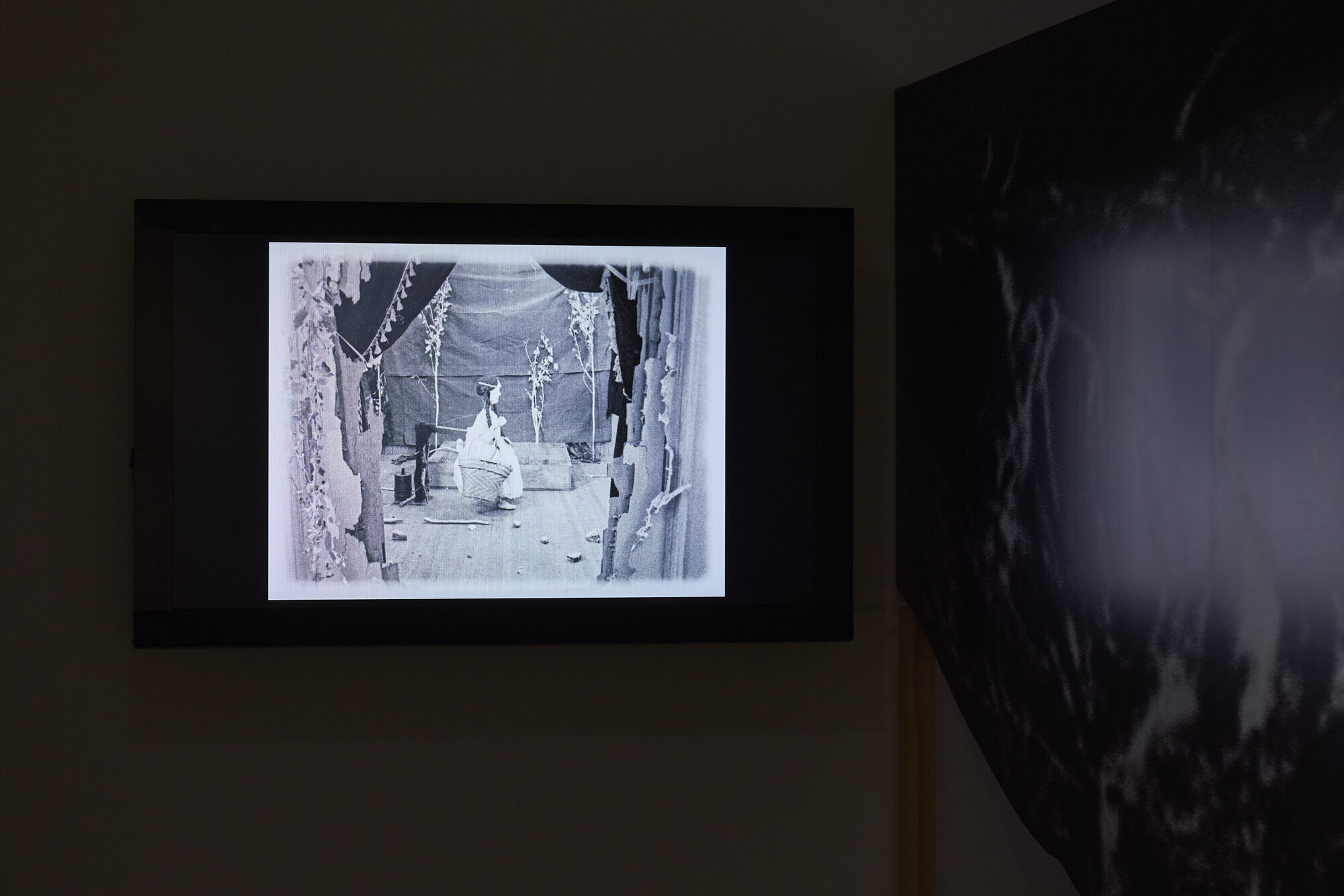
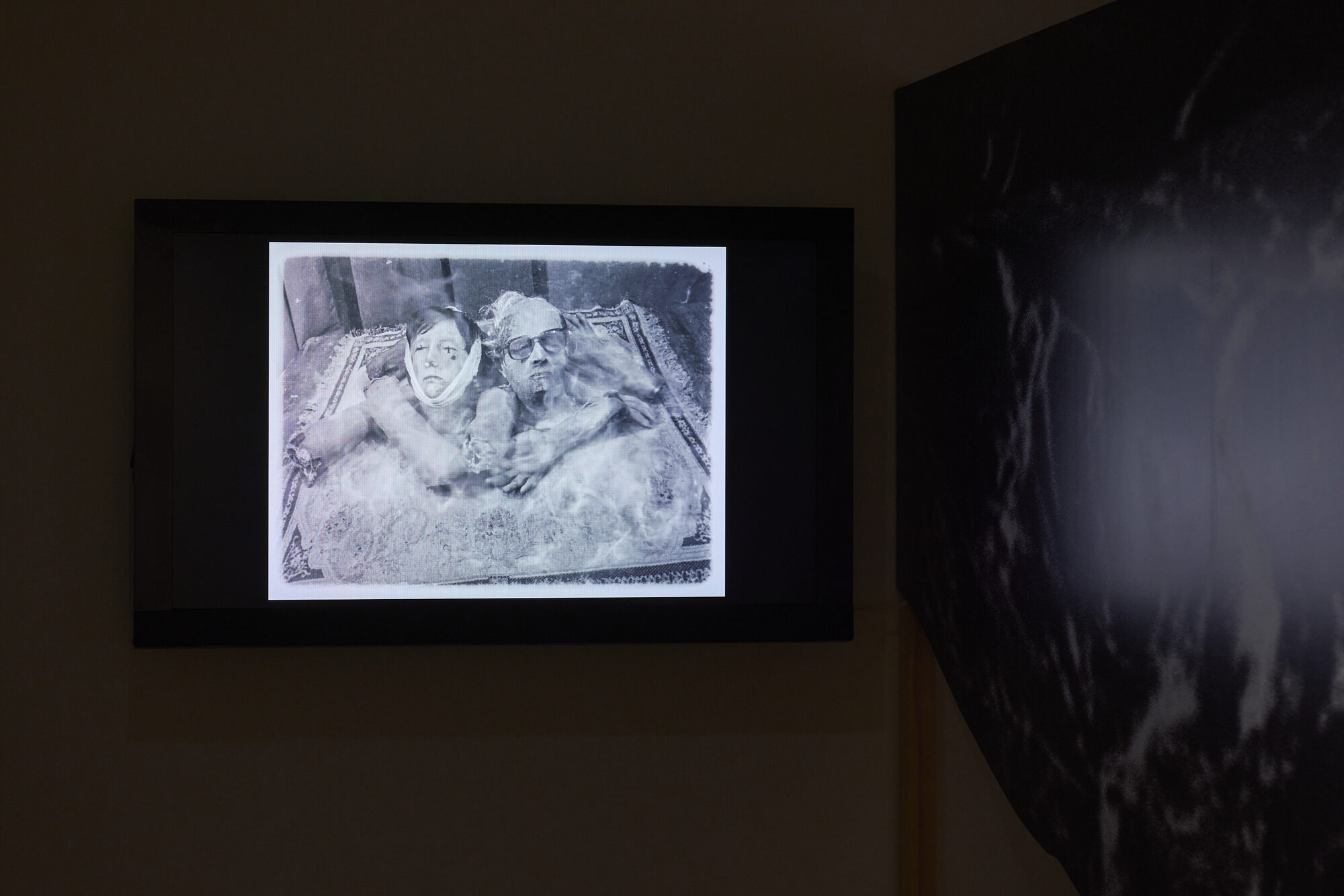
Los HUESOS, de León & Cociña es una película corta en donde la niña, Constanza de Nordenflicht, a partir de restos óseos, revive a dos personajes históricos de la política chilena; Diego Portales (quién fuese su esposo) y Jaime Guzmán. Estos dos personajes son agentes centrales en la escritura de dos de las constituciones de Chile, autoritario y oligárquico. La niña revive estos cuerpos, los trae de regreso en un ritual emancipador, por el medio del que se divorcia (o más bien deshace su vínculo) con Diego Portales, el que siendo un político influyente, inicia un romance con Constanza, siendo ella aún una niña. Jaime Guzmán, oficia como una suerte de sacerdote de este matrimonio a la inversa. Constanza, por medio de su desvinculación, nos permite pensar en la posibilidad de deshacer los designios propuestos por estos hombres de la política Chilena. Su desvinculación es un signo de esperanza, nos propone que esta hazaña de dividirnos del autoritarismo abusivo encarnado por estos personajes es una perspectiva en la que podemos pensar. Es importante considerar que, si bien la película está ficticiamente situada en 1901, fue producida en el tiempo que en Chile estábamos viviendo un proceso de reforma constitucional. Esta parece ser un aliciente, una ficción que acompaña a la realidad en este proceso de intentar lograr la emancipación por medio de un texto constitucional escrito con participación ciudadana y perspectivas de resguardo de minorías, la naturaleza, pueblos originarios, entre otros.

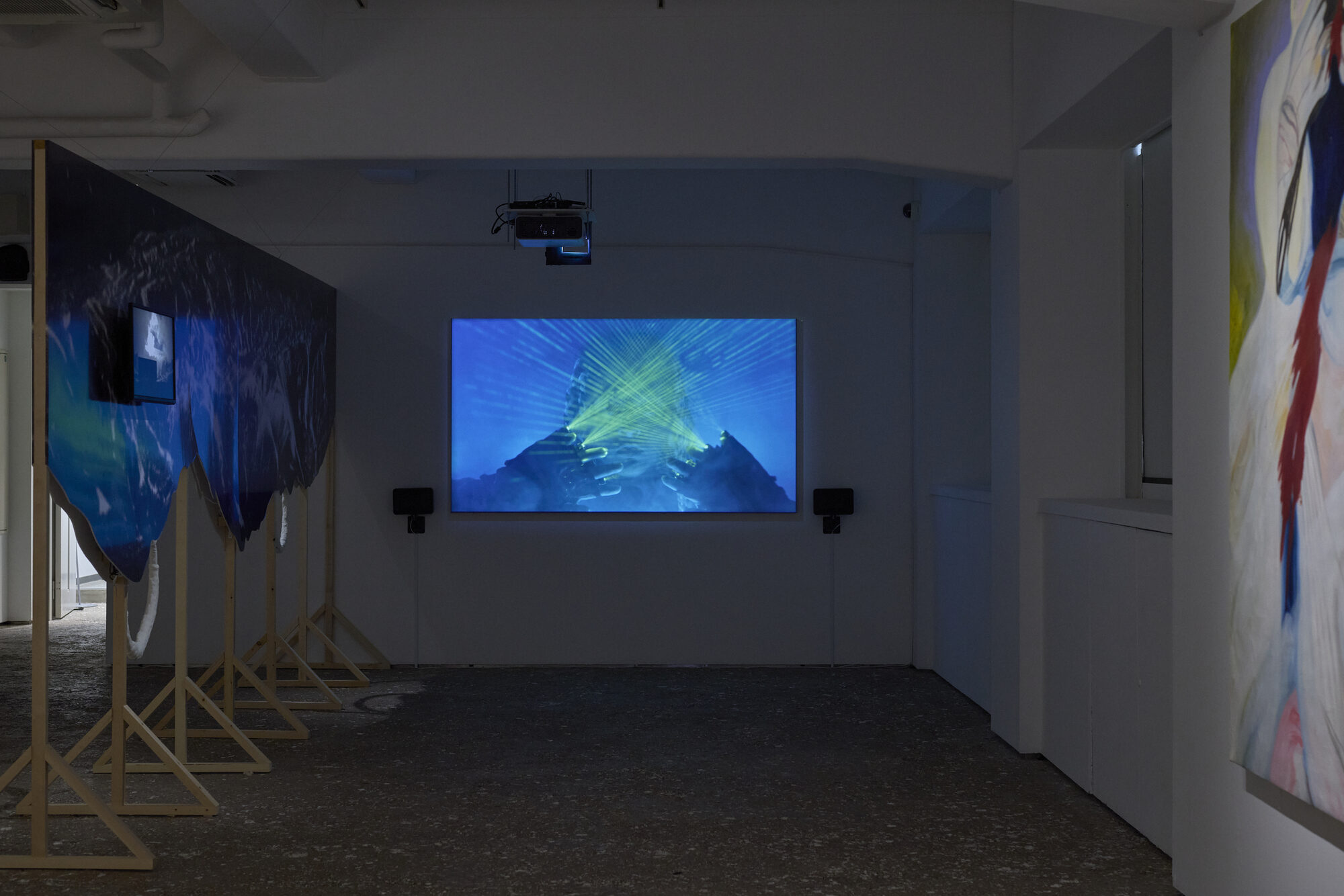
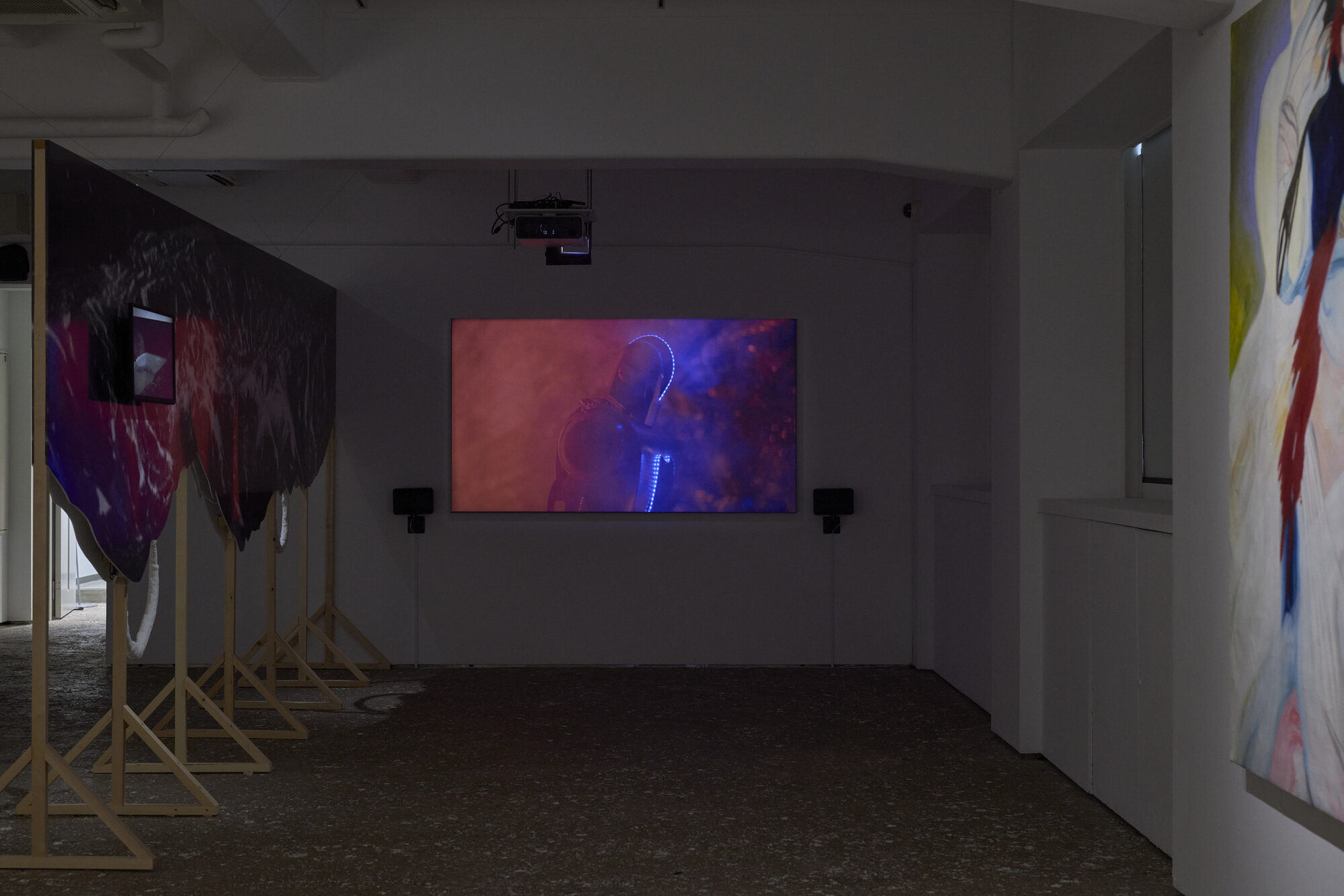
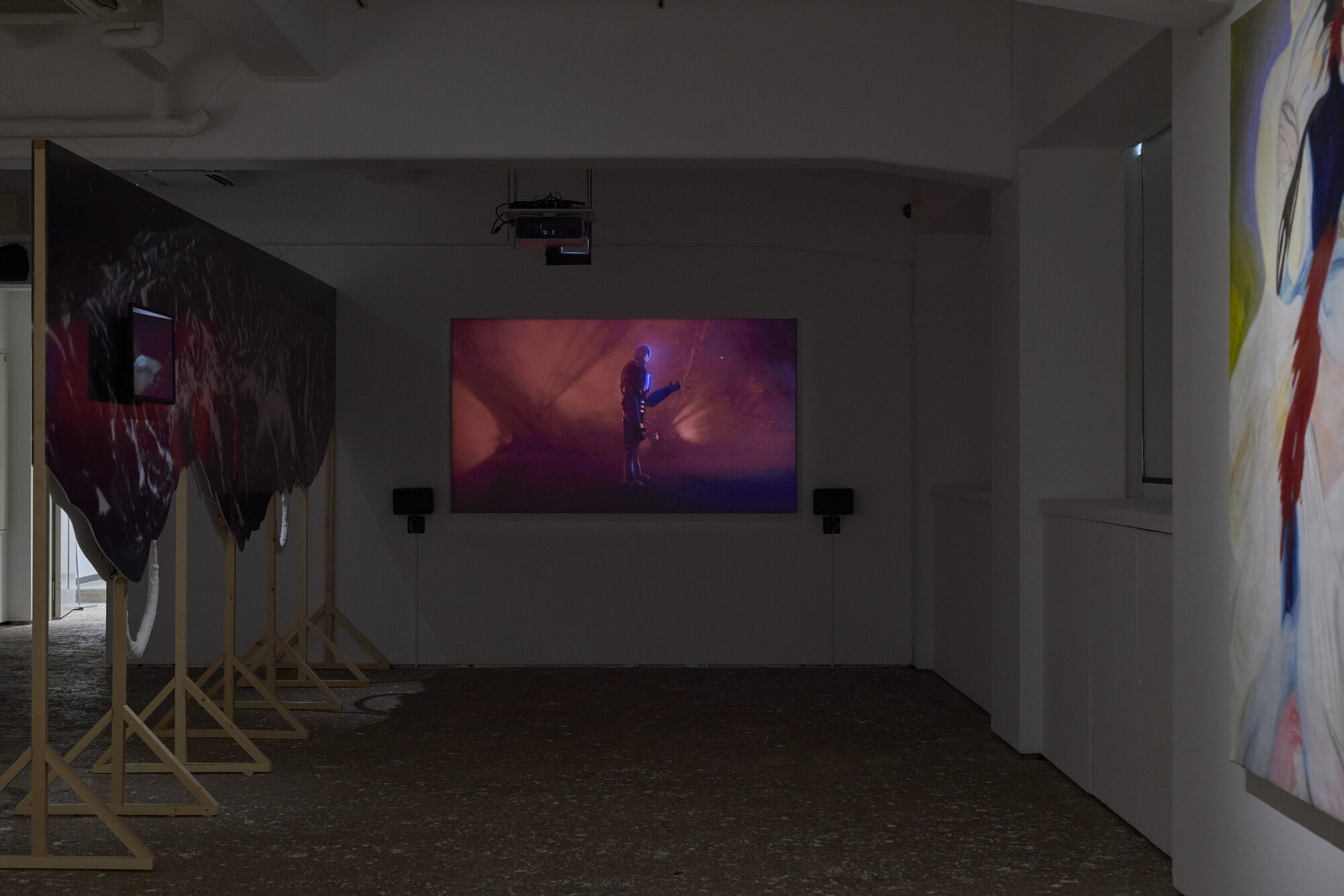
En el otro extremo de la exhibición (al final del recorrido) nos encontramos con MADRE DRON de Patricia Domínguez. Este video nos propone pensar la relación entre política y naturaleza (biología), donde el impacto de las decisiones humanas es transnacional y múltiple, muchas veces movilizado como una energía de violencia. La artista cruza tres cegueras (humana, animál, robótica) en un relato múltiple que sucede en el extenso territorio sudamericano, conectando las protestas Chilenas con imágenes de rescate y rehabilitación de especies animales en la Amazonía Boliviana. Desde 2019 en Chile hubieron importantes movilizaciones sociales que convirtieron muchas ciudadaes del país en territorios de enfrentamiento donde se explicitó el antagonismo entre una ciudadanía disconforme, desesperada, agobiada (por una parte) y unas estructuras de poder y represión política (por la otra). Los enfrentamientos parecían apuntar parte de su violencia hacia la visión, resultando al menos 445 heridos oculares (según conteos del Instituto Nacional de derechos Humanos). Por su parte, los manifestantes usaron punteros laser como una herramienta con la cual enseguecer las cámaras aéreas portadas por drones que sobrevolaban las marchas como herramientas de control. Cientos de delgadas luces laser se elevaban hacia el cielo persiguiendo a estos ojos voladores, intentando anular esta mirada vigilante. Este gesto, que conecta al suelo con el cielo, a un dedo (laser) con un ojo (robot), a las personas protestando con la vigilancia tecnológica, se volvió una escena muy representativa de las movilizaciones de 2019. La película nos propone desplazarnos a la amazonía, en donde los incendios forestales (que en los últimos años se han multiplicado por el impacto del calentamiento global y las actividades industriales en la zona) afectan gravemente a muchos animales. Un tucán afectado en su ojo toma un cierto protagonismo, en un relato visual que vincula a esté ser amazónico con el dron (una especie de ave de plástico y metal, sin voluntad animal pero como un instrumento de visión institucional) y los ojos de los manifestantes chilenos. Esta contienda entonces parece ser cibernética, multiespecie y no un fenómeno acotado a la política humana.

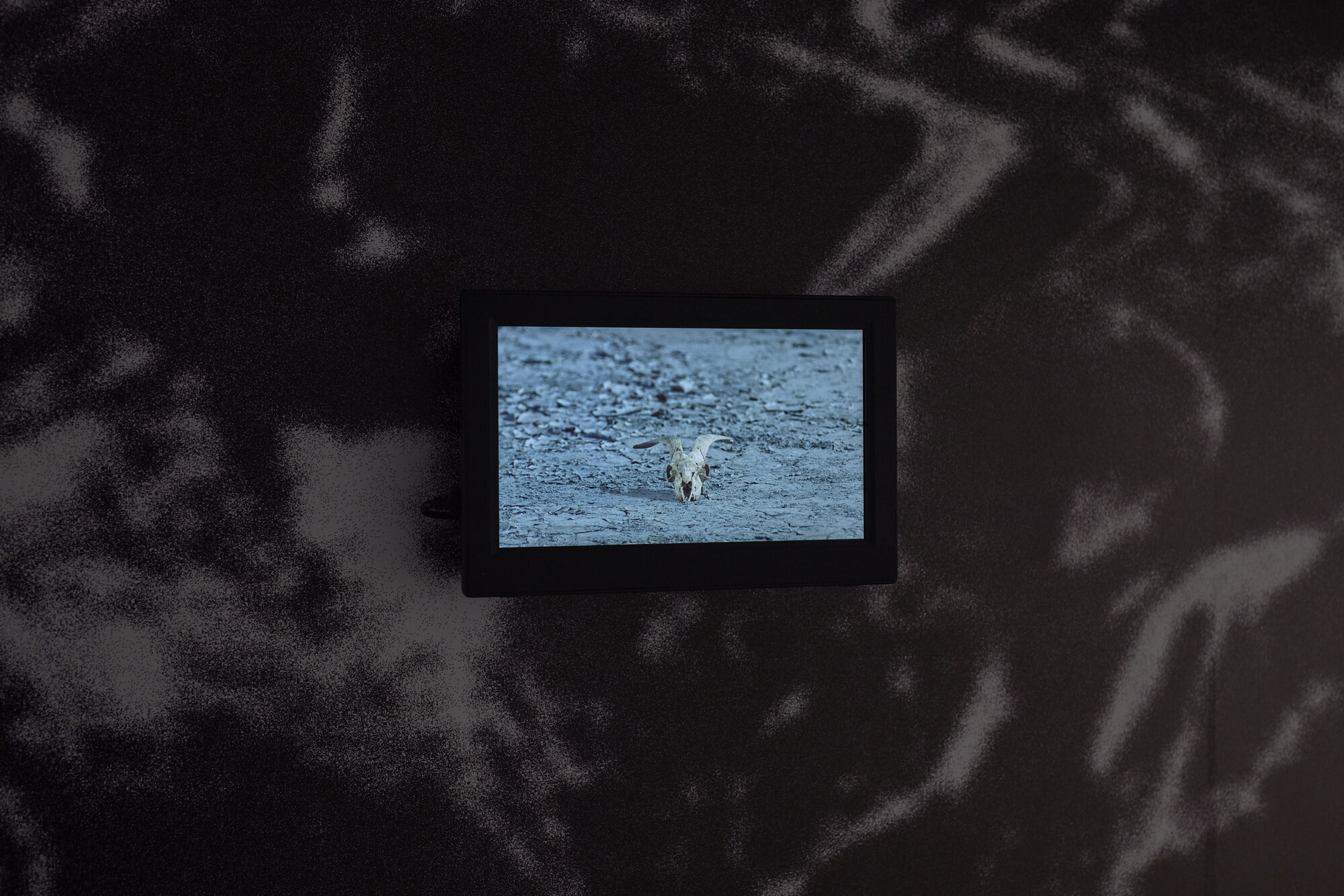
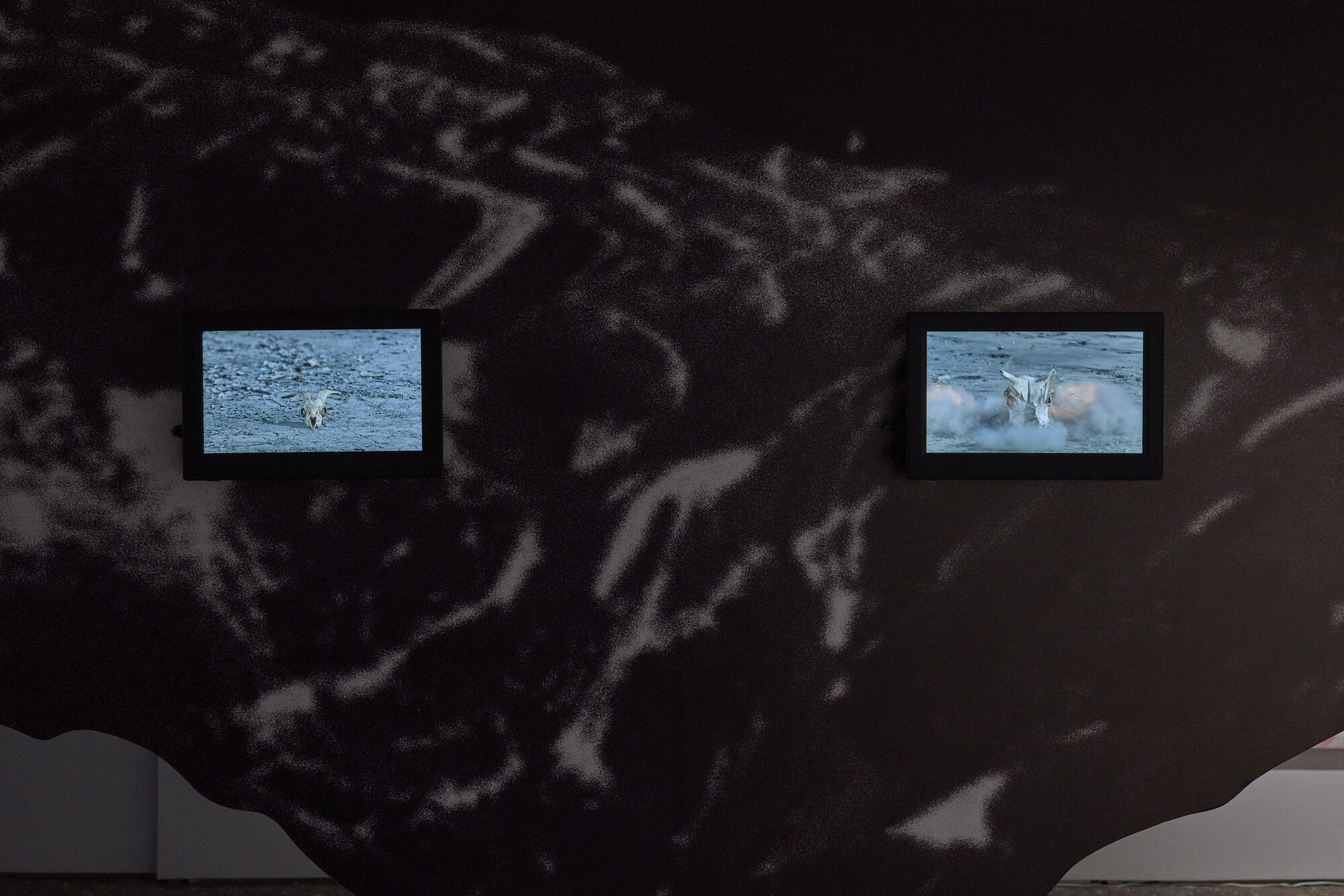
Entre estos extremos (“Los Huesos” y “Madre Dron”) el resto de los trabajos como apariciones significantes activando la exhibición como un sistema lleno de figuras y operaciones críticas. Aymara Zegers muestra su serie de videos Del cuerpo no podemos caer donde unos cráneos animales explotan lentamente, dejándonos ver cada detalle de un gesto de violencia explosiva, “un gesto escultórico terminal”, diría la artista. El cuerpo ya no vuelve, la forma del esqueleto se despedaza, siendo su reconstrucción una imposibilidad. El estallido nos recuerda la mecánica de extracción de cobre y otros minerales. Se dinamita la tierra para alcanzar una profundidad rica en sustancias minerales. Este proceso convierte el paisaje del desierto en unos áridos acantilados, como cráteres generados por la industria. El rastro de la violencia extractiva impacta el territorio de una manera que es dificil revertir, epro que es parte sustancial del progreso.

Ei trabajo de Nicolás Rupcich, EDF, nos presenta una serie de paisajes naturales del sur de Chile, siendo amenazados por una obscuridad lenta, como un fantasma sombrío que tiene la capacidad de tragarse incluso la montaña más alta. Esta barra de opacidad negra acvanza silenciosa, lenta, pero al parecer sin freno. La naturaleza no sabe reaccionar, no puede huir, parece esperar su tiempo de entrar en la obscuridad para volverse invisible, para habitar la prolongación de un ambiente sin sol. Estas escenas parecen como las de una película de terror, en donde los cuerpos en angustiosa persecución tienen el tamaño del territorio, la fragilidad amenazada es el paisaje mismo y toda la vida que lo constituye.

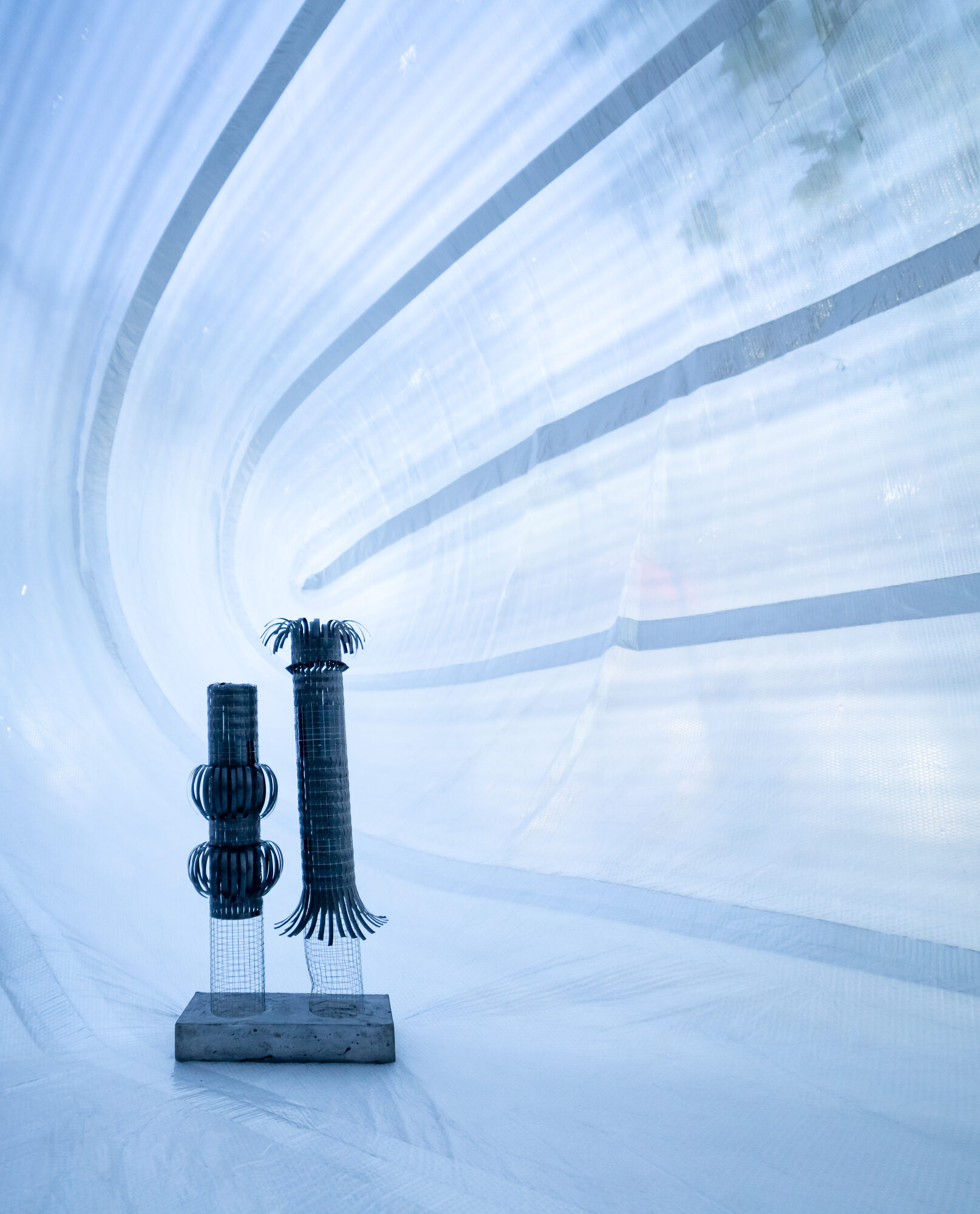
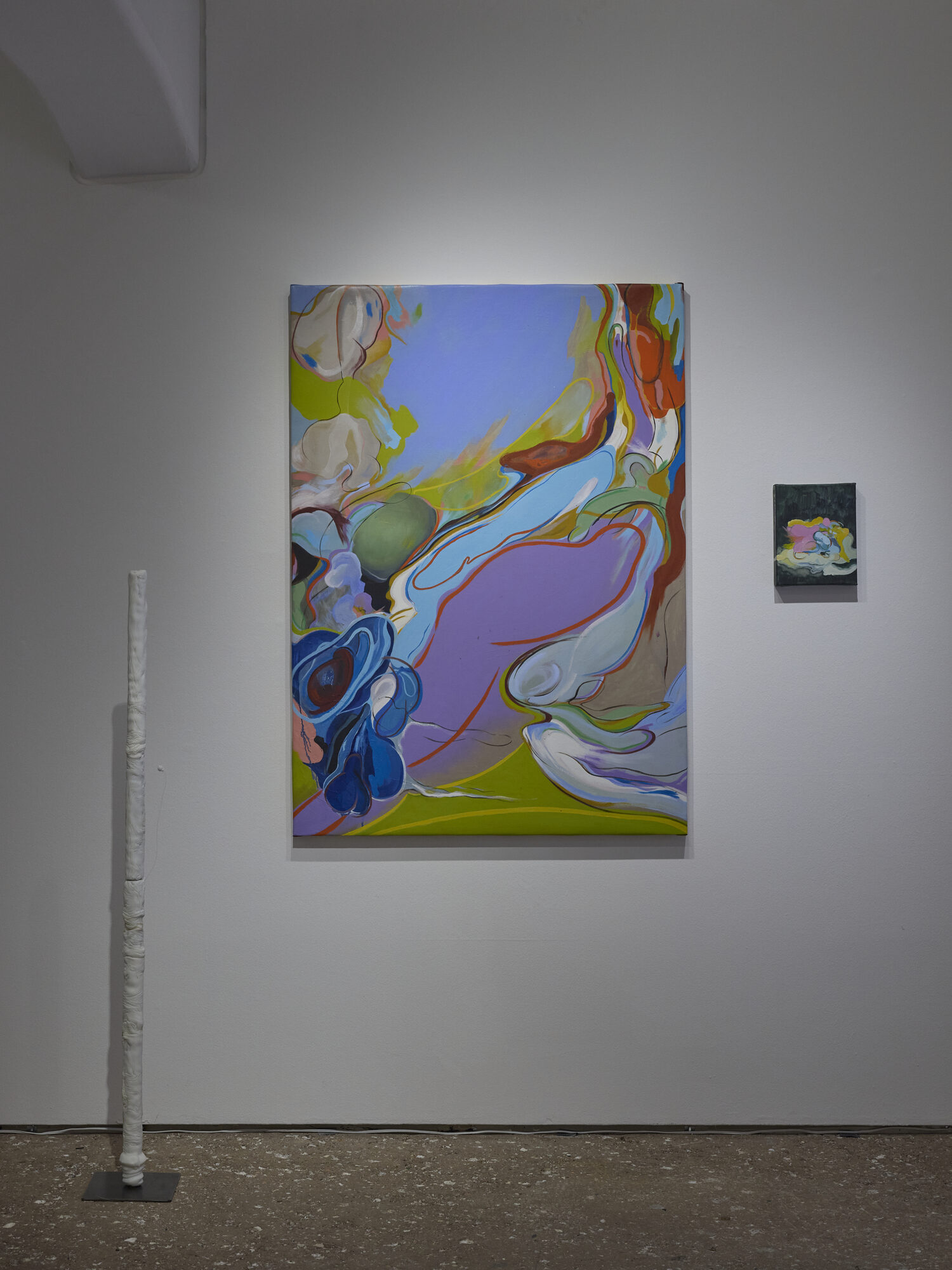
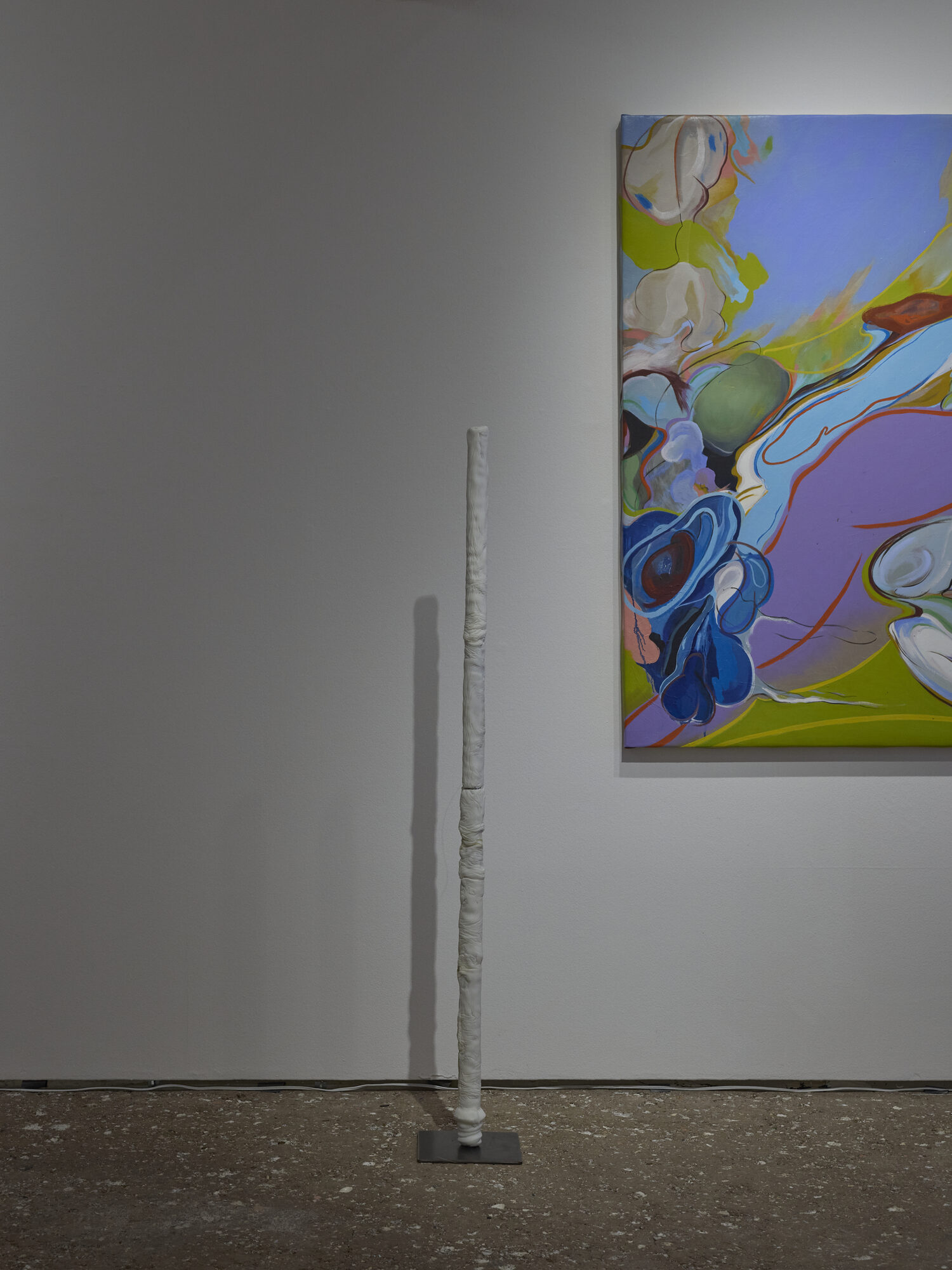
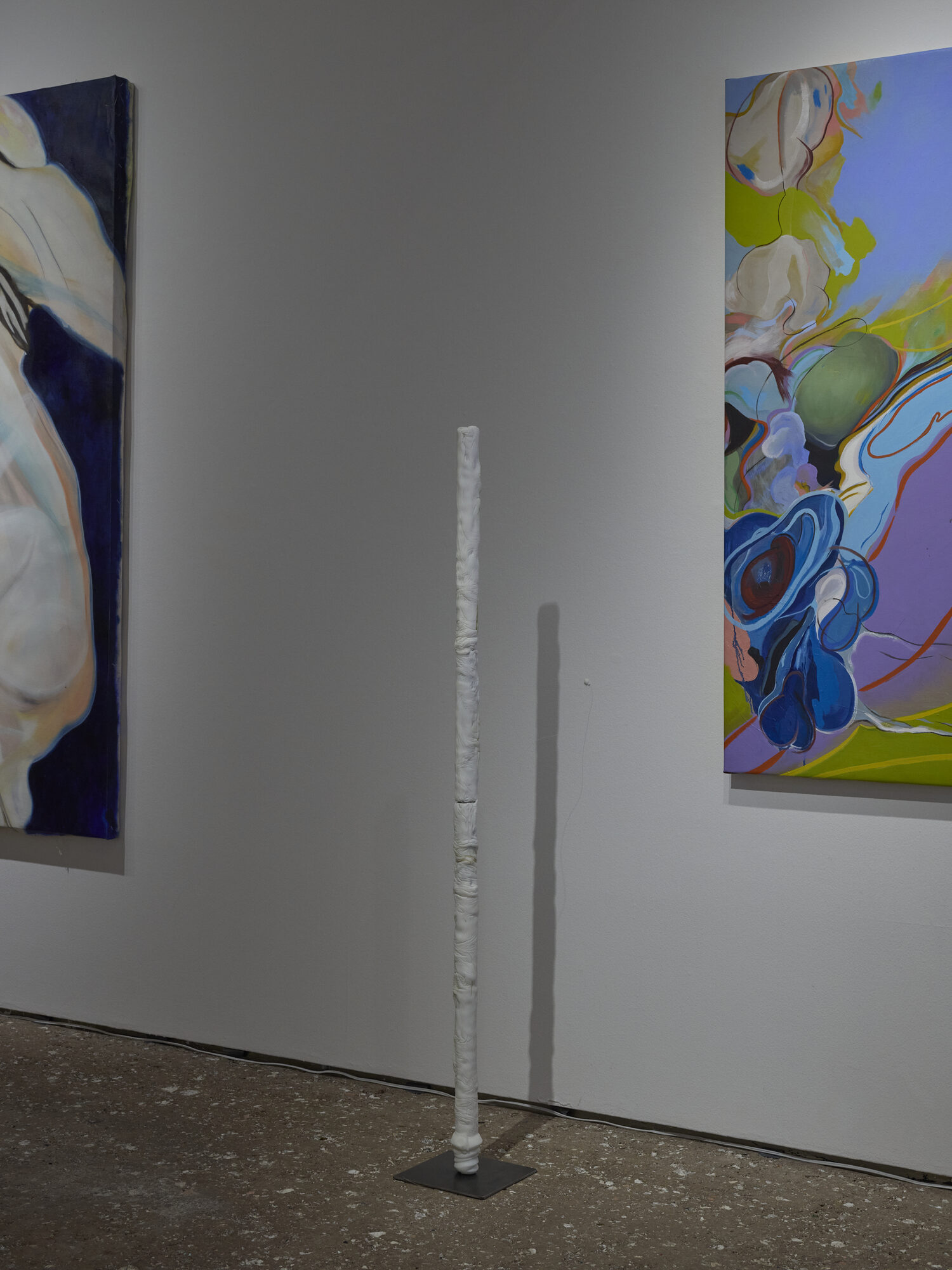
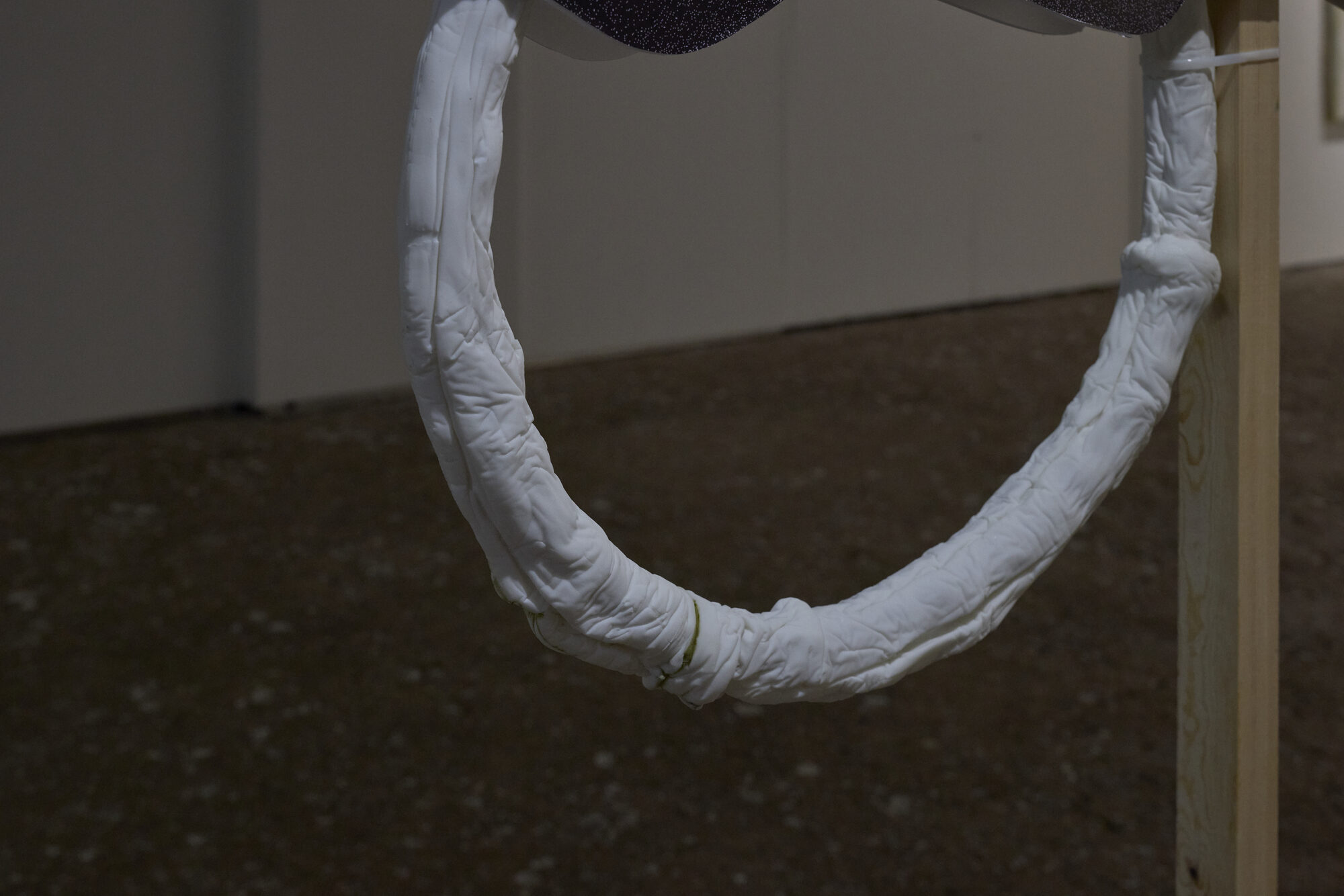
Crisol Negativo es una serie escultórica que la artista Sofía de Grenade viene desarrollando hace algunos años. En esta oportunidad exhibe tres piezas delgadas, un poco como huesos rugosos. Dos dibujan círculos, los que montados en el panel con la cordillera invertida parecen soles raquíticos ocultándose detrás de una montaña en blanco y negro, una puesta de sol en estado de deshidratación. Otra pieza se iergue como un vestigio terminal de un árbol que soportó un incendio devastador. Estas piezas están hechas de resina y tienen manchas de toxinas vegetales extraidas del Eucalipto, como mánchas que se impregnan en las grietas y poros de su superficie. El eucalipto es una especie de árbol que ha sido introducido en el territorio Chileno por la industria maderera, modificando unos suelos que no estaban preparados para tolerar su acidés. Unas cuantas generaciones de plantaciones de monocultivo de eucalipto nos han dejado suelos faltos de nutrientes, prácticamente estériles.

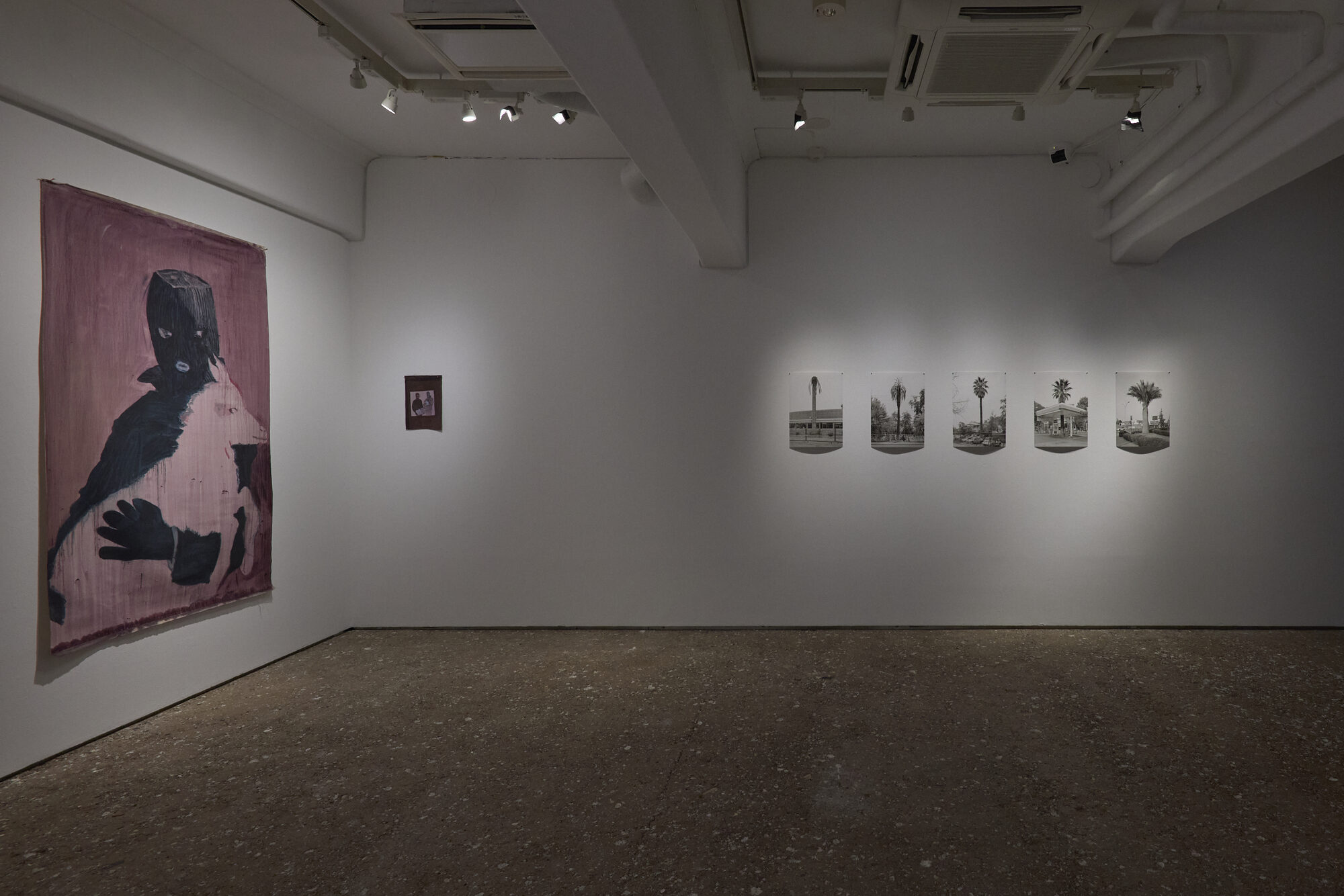
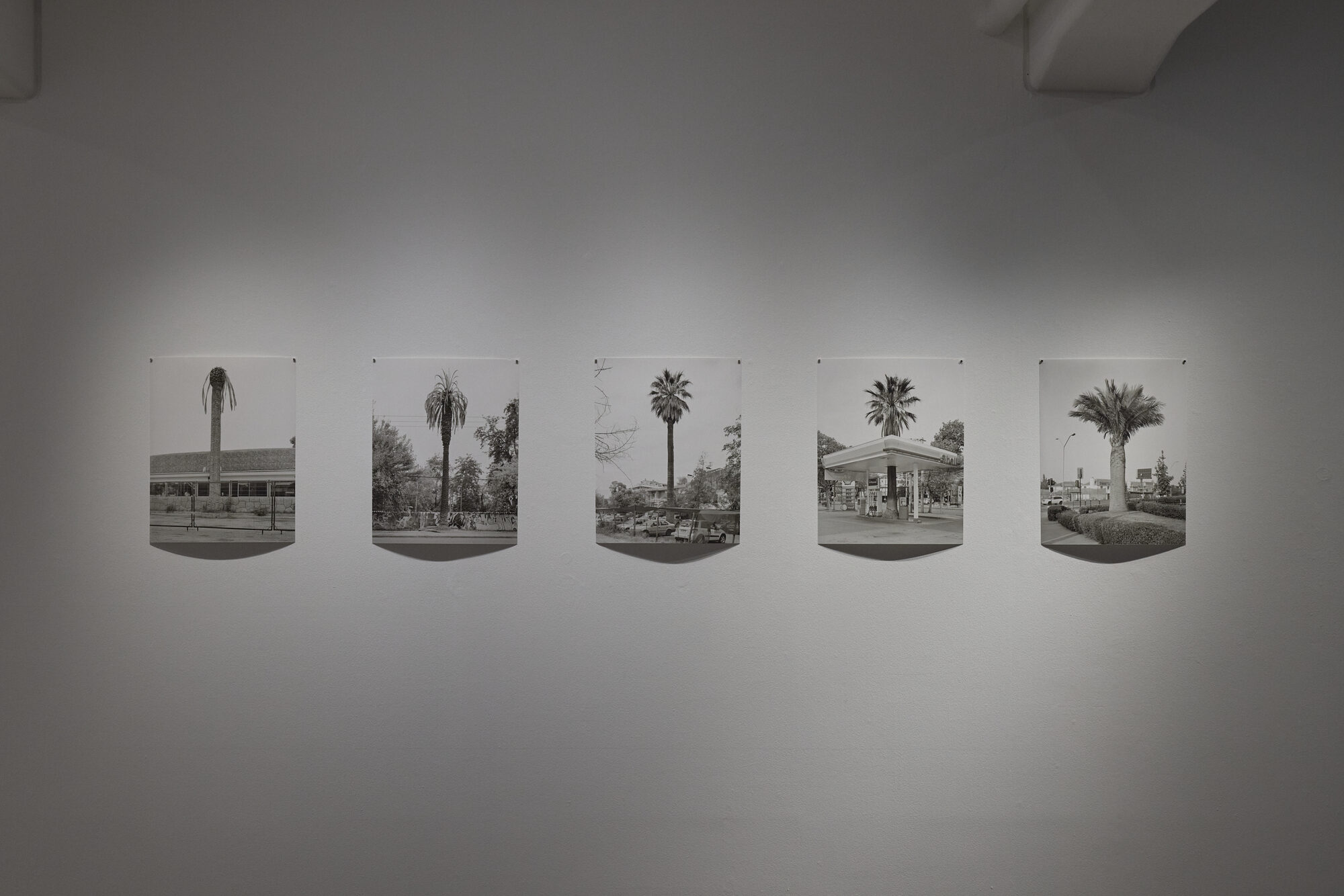
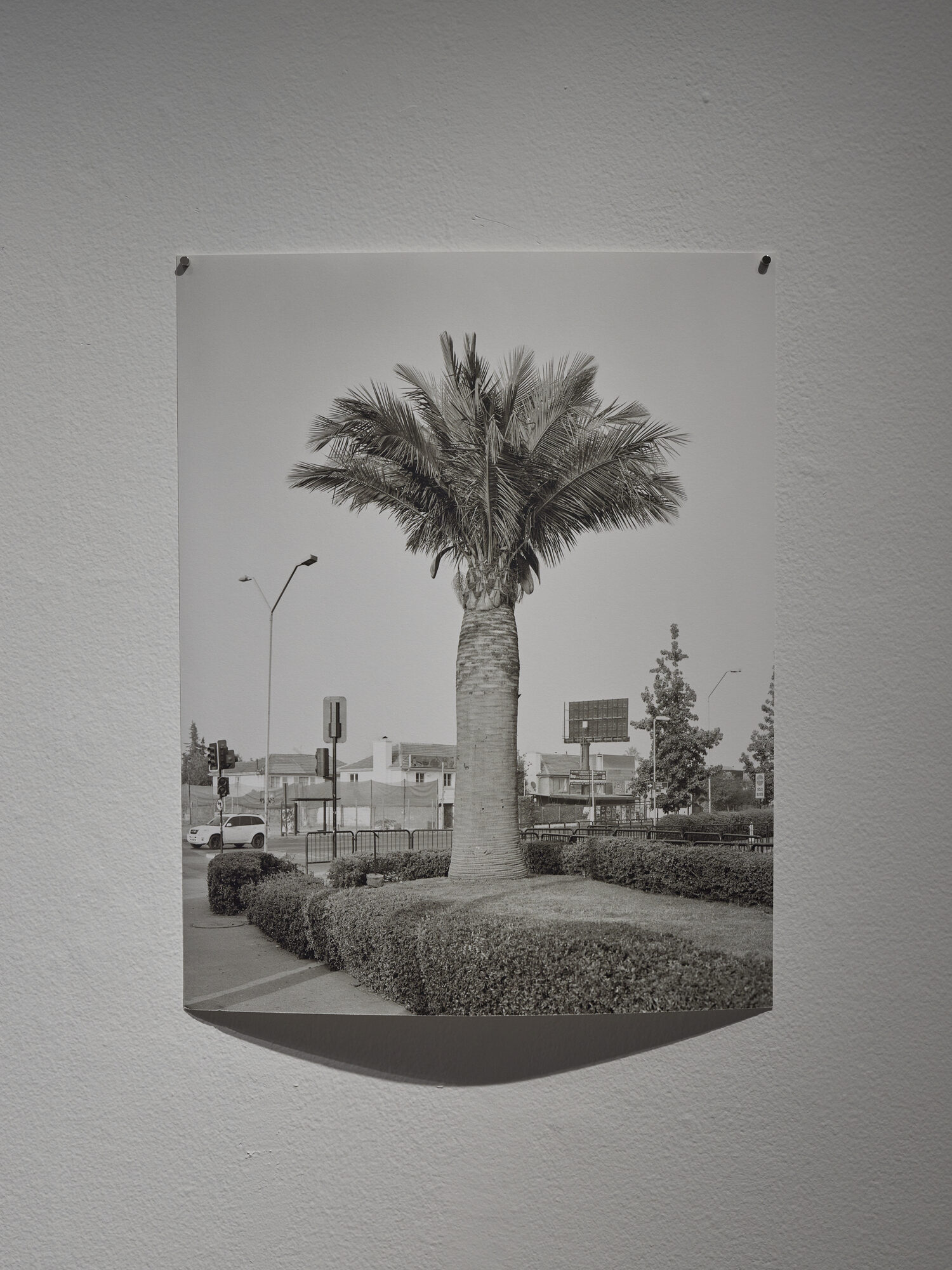
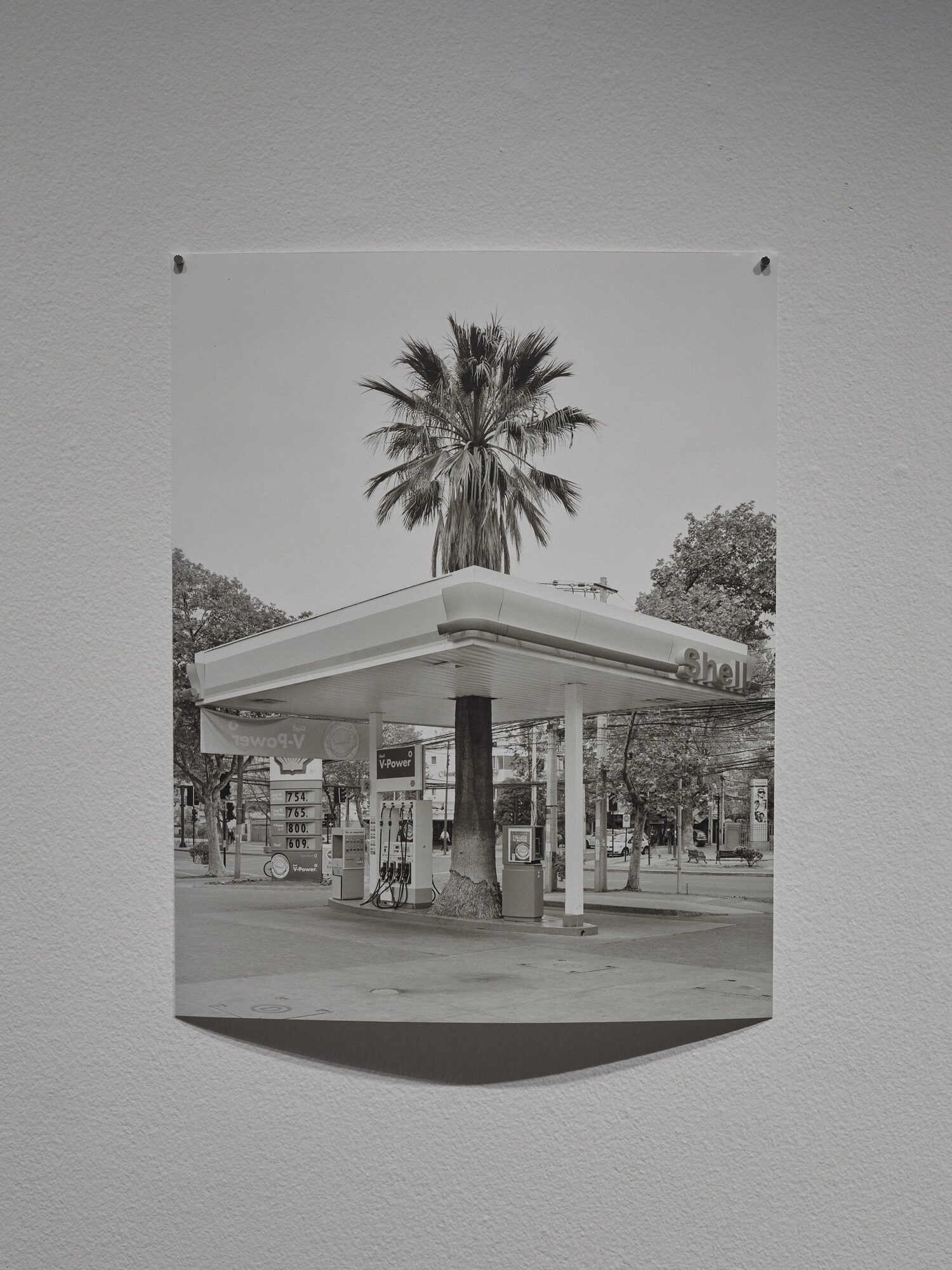
Sebastián Mejía muestra algunas fotos de su serie Cuasi Oasis, donde registra palmeras que parecen estar muy incómodas al tener que habitar la ciudad. El moviliario de la ciudad parece acosarlas, cediéndoles poco espacio. Las palmeras se ven secas, casi deprimidas, con pocas hojas y poca vitalidad. La ciudad, en su contraparte parece fria, indiferente, dura y hostil. Un territorio que no sabe ser amable con las formas vivas, las estresa con la rasposidad de su presencia. Estas palmeras que son una forma de vida silvestre convertida en ornamento urbano, son como unos oasis tristes.

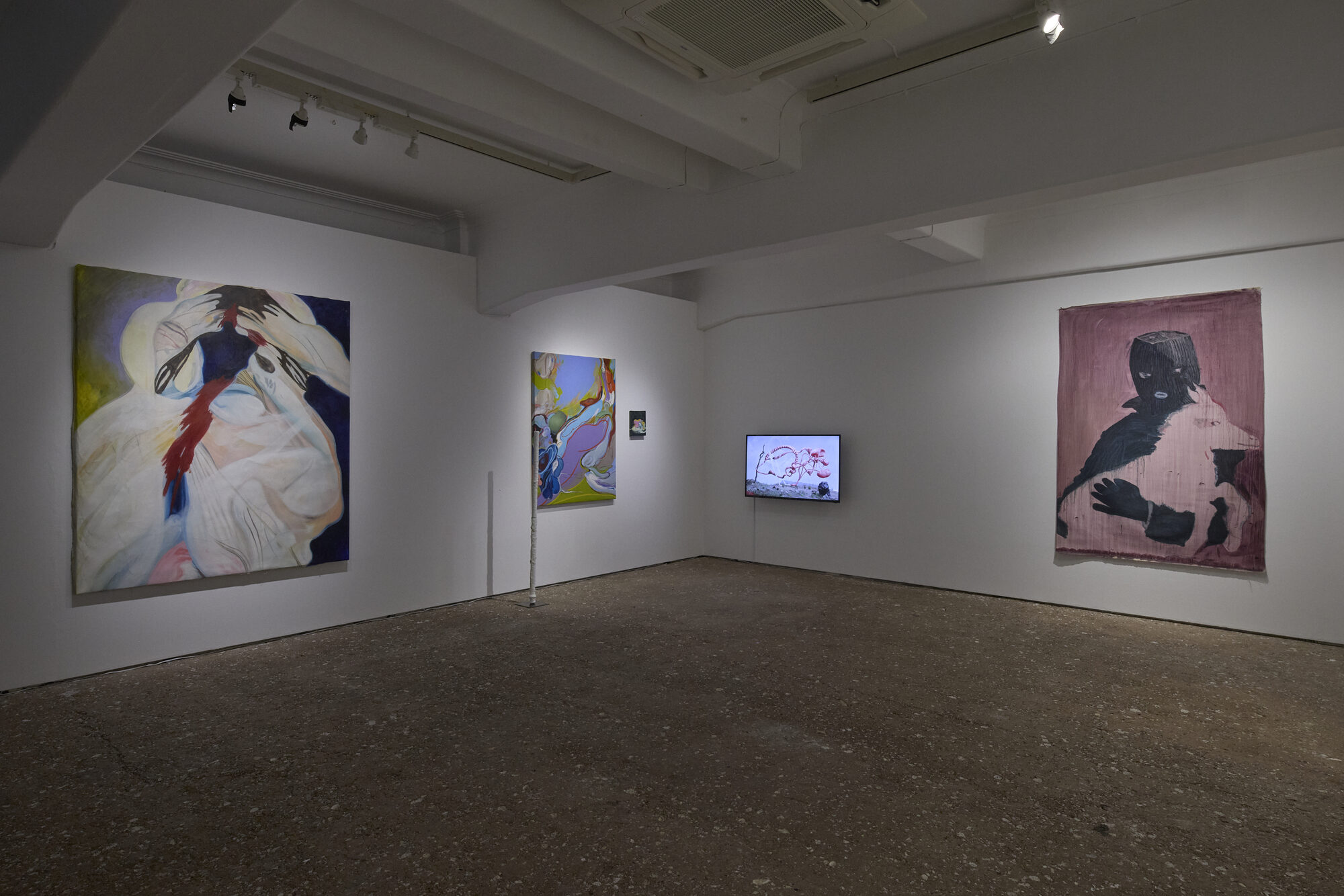
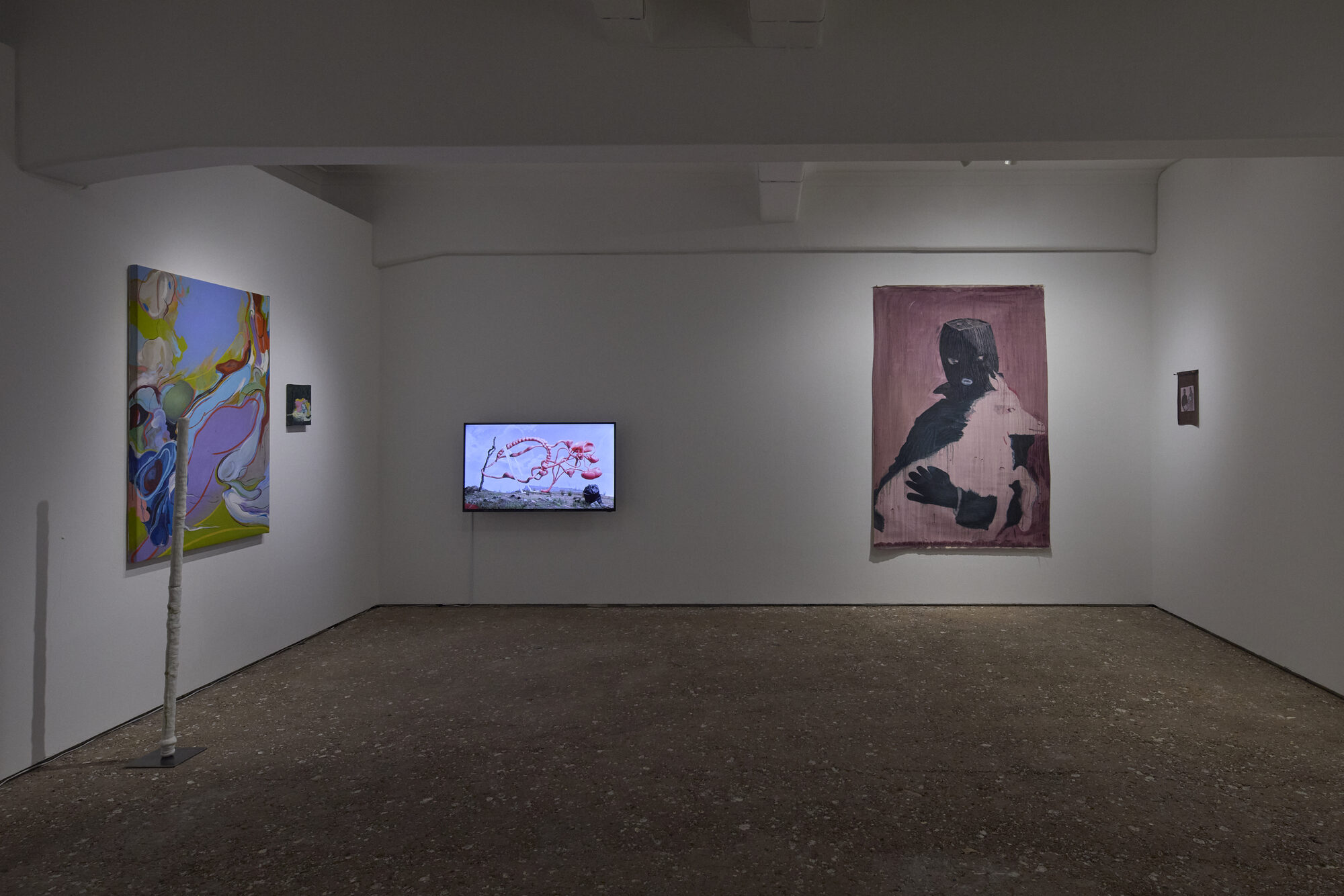
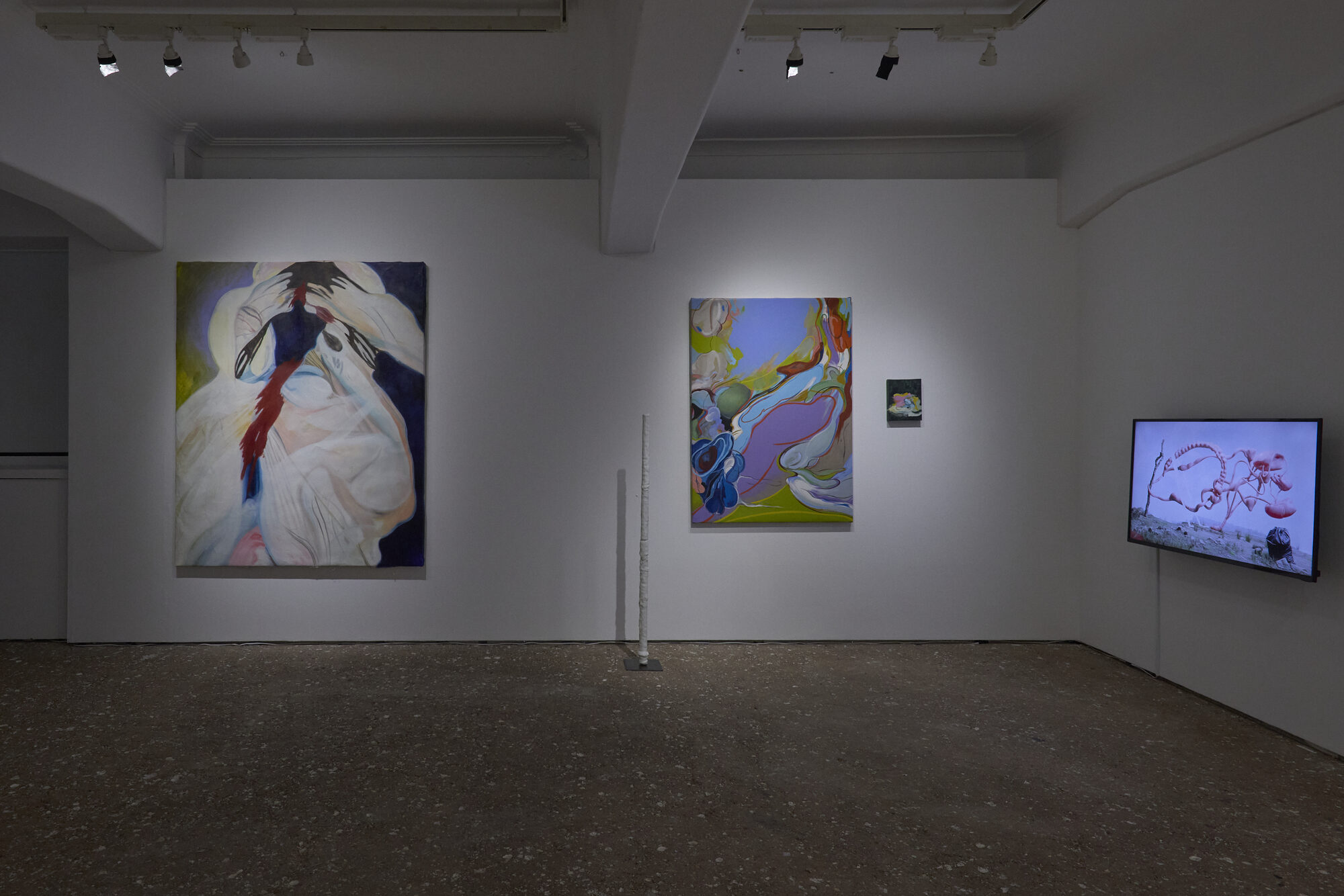
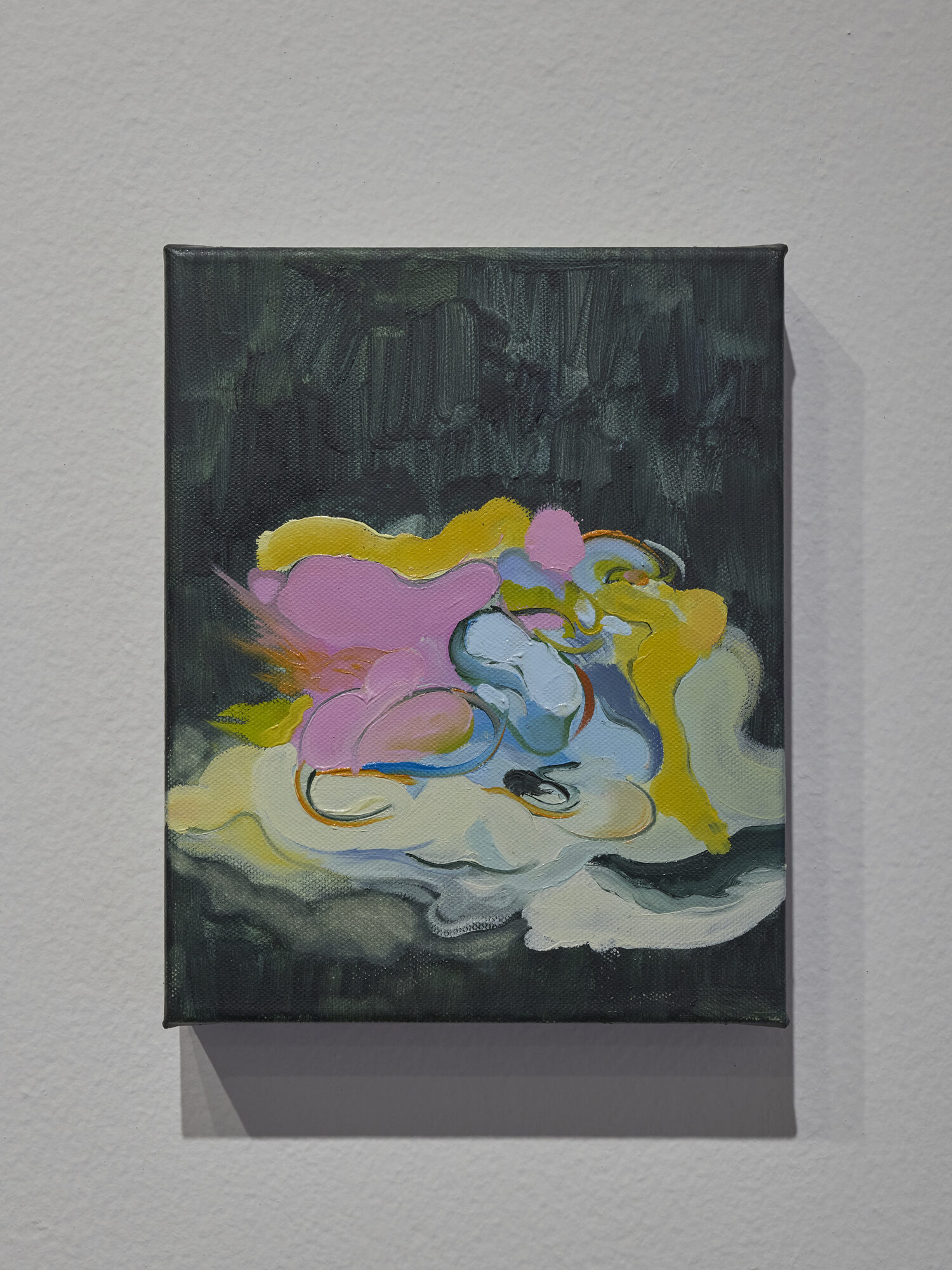
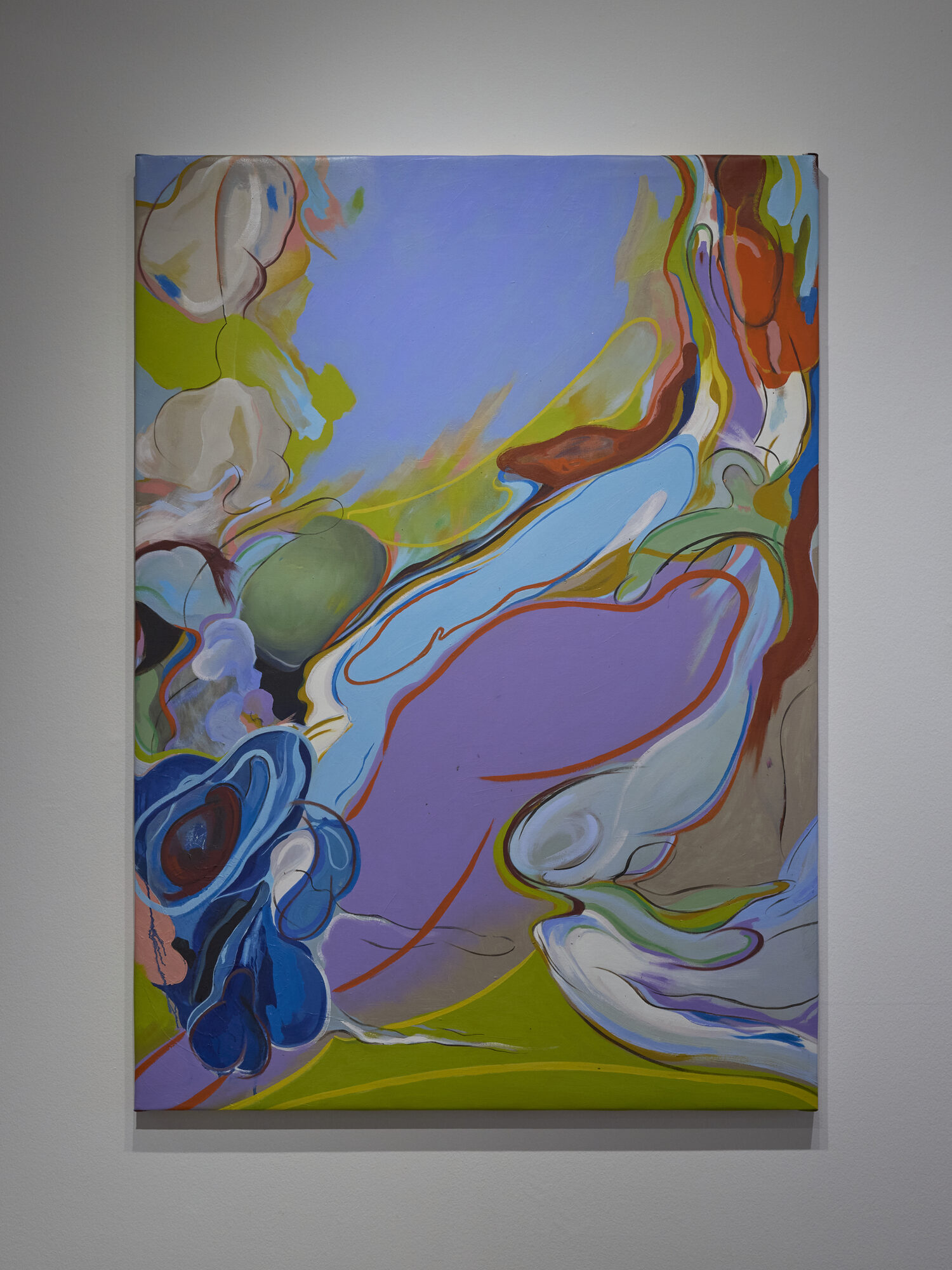
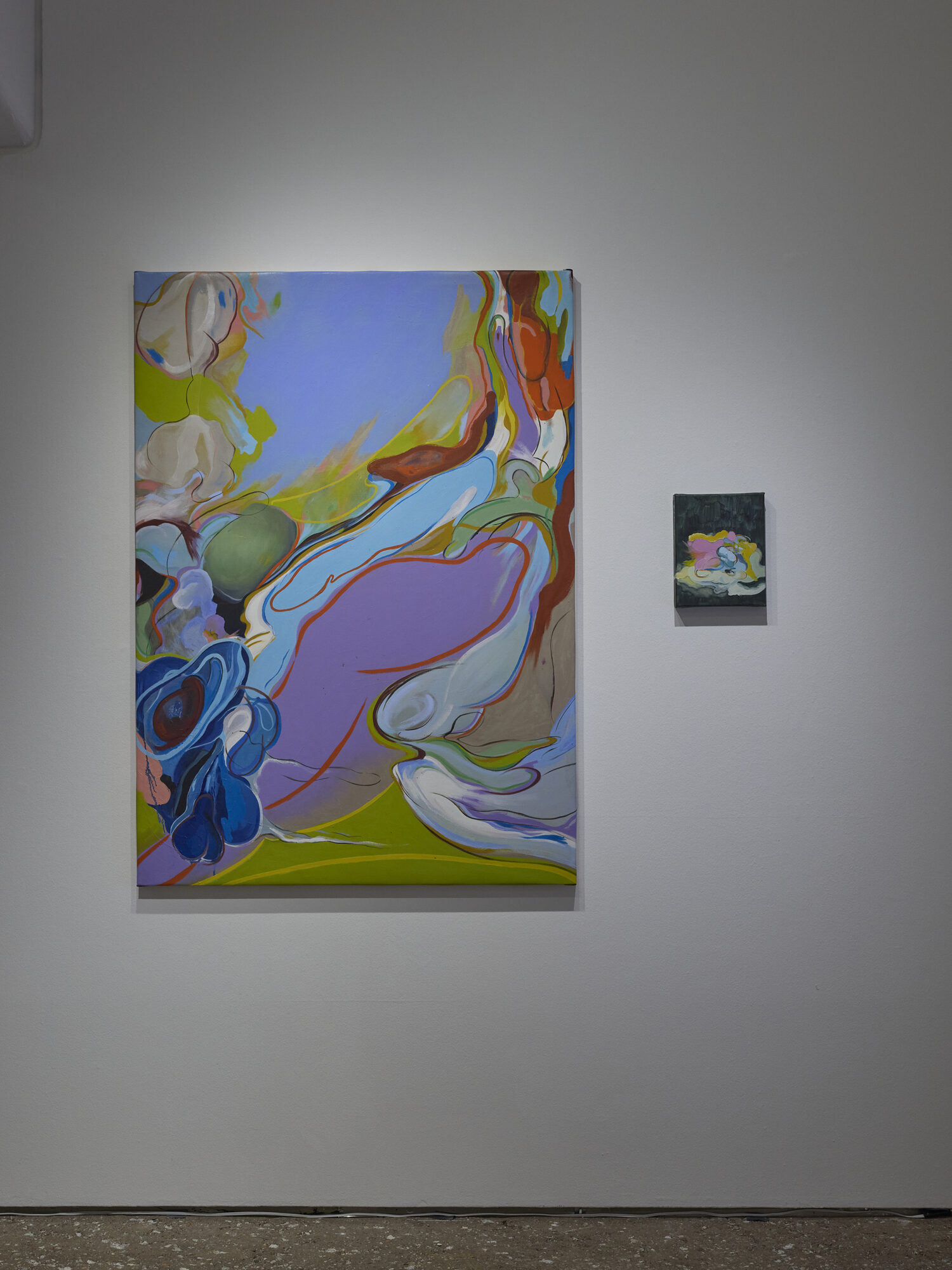
A diferencia de estas piezas fotográficas que parecen una especie de registro proveniente de un futuro sombrío. Las pinturas de Juana Subercaseaux son especulaciones que derivan hacia lo abstracto, pero que en su origen se nutren de una observación de elementos silvestres, la naturaleza misma. Tanto es así que uno de los cuadros se llama The River, un río que es una idea fantasmal, una forma expresiva que nos propone al paisaje en un estado de vitalidad desconocida. Estas abstracciones son como ejercicios de mirar algo que no se ve, fantasear a partir de la naturaleza, proyectando viscosidades, brillos, arideces que suelen no convivir, pero que son posibilidades de una naturaleza del futuro, devenida gesto mutante.

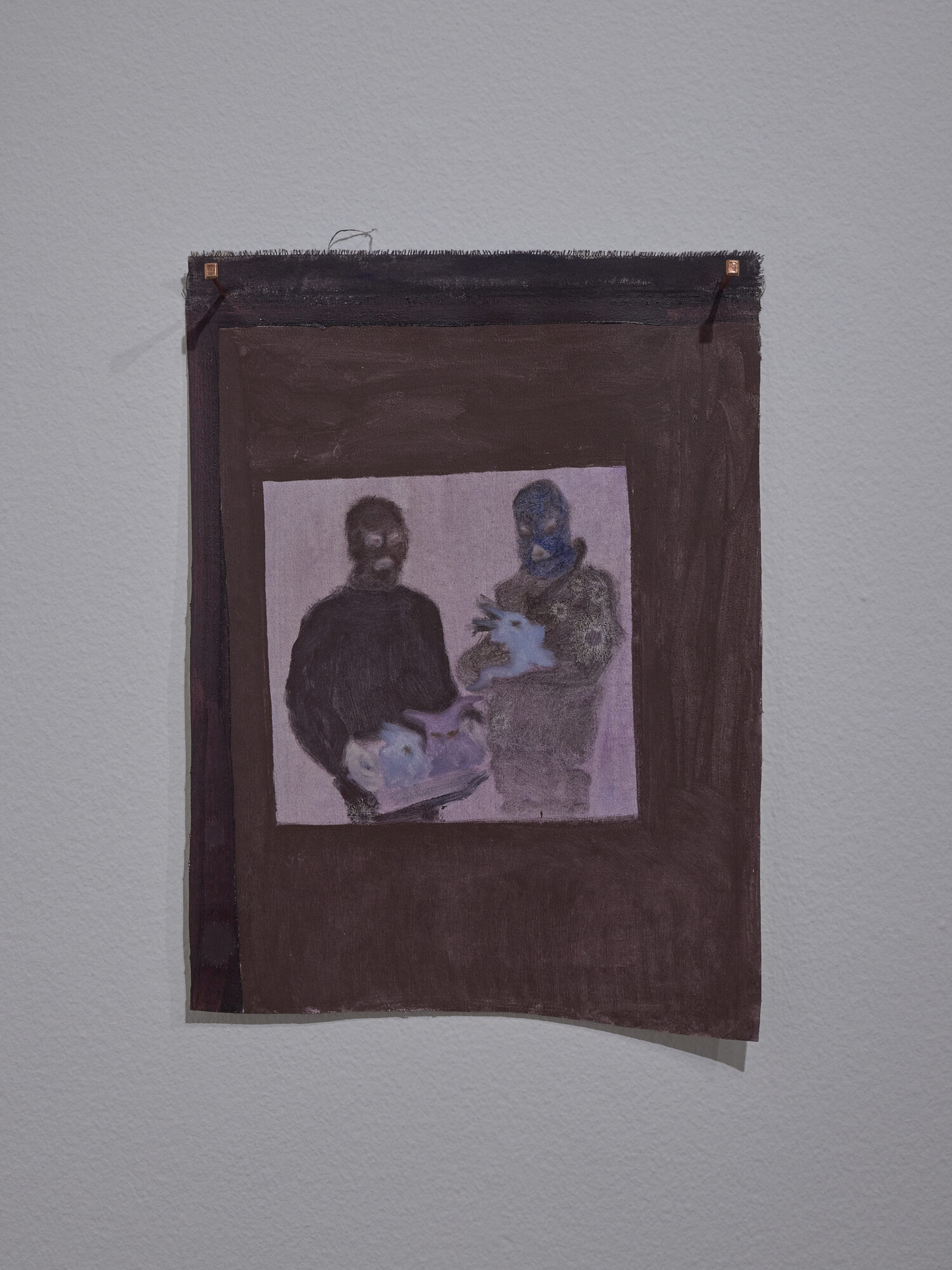
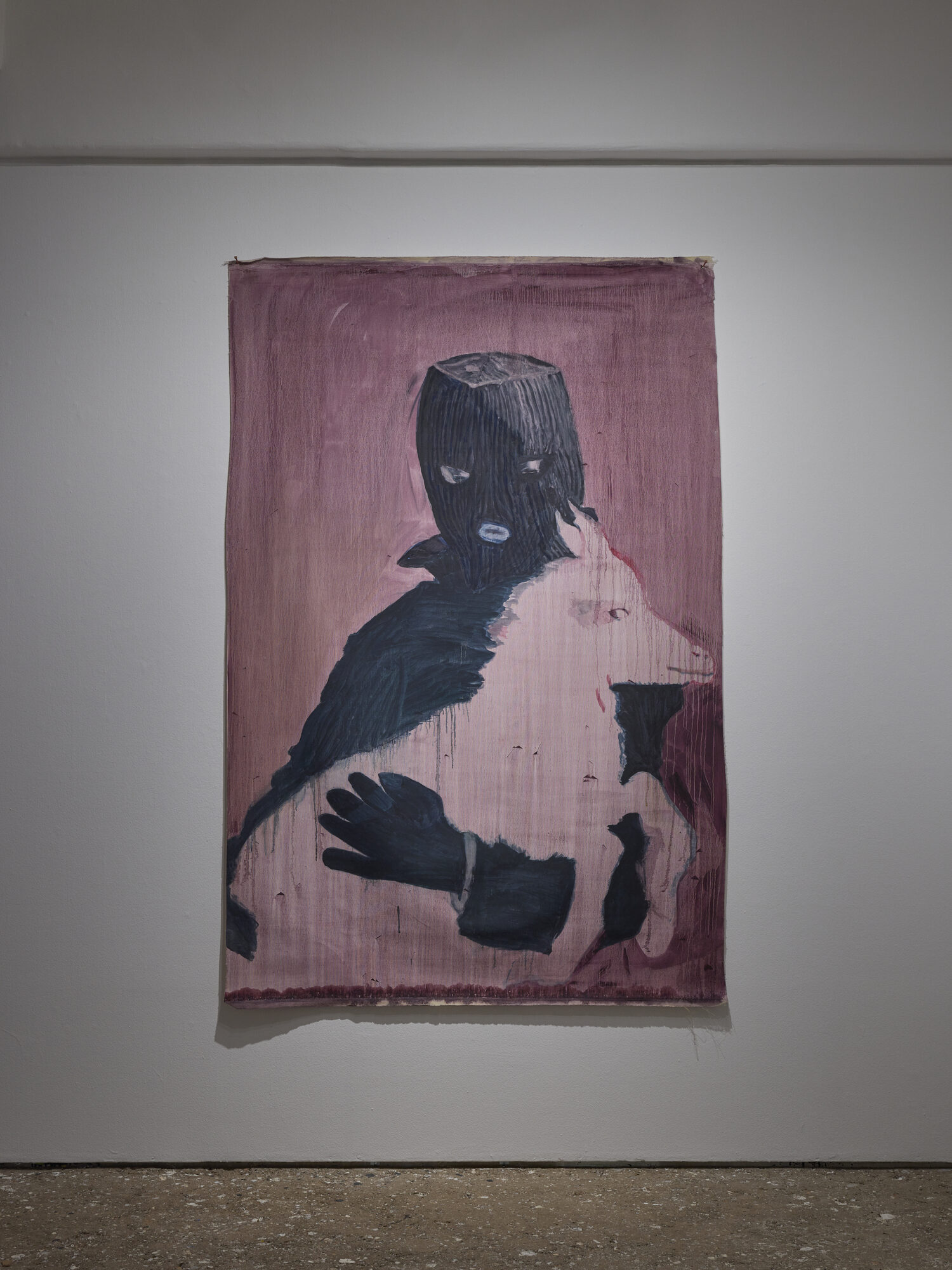
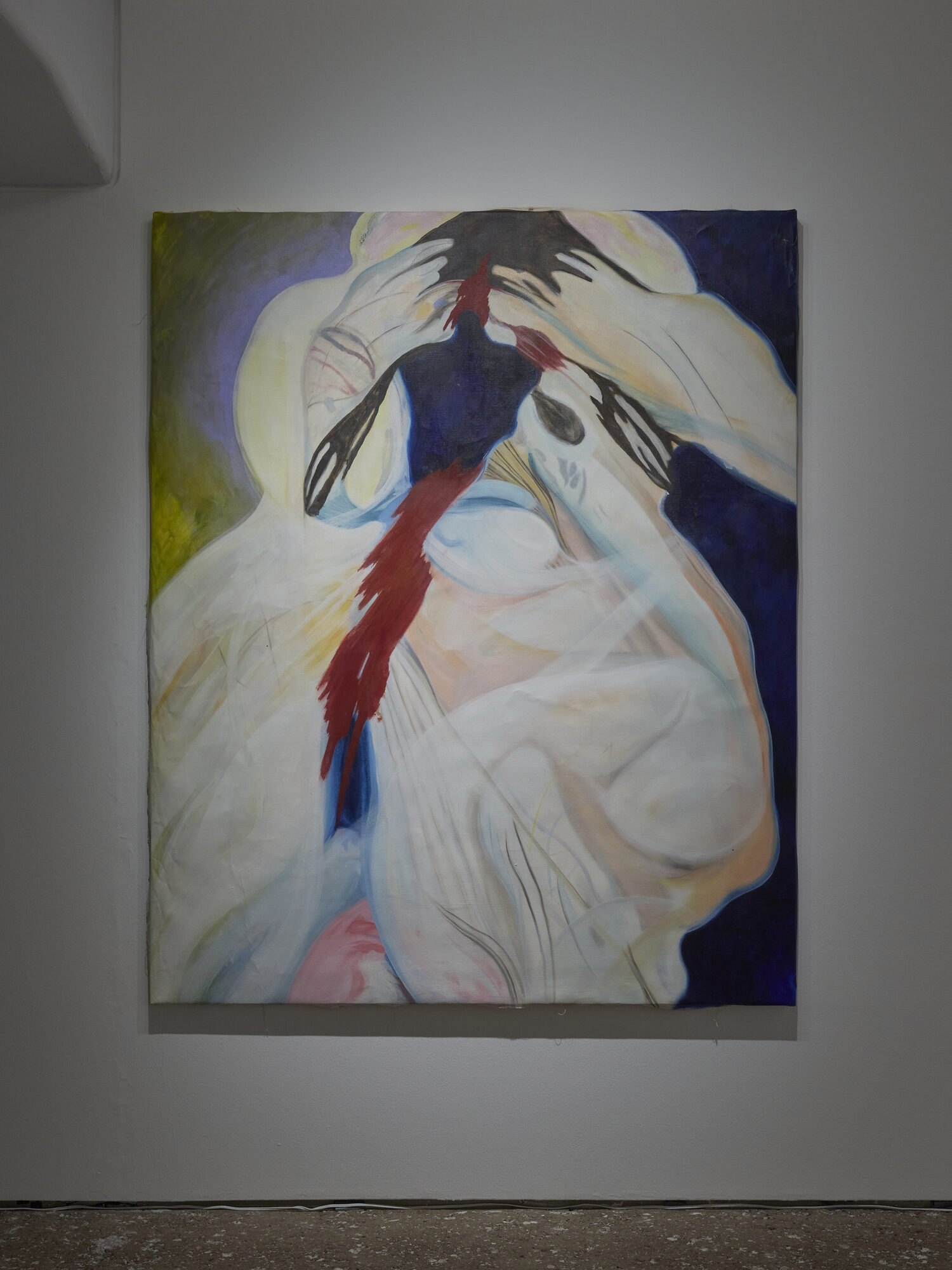
Las pinturas de Irma Sepúlveda retratan a unos encapuchados sosteniendo animales. Estos personajes que asociamos a la revuelta, al vandalismo con motivación política, nos son ahora presentados como personas cariñosas, que cuidan a seres vulnerables, pequeños animales. La artista se encontró con estas imágenes entre los archivos de ALF (Frente de Liberación Animal). Esta Organización activista internacional se ocupa de rescatar animales de espacios de experimentación científica y otros lugares en los que son sometidos a maltratos.

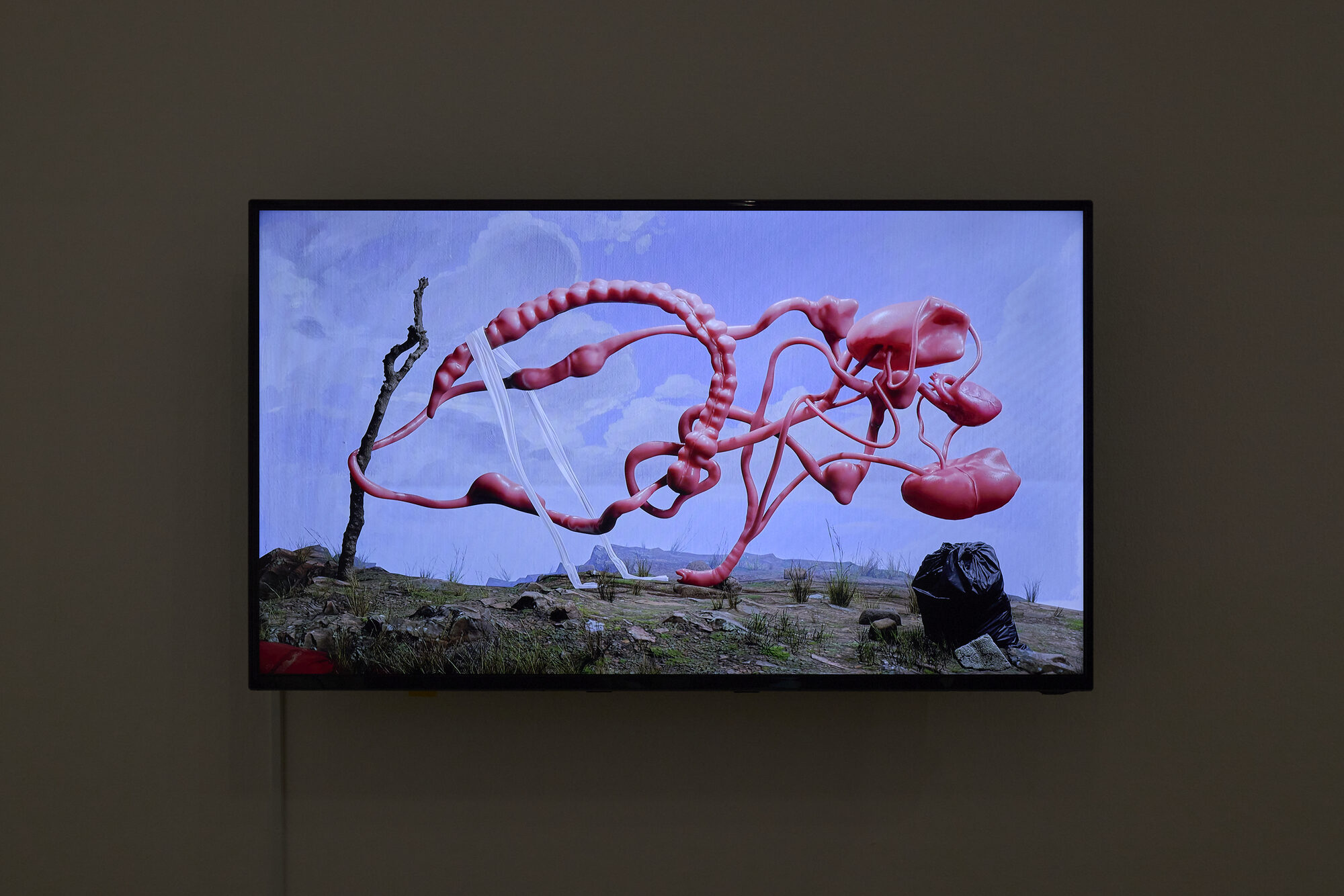
Finalmente, el Trabajo de Cristobal Cea, La cosa expandida nos presenta una animación en la que un sistema digestivo, que carece de un tejido muscular o una piel que la sostenga, flota como una red de órganos, ingrávida en un paisaje árido, un paisaje que perfectamente se pudiese encontrar en Chile. Este sistema que se alimenta así mismo con sus propias deposiciones, encuentra en este ejercicio de auto alimentción, la justificación de su existencia, se provee ciclica y repetitivamente de el alimento que moviliza su existencia. El paisaje no le ofrece nada, el sistema digestivo se tiene a si mismo, vive en el descampado, del que no necesita otra cosa que el espacio para flotar y digerir.

Termino con este sistema digestivo, que resulta una manera de recordar que la exhibición misma es un sistema que digiere (como el estómago), que propone imágenes (como el cerebro). Digerir y razonar parecen ser dos funciones distintas pero homologas, las habilidades de dos órganos distintos pero conectados. La exhibición es una especie de lugar temporal, una experiencia que contiene una serie de propuestas en torno al territorio, que visitó Japón, desde Chile.

MUNDO II (EVAPORACIÓN)

“en los intersticios de materia primordial está la línea de misterio y fuego que es la respiración del mundo, y la respiración continua del mundo es aquello que oímos y denominamos silencio”

Clarice Lispector

AGUA.

Ya mencionaba que estamos hechos, en importante medida, de agua. La humanidad es entonces un tipo de líquido, como un océano pero con otra forma, con otra manera de moverse y con la capacidad de hacer otras cosas. Podríamos decir que a los océanos, sus partículas y partes, se mueven por medio de fuerzas del tipo natural, que la física puede explicar. Toda el agua del mar se encuentra pegada, cada partícula se choca con otras generando una vastedad acuosa. Cada partícula de mar se encuentra sujeta a la voluntad de la gran masa de partículas, en este sentido se mueve todo junto, un gran ser pesado que se incrusta como una gran mancha en cada cavidad de la tierra a la que su cuerpo logra acomodarse. El océano mismo como organismo pareciera ser un gran estómago con una serie de sistemas adentro. De alguna manera todo está un poco diluido dentro del mar (por mucho que si existen contornos en su interior). Un arrecife de coral, por ejemplo, puede ejecutar una función homologable a la de un pulmón, pero sin ser cavidad. El efecto de su acción queda suspendido en el medio acuoso (y no contenido como en los órganos corporales), ejecuta su labor como un efecto al ambiente, el que luego se encarga de transportar para que su acción sea de mayor alcance. Los moluscos, filtran, como hacen los riñones, pero su estrategia no es desde la opacidad, sino desde la dispersión. Cada pequeña concha submarina esconde una pequeña lengua depurante, el efecto de todos estos seres dispersos actúa sobre el ambiente, oxigenándolo, limpiándolo. Y así lo que expulsa un cuerpo lo ingiere otro, generándose una sucesión descomunal de emanaciones fluctuantes, que atraviesan todo lo que tocan, como en una comunidad que se conecta a través de la materia misma y por medio de su flujo y movimiento. Una democracia colaborativa de los fluidos. Entonces, si el cuerpo animal está lleno de cavidades, bolsas corporales que, en su interior movilizan procesos vitales sobre las materias que engullen y hacen circular de órgano en órgano, el Mar es como una gran medusa, sin bolsa alguna, un organismo sin compartimientos, una mancha gigantesca donde los procesos vitales suceden sostenidos en él, como ser - ambiente. Pero, y así nos dice la ciencia, todo animal terrestre (incluida nuestra especie), proviene del mar. Seres que reptaron desde el agua, se han adaptado en una travesía de transformación evolutiva milenaria, hasta conquistar unas formas anatómicas adaptadas a la vida sobre la tierra. De alguna manera también somos el mar, unas partículas de este que avanzaron hacia la conquista del territorio terrestre, el que hemos logado habitar con bastante éxito. Si el delirio ambicioso de Elon Musk se concreta, podríamos decir que, unas partículas de mar rebeldes, devenidas humanas conquistará Marte. El primer guarisapo que se aventuró a escapar de los límites del agua, nunca imaginó que ese incómodo gesto de curiosidad, era el inicio de un proceso evolutivo que hoy nos tiene viviendo una fase avanzada del proceso de tecnificación del mundo. Y el cuerpo humano sigue siendo más de 50% agua. Es una parte del mar que se ha reproducido fuera de este conquistando un nuevo territorio. Pero sin duda, y aunque sigo pensando que somos cuerpos de agua y que nuestro origen son los océanos, no somos lo mismo que el mar. De este nos revelamos y hoy pareciéramos incluso agredirlo, podríamos decir que renegamos de este origen (del cual además dependemos vitalmente) cual adolescente rebelde. Y no es que le declaremos al mar nuestra animosidad, es que simplemente no sabemos vivir sin atentar contra su bienestar (que también es el nuestro, ya que, de alguna manera, seguimos siendo lo mismo). Y como descendientes del pez que quiso explorar nuevos territorios, resulta natural que, la legión de mamíferos humanos, seamos un poco antagonistas de las formas más antiguas del agua. Como planteaba en la primera parte de este texto (MUNDO I); si el cuerpo humano está compuesto en de agua, la expansión, multiplicación y crecimiento de nuestra especie implica la deshidratación de otros cuerpos.

COLONIZACIÓN.

Si la América indígena de los Siglos XVI y XVII representó, para los humanos que la invadieron, un mundo sin humanos -ya sea porque la despoblaron objetivamente, ya porque los hombres que encontraron allí no cuadraban en la categoría de humanos-, los indios sobrevivientes, los terrícolas de pleno derecho de aquel Nuevo Mundo, se vieron, a la inversa, como hombres sin mundo, náufragos, refugiados, inquilinos precarios de un mundo al que ya no podían pertenecer. Y, no obstante, inesperadamente, muchos de ellos sobrevivieron. Pasaron a vivir en otro mundo, un mundo de otros. Algunos de esos náufragos se adaptaron y se modernizaron… Otros luchan por mantener lo poco de mundo que les quedó, con la esperanza de que, mientras tanto, los blancos no acaben por destruir su propio mundo, el de los blancos mismos, ahora convertido en el Mundo Común de todos los seres vivos”

Déborah Danowski y Eduardo Viveiros de Castro.

Si la humanidad es un líquido (para esto me sustento en el hecho de la composición material del cuerpo humano, que es la unidad que constituye la humanidad), entonces los procesos migratorios, guerras y colonizaciones, de alguna manera son también fenómenos de lo líquido (en un sentido burdamente material). Derrames. Pero la parte compleja de este asunto -y la que la aleja de la mera fenomenología física- es el hecho de que la humanidad es también otras cosas. Quero plantear entonces los procesos coloniales como un problema hídrico, un asunto en el dominio de la distribución del agua (que se encuentra cifrada dentro del cuerpo humano). El cuerpo humano es portador de una serie de contenidos de diversa índole, para hablar de colonización propongo no olvidemos el dato de la composición líquida del cuerpo, pero ahora consideremos además en el contenido cultural, ideológico que se aloja en los sistemas humanos. Es en este campo en donde posiblemente encontremos mayores diferencias genéricas. Los cuerpos materialmente, inclusive genéticamente son muy similares, sus ideas eso sí, sus culturas y cosmovisiones, pueden llegar a ser opuestas, y esta sí es una característica del cuerpo humano de la que el mar no entiende. Si pensamos en las guerras como enfrentamientos materiales, podemos decir que son momentos de ebullición de la partícula humana como la reacción de distintas voluntades ideológicas en pugna (en este caso lo ideológico empuja a la destrucción de la materia). Cuando dos cuerpos culturales (o dos cuerpos de agua bajo los dominios de la forma humana) interactúan, existe la posibilidad de que sus contenidos ideológicos reaccionen de manera violenta, y esto aplica tanto a individuos como comunidades (de las dimensiones que estas sean). La colonización como un fenómeno del movimiento de comunidades europeas sobre otras zonas geográficas, si la vemos bajo la perspectiva del movimiento acuoso, podríamos decir es una especie de derramamiento o desplazamiento expansivo de una mancha hecha de personas. La unidad que compone la mancha colonialista (pienso en el proceso histórico de colonización de América) es el cuerpo humano de personas provenientes de Europa, cuya biología podríamos seguir dividiendo en unidades biológicas (hasta llegar al átomo), pero no vamos a pensar en el mundo microscópico por ahora. El cuerpo humano es la unidad, porque este está compuesto, no solo de unas materias biológicas, sino también de unas componentes culturales. Entonces, la mancha no es solo una sucesión de cuerpos hechos (principalmente) de agua, pero también de individuos portadores de unas creencias, unos idiomas, unas ideologías y productos además de la influencia de su contexto e historia. De esta manera, la contigüidad de las partículas (los cuerpos humanos) también genera ondas de movimiento, como sucede materialmente en cualquier medio acuoso. La “mancha Europea”, al no reconocerse como igual en la composición de su sustancia cultural respecto de las comunidades humanas encontradas en el “nuevo continente”, reaccionó con energía destructiva, avanzando sobre el territorio como una violenta máquina de conquista. Su objetivo es, en la medida de lo posible, neutralizar las formas culturales que ocupan el territorio ocupado, para homologarlas lo más posibles a las formas culturales Europeas. Este es un fenómeno que también se manifestó en la ínfima biología. La carga viral europea es de los primeros organismos que infiltran el territorio americano, los que, al ser completamente desconocidos para los cuerpos de esta zona del mundo resultaron dañinos, incluso mortales. Las enfermedades provenientes del continente europeo se infiltraron en los cuerpos de América, generando oleadas de enfermedades. De esta manera la fricción entre cuerpos de distintos continentes, se manifestó agresiva y llena de muerte en muchos niveles. Esto demuestra que, desde sus partes microscópicas a sus partes culturales, estas dos comunidades (colonos y nativos) siempre colisionaron con violencia mortal. Una sustancia humana se fue volviendo gobernante sobre la otra. El proceso colonial hiso desaparecer formas de vida, cosmovisiones, lenguajes, informaciones genéticas, en definitiva, todas esas variables que componen la diversidad humana. Y pensemos que un idioma no es solo un código que permite nombrar las cosas. Un idioma es un sistema para la construcción de sentido y sensibilidad. Un idioma se mueve, cambia, evoluciona, y es conformado como la estructura para la expresión y experiencia de una sensibilidad particular. Cada idioma contiene la posibilidad de constituir una subjetividad, de ensamblar una cosmovisión. La muerte de una lengua implica la extinción de una forma de existir y de sentir, una sensibilidad que procesa al mundo. Expandamos esto a escalas continentales, el impacto del proceso colonial de América es incalculable en cuanto a la destrucción de sensibilidades humanas, el fin de varios mundos.

El cuerpo es una conformación biológica, pero que contiene además una carga ideológica. La biología del cuerpo contiene la facultad de la reproducción, de manera antagónica a esta facultad tenemos la enfermedad o el envenenamiento, que, al contrario de reproducir, puede matar. El proceso de colonización está repleto de reproducción y de muerte, pero si lo pensamos bien, la carga human Europea actuó, sobre el territorio Americano como un ente viral. Su efecto, junto con el de la proliferación de cuerpos, trajo también el exterminio de unas comunidades para ser estas reemplazadas por otras (exterminio). La mera reproducción es un proceso más bien similar a la acción realizada por el estómago; la sumatoria nutritiva de organismos, un encuentro en donde dos corporalidades se entrecruzan hibridándose. La colonización, por el contrario, es un proceso en el que dos cuerpos se encuentran y el resultado es la aniquilación gradual de uno de estos, siendo la sustancia invasora la que termina por apoderarse de un territorio al que no pertenecía. Europa enfermó a América, no conocemos la cura.

CUERPOS SUCECIVOS

Solemos percibir la vida humana como el tiempo vital individual que se inicia en el nacimiento de una persona y culmina con su muerte. La vida humana se regenera en el nacimiento. Un cuerpo que genera vida humana, da a luz, es uno que se escinde. Es una biología que se reproduce, externalizando un organismo (cuerpo) que proviene de sí, del interior de su propio cuerpo, que luego se desarrolla deviniendo humano independiente. Propongo pensar la reproducción como un proceso sucesivo en la que un cuerpo, una información genética, una biología extiende su existencia. El cuerpo en el que pienso es uno lineal (en términos temporales), un cuerpo que muere y que sobrevive en un proceso biológico de perpetuación y sobrevivencia genética. El cuerpo en el que pienso dura miles de años en una posta reproductiva que procura la conservación de una información genética. El cuerpo en el que pienso es uno que lleva adelante una empresa de sobrevivencia intergeneracional. Este cuerpo es una unidad lineal bifurcada, este cuerpo nunca se termina, solo se divide sucesivamente muriendo y naciendo múltiples veces desde una misma matriz. El cuerpo que imagino es uno en el que todos los parientes de todos los tiempos son unidades de sobrevivencia de un mismo organismo inextinguible.

A diferencia de las especies no humanas, lo que sobrevive en este proceso no es solo una biología, una genética o una raza, sino también un tipo de ser humano. El cuerpo humano es un aparato político, una unidad social. El cuerpo humano es portador de sensibilidades, el cuerpo humano es portador de una cosmovisión, de una potencia poética y una política de existencia. Cuando sobrevive una biología, esta también hace sobrevivir -perpetuando- una lengua, una sensibilidad, un sistema de creencias. Dentro de este sistema de perpetuidad biológica puede haber rebeldías valiosas, pero son sin duda la excepción. La reproducción humana reproduce a su vez maneras de pensar, maneras de sentir y maneras de vivir.

LA GENÉTICA HUMANA ES LA SUSTANCIA DEL FIN DEL MUNDO.

“El blanco estudió, sabe escribir, ya sabía que el mundo iba a terminar con fuego, entonces dijo; Vamos a hacer la usina nuclear cuanto antes para que todo termine precisamente con fuego”

Chamán citado por Aldo Litaiff.

Una cultura piensa que la otra está mal. Que la manera correcta de vivir es la que ella misma ha desarrollado y bajo la cual codifica su vida. En este proceso de choque instintivo que experimentan las sociedades cuando se encuentran unas con otras, tendemos a olvidarnos de que para creer en los sistemas sociales debemos portar, como si se tratara de un virus, unos convencimientos culturales profundamente arraigados. En el mundo hay distintas formas de gobierno nacional, cada una es solo practicable en la medida de que el territorio humano que la aplique, esté también (culturalmente) convencido de que esa forma de gobierno es una manera aceptable de organización. Siempre ha habido grupos sociales y culturales que se han sentido en la posición de superioridad que les habilita para imponer sus formas de comportamiento y administración política a otras, que incluso muchas veces les quedan muy distantes. Las guerras son actos de fuerza masiva que, muchas veces, confronta la arrogancia de partes que creen estar tan en lo correcto respecto de su manera de vivir y sentir que se sienten en condición de imponérselas a otros grupos humanos. En esta desconfianza que nos producen las posturas vitales de sociedades y naciones, es que hemos desarrollado una serie de armamentos y dispositivos bélicos con la capacidad de destruir el mundo varias veces. La violencia es una dimensión, que, bajo el dominio técnico y conducción humana, ha evolucionado. Un primer armamento disponible fue el propio cuerpo, el que luego complementamos con palos y piedras, para ir posteriormente sofisticando sus dispositivos y alcances. Así se ha avanzado en la sofisticación técnica de los armamentos de guerra, y si la tecnología bélica de la primera guerra permitía envenenar el aire asfixiando comunidades completas o arrasar materialmente con ciudades, ya hacia la segunda Guerra (desde la bomba atómica) que la humanidad ha dado con una forma armamentística que puede, no solo arrasar con los dominios propios de nuestra especie y el mundo que la circunda, sino que, hemos producido la energía explosiva capaz de producir un cataclismo. Y como un terrible guion de ciencia ficción, la historia de la humanidad, es también la historia biológica en la que, una parte de la vida del mar experimenta un éxodo hacia los territorios secos de la tierra, para luego evolucionar como especie al punto de tener la capacidad técnica de producir la evaporación de toda el agua del planeta, acabando en este evento con prácticamente toda forma de vida como la conocemos; el fin del mundo. Entonces, esa colectividad de animales marinos que, en una actitud que parece curiosa o aventurera, en realidad convirtieron toda su misión, luego de un proceso evolutivo de millones de años, en la posibilidad de la destrucción de su territorio de origen. La historia de la especie humana (de esta ser la responsable del fin de la vida en el planeta) es entonces la historia de una parte del mar que se revela de si mismo y produce su evolución como una entidad capaz de generar una sofisticación técnica de la violencia para producir su autoeliminación. Una parte del mar se transformó en humanidad para producir su suicidio. Y si bien el mar puede muchas cosas, no tiene herramienta que le permita suicidarse. Nos hemos permitido ver a la eutanasia como una forma de liberación, no es de extrañar que el mundo busque las vías de, en la medida de no poseer la capacidad de auto-eliminarse, generar un cuerpo que sepa ejecutar esta tarea, ¿por qué no contar con un plan de autoeliminación? Se que suena raro, pero esta es la fantasía (a ratos muy verosímil) que nos proponen películas como 2001, donde se plantea que la robótica, como invención humana y, luego de su desarrollo como ente con relativa autonomía, se devuelve hacia su creador (la humanidad misma) para eliminarla. Lo que parecía una herramienta, es, en definitiva, una vez emancipada, nuestra asesina. En mi relato la tecnología también está implicada, el fin es similar, solo me propongo fijar el origen varios millones de años antes. De esta manera el fin del mundo no es -solo- una empresa de la que la humanidad es responsable, sino también el mar, la naturaleza misma en un desencadenamiento de procesos evolutivos que producen la autodestrucción. Muchas veces hemos tenido la tentación como especie de pensarnos como apartados de la naturaleza; “somos otra cosa”, parecemos querer pensar. ¿Pero si somos otra cosa, entonces, qué cosa? Y como es qué, de todos los cuerpos vivos, solo la evolución humana alcanza el potencial de consumir toda la vida. Esa es una diferencia que me parece relevante. Propongo que sí somos naturaleza, pero una donde la continuidad de esta (de muchas maneras y formas), se ve amenazada. Esto incluso antes de la destrucción de todo, la sola posibilidad de que nos podamos pensar como forasteros de lo natural implica una primera discontinuidad, la que hace eco en muchas de nuestras actividades. Somos los inventores de lo artificial, sea lo que sea que eso quera decir.

EVAPORACIÓN

Hoy vivimos conscientes de que nuestra propia vida ha generado sustancias que atentan contra la vitalidad del planeta, por supuesto con nosotros mismos como especie bajo amenaza de muerte. Si las generaciones humanas anteriores miraban el futuro como el espacio de lo posible, los humanos de este tiempo presentimos -o bien sabemos- que el futuro está hecho de calor, deshidratación y muerte. En este estado de conciencia, la depresión es una tendencia al alza. Autores como Franco Berardi ha reflexionado largamente en torno a esto. Si ya destruimos el mundo, o generamos una aceleración del calor que no sabemos (o no nos ponemos de acuerdo en) detener, entonces que sentido tiene seguir avanzando. La destrucción aparece como el destino posible, el acto cúlmine y más definitivo articulado por nuestra especie. El fin de la historia, bien puede ser uno que padezcamos como lenta sofocación o bien, aceleramos el proceso y hagamos una serie de explosiones atómicas que generen un alza repentina de las temperaturas, evaporándonos junto con todo lo demás que esté constituido de agua. El mundo que siempre nos ha parecido un territorio vasto, imposible de explorar en su totalidad, podría ser abrazado hasta cada rincón por un calor atómico definitivo. La explosión del arsenal nuclear mundial volvería a todas las partículas que existen en la superficie terrestre un asunto al dominio de la violencia producida por la humanidad. La pulsión de violencia del pasado (en la época pre-nuclear) tenía otros alcances. La guerra en el presente, podría implicar el fin del mundo, por lo que la pulsión de guerra de las grandes potencias -y más preocupante aún, de personas como Donald Trump o Vladimir Putin- podrían ser acompañados de un paradójico deseo megalomaníaco de trascendencia absoluta; provocar el “fin del Mundo” (sabemos que solo se acaba como lo conocemos). La próxima gran guerra puede ser el fin de la historia, el fin de la humanidad, el fin de la vida tal y como ha existido en el planeta por miles de años. Nunca le asignaremos un nombre propio a aquellos seres que tuvieron la primera pulsión rebelde y se alejaron del mar, desencadenando procesos evolutivos que poblaron la tierra firme de seres, pero si podemos tener conocimiento de quién es quién concluye con la tarea de destruirlo todo, cerrar el ciclo evolutivo que, tristemente, tiene como desenlace el vacío más desconcertante. Pero es precisamente en este punto en el que se aloja la paradoja del acto más determinante de la humanidad, y es que este implica una liberación de energía tan descomunal, que tiene la capacidad de transformar todo lo conocido de manera tan radical que, incluso no quedaría sobreviviente alguno que pueda hacer de testigo. En este punto la pulsión Narcisa pierde potencia, se da el paso más radical de la historia para encontrarse, luego de esto en un mundo sin una humanidad que pueda registrar este punto cúlmine dentro de su historia (esta se encontraría cancelada). De verdad espero que el narcisismo de los gobernantes actuales, no ponga el deseo de trascendencia por sobre las ansias de reconocimiento. Si todo viene del Big Bang como explosión original del universo, la bomba nuclear puede ser el fenómeno del origen a la inversa, eso sí, en la pequeña escala de nuestro planeta, ese lugar donde queda todo lo que conocemos.

FIN

Al pensar en el mar, en el líquido, mencionaba que todas las unidades que lo componen están en contacto. Cada movimiento se traspasa a la partícula siguiente. Una ola es la acción en cadena de las partículas de agua empujándose unas a otras a través de la vastedad del mar, de costa a costa. En este espacio no existe individuo posible. Ni siquiera cabe acá la idea de lo “individual”, todo en el mar es “lo mismo”, mar, una comunidad indivisible. Si consideramos la vida sobre la tierra como un continuo evolutivo que se inicia en el mar (o una evolución de una parte del mar), podría uno decir, que la mayor conquista en términos de diferenciación respecto del origen, sería la individualidad. Las ideas políticas de Socialismo, por ejemplo, recogen en su reflexión sistémica respecto de la composición de lo humano, al mar y su sustancia interconectada como modelo. Las tendencias políticas actuales (post-fascismos) nos entregan el diseño de lo colectivo como una estructura de la competencia. Cada unidad constitutiva de lo social -cada persona- como un cuerpo en pugna con el siguiente. Estamos aspirando a conquistar una forma organizativa social que se opone sustancialmente a la forma organizativa del agua -la sustancia madre- lo que es una contradicción de lo que somos como especie; una nueva forma del agua. Nunca ha habido un tiempo como este, en el que el proyecto de destrucción del mundo resulte tan escalofriante (por su condición de posibilidad).

Javier González Pesce

[1] Brauch de Spinoza. Ética.
EN

MUNDO I (DEHYDRATION)

“The earth offers enough to satisfy what every person needs, but not what every person craves.”

Mahatma Gandhi.

“If everything is human, then everything is dangerous.”

Eduardo Viveiros de Castro.

This is an exhibition that originates in Chile but addresses the world. It is from a series of Chilean experiences that the exhibition emerges as a framework for thinking about the relationship between biology and politics. The human body is an organism divided between a political or social dimension and a corporeal or organic dimension—or so we sometimes believe. From where do we inhabit and perceive the world? Which faculty connects us to reality? Two simple examples to illustrate this division could be breathing and thinking. Both actions seem to occur almost as a reflex. They are things the body knows how to do without difficulty and, often, does not require the activation of voluntary consciousness to carry out these tasks. Both actions seem to deal with invisible substances, yet in some way they bear witness to the body’s contact with the environment (the World). Thinking seems to nourish the human realm of ideas, hence its natural association with the “political” sphere. In contrast, breathing oxygenates the body, maintaining the vital flow of oxygen particles within the organism and ensuring its survival; breathing is an action rooted in the body’s biology. But do thought and breathing occur in separate realms? Can the body be split into a breathing apparatus and a thinking apparatus? Are these activities—rational on the one hand, biological on the other—housed in compartments of the body that sometimes seem to us to exist in disconnected dimensions? At this point, I will propose that recent Western political tradition has failed to integrate Spinoza’s tenet, which states that everything is composed of “a single substance consisting of an infinity of attributes”[1]. Technological developments over the last few centuries of human existence have allowed us to construct this fiction that the human body does not exist in a state of continuity with the rest of the world. Political documents often seem to ignore—one need only examine, for example, Chile’s current constitution—that the system of (human) relationships they regulate is embedded in a (non-human) environment that is affected by the consequences of that regulation. Put another way: politics regulates the relationships among bodies that reason, relegating to a secondary (or even tertiary, quaternary, or quinary) level of importance the concerns of bodies that breathe without reasoning—or so we believe. Recent politics (from our perceived state of emancipation from the natural world) has ignored the fact that its effects—being those of a politically regulated human life—leave their mark on the nonhuman world, with which it precisely borders, or even within which it exists. I propose to consider, moreover, that those non-human bodies—which serve as direct fuel for human life (whether in its biological, material, or symbolic dimension)—take precedence in politics even over other living entities. We have already seen how political apparatuses have prioritized the existence of a logging company over that of a forest, or the oil industry over the preservation of unpolluted air. In this way, we have fostered a kind of antagonism against a part of our own vitality, turning politics into a tool for our own destruction, since it fails to consider the impacts of its regulatory effects. Thus, the world as an organism has become divided. One part of its continuity (ourselves as a species) has been mistakenly perceived as sufficient and independent of its other vital half (nature itself), and in this way we have designed the regulations governing our existence (politics) as an attack on the biology of the vital environment that allows us to exist. I illustrate this as follows: it is the brain declaring war on the lungs. In the example I propose, the world would be the body, humanity the brain, and the lungs are everything else that breathes—whose dysfunction poisons everything that exists within our domain (including the brain and the ideas it generates). The world has been left with no other means of survival than to adapt to death, to learn to nourish itself on poison; yet this is an adaptive process that might prove slower than the human body’s own capacity to adapt—or even our flight from the planet. What are we to do when we realize that what we have been plundering is nothing other than a vital part of an organism that is our own? What contingency plan will we devise when the air no longer has the capacity to carry oxygen particles, or when these particles are so depleted that no lung is capable of extracting their vital content? If we poison the air, will it intoxicate us? Humanity ingests non-lethal poisons, such as alcohol. This controlled poisoning alters our states of perception—will the same happen with poisoned air? Will we be able to distinguish intoxication when it is the air that alters our states of consciousness, when it is the very medium in which we breathe that is altered in such a way as to generate a hallucination from which the collective of breathing beings cannot escape? Could it be that we have already entered that state? Poisoning oneself is deadly, harmful, but (depending on the substance and the amount used for this purpose), it is also a way of confronting death as if it were an intoxicating pastime. How much time do we have left as a species to live collectively in the intoxication of slow, global poisoning? Like all use of hallucinogenic substances, the process can be recreational and stimulating—until we cross the point of no return: overdose. It terrifies me to imagine us sharing that moment—all of humanity—on an agonizing and delirious collective journey. What’s most disturbing is that we may have already entered this state without even realizing it.

In the belief that politics is our regulatory tool for shaping the fabric of human relationships, we have turned our existence into a poisonous substance whose effects we have chosen to ignore until they have become undeniable (the Anthropocene). The human body lies at the center of the design of this structure (politics), currently conceived more as a thinking body than as one that breathes; it is becoming urgent to recalibrate this belief through an exercise in consciousness that redefines us as biological entities. We need to rethink ourselves as organisms of environmental continuity and, from this new worldview, rearticulate a political project capable of ensuring protection for all that breathes. In a way, the process of rewriting Chile’s political constitution was an effort of collective consciousness that moved in this direction, only to later retreat from the full extent of its advance. It seems natural to me that human communities would initiate these processes of political redefinition, given that the environmental conditions necessary for healthy breathing are under threat. But before delving into the specific case of Chile, I’d like to propose an idea as a model for thinking about this problem; the model is the location of water.

Where Is the Water?

One thing I’ve had to learn—with some disbelief—is that our bodies are composed mainly of water (more than 50%). This idea has been reinforced to me since I was a child, and it has always struck me as fascinating and strange. How can water build? How can it become corporeal? A cell is the fundamental unit for this process—the “water brick,” so to speak. An encapsulated liquid, transformed into a microscopic organism, with a membrane (water that acts as skin) serving as its boundary and support. But this skin (the membrane) is a connective boundary that allows for flow and circulation. In this way, the cell is not only a modular, living form of the liquid, but it is also a social unit that allows it—even in an embodied state—to carry out the dynamics inherent to water, as it does, for example, in a river (the flow). The human body is, therefore, a form of water (not pure water, but a liquid that, when combined with other substances, is capable of taking shape and becoming an organism). Cells are aqueous units that, like a fragile architecture, are capable of producing beings of different natures, among them, us humans.

But, returning to this initial idea, if the body is water, it must follow that the accelerated growth of the human species implies the dehydration of some other body (on a macro scale). The human collective is thus like a vast, thirsty sponge, dehydrating the spaces with which it comes into contact. It is no surprise that human population growth is closely linked to drought processes on a planetary scale. The fact is, the growth in the number of our species does not only mean that there is more water located within human bodies (which, if it were not there, could be in the environment or in some other water-based form of matter), but also that there are very significant volumes of liquid that are no longer located in areas of biological nature per se, but now form part of a system that sustains human life. By this I mean that the “human sponge” is not only the collective of human bodies, but also all those forms of existence that humanity has intervened in for its own use (exclusively as a species)—and which often involve natural bodies other than the human body.

Take, for example, the bodies of chickens in a poultry farm or the countless particles of water and minerals involved in the mining industry. What percentage of the world’s water particles are invested in the processes of human life? How many of these water particles have been diverted from other cycles and processes of non-human organic life, with humanity thus behaving like a giant suction hole? How many forms of life have been extinguished (dehydrated) in this process of coexistence with a humanity that does not view its regulation as a form of self-control, but rather, on the contrary, as a devastating machinery of expansion? The human collective is a vast water-based system-being with a thirst it cannot control; its desire for water is growing exponentially.

Let us return to the initial question: Where is the water? It seemed to circulate through an organic system on a planetary scale. My proposal is that humanity (which has always been part of this cycle) emerged ecologically as a mechanism for the imbalance of this system, capturing more particles of vitality than is sustainable.

MUNDO (The exhibition).

This exhibition has, in its design, a dual purpose: to speak to a dual body; on the one hand, the thinking part; on the other, the sensitive part rooted in its biology (in my deepest conviction, these two “parts” are inseparable, and their faculties are one and the same, though we experience their manifestations as if they were substantially distinct matters). I conceived the installation design as a journey that is, at times, cerebral (narrative) and, at others, visceral (emotional). In a way, there is a desire to arrange things as if they were meant to be perceived by the brain; at other times, the exhibition proposes an arrangement of elements similar to what might exist within the dark cavities of a body. The exhibition, then, begins narratively (LOS HUESOS) and ends narratively (MADRE DRON), as if these two ends were a parenthesis of meaning that provides context for the rest of the elements they contain (the rest of the pieces in the exhibition). This parenthesis thus functions as a containment sac (a gut), which accommodates dissimilar forms, yet forms associations—from different perspectives—with the contents of the exhibition’s proposal. In this way, the extremes of the exhibition—the entrance and the exit (we might call them its mouth and its anus)—are the poles of a diverse journey that offers perspectives on ecological issues from Chile. Each piece functions as an island buried in a substance that is, in a sense, the space affected by the exhibition.

Furthermore, the exhibition contains a museographic element that serves, on the one hand, as a structuring element, since it proposes a route and functions as a support for some of the works. But it is also a symbolic element, as it presents us with an image. A section of the Andes mountain range appears inverted in the exhibition hall. I propose this element as a displaced substance from Chilean territory, visiting the other side of the world. The mountain seems to drip as if it were a solid liquid—a substance that is part bleed and part stalactite, like a cave capable of moving photographically and making its appearance in the TOKAS (Tokyo) gallery. It remains inverted, as if it had never left its original territory (Chile, on the other side of the world). The photographic mountain range and I travel together; we both experience the effect of living with our bodies inverted as we stand on Japanese soil. Works by Sofía de Grenade, Aymara Zegers, and Nicolás Rupcich were installed on this photographic panel.

Los HUESOS, by León & Cociña, is a short film in which the young girl, Constanza de Nordenlicht, uses skeletal remains to bring two historical figures from Chilean politics back to life: Diego Portales (who was her husband) and Jaime Guzmán. These two figures were central figures in the drafting of two of Chile’s constitutions—one authoritarian, the other oligarchic. The girl revives these bodies, bringing them back through an emancipatory ritual, by means of which she divorces (or rather, severs her bond) with Diego Portales—an influential politician who began a romance with Constanza when she was still a child. Jaime Guzmán acts as a sort of priest for this reverse marriage. Through her severing of ties, Constanza allows us to contemplate the possibility of undoing the plans proposed by these men in Chilean politics. Her severing of ties is a sign of hope; she suggests that this feat of breaking away from the abusive authoritarianism embodied by these characters is a perspective we can consider. It is important to note that, although the film is fictionally set in 1901, it was produced at a time when Chile was undergoing a process of constitutional reform. This seems to be an incentive—a work of fiction that accompanies reality in this process of seeking emancipation through a constitutional text drafted with citizen participation and perspectives that protect minorities, nature, and Indigenous peoples, among others.

At the other end of the exhibition (at the end of the tour), we encounter MADRE DRON by Patricia Domínguez. This video invites us to reflect on the relationship between politics and nature (biology), where the impact of human decisions is transnational and multifaceted, often mobilized as a force of violence. The artist intertwines three forms of blindness—human, animal, and robotic—in a multifaceted narrative set across the vast South American territory, connecting the Chilean protests with images of the rescue and rehabilitation of animal species in the Bolivian Amazon. Since 2019, Chile has seen major social mobilizations that turned many of the country’s cities into battlegrounds where the antagonism between a disaffected, desperate, and overwhelmed citizenry (on one side) and structures of power and political repression (on the other). The clashes seemed to direct part of their violence toward the sense of sight, resulting in at least 445 eye injuries (according to counts by the National Institute of Human Rights). For their part, protesters used laser pointers as a tool to blind the aerial cameras carried by drones flying over the marches as instruments of control. Hundreds of thin laser beams shot up into the sky, chasing these flying eyes in an attempt to neutralize this watchful gaze. This gesture—which connects the ground to the sky, a finger (laser) to an eye (robot), and the protesters to technological surveillance—became a highly symbolic scene of the 2019 protests. The film invites us to travel to the Amazon, where forest fires (which have multiplied in recent years due to the impact of global warming and industrial activities in the region) are severely affecting many animals. A toucan with an injured eye takes center stage in a visual narrative that links this Amazonian creature to the drone—a sort of bird made of plastic and metal, devoid of animal will yet functioning as an instrument of institutional vision—and to the eyes of the Chilean protesters. This struggle thus appears to be cybernetic and multispecies, rather than a phenomenon confined to human politics.

Between these extremes (“Los Huesos” and “Madre Dron”), the rest of the works function as significant apparitions, activating the exhibition as a system brimming with figures and critical operations. Aymara Zegers presents her video series Del cuerpo no podemos caer, in which animal skulls slowly explode, allowing us to see every detail of an act of explosive violence—“a terminal sculptural gesture,” as the artist would put it. The body does not return; the skeleton’s form shatters, making its reconstruction impossible. The explosion reminds us of the mechanics of copper and other mineral extraction. The earth is dynamited to reach depths rich in minerals. This process transforms the desert landscape into arid cliffs, like craters created by industry. The traces of extractive violence impact the territory in a way that is difficult to reverse, yet it is a substantial part of progress.

Nicolás Rupcich’s work, EDF, presents a series of natural landscapes in southern Chile that are threatened by a creeping darkness—like a gloomy specter capable of swallowing even the tallest mountain. This band of black opacity advances silently, slowly, yet seemingly unstoppable. Nature does not know how to react; it cannot flee. It seems to wait for its time to enter the darkness, to become invisible, to inhabit the prolongation of a sunless environment. These scenes resemble those from a horror film, where bodies in agonizing pursuit are as vast as the territory itself, and the fragility under threat is the landscape itself and all the life that constitutes it.

Crisol Negativo is a series of sculptures that artist Sofía de Grenade has been developing for several years. On this occasion, she exhibits three slender pieces, somewhat like rough bones. Two of them trace circles; mounted on the panel with the inverted mountain range, they resemble stunted suns hiding behind a black-and-white mountain—a sunset in a state of desiccation. Another piece stands as the final remnant of a tree that withstood a devastating fire. These pieces are made of resin and bear stains of plant toxins extracted from eucalyptus, like stains seeping into the cracks and pores of their surface. The eucalyptus is a tree species that was introduced into Chile by the logging industry, altering soils that were not prepared to tolerate its acidity. Several generations of eucalyptus monoculture plantations have left us with nutrient-depleted, practically sterile soils.

Sebastián Mejía displays some photos from his series Cuasi Oasis, in which he captures palm trees that seem very uncomfortable living in the city. The city’s street furniture seems to harass them, leaving them little space. The palm trees look dry, almost depressed, with few leaves and little vitality. The city, in contrast, appears cold, indifferent, harsh, and hostile. It is a territory that does not know how to be kind to living things, stressing them with the harshness of its presence. These palm trees—a form of wildlife transformed into urban ornamentation—are like sad oases.

In contrast to these photographic works—which seem like a record from a bleak future—Juana Subercaseaux’s paintings are speculations that drift toward the abstract, yet are rooted in an observation of wild elements, of nature itself. So much so that one of the paintings is titled The River—a river that is a ghostly idea, an expressive form that presents the landscape to us in a state of unknown vitality. These abstractions are like exercises in seeing something that cannot be seen, in fantasizing based on nature, projecting viscous textures, glimmers, and aridity that do not usually coexist, yet represent possibilities for a future nature, transformed into a mutating gesture.

Irma Sepúlveda’s paintings depict hooded figures holding animals. These characters, whom we associate with revolt and politically motivated vandalism, are now presented to us as caring individuals who look after vulnerable beings—small animals. The artist came across these images in the archives of ALF (Animal Liberation Front). This international activist organization is dedicated to rescuing animals from scientific experimentation facilities and other places where they are subjected to abuse.

Finally, Cristóbal Cea’s work, La cosa expandida, presents an animation in which a digestive system—lacking any muscle tissue or skin to support it— floats like a network of organs, weightless in an arid landscape—a landscape that could very well be found in Chile. This system, which feeds itself on its own waste, finds in this act of self-nourishment the justification for its existence; it cyclically and repetitively supplies itself with the sustenance that sustains its existence. The landscape offers it nothing; the digestive system is self-sufficient, living in the open field, from which it needs nothing more than the space to float and digest.

I conclude with this digestive system, which serves as a reminder that the exhibition itself is a system that digests (like the stomach) and proposes images (like the brain). Digesting and reasoning appear to be two distinct yet homologous functions—the abilities of two separate yet connected organs.

The exhibition is a kind of temporary space, an experience that contains a series of proposals centered on the territory, which traveled to Japan from Chile.

MUNDO II (EVAPORATION)

“In the interstices of primordial matter lies the line of mystery and fire that is the breath of the world, and the continuous breath of the world is that which we hear and call silence”

Clarice Lispector

WATER.

I mentioned earlier that we are, to a significant extent, made of water. Humanity is, therefore, a kind of liquid—like an ocean but with a different form, a different way of moving, and the capacity to do other things. We could say that oceans—their particles and parts—move through natural forces that physics can explain. All the water in the sea is bound together; each particle collides with others, generating a vast expanse of water. Each particle of the sea is subject to the will of the great mass of particles; in this sense, everything moves as one—a massive, heavy being that embeds itself like a vast stain in every cavity of the earth where its body can fit. The ocean itself, as an organism, seems to be a vast stomach containing a series of internal systems. In a way, everything is somewhat diluted within the sea (even though there are distinct boundaries within it). A coral reef, for example, can perform a function analogous to that of a lung, yet without being a cavity. The effect of its action remains suspended in the aquatic medium (rather than contained within bodily organs); it performs its function as an effect on the environment, which then takes charge of transporting it so that its action has a wider reach. Mollusks filter, just as kidneys do, but their strategy is not based on opacity but on dispersion. Each tiny underwater shell conceals a small purifying tongue; the combined effect of all these dispersed creatures acts upon the environment, oxygenating and cleansing it. And so what one body expels is ingested by another, generating a colossal succession of fluctuating emanations that pass through everything they touch, as in a community that connects through matter itself and through its flow and movement. A collaborative democracy of fluids. So, if the animal body is full of cavities—bodily pouches that, within them, mobilize vital processes on the matter they swallow and circulate from organ to organ—the Sea is like a great jellyfish, without any pouches at all, an organism without compartments, a gigantic expanse where vital processes occur sustained within it, as being-environment. But, as science tells us, every terrestrial animal (including our own species) comes from the sea. Beings that crawled out of the water have adapted over a millennia-long journey of evolutionary transformation, until they achieved anatomical forms suited to life on land. In a way, we, too, are the sea—particles of it that advanced toward the conquest of land, which we have managed to inhabit quite successfully. If Elon Musk’s ambitious dream comes true, we could say that some rebellious particles of the sea, now transformed into humans, will conquer Mars.

The first newt that ventured to escape the confines of the water never imagined that this awkward act of curiosity was the beginning of an evolutionary process that today has us living in an advanced phase of the world’s technological transformation. And the human body is still more than 50% water. It is a part of the sea that has reproduced outside of it, conquering new territory. But without a doubt—and although I still believe that we are bodies of water and that our origin lies in the oceans—we are not the same as the sea. We have broken away from it, and today we even seem to be attacking it; we could say that we renounce this origin (on which we also vitally depend) like a rebellious teenager. And it’s not that we declare our hostility toward the sea; it’s simply that we don’t know how to live without threatening its well-being (which is also our own, since, in a way, we are still the same). And as descendants of the fish that sought to explore new territories, it is only natural that we—the legion of human mammals—should be somewhat at odds with the water’s most ancient forms. As I noted in the first part of this text (WORLD I): if the human body is composed of water, the expansion, multiplication, and growth of our species entail the dehydration of other bodies.

COLONIZATION.

If indigenous America in the 16th and 17th centuries represented, for the humans who invaded it, a world without humans—whether because they objectively depopulated it, or because the people they found there did not fit into the category of humans—the surviving Indigenous people, the rightful inhabitants of that New World, saw themselves, conversely, as people without a world: castaways, refugees, precarious tenants of a world to which they could no longer belong. And yet, unexpectedly, many of them survived. They came to live in another world, a world belonging to others. Some of those castaways adapted and became modernized… Others struggle to hold on to what little of the world remains to them, in the hope that, in the meantime, white people will not end up destroying their own world—the world of white people themselves—now transformed into the Common World of all living beings”

Déborah Danowski and Eduardo Viveiros de Castro.

If humanity is a liquid (for this I rely on the material composition of the human body, which is the unit that constitutes humanity), then migratory processes, wars, and colonization are, in a way, also phenomena of the liquid (in a crudely material sense). Spills. But the complex part of this issue —and what sets it apart from mere physical phenomenology—is the fact that humanity is also other things. I wish, then, to frame colonial processes as a water-related problem, an issue within the realm of water distribution (which is encoded within the human body). The human body carries a variety of contents of different kinds; when discussing colonization, I propose that we not overlook the body’s liquid composition, but that we also consider the cultural and ideological content housed within human systems. It is in this realm that we may find the greatest generic differences. Bodies are materially—and even genetically—very similar; their ideas, however—their cultures and worldviews—can be diametrically opposed,

and this is indeed a characteristic of the human body that the sea does not understand. If we think of wars as material confrontations, we can say that they are moments of turmoil for the human particle—like the reaction of different, conflicting ideological wills (in this case, the ideological drives the destruction of matter). When two cultural bodies (or two bodies of water under human control) interact, there is a possibility that their ideological contents will react violently, and this applies to both individuals and communities (regardless of their size). Colonization, as a phenomenon involving the movement of European communities into other geographic areas, can be viewed—from the perspective of aqueous movement—as a kind of spill or expansive displacement of a stain made up of people. The unit that makes up the colonialist stain (I am thinking of the historical process of the colonization of the Americas) is the human body of people from Europe, whose biology we could further divide into biological units (down to the atom), but we will not consider the microscopic world for now. The human body is the unit because it is composed not only of biological matter but also of cultural components. Thus, the “stain” is not merely a succession of bodies made (primarily) of water, but also of individuals who carry beliefs, languages, ideologies, and products, as well as the influence of their context and history. In this way, the contiguity of the particles (the human bodies) also generates waves of movement, just as occurs physically in any aqueous medium. The “European blot,” failing to recognize itself as equal in the composition of its cultural substance to the human communities found on the “New World,” reacted with destructive energy, advancing across the territory like a violent machine of conquest. Its objective is, to the extent possible, to neutralize the cultural forms present in the occupied territory, in order to standardize them as closely as possible to European cultural forms. This is a phenomenon that also manifested itself at the microscopic level of biology. The European viral load was among the first organisms to infiltrate the American territory; since these were completely unknown to the bodies in this part of the world, they proved harmful, even deadly. Diseases originating from the European continent infiltrated the bodies of the Americas, triggering waves of illness. In this way, the friction between bodies from different continents manifested as aggressive and deadly on many levels. This demonstrates that, from their microscopic components to their cultural aspects, these two communities (colonists and Indigenous peoples) always collided with deadly violence. One human entity gradually came to dominate the other. The colonial process caused forms of life, worldviews, languages, and genetic information—in short, all those variables that make up human diversity—to disappear. And let us consider that a language is not merely a code that allows us to name things. A language is a system for constructing meaning and sensibility. A language moves, changes, evolves, and takes shape as the structure for the expression and experience of a particular sensibility. Every language holds the potential to constitute a subjectivity, to assemble a worldview. The death of a language implies the extinction of a way of existing and feeling—a sensibility that processes the world. Let’s expand this to a continental scale: the impact of the colonial process in the Americas is incalculable in terms of the destruction of human sensibilities—the end of several worlds.

The body is a biological formation, but one that also carries an ideological burden. The biology of the body encompasses the faculty of reproduction; in opposition to this faculty lies disease or poisoning, which, rather than reproducing, can kill. The process of colonization is rife with reproduction and death, but if we think about it carefully, European humanity acted upon the American territory like a viral entity. Its effect, along with the proliferation of bodies, also brought about the extermination of certain communities, which were then replaced by others (extermination). Mere reproduction is a process rather similar to the action of the stomach: the nutritive summation of organisms, an encounter in which two corporealities intertwine and hybridize. Colonization, on the other hand, is a process in which two bodies meet, resulting in the gradual annihilation of one of them, with the invading entity ultimately taking over a territory to which it did not belong. Europe infected America; we do not know the cure.

SUCCESSIVE BODIES

We tend to perceive human life as the individual lifespan that begins at a person’s birth and ends with their death. Human life is regenerated at birth. A body that generates human life—that gives birth—is one that splits apart. It is a biology that reproduces, externalizing an organism (body) that originates from itself, from within its own body, which then develops into an independent human being. I propose thinking of reproduction as a successive process in which a body, a set of genetic information, a biology extends its existence. The body I have in mind is a linear one (in temporal terms)—a body that dies and survives through a biological process of perpetuation and genetic survival. The body I have in mind endures for thousands of years in a reproductive relay that seeks to preserve genetic information. The body I have in mind is one that carries out an undertaking of intergenerational survival. This body is a bifurcated linear unit; this body never ends, but only divides successively, dying and being born multiple times from the same matrix. The body I imagine is one in which all relatives throughout all time are units of survival within the same indestructible organism.

Unlike non-human species, what survives in this process is not only a biology, a genetics, or a race, but also a type of human being. The human body is a political apparatus, a social unit. The human body is the bearer of sensibilities; the human body is the bearer of a worldview, of poetic power, and of a politics of existence. When a biology survives, it also ensures the survival—the perpetuation—of a language, a sensibility, and a belief system. Within this system of biological perpetuity, there may be valuable acts of rebellion, but they are undoubtedly the exception. Human reproduction, in turn, reproduces ways of thinking, ways of feeling, and ways of living.

HUMAN GENETICS IS THE SUBSTANCE OF THE END OF THE WORLD.

“The white man studied, knows how to write, and already knew that the world was going to end in fire, so he said, ‘Let’s build the nuclear power plant as soon as possible so that everything ends precisely in fire.’”

Shaman quoted by Aldo Litaiff.

One culture believes that the other is wrong. That the correct way of life is the one it has developed itself and by which it structures its existence. In this process of instinctive clash that societies experience when they encounter one another, we tend to forget that in order to believe in social systems, we must carry—as if it were a virus—deeply ingrained cultural convictions. There are different forms of national government in the world; each is practicable only to the extent that the human community applying it is also (culturally) convinced that this form of government is an acceptable way of organizing society. There have always been social and cultural groups that have felt they were in a position of superiority that enables them to impose their ways of behaving and their political administration on others—groups that are often very different from them. Wars are acts of massive force that often pit the arrogance of parties who believe they are so right about their way of life and thinking that they feel entitled to impose them on other human groups. It is precisely this mistrust—arising from the fundamental worldviews of societies and nations—that has led us to develop a range of weapons and military devices capable of destroying the world several times over. Violence is a dimension that has evolved under technical mastery and human direction. The first weapon available was the human body itself, which we later supplemented with sticks and stones, gradually refining their mechanisms and range. Thus, the technical sophistication of weapons of war has advanced; and while the military technology of the First World War made it possible to poison the air, suffocating entire communities, or to physically raze cities, it was by the time of the Second World War (with the atomic bomb) that humanity had developed a form of weaponry capable not only of devastating the domains of our own species and the world around us, but also of producing the explosive energy capable of triggering a cataclysm. And like a terrifying science-fiction script, the history of humanity is also a biological story in which a portion of marine life undertook an exodus to the dry lands of the earth, only to later evolve as a species to the point of possessing the technical capacity to evaporate all the water on the planet, thereby ending, in this event, virtually every form of life as we know it—the end of the world. Thus, that community of marine animals—which, in what appears to be a curious or adventurous endeavor, actually dedicated its entire mission, following an evolutionary process spanning millions of years, to the potential destruction of its territory of origin. The history of the human species—if it is indeed responsible for the end of life on the planet—is thus the story of a part of the sea that reveals itself and evolves into an entity capable of developing a sophisticated technical means of violence to bring about its own elimination. A part of the sea transformed itself into humanity to bring about its own suicide. And while the sea is capable of many things, it lacks the means to commit suicide. We have come to view euthanasia as a form of liberation; it is no wonder that the world seeks ways—since it lacks the capacity to self-eliminate—to create a body capable of carrying out this task. Why not have a plan for self-elimination? I know it sounds strange, but this is the fantasy—at times very plausible—presented to us by films like *2001*, where it is posited that robotics, as a human invention and, after its development into an entity with relative autonomy, turns back on its creator (humanity itself) to eliminate it. What seemed like a tool is, ultimately, once emancipated, our killer. In my story, technology is also involved; the outcome is similar, though I set the origin several million years earlier. In this way, the end of the world is not—solely—an undertaking for which humanity is responsible, but also the sea and nature itself, in a chain reaction of evolutionary processes that lead to self-destruction. As a species, we have often been tempted to think of ourselves as separate from nature; “we are something else,” we seem to want to believe. But if we are something else, then what exactly are we? And why is it that, of all living bodies, only human evolution has the potential to consume all life? That is a difference I find significant. I propose that we are indeed nature, but a nature in which its continuity—in many ways and forms—is threatened. Even before the destruction of everything, the mere possibility that we might think of ourselves as outsiders to the natural world implies an initial discontinuity, one that echoes in many of our activities. We are the inventors of the artificial, whatever that may mean.

EVAPORATION

Today we live with the awareness that our own lives have generated substances that threaten the planet’s vitality—with our own species, of course, under threat of extinction. If previous human generations viewed the future as the realm of the possible, we humans of this era sense—or indeed know—that the future is made up of heat, dehydration, and death. In this state of consciousness, depression is on the rise. Authors such as Franco Berardi have reflected at length on this. If we have already destroyed the world, or set in motion a rise in temperature that we do not know how (or cannot agree on how) to stop, then what is the point of moving forward? Destruction appears as the possible destiny, the culminating and most definitive act carried out by our species. The end of history may well be one we endure as a slow suffocation—or we could accelerate the process and set off a series of atomic explosions that cause a sudden spike in temperatures, vaporizing us along with everything else composed of water. The world, which has always seemed to us a vast territory, impossible to explore in its entirety, could be engulfed down to its very corners by a definitive atomic heat. The detonation of the world’s nuclear arsenal would render every particle on the Earth’s surface subject to the violence wrought by humanity. The drive toward violence in the past (in the pre-nuclear era) had different implications. War in the present could mean the end of the world, so the drive toward war by the great powers—and even more worryingly, by people like Donald Trump or Vladimir Putin—could be accompanied by a paradoxical, megalomaniacal desire for absolute transcendence: to bring about the “end of the world” (we know that it only ends as we know it). The next great war could be the end of history, the end of humanity, the end of life as it has existed on the planet for thousands of years.

We will never give proper names to those beings who first felt the urge to rebel and ventured away from the sea, setting in motion evolutionary processes that populated the land with life, but we can come to know who it is that will ultimately destroy it all, bringing the evolutionary cycle to a close—a cycle that, sadly, ends in the most disconcerting void. But it is precisely at this point that the paradox of humanity’s most decisive act lies, and that is that it involves such a colossal release of energy that it has the capacity to transform everything known so radically that not even a single survivor would remain to bear witness. At this point, the Narcissistic impulse loses its power; the most radical step in history is taken, leading—afterward—to a world without a humanity capable of recording this culminating moment in its history (which would effectively be erased). I truly hope that the narcissism of today’s leaders does not place the desire for transcendence above the craving for recognition. If everything stems from the Big Bang as the universe’s original explosion, the nuclear bomb could be the phenomenon of origin in reverse—albeit on the small scale of our planet, that place where everything we know remains.

END

When thinking about the sea, about liquid, I mentioned that all the units that compose it are in contact. Every movement is transmitted to the next particle. A wave is the chain reaction of water particles pushing one another across the vastness of the sea, from coast to coast. In this space, there is no such thing as an individual. Not even the idea of the “individual” has a place here; everything in the sea is “the same”—the sea, an indivisible community. If we consider life on Earth as an evolutionary continuum that begins in the sea (or an evolution of a part of the sea), one could say that the greatest achievement in terms of differentiation from our origin would be individuality. Political ideas of Socialism, for example, draw upon the sea and its interconnected substance as a model in their systemic reflection on the composition of the human. Current political trends (post-fascisms) present the collective as a structure of competition. Each constituent unit of the social—each person—is a body in conflict with the next. We are striving to achieve a form of social organization that is fundamentally opposed to the organizational form of water—the mother substance—which is a contradiction of what we are as a species; a new form of water. There has never been a time like this, in which the project of destroying the world is so chilling (due to its very possibility).

Javier González Pesce

[1] Spinoza’s “Brauch.” *Ethics*.

Ficha técnica
InstituciónTOKAS (Tokyo Arts and Space)
LugarTokio, Japón
Fecha2025
Curaduría
Javier González Pesce
Curador
2 — MUSEO EN CAMPAÑA
2021, Santiago, Chile
Video Performance
Registro
MUSEO EN CAMPAÑA — foto 1
MUSEO EN CAMPAÑA — foto 2
MUSEO EN CAMPAÑA — foto 3
MUSEO EN CAMPAÑA — foto 4
MUSEO EN CAMPAÑA — foto 5
MUSEO EN CAMPAÑA — foto 6
MUSEO EN CAMPAÑA — foto 7
MUSEO EN CAMPAÑA — foto 8
MUSEO EN CAMPAÑA — foto 9
MUSEO EN CAMPAÑA — foto 10
MUSEO EN CAMPAÑA — foto 11
Descripción
ES

MUSEO EN CAMPAÑA.

1.Historia de una cueva imaginada.

“Definimos el apartamento como forma egosférica atómica o elemental, y, en consecuencia, como burbuja celular del mundo, de cuya repetición masiva surgen las espumas individualistas”[1]

Peter Sloterdijk.

Un globo y un durazno son cuerpos que crecen hacia la búsqueda anatómica de una imperfecta esfera. Ambas tienen un límite que encierra un adentro y les permite recortarse formalmente del afuera, una piel que es también su contorno. Este límite crece, se enancha en la medida de que algo dentro de sí se expande estirándolo hacia su redondez. En el caso del durazno esa sustancia es una carnosidad frutal, un cototo dulce, en el caso del globo, lo que tiene dentro es lo mismo que se encuentra fuera: aire. El globo es una discontinuidad, un paréntesis que encierra una suerte de nada, la misma sustancia en la que el globo habita, como una burbuja, pero más duradera. Si uno quisiera ingresar en el durazno habría que hacerlo devastando, cavando, como haría un gusano. En el caso del globo, lo que hay del otro lado de su superficie (en su interior), es un espacio, una potencial cueva.

Una Bandera se mueve, se extiende y despliega sin tener musculatura, articulaciones o huesos, de la misma manera un globo habilita una espacialidad, una arquitectura potencial, sin columnas, paredes o rigidez alguna, solo en un diálogo (que es un encuentro físico) con el aire. Un gran globo fue la cavidad que Smiljan Radic propuso como respuesta a mi solicitud de una cueva para la Galería Gabriela Mistral.

Se cumplían 30 años de existencia de la Galería Gabriela Mistral y pensaba en maneras de articular una exposición que conmemorase estas tres décadas de existencia. Entre los muchos hitos que son parte de la historia de este espacio, hay uno que me resuena de manera particular: en 2011 el Ministerio anuncia el potencial cierre de la Galería. Ante la posibilidad de desaparición del espacio, la colectividad de artistas nos unimos hacia su rescate. La posibilidad de su desaparición la volvía urgente. Me parecía que podíamos casi sentirla en estado de desvanecimiento, como si este drástico anuncio la hubiese ablandado acercándola a su descomposición. Y es que pensar en la escena local del arte sin la Galería Gabriela Mistral sin dudas que se nos hizo algo muy triste, como el sentimiento de la derrota.[2] Me pareció que había algo interesante en rememorar este momento de la historia de la Galería (ante su posible desaparición). Como propuesta para este acto conmemorativo, propuse una versión instalativa de esta situación. En los actos de magia se juega constantemente a la desaparición, se la finge. Y es que la idea de que lo que existe se nos pierda de vista, se deshaga en el espacio y ante nuestros ojos, es solo tolerable si es que la desaparición es momentánea. La angustia que genera el apego por lo que se acaba de desvanecer (o el apego por la presencia misma de las cosas que apreciamos), es el punto culmine en la narratividad del acto de magia.

Esta exposición propone esa misma lógica en su narración, pero con la temporalidad dilatada que tienen las exposiciones de artes visuales: la galería desaparecería durante el mes que dura la exposición. Esta resta a la que se sometiera la galería nos proporcionaría un nuevo espacio. Esta desaparición, al contrario que en la magia, no debía acontecer de manera ilusoria, sino que sería ejecutada de forma material, como se ejecuta la escultura o la arquitectura. La situación que este acto debía propiciar era la de ocultar el espacio interior de la Galería Gabriela Mistral detrás de un nuevo espacio que se erige justo por delante de esta. La sala de la galería debía tener un espacio dentro de sí, de manera que, si un cuerpo atraviesa la puerta de la sala, hace ingreso a un espacio distinto que se encuentra encapsulado justo dentro de la sala de la Galería, que cede su propia espacialidad a la del espacio nuevo. Un cuerpo que sigue la ruta hasta la sala se desorienta al hallar, en el lugar de un espacio conocido, uno desconocido. A veces sucede que se nos extravía alguna cosa, el lápiz o las llaves, pero es poco común que sean las habitaciones o los lugares los que se nos pierdan, más aún si se pierden dentro del edificio del que siempre han sido parte.

Otra idea que me parecía interesante es que esta propuesta no considera la instalación de una exhibición al interior de la galería, sino la instalación de un lugar dentro de la galería, el que puede o no, contener una exposición. La autonomía del Museo en Campaña se pondrá a prueba en la medida que este pueda itinerar, desplazarse y volver a erigirse, dentro o fuera de otros espacios. Sin embargo, la Mistral es su matriz referencial, un volumen al que el Museo en Campaña le debe sus dimensiones, es un dispositivo de espacialidad que visita la arquitectura de la Galería Gabriela Mistral temporalmente, un lugar dentro de otro lugar, como las Matrioskas, que son una especie de burbujas rígidas, cavidades que están diseñadas para caber unas dentro de otras. Esta situación la vi en el Museo de Pérgamo, que exhibe, entre otras cosas, una serie de “lugares”: partes de edificios antiguos que fueron transportados a Berlín (algunos, ladrillo por ladrillo) desde diversas latitudes.

Hay también una serie de proyectos de Smiljan Radic en donde esta lógica (dos arquitecturas que se superponen negociando materialmente para existir en el mismo espacio físico) es utilizada: La carpa de circo en la azotea del Centro Nave, el proyecto Chanchera para el Expo Dubái 2020 o el Pabellón Celine (que es un antecedente claro para Museo en Campaña), son especies de collages arquitectónicos, en donde edificios de distinta naturaleza se atraviesan, superponen y encuentran, habitando unos sobre, dentro o atravesados por otros. Sin emargo, antes de que Smiljan fuese parte de este este proyecto, tuve una idea que me acompañó como una aparición; una cueva imaginaria, una cueva mental. Mi cabeza situó al interior de la sala una especie de caverna. La caverna mental que escondía la sala detrás de sí, me permitía visualizar la espacialidad interior de esta sin su presencia. Claramente yo estaba abierto en este punto a que la construcción a anteponer a los muros de la galería fuese otra cosa, pero esta imagen mental de la cueva se me hacía imponente, casi ineludible. La cueva proponía una modificación radical a la experiencia del espacio, imponiendo su presencia primaria o rústica, opuesta a una habitación rectangular, el “Cubo Blanco”. Una cueva es de alguna manera una roca convexa, como una especie de gran piedra invertida, que ofrece una espacialidad cobijante, una arquitectura espontánea como un útero o una boca geológica. El problema era como introducir esta cueva (o alguna concavidad habitable) al interior de la galería. Este nuevo espacio que necesariamente debía ser más grande que cualquier acceso, tenía que ser construido en el interior de la sala, o bien había que generar una arquitectura que tuviese la capacidad de adelgazarse o comprimirse para luego expandirse. En este punto es que contacto a Smiljan, le comenté que necesitaba una cueva (o una gran cavidad).

2.Historia de una cueva real

Retomemos la imagen inicial de los duraznos y los globos; me parece que el durazno (el cuerpo denso) es una figura que podemos vincular a las piedras, mientras que el globo (el cuerpo lleno de aire) se asimila a las habitaciones o a las cuevas. El trabajo de Smiljan dialoga con estos elementos (piedras y habitaciones, llenos y vacíos, sólidos y burbujas), donde elementos brutales, asperezas, se encuentran físicamente con estados casi poéticos de lo material. Me parece muy interesante la manera que Smiljan Radic habilita cavidades. Cuando lo convoqué para que participe de este proyecto, lo pensé como un generador de rigideces más que de suavidades (error de principiante). Tenía muy presente “El Niño Escondido en un Pez”, trabajo en colaboración con Marcela Correa que fue exhibido en la Bienal de Arquitectura de Venecia en 2010. Este habitáculo o artefacto, supone el ahuecamiento de una piedra para habilitar un pequeño espacio en su interior que tiene la capacidad de cobijar a un cuerpo acostado. Me parecía que en este gesto había algo similar al que ejecuta el gusano en el durazno o el topo bajo tierra, que usan su propia anatomía como una especie de flecha lenta, roedora, que se incrusta y avanza devastando un sólido para procurar un espacio mínimo por el que su cuerpo se desplaza, generando túneles como esófagos que antes de su paso no existían. Como una estrella fugaz lenta y subterránea. Yo sabía que un antecedente de este proyecto era un dibujo de David Hockney (también titulado “Boy Hidden in a Fish”), en donde el dibujo de un niño en posición fetal se superpone al dibujo de un pez. El cuerpo del niño queda inscrito en el del animal, convirtiéndose este último en una especie de útero/cavidad contenedora. Me parecía fascinante esta propuesta de habilitar espacios para el cuerpo (generar arquitectura) en contextos que no tienen vocación habitacional. Desconocía que junto a la ilustración del niño en el pez, había otro dibujo de la misma serie de Hockney que había servido de referencia para el artefacto “Niño escondido en un huevo, escultura” desarrollado en colaboración con Alejandro Lüer. Una ubre de vaca es complementada con una estructura de cinta de enmascarar hacia la configuración de un volumen ovalado que nos recuerda a la forma de un huevo. “Siguiendo el rastro de los grabados de David Hockney, construimos varios artefactos. “El niño escondido en un pez”, “El niño escondido en un huevo” y “Frágil, Una Torre de Copas de Vino”. Todas estas obras, junto con “El castillo del gigante egoísta”, “Grifo”, “Kewpie mi primera torre”, “La muerte en casa” y “Cuerpos inflados”, crean una especie de bestiario que ha desviado (esporádicamente) algunas de las obras arquitectónicas de mi estudio.”[3] Así se refiere Smiljan a esta serie de artefactos que combinan objetos sólidos con otros que están llenos de aire y que provendrían de la observación de los grabados de Hockney. Este bestiario despliega una colección de situaciones materiales que se oponen a la corporalidad humana, ofreciéndole espacialidades para su cobijo.

Cuando era yo quién me hacía cargo (en soledad) del acto de imaginar una versión realizable de la cueva imaginaria pensaba solo rigideces, invocaba materiales duros. Mi cueva había que hacerla ingresar a la sala ablandada o bien por partes y una vez terminada la exposición despedazarla para hacerla pasar por la puerta de la galería en condición de ruina. Smiljan simplemente imaginó un globo. Me envió una serie de dibujos y fotos de maquetas en donde la rigidez de la sala de la Galería era invadida por una gran burbuja que crecía en su interior hasta apretarse físicamente contra las paredes, el suelo y el techo, quedando anclada, abrazada por la arquitectura, o mejor dicho, la arquitectura dura apretujada por este cuerpo engordante en un abrazo invertido.

Smiljan propuso también sacar el ventanal para que el cuerpo blando pudiese salir hacia el espacio público y se posara lánguido sobre la vereda, como una protuberancia que sale del edificio. El ventanal es una transparencia que permite que la mirada de quién está fuera del edificio, logre ver el interior de la Galería, es un portal rígido pero translúcido, que pretende juntar interior y exterior. La propuesta de Smiljan hacía que este encuentro entre la sala y la calle fuese uno con condición material. Esta propuesta permitía que, el Globo Museo, dentro de la Galería, fuera ahora un Globo Museo dentro y fuera de la galería.

Bajo este esquema, la interacción de la galería (y sus dos salas) con el museo inflable (su parte cobijada por la arquitectura y la que sale a la calle) configuran una suerte edificación con cuatro ambientes: 1- antes de entrar a la galería hay un espacio virtual en donde el aire circula libre (espacio exterior), 2- luego entramos a la sala 1 y el aire está atrapado dentro de la rigidez de este espacio, 3- al entrar a la sala dos el aire (y nuestros cuerpos) ya está dentro de la bolsa, la que a su vez está dentro de la sala y, por último, 4- si salimos hacia la vereda por el vano del ventanal (que fue retirado) accedemos a un espacio donde el aire es solo contenido por la bolsa que se asoma al espacio exterior y se encuentra nuevamente con el primer cuarto (1- donde el aire transita en libertad). Es como una espiral en la que el aire transita cuatro zonas y cada una le propone una anatomía espacial distinta.

Este esquema, o modelo para la habilitación de espacios, por tanto para la compartimentación del aire, me hizo pensar en la visión planteada por Peter Sloterdijk quien en su trilogía de libros Esferas, propone que todo espacio es una división del ambiente, por tanto una compartimentación a la continuidad del aire. Bajo esta mirada cada habitación, por muy rígida que sea, es también una burbuja: una espacialidad que está llena de aire. De alguna manera la arquitectura sería la disciplina que diseña maneras de dividir el aire y la estructura (rígida) de un edificio es equivalente a la de la (blanda) espuma. Siguiendo esta lógica, la intervención que propone Museo en Campaña, se compone de estas cuatro burbujas (o cuatro espacios), que proponen un tránsito de la rigidez a la suavidad.

El Museo en Campaña

La primera vez que visité el Museo este no estaba en la Galería Gabriela Mistral, si no que en un Galpón en Recoleta (el taller de Marcela Correa) donde fue confeccionado. Suelo tener una manera muy fallida de pronosticar el mundo material, mi imagen mental del Museo en Campaña (antes de conocerlo), puede asemejarse a una gota gigante. Una porción de líquido tan compacta que no necesita contenedor para no derramarse, solo que del tamaño de una casa. Esta imagen es casi equivalente al de la piel digital; una superficie sin accidentes ni biología (una burbuja virtual). Imaginé algo similar a Cloud Gate de Anish Kapoor. El gran globo estaba inflado al interior de un galpón (cuerpo rígido contra el que se estrellaba suavemente), el reflejo brillante del sol hacía difícil mirarlo fijamente incluso a la distancia. Al interior del gran globo, lejos de la textura que podría tener una gran gota, habían muchas arrugas y pliegues, había una innegable manifestación del material. Había también un movimiento, similar al de la respiración, el que era producto de la fuga de aire que propiciaba la abertura de su acceso cuando alguien entraba o salía. Me pareció que la luz tenía algo acuático. El sol se colaba, atravesando la membrana material iluminando el interior de la burbuja, lo que me recordó la experiencia de estar dentro de una masa líquida. También había una sensación en los pies. Pisarla se hacía raro, como un suelo ablandado, como una piel, una lámina adiposa o oxigenada.

Esta primera experiencia física al interior del Museo fue muy reveladora. Supe que esta era la primera vez que mi cuerpo tenía una experiencia espacial de esta naturaleza. Bueno, mis extremidades tal vez sí, como cuando mi mano entra a algún bolsillo, pero mi mano tiene una capacidad perceptiva limitada si la comparamos con el cuerpo en su totalidad, sobretodo si consideramos la vista y su capacidad de situarnos espacialmente en un contexto material, percibir distancias y texturas. Muy pronto tuve la sensación de estar dentro de algo que tenía la identidad de lo pequeño pero en la escala de lo grande (un poco como una gota gigante). Las cosas grandes deben proveerse de estructura para erigirse y este es un material que, por si solo, no tiene la capacidad de soportarse sin la asistencia de un aire en condiciones de flujo y presión específicas. Un material como este, sin la asistencia de turbinas, sería una especie de plasta, un cuero pegado al piso, como una gran chaqueta tirada sobre el suelo. Se me ocurre que una ballena pueda ser el cuerpo que más podría vincular formalmente con esta gran bolsa dentro de la que estaba. (Sería entonces como una especie de Jonás o el niño del grabado de Hockney, pero con abundancia de espacio), como si la ballena fuese solo una cáscara, sin órganos que hiciesen de su interior un estrecho y cálido laberinto. El Museo desinflado y plegado cupo en un camión ¾ donde fue trasladado hasta la Galería. Esta es una arquitectura que se sabe compactar y luego extender, tiene la capacidad de volumetrizarse y aplanarse, un poco en como la lógica de la pintura aeropostal de Eugenio Dittborn, que es pintura una vez se encuentra en exhibición pero cuando tiene que desplazarse lo hace como una gran carta.

La experiencia física de estar dentro del Museo en Campaña y, a su vez dentro de la Galería Gabriela Mistral, fue sin dudas novedosa. De alguna manera las salas de exhibiciones de artes visuales tienen una suerte de comportamiento ansioso o promiscuo. Son visitadas por más cosas que otras habitaciones. Un comedor es tanto más conservador y progresivo en relación a los objetos que ingresan a su espacialidad. En las habitaciones de cualquier casa la mayoría de los objetos son esperables y se quedan por mucho tiempo, lo habitual es que las cosas no salgan de ahí y esporádicamente algo nuevo haga ingreso. Las salas de arte son visitadas por cosas muy diferentes y cada ciclo expositivo implica la remoción de todo lo que había antes, así y todo uno siempre ve la sala, porque esta no suele ser tratada como un objeto más que se puede retirar. El Museo en Campaña hacía de alguna manera este intento, el de expulsar a la Galería de la Galería.

El gran globo plateado salía a la calle como un gran órgano suave y respirante, que se posaba enigmático sobre la vereda, como un animal que duerme la siesta. El sol le pegaba por las tardes, generando un intenso resplandor. Algo había llegado a la Vereda Norte de la Alameda y salía silencioso todos los día entre 10 AM y 6 PM durante un mes. Cada jornada el Muso hacía su performance (asistido por Sergio Soto). Se abría la persiana y la gran bolsa se derramaba sobre la vereda, como una lengua que de a poco se hinchaba hasta volverse espacialidad. Yo había pensado siempre en una cueva y las cuevas no tienen afuera, son solo cavidad, solo interior. Esta propuesta -y su fuga física desde el edificio- hacía que esta fuese una cueva con forma exterior (una cueva con una convexidad).

La parte exterior de la cueva y su vocación pública generó una serie de situaciones. Me interesa referirme a una en particular: El globo ocupaba una porción de vereda en donde los carabineros almacenan un gran número de Vallas Papales, las que se despliegan en caso de necesidad de orden y control del espacio público (la Galería Gabriela Mistral se encuentra a una cuadra del Palacio de la Moneda). La presencia del Museo hizo necesario que la policía re-articulara su plan de contingencia, ya que si las Vallas permanecían en este lugar, no había espacio para el tránsito de peatones. En este aspecto de la exposición (y en su condición de intervención en el espacio público), una suavidad desplazó a una rigidez, una bolsa con aire relocalizó una serie de rejas metálicas modulares de las que la policía hace uso ante la necesidad de imponer orden. De esta manera la aparición del Museo en Campaña en el espacio público no fue solo el curioso fenómeno de su presencia, sino también un agente espacial que restructuró algunas situaciones y afectó el flujo de cuerpos.

3. La Exposición.

La exhibición al interior del Museo en Campaña fue articulada a partir de obras de las y los artistas Patricia Dominguez, Magdalena Atria, Jorge Cabieses, Alejandro Leonhardt, Fabiola Burgos, Nicolás Franco, María Karantzi, Johanna Unzueta y Francisca Sánchez. Todos estos artistas son parte de la colección de la Galería Gabriela Mistral, lo que quiere decir que han exhibido en la galería y por tanto están inscritos como parte de su historia. Ya había mencionado que una segunda parte del acto conmemorativo consistía en celebrar la historia del espacio utilizando obras de su colección para configurar una exposición. Me fue difícil pronosticar el espacio antes de verlo y pensaba que esta exposición debía vincularse con las particularidades espaciales y materiales del Museo en Campaña, que de alguna manera era un objeto escultórico más. Una vez el Museo llegó a la Sala, esta perdió sus esquinas, la homogeneidad de su iluminación, la blancura de sus muros, sus capacidades rígidas y regulares. La experiencia física en el espacio fue importante en la selección de obras. La desorientación respecto de la escala, por ejemplo, me hizo pensar en la pintura de la serie “Miniatura” de Jorge Cabieses. También el trabajo de Alejandro Leonhardt o el de Francisca Sánchez que proponen una posición respecto del tamaño de las cosas.

Pero por sobretodo fueron las referencias formales de semejanza las que me hicieron idear mi plan de selección y montaje. El Museo en campaña siempre me pareció un bolsillo o un estómago agigantado. En estos espacios (obscuros) las cosas se encuentran de maneras que poco tienen de control o organización. Dentro del estómago sucede que lo muy triturado se pueda encontrar con algo que logra conservar parte de su figura original intacta. Lo mismo sucede en el bolsillo, cuando una moneda se encuentra con una boleta, un clip y una pelusa. Son como sacos en los que los objetos se revuelven encontrándose sin jerarquía y bajo unas lógicas estructurales que terminan moviendo a las cosas en el espacio, generando constantes uniones azarosas. En este sentido me interesó producir encuentros entre lo figurativo y lo abstracto, entre los objetos y las cosas. Trabajé con las obras como si estas fuesen parte de una corporalidad, más que como si fuesen parte de una narrativa. Busqué articular una coreografía, si se quiere, una asociatividad sensible entre elementos que son parte de un conjunto (la colección). Me propuse genera un montaje, una propuesta de convivencia, en el que se pone a prueba la vitalidad de unas obras y su capacidad de generar relaciones sensibles entre sí. En este sentido la colección no es tratada como un material de estudio que congela un tiempo intocable, sino que es tratada como un organismo dinámico, plástico, múltiple, contingente. Traté a la colección como una entidad que opera en el dominio de las cosas y los fenómenos, con sustancialidad y potencialidad fenomenológica, artística, no como un documento al servicio de una lógica puramente intelectual.

Algún tiempo después de la inauguración me encontré con una de las artistas quién me dijo que luego de ver su trabajo expuesto en el Museo en Campaña, le parecía muy curioso que nunca nos preguntásemos por qué las salas de exhibiciones nos proponen muros y esquinas tan regulares. Sin dudas que este comentario me dejó con la sensación de que el trabajo realizado había hecho un efecto valioso.

[1] Peter Sloterdijk, Esferas III, Editorial Siruela 2006

[2] Considerando que este es el texto que acompaña al gesto de conmemoración (en los 30 años de la Galería Gabriela Mistral), creo corresponde señalar que este espacio ha sido dirigido por mujeres que han hecho de sus proyectos de programación y dirección uno de los antecedentes más importantes de la historia del arte contemporáneo local. Corresponde reconocer y celebrar el trabajo de Luisa Ulibarri, Claudia Zaldivar y Florencia Loewenthal.

[3] Smiljan Radic. Nenia Project, A+U (Architecture and Unbanism) Magazine, Tokio, Japón.

EN

1. The Story of an Imagined Cave.

“We define the apartment as an atomic or elemental egospheric form, and, consequently, as a cellular bubble of the world, from whose massive repetition individualistic foams emerge”[1]

Peter Sloterdijk.

A balloon and a peach are bodies that grow in the anatomical search of an imperfect sphere. Both have a boundary that encloses an interior and allows them to be formally set apart from the outside by a skin that is also their outline. This boundary grows and expands as something within it expands, stretching it toward its roundness. In the case of the peach, that substance is the flesh of the fruit; in the case of the balloon, what it contains is the same as what is found outside: air. The balloon is a discontinuity, a parenthesis that encloses a sort of nothingness, the very substance in which the balloon dwells (like a bubble, but more restraint). If one wanted to enter the peach, one would have to do so by devastating it, by digging, as a worm would. In the case of the balloon, what lies on the other side of its surface (inside it) is a space, a potential cave. A flag moves, extends, and unfurls without muscles, joints, or bones; in the same way, a balloon creates a spatiality, a potential architecture, without columns, walls, or any rigidity whatsoever, existing solely in a dialogue (which is a physical encounter) with the air. A large balloon was the cavity that Smiljan Radic proposed in response to my request for a cave for the Gabriela Mistral Gallery.

For the thirty-year anniversary of the Gabriela Mistral Gallery I was thinking about ways of articulating an exhibition to commemorate the date. Among the many milestones that are part of this space’s history, there is one that resonates with me in a particular way: in 2011, the Ministry announced the potential closure of the Gallery. Faced with the possibility of the space disappearing, the artist community came together to save it. The threat of its disappearance made its survival an urgent matter. It seemed to me that we could almost feel it fading away, as if this drastic announcement had weakened it, bringing it closer to its demise. And the fact is, thinking about the local art scene without the Gabriela Mistral Gallery undoubtedly felt very sad to us, like a sense of defeat.[2] It struck me that there was something interesting in recalling this moment in the Gallery’s history (in the face of its possible disappearance). As a proposal for this commemorative event, I suggested an installation-based interpretation of this situation (the eventual desapearing). In magic acts, disappearance is constantly played with—it is feigned. The idea that what exists might vanish from view, dissolve into space right before our eyes, is only tolerable if the disappearance is momentary.

The anguish generated by our attachment to what has just vanished (or our attachment to the very presence of the things we cherish) is the climax of the narrative in a magic trick.

This exhibition applies that same logic to its narrative, but with the extended timeframe characteristic of art exhibitions: the gallery would disappear for the month-long duration of the exhibition. This subtraction to which the gallery would be subjected would provide us with a new space. This disappearance, unlike in magic, was not to occur in an illusory manner, but would be carried out materially, just as sculpture or architecture is executed. The situation that this act was intended to create was that of concealing the interior space of the Gabriela Mistral Gallery behind a new space erected directly in front of it. The gallery hall was to contain a space within itself, so that if a person walks through its access, they would enter a distinct space that is encapsulated right inside the gallery room, which yields its own spatiality to that of the new space. A person following the path to the hall becomes disoriented upon finding, in place of a familiar space, an unfamiliar one. Sometimes we misplace something—a pencil or our keys—but it is rare for rooms or places to “get lost,” especially if they disappear within the very building of which they have always been a part.

There is a series of projects by Smiljan Radic in which this logic—two architectures that overlap, materially negotiating to coexist in the same physical space—is employed: The circus tent on the rooftop of the Centro Nave, the Chanchera project for Expo Dubai 2020, and the Celine Pavilion (which is a clear precursor to Museo en Campaña) are all forms of architectural collages, where buildings of different natures intersect, overlap, and converge, inhabiting one another—on top of, inside, or through one another. However, before Smiljan became part of this project, I had an idea that lingered with me like a vision: an imaginary cave, a mental cave. My mind placed a sort of cavern inside the room. This mental cavern, which concealed the room behind it, allowed me to visualize the room’s interior space without its physical presence.

Clearly, at this point I was open to the possibility that the structure to be placed in front of the gallery walls might be something else, but this mental image of the cave seemed overwhelming to me, almost inescapable. The cave proposed a radical transformation of the experience of space, imposing its primal or rustic presence—in contrast to a rectangular room, the “White Cube.” A cave is, in a way, a convex rock—like a sort of large inverted stone—that offers a sheltering spatiality, a spontaneous architecture akin to a womb or a geological mouth. The problem was how to introduce this cave (or some habitable concavity) into the interior of the gallery. This new space, which necessarily had to be larger than any access point, had to be built inside the room, or else we had to create an architecture capable of thinning out or compressing itself and then expanding. With this in mind I contacted Smiljan and told him I needed a cave.

2. The Story of a Real Cave

Let’s return to the initial image of peaches and balloons; it seems to me that the peach (the dense body) is a figure we can associate with stones, while the balloon (the body filled with air) is likened to rooms. Smiljan’s work engages with these elements (stones and rooms, full and empty, solids and bubbly), where raw, rough elements physically encounter almost poetic states of the material. I find the way Smiljan Radic creates cavities very interesting. When I invited him to participate in this project, I thought of him as someone who generates rigidity rather than softness (a beginner’s mistake). I was very much aware of “The Child Hidden in a Fish,” a collaborative work with Marcela Correa that was exhibited at the Venice Architecture Biennale in 2010. This artifact involves hollowing out a stone to create a small space inside it, capable of sheltering a reclining body. It seemed to me that this gesture bore a resemblance to that of a worm in a peach or a mole underground, which use their own anatomy as a kind of slow, gnawing arrow that burrows in and advances, breaking through a solid mass to carve out a minimal space through which their bodies can move, creating tunnels like esophagi that did not exist before their passage. Like a slow, subterranean shooting star. I knew that a reference to this project was a drawing by David Hockney (also titled “Boy Hidden in a Fish”). The drawing of a child in a fetal position is superimposed on the image of a fish. The child’s body is inscribed within that of the animal, transforming the latter into a sort of womb/containing cavity. I found this idea of creating spaces for the body (generating architecture) in contexts not intended for habitation, fascinating.

I was unaware that, alongside the illustration of the boy in the fish, there was another drawing from the same Hockney series that had served as a reference for the artifact “Boy Hidden in an Egg, Sculpture” developed in collaboration with Alejandro Lüer. A cow’s udder is complemented by a structure made of masking tape to form an oval volume reminiscent of the shape of an egg. “Following the trail of David Hockney’s prints, we constructed several artworks: “The Boy Hidden in a Fish,” “The Boy Hidden in an Egg,” and “Fragile, A Tower of Wine Glasses.” All these works, along with “The Selfish Giant’s Castle,” “Griffin,” “Kewpie, My First Tower,” “Death at Home,” and “Inflated Bodies,” create a sort of bestiary that has (sporadically) diverted some of the architectural works from my studio.”[3] This is how Smiljan refers to this series of artifacts that combine solid objects with others which are soft and filled with air, which are said to stem from his observation of Hockney’s prints. This bestiary unfolds a collection of material situations that stand in opposition to human corporeality, offering it spaces for shelter.

When I was the one taking charge (just by myself) of the task of imagining a feasible version of the imaginary cave, I thought only of rigidity; I invoked hard materials. My cave had to be brought into the exhibition space either in one piece or in parts, and once the exhibition was over, it had to be torn apart so it could be carried through the gallery door in a state of ruin. Smiljan simply imagined a balloon. He sent me a series of drawings and photos of models in which the rigidity of the gallery space was invaded by a large bubble that grew within it until it pressed physically against the walls, floor, and ceiling, remaining anchored, embraced by the architecture—or rather, the hard architecture squeezed by this swelling body in a reversed embrace. Smiljan also proposed removing the large window so that the soft form could extend into public space and rest languidly on the sidewalk, like a protrusion emerging from the building. The large window is a transparent opening that allows those outside the building to see into the gallery; it is a rigid yet translucent portal intended to bridge the interior and exterior. Smiljan’s proposal gave this encounter between the gallery space and the street a material dimension. This proposal allowed the Balloon Museum, inside the gallery, to now be a Balloon Museum both inside and outside the gallery.

Under this scheme, the interaction between the gallery (and its two rooms) and the inflatable museum (both the part sheltered by the architecture and the part extending onto the street) forms a sort of building with four distinct spaces: 1—before entering the gallery, there is a virtual space where air circulates freely (outdoor space); 2—then we enter Room 1, the air is trapped within the confines of this space; 3—upon entering Room 2, the air (and our bodies) is already inside the bag, which in turn is inside the room; and finally, 4- if we step out onto the sidewalk through the opening where the large window used to be (which has been removed), we enter a space where the air is contained only by the bag that juts out into the exterior space and reconnects with the first room (1—where the air flows freely). It is like a spiral in which the air passes through four zones, each presenting a distinct spatial anatomy.

This scheme—or model for the configuration of spaces, and thus for the compartmentalization of air—made me think of the vision proposed by Peter Sloterdijk, who, in his trilogy “Spheres”, argues that every space is a division of the environment and, therefore, a compartmentalization of the continuity of air. From this perspective, every room, no matter how rigid it may be, is also a bubble: a spatiality filled with air. In a way, architecture would be the discipline that designs ways to divide the air, and the (rigid) structure of a building is equivalent to that of (soft) foam. Following this logic, the intervention proposed by Museo en Campaña consists of these four bubbles (or four spaces), which suggest a transition from rigidity to softness.

The Museo en Campaña

The first time I visited the Museum, it wasn’t at the Gabriela Mistral Gallery, but rather in a warehouse in Recoleta (Marcela Correa’s studio), where it was constructed. I tend to be quite poor at predicting the material world; my mental image of the Museo en Campaña (before seeing it) might resemble a giant drop. A portion of liquid so compact that it needs no container to prevent spillinr. A drop that might be large as a house. The large balloon was inflated inside a warehouse (a rigid structure against which it gently bumped); the sun’s glare made it difficult to look at it directly, even from a distance. Inside the giant balloon—far from the texture one might expect from a large drop—there were many wrinkles and folds; the material’s presence was undeniable. There was also a movement, similar to breathing, caused by the escape of air as the entrance opened when someone went in or out. The light struck me as having something aquatic about it. The sun streamed in, passing through the material membrane and illuminating the interior of the bubble, which reminded me of the experience of being inside a liquid mass (underwater). There was also a sensation in my feet. Stepping on it felt strange, like a softened floor, like skin, a layer of oxygenated tissue. This first physical experience inside the Museum was very revealing. I realized this was the first time my body had had a spatial experience of this nature. Well, perhaps my limbs had, like when my hand goes into a pocket, but my hand has limited perceptual capacity compared to the body as a whole—especially when we consider sight and its ability to situate us spatially within a material context, to perceive distances and textures.

Very soon I had the sensation of being inside something that had the identity of the small but on the scale of the large (a bit like a giant drop). Large things must be provided with a structure to stand upright, and this is a material that, on its own, lacks the ability to support itself without the assistance of air under specific conditions of flow and pressure. A material like this, without the aid of turbines, would be a sort of blob—a piece of leather stuck to the floor, like a large jacket thrown on the ground. It occurs to me that a void whale might be the body most formally comparable to this large bag I was inside. (It would then be like a sort of Jonah or the child in Hockney’s engraving, but with an abundance of space), as if the whale were merely a shell, devoid of organs that would turn its interior into a narrow, warm labyrinth. The deflated and folded Museum fit into a ¾-ton truck, which transported it to the Gallery. This is a form of architecture that knows how to compact itself and then expand; it has the capacity to take on volume and then flatten out—somewhat like the logic of Eugenio Dittborn’s “aeropostal” paintings, which are paintings once on display but, when they need to be moved, travel like a large letter.

Once at the Galería Gabriela Mistral, the large silver balloon emerged onto the street like a huge, soft, breathing organ, settling enigmatically on the sidewalk, like an animal taking a nap. The sun beat down on it in the afternoons, creating an intense glow. Something had arrived on the North Sidewalk of the Alameda and emerged silently every day between 10 a.m. and 6 p.m. for a month. Each morning, the Museo performed his public apearence (assisted by Sergio Soto). The shutter would open, and the large bag would spill out onto the sidewalk, like a tongue that gradually swelled until it became a spatial entity. I had always thought of a cave, and caves have no “outside”—they are merely cavities, purely interior. This installation—and its physical extension beyond the building—transformed it into a cave with an exterior form (a cave with a convex shape).

The cave’s exterior and its public nature gave rise to a series of situations. I’d like to mention one in particular: The balloon occupied a section of the sidewalk where the police store a large number of “Papal Barricades,” which are deployed when there is a need to maintain order and control in public spaces (the Gabriela Mistral Gallery is located one block from the Palacio de la Moneda government palace). The Museum’s presence required the police to revise their contingency plan, since if the barriers remained in that spot, there would be no room for pedestrian traffic. In this aspect of the exhibition (and in its capacity as an intervention in public space), softness displaced rigidity; an air-filled bag displaced a series of modular metal barriers that the police use when they need to impose order. Thus, the appearance of the Museo en Campaña in public space was not merely the curious phenomenon of its presence, but also a spatial agent that restructured certain situations and affected the flow of people.

3. The Exhibition.

The exhibition inside the Museo en Campaña was organized around works by the artists Patricia Dominguez, Magdalena Atria, Jorge Cabieses, Alejandro Leonhardt, Fabiola Burgos, Nicolás Franco, María Karantzi, Johanna Unzueta, and Francisca Sánchez. All of these artists are part of the Gabriela Mistral Gallery’s collection, which means they have exhibited at the gallery and are therefore part of its history. I had already mentioned that a second part of the commemorative event consisted of celebrating the history of the space by using works from its collection to curate an exhibition. It was difficult for me to envision the space before seeing it, and I thought this exhibition should engage with the spatial and material characteristics of the Museo en Campaña, which was, in a way, yet another sculptural object. Once the Museo arrived in the exhibition room, the space lost its corners, the uniformity of its lighting, the whiteness of its walls, and its rigid, regular proportions. The physical experience of the space was a key factor in the selection of works. The disorientation regarding scale, for example, made me think of the paintings in Jorge Cabieses’s “Miniatura” series. Also the work of Alejandro Leonhardt or Francisca Sánchez, which propose a perspective on the size of things.

But above all, it was the formal references of similarity that led me to devise my plan for selection and installing. The “Museo en Campaña” has always struck me as a pocket or a giant stomach. In these (dark) spaces, things come together in ways that have little to do with control or organization. Inside the stomach, it happens that something thoroughly crushed might encounter something that manages to keep part of its original shape intact. The same thing happens in a pocket, when a coin comes across a ticket, a paperclip, and a piece of lint. They are like sacks in which objects tumble about, encountering one another without hierarchy and governed by structural logics that end up shifting things around in space, generating constant, random connections. In this sense, I was interested in creating encounters between the figurative and the abstract, between objects and things. I organized the works as if they were part of a corporeality, rather than as if they were part of a narrative. I sought to articulate a choreography, a sensitive associativity among elements that are part of a whole. I set out to create an installation, a proposal for coexistence, in which the vitality of the works and their capacity to generate sensitive relationships with one another are put to the test.

In this sense, the collection is not treated as study material that freezes an untouchable moment in time, but rather as a dynamic, malleable, multifaceted, and contingent organism. I treated the collection as an entity operating within the realm of things and phenomena, endowed with phenomenological and artistic substance, rather than as a document at the service of a purely intellectual logic.

Some time after the opening, I ran into one of the artists, who told me that after seeing her work exhibited at the Museo en Campaña, she found it very curious that we never asked ourselves why exhibition halls present us with such regular walls and corners.

[1] Peter Sloterdijk, *Spheres III*, Siruela Publishing, 2006

[2] Given that this is the text accompanying the commemorative event (marking the 30th anniversary of the Gabriela Mistral Gallery), I believe it is worth noting that this space has been directed by women whose curatorial and management projects have become some of the most significant milestones in the history of local contemporary art in Chile. We should recognize and celebrate the work of Luisa Ulibarri, Claudia Zaldivar, and Florencia Loewenthal.

[3] Smiljan Radic. Nenia Project, A+U (Architecture and Urbanism) Magazine, Tokyo, Japan.

Ficha técnica
InstituciónGalería Gabriela Mistral
LugarSantiago, Chile
Fecha2021
Curaduría
Javier González Pesce
Curador
3 — LOCAL Arte Contemporáneo
Desde 2011, Santiago, Chile
Espacio independiente Curaduría
Registro
Tempietto, Alonso Bello
Agua Malva, Elizabeth Burmann
Al pie de la letra, Gonzalo Díaz, 2014
LOCAL, Smiljan Radic
Autorretrato con manzanas, María Karantzi
Un monstruo que nunca había visto, Miguel Soto, 2023
Museo en Campaña, en LOCAL, 2023
Prototipo para señales de humo, Carlos Costa, 2018
Descripción
ES

“…me doy cuenta de que los vapores de la tierra no dejan de ascender hacia las nubes y descender de ellas, de que el aire está siempre agitado por los vientos, de que el mar no está jamás en reposo, de que las fuentes y los ríos fluyen sin cesar, de que las más sólidas edificaciones entran finalmente en decadencia, de que las plantas y los animales no hacen sino crecer o corromperse, en definitiva, de que no hay nada, en ningún lugar, que no cambie.”

Rene Descartes

1. El antecedente más reciente de la casa con el arquitecto Smiljan Radic es la intervención Museo en Campaña, en la que el interior fue completamente envuelto por un material plateado, generando una forma de habitar “blanda” dentro del espacio en convivencia con obras y experiencias sonoras.  ¿Qué reflexiones pueden compartir sobre la incorporación de la arquitectura experimental en contextos artísticos de exhibición? ¿Qué vínculos productivos se revelan en estos cruces disciplinares?

En las exposiciones el cuerpo, como una especie de antena sensible, se expone a percibir o interpretar los estímulos desplegados. Pareciera ser que es común que el cuerpo al entrar a una exhibición, siempre se encuentra un poco fuera, recorriendo, rodeado, pero no atrapado o deglutido (que quede claro que este no es un juicio de valor, sino una simple apreciación). Yo me formé como escultor, ese es el lenguaje artístico que padezco. Siempre he tenido la fantasía de que la escultura ocupe el espacio de maneras radicales, no permitiéndonos enfrentemos a sus formas desde afuera, como cuerpos conjuntos (espectador y escultura), sino más bien, que la escultura nos ponga en su interior, que la escultura nos sitúe como la ballena a Jonás, esto siempre me ha parecido una posibilidad radical de la práctica. El cuerpo que percibe no puede escapar porque queda dentro, el cuerpo percibido está en todo nuestro campo perceptual. Esta idea de que la escultura te localice siempre dentro de sí es una cosa muy propia de la arquitectura, y creo que es por esto que contacto a Smiljan ante el desafío de generar un volumen que se experimenta desde su interior para “Museo en Campaña” (2021, Galería Gabriela Mistral), una cueva, pensaba. Es corriente para la arquitectura proponerse como productora de figuras reversibles (es decir, articulando formas que tienen un afuera y un adentro). “Museo en Campaña” es como un gran saco que se expande una vez se llena de aire, siendo siempre un poco blando, esto lo hace dócil, moldeable, adaptable. Esto permite al inflable ser sometido a distintas arquitecturas (inflarse al interior de espacios diferentes), transformando la experiencia de interioridad de estas, de maneras que considero escultóricamente invertidas (se perciben desde dentro), una experiencia de una especie de híbrido escultura-arquitectura. Entonces sí, esta experiencia fue muy interesante en términos que me permitió pensar que la espacialidad que aloja una exhibición, la sala misma, puede ser también un poco una “escultura”. ¿Dónde se ubica una escultura respecto de la sala que la aloja? ¿Cuán cerca puede localizarse de sus límites? ¿Podría la sala y la escultura ocupar la misma espacialidad? ¿Tener formas equivalentes y superpuestas? ¿Pueden la sala y la escultura ser la misma cosa? Estas preguntas afloraron en el proceso y me acompañan. Siguiendo su lógica, las piezas que se muestran en su interior se encuentran como incrustadas, en un dialogo formal continuo. Esto quiere decir que toda superficie es la superficie de un ente escultórico. No hay pared, suelo o techo, solo hay escultura y espacio, arriba, abajo, espesor. En esa oportunidad usamos aire, sustancia invisible que nos permite hinchar el material hasta volverlo espacio. En el nuevo LOCAL usamos agua, lo que hace que la casa quede con un estanque en remplazo de un suelo, lo que nos permite tener un espacio de arte con características físicas inusuales, como un poco intentando neutralizar, o al menos suavizar la gravedad (en la medida que el agua permite la flotabilidad, que es una forma de ingravidez).

2. ¿Qué significa el agua en esta nueva etapa de LOCAL? ¿Cómo surge esta idea y qué desafíos arquitectónicos implicó su incorporación?

Local es un espacio de arte, una casa que aloja experiencias artísticas, pero es también un proyecto en base a una amistad. Junto a Ignacio Murúa dirigimos el espacio hace ya casi 15 años. Pamela Ipinza nos puso en contacto en 2011, cuando comenzamos a trabajar como un trio y luego de un año seguimos solo yo e Ignacio. Local es anterior a la amistad y esta se inicia con Local en el centro, enredado en la relación y así es como estamos acostumbrados a ser amigos, con este asunto entremedio, una casa, un espacio en donde realizamos proyectos. Siempre es parte de lo que conversamos, es como una especie de apéndice material de nuestra relación. Nuestro vínculo ha progresado, de la misma manera que LOCAL ha progresado. En estos años como directores hemos transformado nuestro proyecto, tanto material como ideológicamente. En un principio lo concebimos como un espacio de exhibiciones, con el tiempo se volvió un lugar para conducir experiencias sensibles, hoy, aún dentro de esa lógica, LOCAL es además un espacio inundado, una arquitectura alterada, una casa rara. Pero este estado variable, o en progreso de como percibimos el espacio, es solo posible a partir de una relación larga y abierta en cuanto a lo creativo. Esto nos permite estar un día almorzando y proponer, casi al unísono, como si tuviésemos la capacidad de pensar a dúo; “y si sacamos el piso y lo llenamos de agua”. Honestamente entre yo e Ignacio es difícil recordar quién dice qué, somos muy sincrónicos cuando estamos pensando en conjunto, vamos rápido y siempre estamos muy entretenidos, usando la conversación como una forma de edificar pensamientos a duo. Pero esto no es nuestro mérito en solitario, le debemos mucho a algunas experiencias que nos influyeron y que incluso nos condujeron a poder concebir esta idea acuática: 1- La exhibición “Agua Malva” (2022) de Elizabeth Burmann en nuestro espacio. Ella hizo un proceso muy comprometido, trabajamos mucho. Niní llevó un imaginario acuático a LOCAL. Además, agujereó el piso, nosotros ya sabíamos de este espacio que hay bajo el suelo de la casa, se lo sugerimos. Sin embargo, su intervención nos permitió observar ese espacio subterráneo, nos obligó a convivir con él y asimilarlo. 2- Mi propia investigación en torno a medios acuáticos. En mi deseo de practicar la escultura en espacios cambiantes, sin gravedad, me aproximé al mar, lagos y piscinas para hacer experimentos con esculturas flotantes. 3- Todos y todas las artistas que han pasado por la galería: cada conversación, negociación o experiencia han hecho un camino de re-concepción de lo que entendemos y sentimos hacia nuestro espacio influenciando nuestro delirio, nuestra capacidad de considerar posible lo insólito.

Volviendo a tu pregunta, esta nueva etapa significa que Local es un espacio en estado de transformación, no solo a partir de nuestra posición en la dirección del espacio, pero como una estructura dinámica que reacciona a nuestro pensamiento y a su propia historia, como una casa en interacción con el trabajo y pensamiento de los artistas. LOCAL no es una estructura incuestionable, su historia nos demuestra que todas sus potenciales rigideces son más bien superficies maleables. Incluso la dureza del suelo es una verdad relativa, a lo menos enmendable. Poner una superficie líquida ahí donde había suelo pareciera una metáfora de inestabilidad, que estamos totalmente dispuestos a asumir. De hecho, todo espacio de arte es de alguna manera una plataforma para el flujo. Si se compara una sala de exhibiciones con cualquier otro tipo de habitación, podemos ver que los espacios de arte alojan el cambio, la transformación, el devenir. En una cocina o dormitorio cualquiera, los cambios se suscitan con lentitud, mientras que, en las salas de arte, prácticamente cada mes hay situaciones materiales distintas. LOCAL inundado es un momento material en la historia de nuestro progreso como un espacio que se piensa y reformula constantemente.

3. Siguiendo la historia de LOCAL y sus últimas exposiciones, la casa resulta un dispositivo en sí mismo, la cual recibe diferentes exposiciones/narrativas que van generando cambios físicos en su edificio y también percepciones diferentes sobre el espacio. ¿Qué poética y/o reflexiones suma esta intervención al trayecto de LOCAL como espacio de arte?

Esto que dices es muy cierto. En un principio la casa era un recipiente que contenía objetos, situaciones, exhibiciones, en definitiva. Con el tiempo las exhibiciones me empezaron a parecer esculturas, siempre con la forma de la casa, esta como una especie de cáscara, de última superficie o contorno de cada situación que cobijaba. Carlos Costa, por ejemplo, para su exhibición “Prototipo para señales de humo” (2017) ocasionó una explosión que quemó el techo de la galería. Esto, que fue un accidente, luego lo asumimos como gesto constructivo (o destructivo). El proceso de trabajo avanzó en una dirección inesperada, pero no por esto podemos deslocalizar el accidente (la explosión misma) del proceso de trabajo. Los rastros del acontecimiento chocaron con las ventanas, las paredes y contra el techo. Nuestra voluntad fue conservarlas, no ocultarlas, satisfechos de lo extremo que resultó el despliegue gestual del proceso de Carlos. Nos pareció que la energía desencadenada merecía un lugar en nuestro espacio, donde lucimos sus rastros a modo de memorial por años. Luego, a propósito de la exhibición colectiva “Anunciación” (2018), Elizabeth Burmann reparó parte de la ventana rota con una nueva intervención que se superpone al trabajo de Carlos en una especie de colaboración a destiempo.

Y si en la escultura existen gestos como la devastación, que funciona a partir de la extracción de material (que podríamos asimilar a los efectos de la explosión de Carlos), luego tenemos gestos como los que hizo Isidora Gilardi en su exposición “Habias sido yo” (2018), donde modeló directo sobre el muro la figura de un cocodrilo. A la inversa, el modelado suma, generando una figuro que se adosa a la pared. María Karantzi en la exposición “Robo con Fractura” hizo una copia en papel aluminio de una de las ventanas.

Diría que una de las primeras exhibiciones que nos empujó en esta dirección fue “Al pie de la letra” (2014) de Gonzalo Díaz, quién alzaprimó toda la casa, de alguna manera delimitándola desde el interior, diseñando el trazado de su obra como una imitación de la estructura de la planta de la arquitectura de LOCAL. Estas experiencias consideran a la casa como un contenedor, un lugar para situar exposiciones, pero también llegan un poco más lejos, en la medida que empujan los límites materiales de la casan, la tocan, la atraviesan, la empujan. Todas estas exposiciones (y muchas otras) nos llevaron a entender nuestro espacio como maleable, una casa-material, un recipiente reversible que se puede atravesar, una casa muy dócil y con vocaciones transformistas. Esta mentalidad ya nos lleva a contemplar exhibiciones como “Agua Malva” (Elizabeth Burmann, 2022), “Un Monstruo que nunca había visto” (Miguel Soto 2023) o “Museo en Campaña” (Smiljan Radic, 2023), que ya proponen a la casa como una forma constitutiva, su superficie se transforma y pasa a ser la textura de la exhibición. Un paso natural resultaba transformar la casa desde su concepción formal por medio de una intervención material radical que la vuelve Veneciana.
4. Los proyectos/exposiciones que se “sumerjan” en LOCAL ¿tendrán algún criterio o factor en común? ¿seleccionan proyectos con características compatibles y/o que tengan como desafío la adaptación a este espacio?

La verdad es que no podemos estar seguros, pero al menos esa es nuestra expectativa. Desde mis propias obsesiones e intereses, yo me esperaba que las propuestas tuviesen que ver con la flotabilidad. En una sala corriente, afectada principalmente por la gravedad, los objetos instalados en su interior no se desplazan, en este sentido el artista puede diseñar la instalación sin miedo a una rebeldía desplazatoria de sus partes. Yo pensaba que una cosa entretenida es que, si la exposición flota el artista pierde el control, no puede imponer el diseño instalativo a las partes que la constituyen. Esto me parece muy atractivo, y yo, que soy limitado, me hubiese quedado atrapado en este problema ya que me parece muy seductor. Sin embargo, los artistas invitados han pensado en muchas cosas formales que yo no podría haber pensado, como teñir el agua, iluminarla, generar corrientes, sumergir cosas para que sean vistas con anteojos de agua, en fin, cada quién ha visto posibilidades diversas y eso me parece muy estimulante. De alguna manera estamos ofreciendo una espacialidad con condiciones muy particulares que propone desafíos y formas materiales de abordarla muy diversas. Para exhibir en LOCAL desde 2026 hay que pensar la exhibición con un componente espacial que no suele ser parte de los espacios de arte: Una parte de la galería está sumergida en aire (como suele suceder) y otra porción está llena de agua.

Como es nuestra tradición, nosotros invitamos a los artistas a negociar e interactuar con ciertos problemas dados de antemano (en este ciclo la condición inundada del espacio), pero después de esto la confianza y libertad es bastante radical. Invitamos a artistas que admiramos, los apoyamos, los acompañamos, Les hacemos sugerencias, pero no les imponemos. La invitación es a diseñar su propuesta con todo nuestro apoyo para el despliegue de toda su autonomía.

5. Pienso en las otras búsquedas e intereses que puede despertar este tipo de espacio, donde el agua se filtra cómo dinámica expositiva en la producción de artistas y curadorxs. En este sentido, ¿Qué imaginarios-pensamientos-construcciones creen y/o desean que tenga este proyecto para la comunidad artística? ¿De qué manera creen que el agua, como medio, influye en la experiencia de ver arte?

En Chile hay una parte de lo que se podría llamar “crítica” que goza con la posibilidad de extraer el componente experiencial de la producción de arte. En este sentido, trabajan para que lo central, sea un carácter muy intelectual de la producción de arte, el que radica en la capacidad de ser leído o interpretado mental o intelectualmente. Esta adaptación de Local se revela un poco a esto, porque impone experiencias físicas (sensoriales) difíciles de esquivar. Nuestra primera exhibición, “Warmcurrent & Undercurrent” del artista Chino Yi Lian consistía en la proyección de tres piezas audiovisuales generadas entre 2016 y 2018. Estas dialogan con los recuerdos de infancia del artista cuando su pueblo natal se inundaba en periodos lluviosos. Exhibir estos trabajos en LOCAL inundado se nos hiso tremendamente congruente en términos de la formalidad de las imágenes y las características del espacio. Además, el video se veía muy interesante al reflejarse en la superficie de agua y sus leves ondulaciones. Pero la gente vino con traje de baño y toalla. Nadaron, se crea una dinámica que es muy particular y que repercute en la experiencia ante la obra. El espacio habilita formas de interacción que cambian un poco las reglas de cómo se exhibe el arte. Yi Lian sintió que su trabajo se resignificaba o se reactivaba al ser exhibido en estas condiciones. Los artistas que siguen han sido invitados a diseñadar proyectos de manera específica para el espacio, lo que hace del diálogo exhibición-sala inundada un componente importante de nuestras futuras exhibiciones. Estamos expectantes de ver cómo es que los artistas reaccionarán, como siempre, tenemos muchas ganas de seguir trabajando y ver que aparece en LOCAL, que es una plataforma de interacción con el trabajo de artistas.

EN

LOCAL Arte Contemporáneo after 15 years. A conversation with Mercedes López Moreyra.

“…I realize that the vapors of the earth never cease to rise toward the clouds and descend from them, that the air is always stirred by the winds, that the sea is never at rest, that springs and rivers flow ceaselessly, that even the most solid structures eventually fall into decay, that plants and animals do nothing but grow or decay, in short, that there is nothing, anywhere, that does not change.”

René Descartes

Mercedes. The most recent precedent for the house, in collaboration with architect Smiljan Radic, is the Museo en Campaña project, in which the interior was completely enveloped in a silver material, creating a “soft” way of inhabiting the space in harmony with artworks and sound experiences. What reflections can you share on the incorporation of experimental architecture into artistic exhibition contexts? What productive connections emerge from these interdisciplinary intersections?

Javier. It is common that in exhibitions, the body—like a kind of sensitive antenna—is open to perceiving or interpreting the stimuli on display. It seems that when the body enters an exhibition, it is often slightly outside the experience—moving through it, surrounded by it, but not trapped or swallowed up (let it be clear that this is not a value judgment, but simply an observation). I am trained as a sculptor; that is the artistic language I speak. I have always fantasized about sculpture occupying space in radical ways, not allowing us to confront its forms from the outside—as separate entities (spectator and sculpture)—but rather having the sculpture place us inside it, positioning us within it as the whale did with Jonah; this has always struck me as a radical possibility within the practice. The perceiving body cannot escape because it remains inside; the perceived body is present throughout our entire field of perception. This idea that a sculpture always places you within itself is very characteristic of architecture, and I believe this is why I reached out to Smiljan when faced with the challenge of creating a volume that is experienced from within for “Museo en Campaña” (2021, Gabriela Mistral Gallery), a cave, I thought. It is common in architecture to conceive of itself as a producer of reversible figures (that is, articulating forms that have an outside and an inside). “Museo en Campaña” is like a large sack that expands once filled with air, always remaining somewhat soft—which makes it pliable, malleable, and adaptable. This allows the inflatable to be subjected to different architectural contexts (by inflating within various spaces), transforming the experience of interiority in these spaces in ways I consider sculpturally inverted (they are perceived from the inside)—an experience of a sort of sculpture-architecture hybrid. So yes, this experience was very interesting in that it led me to think that the spatiality that houses an exhibition—the gallery itself—can also be, in a way, a “sculpture.”

Where is a sculpture situated in relation to the gallery that houses it? How close can it be to its boundaries? Could the gallery and the sculpture occupy the same spatiality? Have equivalent and overlapping forms? Can the gallery and the sculpture be the same thing? These questions arose during the process and continue to accompany me. Following this logic, the pieces displayed within it appear to be embedded, engaged in a continuous formal dialogue. This means that every surface is the surface of a sculptural entity. There is no wall, floor, or ceiling—there is only sculpture and space: above, below, and depth. On this occasion, we used air—an invisible substance that allows us to inflate the material until it becomes space. In the new LOCAL, we use water, which means the house has a pool in place of a floor, allowing us to create an art space with unusual physical characteristics—as if trying to neutralize, or at least soften, gravity (to the extent that water allows for buoyancy, which is a form of weightlessness).

Mercedes. What does water signify in this new phase of LOCAL? How did this idea come about, and what architectural challenges did its incorporation entail?

LOCAL is an art space—a house that hosts artistic experiences—but it is also a project rooted in friendship. Together with Ignacio Murúa, we’ve been running the space for nearly 15 years now. Pamela Ipinza put us in touch in 2011, when we began working as a trio; after a year, only Ignacio and I remained. LOCAL predates our friendship, and our friendship began with LOCAL at its center, intertwined with our relationship—and that’s how we’re accustomed to being friends: with this shared endeavor in between—a house, a space where we carry out projects. It’s always part of our conversations; it’s like a kind of material extension of our relationship. Our bond has evolved, just as LOCAL has evolved. Over the years as directors, we’ve transformed our project, both materially and ideologically. At first, we conceived it as an exhibition space; over time, it became a place to facilitate sensory experiences. Today, while still operating within that framework, LOCAL is also a flooded space, an altered architecture, a strange house. But this fluid, evolving state—or the ongoing process of how we perceive the space—is only possible through a long-standing and open creative relationship. This allows us to be having lunch one day and propose, so coordinated —as if we had the ability to think as a duo—“what if we remove the floor and fill it with water?” Honestly, between Ignacio and me, it’s hard to remember who says what; we’re very in sync when we’re thinking together. We move quickly and are always thoroughly engaged, using conversation as a way to build thoughts as a duo. But this isn’t solely our achievement; we owe a great deal to certain experiences that influenced us and even led us to conceive this aquatic idea: 1- Elizabeth Burmann’s exhibition “Agua Malva” (2022) at our space. She undertook a very dedicated process—we worked very hard on it. Niní brought an aquatic imagery to LOCAL. She also drilled holes in the floor; we already knew about this space beneath the house’s floor—we’d suggested it to her. However, her intervention allowed us to observe that underground space; it forced us to coexist with it and come to terms with it. 2- My own research into aquatic media. In my desire to practice sculpture in changing, weightless spaces, I turned to the sea, lakes, and swimming pools to experiment with floating sculptures. 3- All the artists who have passed through our space: every conversation, negotiation, or experience has paved a path toward re-conceiving what we understand and feel about our LOCAL, influencing our imagination and our ability to consider the extraordinary as possible.

Back to your question, this new phase means that Local is a space in a state of transformation—not only because of our role in managing the space, but as a dynamic structure that reacts to our thinking and to its own history, like a house interacting with the work and ideas of the artists. LOCAL is not an unquestionable structure; its history shows us that all its potential rigidity is, in fact, merely a malleable surface. Even the hardness of the floor is a relative truth—at the very least, one that can be altered. Placing a liquid surface where there used to be a floor seems like a metaphor for instability—one we are fully prepared to embrace. In fact, every art space is, in some way, a platform for flow. If we compare an exhibition hall to any other type of room, we can see that art spaces accommodate change, transformation, and becoming. In any kitchen or bedroom, changes occur slowly, whereas in art galleries, there are practically different material situations every month. “Flooded LOCAL” is a material moment in the history of our evolution as a space that is constantly being reimagined and reshaped.

Mercedes. Following the history of LOCAL and its most recent exhibitions, the house itself becomes a device that hosts different exhibitions and narratives, which in turn generate physical changes to the building as well as different perceptions of the space. What poetic elements and/or reflections does this intervention add to LOCAL’s trajectory as an art space?

Javier. What you’re saying is very true. At first, the house was a vessel containing objects, situations, and exhibitions. Over time, the exhibitions began to seem like sculptures to me, always taking the shape of the house, which served as a kind of shell, the contour or outline of each situation it hosted. Carlos Costa, for example, for his exhibition “Prototype for Smoke Signals” (2017), caused an explosion that burned the gallery’s ceiling. This, which was an accident, we later came to view as a constructive (or destructive) gesture. The creative process moved in an unexpected direction, but this does not mean we can separate the accident (the explosion itself) from the creative process. The traces of the event struck the windows, the walls, and the ceiling. Our intention was to preserve them, not to hide them, satisfied with just how extreme the gestural unfolding of Carlos’s process turned out to be. It seemed to us that the unleashed energy deserved a place in our space, where we have displayed its traces for years. Later, in connection with the group exhibition “Anunciación” (2018), Elizabeth Burmann repaired part of the broken window with a new intervention that overlaps with Carlos’s work in a sort of untimely collaboration.

And if in sculpture there are gestures such as devastation—which functions through the extraction of material (which we could liken to the effects of Carlos’s explosion)—then we also have gestures like those made by Isidora Gilardi in her exhibition “Habias sido yo” (2018), where she modeled the figure of a crocodile directly onto the wall. Conversely, modeling adds material, creating a figure that is attached to the wall. María Karantzi, in the exhibition “Robo con Fractura,” made a copy of one of the windows out of aluminum foil. I’d say that one of the first exhibitions that pushed us in this direction was “Al pie de la letra” (2014) by Gonzalo Díaz, who raised the entire house, in a way delineating it from the inside, designing the layout of his work as an imitation of the floor plan of LOCAL’s architecture. These experiences treat the house as a container—a place to host exhibitions—but they also go a step further, in that they push the material limits of the house, touch it, pass through it, and push against it. All these exhibitions (and many others) led us to understand our space as malleable—a “house-as-material,” a reversible container that can be traversed, a very docile house with a penchant for transformation. This mindset already leads us to contemplate exhibitions such as “Agua Malva” (Elizabeth Burmann, 2022), “A Monster I’d Never Seen” (Miguel Soto, 2023), or “Museo en Campaña” (Smiljan Radic, 2023), which already propose the house as a constitutive form—its surface transforms and becomes the texture of the exhibition. A natural next step was to transform the house from its formal conception through a radical material intervention that makes it Venetian.

Mercedes. Will the projects/exhibitions that “submerge” themselves in LOCAL share any common criteria or factors? Do you select projects with compatible characteristics and/or ones that face the challenge of adapting to this space?

Javier. The truth is, we can’t be sure, but at least that’s our expectation. Based on my own obsessions and interests, I expected the proposals to have something to do with buoyancy. In a standard gallery space, subject primarily to gravity, the objects installed inside do not move; in this sense, the artist can design the installation without fear that its parts will shift out of control. I thought it would be interesting that, if the exhibition floats, the artist loses control—he or she cannot impose the installation’s design on the parts that make it up. I find this very appealing, and I—being limited—would have gotten stuck on this problem, as I find it very alluring. However, the invited artists have come up with many formal ideas that I could never have conceived, such as coloring the water, illuminating it, creating currents, or submerging objects so they can be viewed through underwater goggles. In short, each artist has identified diverse possibilities, and I find that very stimulating. In a way, we are offering a spatiality with very particular conditions that presents challenges and a wide variety of material approaches to addressing them. To exhibit at LOCAL starting in 2026, one must conceive of the exhibition with a spatial component that is not typically found in art spaces: Part of the gallery is submerged in air (as is usually the case), and another portion is filled with water.

As is our tradition, we invite artists to engage with and interact with certain predefined challenges (in this cycle, the flooded condition of the space), but beyond that, the trust and freedom we offer are quite radical. We invite artists we admire, support them, accompany them, and offer suggestions—but we do not impose our will on them. The invitation is for them to design their proposal with our full support so they can exercise their full autonomy.

Mercedes. I’m thinking about the other explorations and interests that this type of space might spark, where water seeps in as an exhibition dynamic in the work of artists and curators. In this sense, what imaginaries, thoughts, and constructs do you believe this project has—or hope it will have—for the artistic community? How do you think water, as a medium, influences the experience of viewing art?

Javier. In Chile, there is a segment of what might be called “criticism” that delights in the possibility of stripping away the experiential component of art production. In this sense, they work to ensure that the central focus is a highly intellectual character of art production, one rooted in the capacity to be read or interpreted mentally or intellectually. This adaptation of LOCAL somewhat challenges this approach, as it imposes physical (sensory) experiences that are difficult to avoid. Our first exhibition, “Warmcurrent & Undercurrent” by Chinese artist Yi Lian, consisted of the screening of three audiovisual pieces created between 2016 and 2018. These works engage with the artist’s childhood memories of his hometown flooding during the rainy season. Exhibiting these works in a flooded LOCAL felt tremendously fitting to us in terms of the formal qualities of the images and the characteristics of the space. Furthermore, the video looked very intriguing as it reflected off the water’s surface and its gentle ripples. But people came wearing swimsuits and bringing towels. They swam, creating a very unique dynamic that influenced the experience of the artwork. The space facilitates forms of interaction that slightly alter the rules of how art is exhibited. Yi Lian felt that his work took on new meaning or was reactivated by being exhibited under these conditions. The artists featured here have been invited to design projects specifically for this space, making the dialogue between the proposal and the flooded room an important component of our future exhibitions. We’re eager to see how the artists will react; as always, we’re excited to continue working and see what emerges at LOCAL, which serves as a platform for interaction with artists’ work.

www.localartecontemporaneo.com

Ficha técnica
InstituciónLOCAL Arte Contemporáneo
LugarSantiago, Chile
FechaDesde 2011
ObrasPrograma en curso
Curaduría
Javier González Pesce
Director